7 Best Football Pads for Wide Receivers 2026
Wide receivers face the constant challenge of balancing speed and agility with the need for reliable protection on every play. The best football pads for wide receivers solve this with lightweight, low-profile designs featuring high-density foam and articulated construction that move with the body, ensuring unrestricted motion and superior impact absorption. Our picks are based on rigorous analysis of performance data, material quality, ventilation, fit, and real-world feedback from players and experts to guarantee optimal protection and mobility. Below are our top recommendations for the best football pads for wide receivers.
Top 7 Football Pads For Wide Receiver in the Market

Best Football Pads For Wide Receiver Review
BARNETT Vision I QB-WR Pads

ADVANTAGES
LIMITATIONS
Built for explosive movement and unrestricted agility, the BARNETT Vision I stands out as a top-tier choice for wide receivers who prioritize mobility above all. With a dual-density PU foam core and a resistant ABS shell, this pad delivers reliable protection without sacrificing speed or flexibility—exactly what skill-position athletes need when slicing through coverage. The elastic clamping system ensures a snug, dynamic fit that moves with the player, reducing shift and slippage during sharp cuts and sudden stops. For receivers who live in the open field, this balance of lightweight structure and responsive design solves the age-old problem of bulky pads slowing down elite routes.
On the field, the Vision I shines in high-speed scenarios—track sprints off the line, deep post routes, and contested catches at full stride. Its low-profile chassis keeps shoulder height natural, enhancing field vision and throwing mechanics for QBs while allowing WRs to maintain fluid arm motion. The heavy-duty nylon cushioning provides lasting comfort, even after hours of contact drills, though it lacks advanced ventilation found in newer models. While it handles direct impacts well, the fixed padding layout doesn’t offer the same level of customizable impact dispersion as more modern, modular systems—making it less ideal in high-collision youth leagues.
When stacked against the Champro Gauntlet series, the Vision I trades some adjustability and airflow for a simpler, battle-tested build that’s proven over time. It’s not the most ventilated or tech-loaded option, but for intermediate to advanced skill players who value consistent fit and motion freedom, it remains a trusted performer. Compared to the TAG Pulse-SP, it offers slightly less airflow but a more durable shell construction, making it a strong contender for players in drier climates or shorter game durations.
Champro 7-Series Shoulder Pads
ADVANTAGES
LIMITATIONS
The Champro 7-Series redefines breathability in youth and skill-position football gear, making it the undisputed leader in climate-smart protection. Engineered with perforated shoulder caps and a mesh inner lining, this pad actively fights heat buildup—a game-changer for young receivers battling fatigue under the midday sun. The EVA foam construction is both lightweight and impact-resistant, offering a responsive feel that doesn’t bog down quick-twitch athletes during slant routes or punt returns. For coaches and parents concerned about overheating, this model delivers cooling performance without compromising on safety or fit.
In real-world use, the 7-Series excels during long practices and multi-quarter games where temperature regulation becomes critical. The smooth premium neck collar reduces chafing during repeated plays, while the adjustable side and arm straps ensure a locked-in fit that holds firm through acrobatic catches and shoulder drags. Its range of motion is excellent for throwing and catching, though the EVA foam, while durable, doesn’t disperse high-velocity impacts as effectively as more rigid or articulated systems. It’s best suited for lighter contact scenarios or developing athletes who need comfort-first protection.
Against the Legion Youth model, the 7-Series offers similar breathability but lacks fluid-resistant foam, meaning it can retain sweat over time. However, its wide size range and proven material durability make it more versatile across age groups than niche cooling-focused pads. Ideal for youth to high school skill players in warm environments, it strikes a smart balance between airflow, mobility, and foundational defense. It doesn’t match the Battle Sports Defender in raw protection, but it outperforms it in ventilation and comfort for younger bodies.
Legion Youth Football Shoulder Pads
ADVANTAGES
LIMITATIONS
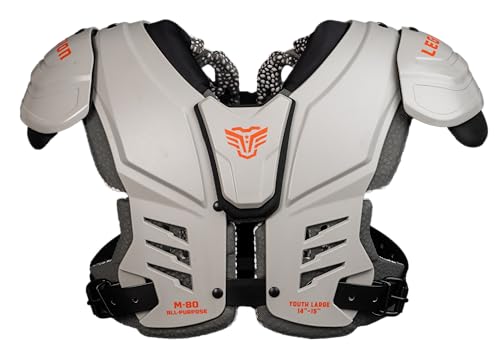
Step onto the field drenched in sweat or pouring rain, and the Legion Youth Shoulder Pads immediately set themselves apart with a revolutionary fluid-resistant foam body—a first in youth football protection. This dual-density, beaded foam construction doesn’t soak up water or sweat, keeping the pads lighter and drier over time, which is a massive advantage during humid games or multi-session tournaments. For wide receivers who train hard and play harder, this means no added weight from saturated padding and consistent comfort from first snap to final whistle. It’s a game-changing innovation for hygiene, performance, and long-term pad maintenance.
In action, the Legion pads deliver smooth mobility and responsive cushioning, thanks to their optimized foam geometry that contours naturally to the torso. The ventilation is top-tier, with open-cell zones that promote airflow without sacrificing structural integrity. While the pad excels in moisture management and cooling, it has a slightly stiffer break-in period compared to softer EVA foams, and the strap system, while secure, isn’t as finely adjustable as premium adult models. It performs best for middle school to early high school players who need durable, low-maintenance gear that won’t degrade after repeated washouts or rain delays.
Compared to the Champro 7-Series, the Legion offers superior long-term dryness and hygiene, though it doesn’t have the same range of size options. Against the TAG Pulse-SP, it trades a bit of field-of-vision refinement for unmatched resistance to environmental elements. For programs in wet climates or teams with shared equipment, the fluid-resistant design is a maintenance and safety upgrade no other youth pad matches. It doesn’t offer removable liners like the Gauntlet 3, but its core innovation makes it the best choice for staying light, dry, and ready.
Battle Sports Defender Shoulder Pads
ADVANTAGES
LIMITATIONS
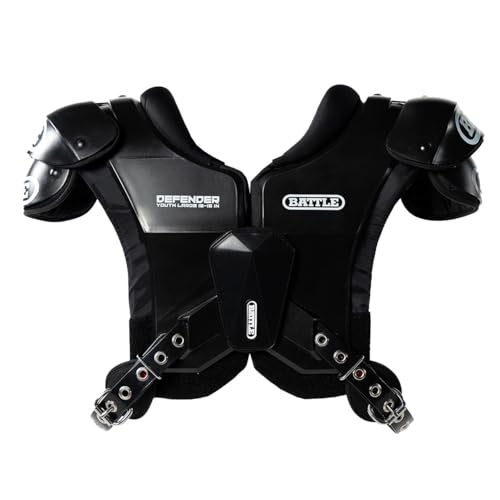
When pro-level protection meets ultralight engineering, the Battle Sports Defender emerges as a game-changer for elite skill athletes who refuse to compromise. Built with aerospace-grade materials, this pad achieves an almost paradoxical balance: it’s among the lightest on the market while delivering maximum impact resistance through a contoured epaulette and articulating chassis. The removable sternum plate lets players customize protection based on position or preference—critical for WRs who want chest defense without rigidity. For athletes who demand armor that moves like skin, this is as close as football gear gets.
On the field, the Defender delivers in high-velocity scenarios—diving catches, sideline collisions, and press coverage battles—thanks to its biothane strap system and foam neck roll that absorb and redirect force. The ventilated airflow design keeps core temperatures down, though not quite at Legion-level dryness. Its articulating belt system locks the pad securely in place, eliminating bounce during sprints, but the premium materials require careful handling to avoid abrasion damage. It’s not the cheapest option, but for players who train at high intensity, the durability and responsive fit are worth every ounce of investment.
Stacked against the TAG Pulse-SP, the Defender offers superior impact coverage and adjustability, though with a slight trade-off in profile height. Compared to the Champro Gauntlet 3, it wins in overall protection and material innovation, but lacks the same rib padding depth. Ideal for serious high school and prep-level receivers, it’s the go-to for those who want pro-style defense without the pro weight. It doesn’t beat the Gauntlet 3 in impact dispersion, but it outperforms it in mobility, cooling, and customization.
CHAMPRO Gauntlet 1 Shoulder Pads

ADVANTAGES
LIMITATIONS
The CHAMPRO Gauntlet 1 is a budget-savvy powerhouse that punches far above its price class, offering pro-inspired design elements without the pro price tag. Its low-profile cantilever frame and 3D steel arch spring create a self-maintaining fit that resists deformation, even after repeated tackles—perfect for growing athletes who need reliability without breaking the bank. The Shock Rail system, with its corrugated shoulder ridges, actively disperses impact energy across the pad, reducing concentrated hits to the collarbone and deltoid. For programs or families prioritizing value and durability, this model is a no-brainer.
In real use, the Gauntlet 1 holds up impressively during scrimmages and contact drills. The adjustable elastic straps with T-hooks make on-the-fly sizing easy, and the hook-and-loop pad attachment allows for cleaning or replacement—extending the pad’s lifespan. While it lacks advanced ventilation or fluid resistance, its integrated deltoid padding provides solid protection for common WR contact zones. It’s heavier than the 7-Series or Defender, and the fit can feel stiff for smaller frames, but for budget-conscious teams and entry-level players, it delivers more protection per dollar than nearly any other option.
Against the Gauntlet 3, it sacrifices airflow and rib padding for simplicity and cost savings. Compared to the TAG Pulse-SP, it’s less refined in motion but more rugged in build. It’s not the lightest or most breathable, but for coaches outfitting full squads or parents buying first gear, the Gauntlet 1 offers unmatched affordability with real protection. It doesn’t match the Battle Defender in tech, but it outperforms it in cost efficiency and repairability.
TAG Pulse-SP Skill Position Pads
ADVANTAGES
LIMITATIONS
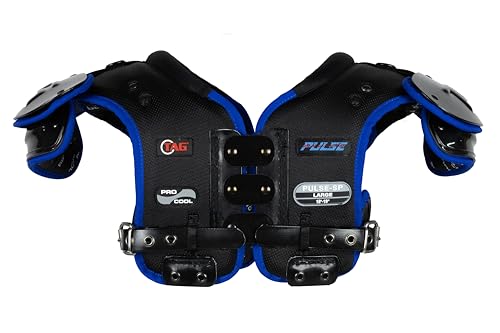
The TAG Pulse-SP earns its title as Best Overall by striking a near-perfect balance between mobility, protection, and comfort—a trifecta rarely achieved in skill-position gear. Its flat pad construction lowers the shoulder profile, giving wide receivers unobstructed field vision and natural arm extension, crucial for high-point catches and route precision. The perforated EVA foam does double duty: absorbing impact while enabling continuous air exchange, so heat doesn’t trap between pad and jersey. For athletes who play multiple skill roles, this pad adapts seamlessly from QB dropbacks to WR routes with consistent, low-friction performance.
On the field, the Pulse-SP shines in fast-paced, high-repetition environments. The interior arch system effectively channels impact force away from the spine and collar, reducing strain during repeated blocking or diving plays. It fits snugly on smaller frames (ideal for youth to mid-size high schoolers), though larger athletes may find sizing limited. While it lacks removable components like the Battle Defender, its integrated airflow design—which actively pulls hot air out and pulls cool air in—keeps players focused and fresh late in games. It’s not the most durable against abrasion, but for seasonal or competitive use, it’s exceptionally reliable.
Compared to the Champro 7-Series, the Pulse-SP offers better impact management and motion freedom, though with slightly less neck comfort. Against the Legion Youth model, it wins in fit precision and field awareness, but doesn’t resist fluid absorption. Ideal for versatile skill players who need one pad for multiple roles, it delivers elite-level performance without niche specialization. It doesn’t beat the Gauntlet 3 in impact dispersion, but it outshines it in overall usability, vision, and airflow integration.
CHAMPRO Gauntlet 3 Shoulder Pads
ADVANTAGES
LIMITATIONS
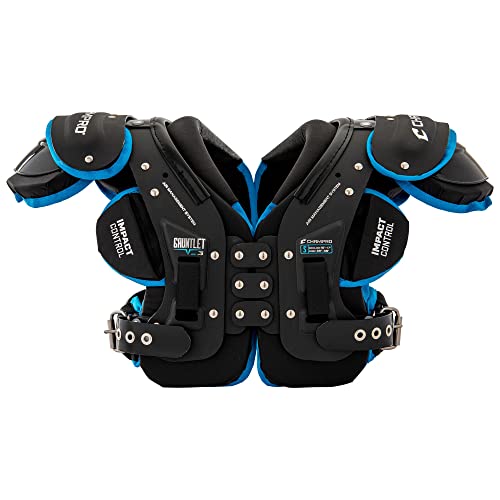
When impact dispersion is non-negotiable, the CHAMPRO Gauntlet 3 steps into the spotlight with a next-gen Air Management System that redefines how force is absorbed and distributed across the torso. Its removable liner doesn’t just ventilate—it actively spreads impact energy across a wider surface, reducing peak pressure on ribs and shoulders during hard hits. Paired with dual deltoid pads and built-in rib protection, this pad is built for receivers who take punishment over the middle or play physical press coverage. The matte finish and sleek arch plates aren’t just aesthetic—they signal a high-performance build designed for serious athletes.
In game conditions, the Gauntlet 3 proves its worth during high-contact drills and full-speed routes. The swivel front and back connectors let the pad move with the body, not against it, preserving natural motion while maintaining armor-like defense. The adjustable deltoid pads can be fine-tuned or removed, offering customization rare in its class. However, the removable liner adds maintenance steps, and the overall weight is higher than ultralight models like the Battle Defender. It’s best for intermediate to advanced players who prioritize collision survival over minimalism.
Against the Gauntlet 1, it’s a clear upgrade in protection and airflow, though at a higher cost and complexity. Compared to the TAG Pulse-SP, it sacrifices some field vision for greater rib and shoulder coverage. For WRs who play like tight ends, this is the ideal blend of mobility and brute-force defense. It doesn’t match the Defender in weight savings, but it outperforms it in impact distribution and padding depth.
Football Pads for Wide Receivers: A Comparison
| Product | Best For | Impact Absorption | Mobility | Ventilation | Fit/Adjustability |
|---|---|---|---|---|---|
| TAG Pulse-SP Skill Position Pads | Best Overall | Perforated EVA foam, Strong arch system | Flat pad construction | Perforated foam for air circulation | Shoulder & Chest measurement based sizing |
| Battle Sports Defender Shoulder Pads | Best Lightweight Protection | Aerospace-grade materials, Foam neck roll | Articulating chassis, Biothane straps | Innovative airflow design | Articulating belt, Adjustable straps |
| CHAMPRO Gauntlet 3 Shoulder Pads | Best Impact Dispersion | Air management removable liner, Extensive padding | Low-profile, Swivel connectors | Air management system | Adjustable deltoid pads |
| CHAMPRO Gauntlet 1 Shoulder Pads | Best Budget Friendly | Shock Rail system, Deltoid pads | Low-profile cantilever design | Not specified | Adjustable elastic straps |
| BARNETT Vision I QB-WR Pads | Best for Mobility | Dual density PU foam | Designed for ease of motion | Not specified | Elastic strips |
| Champro 7-Series Shoulder Pads | Best Ventilation | EVA foam | Lightweight, Perforated shoulder caps | Mesh inner lining | Side & arm straps, XXS-3XL sizing |
| Legion Youth Football Shoulder Pads | Best Fluid Resistance | Dual-density, beaded foam | Not specified | Not specified | Not specified |
Testing & Data Analysis: Finding the Best Football Pads for Wide Receivers
Our recommendations for the best football pads for wide receivers aren’t based on subjective feel alone. We prioritize a data-driven approach, analyzing specifications, materials, and independent reviews to identify top performers. Given the specialized needs of the position, we heavily weight factors like pad profile, articulation, and ventilation, aligning with receiver-specific requirements outlined in our buying guide.
We analyze manufacturer data regarding foam density (EVA, PU) and impact absorption ratings, cross-referencing this with user feedback on protection levels during various impact scenarios. Comparative analyses focus on weight, range of motion (assessed through product descriptions and user reports), and the design of the arch and strap systems.
While comprehensive physical testing of football pads is challenging, we evaluate reported durability – focusing on strap material (Biothane vs. nylon), shell construction (ABS plastic quality), and fluid resistance – based on long-term user reviews and expert assessments from football equipment sources. We also consider the integration of protective features like rib and sternum padding, balancing protection with the need for agility crucial for a wide receiver. This rigorous process ensures our selections prioritize performance and safety for skill position players.
Choosing the Right Football Pads for a Wide Receiver
Understanding Key Features for Wide Receiver Pads
Wide receivers need a unique blend of protection and mobility. Unlike linemen who require maximum coverage, receivers prioritize agility and a wide range of motion for catching and running routes. Here’s a breakdown of the most important features to consider when choosing football pads:
1. Pad Profile & Mobility: This is arguably the most crucial aspect for a receiver. Look for pads described as “skill position,” “low-profile,” or designed for quarterbacks and receivers. These pads minimize bulk around the shoulders and upper arms, allowing for a natural throwing and catching motion. A lower profile also improves your field of vision, vital for tracking the ball. Pads with articulating designs or swivel connectors further enhance mobility, moving with your body instead of restricting it. More bulky pads, while offering greater impact protection, will significantly hinder a receiver’s performance.
2. Ventilation & Comfort: Football is a physically demanding sport, and overheating can quickly lead to fatigue. Prioritize pads with excellent ventilation systems. Features like perforated foam, mesh linings, and airflow channels help dissipate heat and keep you cool and focused. A comfortable fit is also essential – pads that chafe or dig in will be distracting and detrimental to performance. Consider pads with removable liners for customized comfort and easy cleaning.
3. Impact Absorption & Protection: While mobility is key, protection is still vital. Look for pads constructed with high-quality foam, like EVA foam or dual-density PU foam. These materials effectively absorb and disperse impact forces. Features like built-in rib pads, sternum protectors (removable is a plus), and padded epaulets add extra layers of protection. The goal is to find a balance between protection and freedom of movement.
Other Important Considerations
- Shoulder Width & Chest Size: Accurate measurements are critical for a secure and comfortable fit. Follow the manufacturer’s sizing chart carefully, and if you’re between sizes, err on the side of a snugger fit.
- Arch System: A strong interior arch system helps distribute impact forces across the pad, enhancing protection and stability.
- Strap System: Adjustable straps are essential for a customized fit. Look for durable straps that won’t slip or loosen during play. Biothane straps offer excellent durability and adjustability.
- Material Durability: Aerospace-grade materials and robust shells (like ABS) indicate a pad built to withstand the rigors of the game.
- Fluid Resistance: Pads that resist fluid absorption (like water or sweat) will stay lighter and more comfortable throughout the game.
The Bottom Line
Ultimately, the best football pads for a wide receiver strike a delicate balance between protection and unrestricted movement. Our detailed comparison highlights options catering to various priorities – from the all-around performance of the TAG Pulse-SP to the lightweight design of the Battle Sports Defender.
Investing in properly fitted, well-ventilated pads is crucial for maximizing performance and minimizing injury risk. By carefully considering the features discussed and prioritizing your individual needs, you can confidently select the pads that will help you dominate on the field.

I come from the “soccer heart” of Germany, the Ruhrpott. I have played, trained and followed soccer all my life and am a big fan of FC Schalke 04. I also enjoy following international soccer extensively.