Types of Soccer Cleats: The Guide to FG, AG, TF & More
The six main types of soccer cleats are Firm Ground (FG), Soft Ground (SG), Artificial Grass (AG), Multi-Ground (MG), Turf (TF), and Indoor Court (IC). Your primary playing surface dictates the correct type. Using the wrong cleat, like FG on turf, dramatically increases your risk of knee and ankle injuries while destroying your traction and performance.
Most players get this wrong because they buy based on color, brand hype, or a pro endorsement. They end up with a boot designed for a different planet than the patchy municipal pitch or plastic carpet they actually play on.
This guide cuts through the marketing. We’ll map each cleat type to its real-world surface, explain why the stud configuration matters for your joints, and show you how to find a pair that fits your foot, not just your favorite player’s signature line.
Key Takeaways
- Surface is law. The field type (natural grass, AG turf, hard court) chooses your cleat. Ignoring this causes poor performance and a high injury risk.
- FG on turf is dangerous. Firm Ground cleats have concentrated, longer studs that grab too hard on artificial surfaces, increasing torque on knees and ankles. Use AG-specific cleats instead.
- Fit is non-negotiable. A proper soccer cleat fits like a tight sock with 0-5mm of toe space. A loose boot kills ball feel and causes blisters.
- Leather molds, synthetic performs. Kangaroo leather offers a premium, moldable fit and touch but requires care. Synthetic uppers are lighter, consistent in wet conditions, and more durable.
- Position-specific boots are a myth. Marketing divides boots into “speed,” “control,” and “power” silos. In reality, a comfortable boot that fits well matters more than any claimed positional advantage.
The 6 Soccer Cleat Types, Explained by Surface
Forget player position for a minute. Your first and most critical decision is matching your footwear to the ground beneath you. This isn’t about preference, it’s about physics and safety.
Firm Ground (FG) cleats feature a mix of 10-14 molded bladed and conical studs, typically 11-15mm long, designed for traction and stability on dry or slightly damp natural grass pitches. They are the most common type worldwide.
Firm Ground (FG) cleats are the default. You’ll see them on TV. They work on natural grass that is, as the name says, firm. The studs are a mix of shapes: bladed at the forefoot for push-off acceleration, conical at the heel for stable planting. They provide the right balance of grip and give. Use them on well-maintained grass pitches. The moment that grass gets soaked and turns to mud, you lose all purchase.
Soft Ground (SG) cleats are for the swampy matches. They have fewer studs, often six or eight, but they’re longer and sometimes feature a metal tip (a “soft ground soleplate”). These studs pierce deep into soggy ground to find a solid layer underneath. They are overkill and unsafe on firm ground. The studs act like pegs, refusing to release during twists, which can load your knee ligaments.
Artificial Grass (AG) cleats are not just shorter FG cleats. They are a completely different design for modern 3G/4G synthetic turf. The key is pressure distribution.
The soleplate has many more studs, often 20 or more, that are shorter and uniformly placed. This spreads the load across your foot, reducing the “stud-lock” effect that happens when a few long studs dig into the rubber infill. This design lowers stress on your joints.
Turf (TF) shoes are for hard, unforgiving surfaces: old astroturf, compacted dirt, or short-pile turf. The outsole is covered in dozens of small rubber nubs or has a waffle pattern. They provide grip without any stud penetration. They’re also fantastic for training sessions on any hard surface. Many beginners start here because they’re comfortable and versatile.
Indoor Court (IC) shoes have flat, non-marking rubber soles. They’re for futsal or indoor soccer on gym floors. No studs, just grip for quick cuts and stops.
Multi-Ground (MG) is a hybrid attempt. The stud pattern is a compromise between FG and AG. It’s a decent option if you genuinely split time 50/50 between decent natural grass and artificial turf. It’s a jack-of-all-trades, master-of-none solution.
| Cleat Type | Best For | Never Use On | Why It Works |
|---|---|---|---|
| Firm Ground (FG) | Dry/firm natural grass | Artificial turf, hard courts | Concentrated studs grip grass without sinking. |
| Soft Ground (SG) | Wet, muddy natural grass | Firm ground, artificial turf | Long studs penetrate to solid ground below mud. |
| Artificial Grass (AG) | Modern synthetic (3G/4G) turf | Natural grass, hard turf | Many short studs distribute pressure, reducing joint stress. |
| Turf (TF) | Hard turf, asphalt, training | Natural grass, modern AG turf | Rubber nubs grip surface without dangerous penetration. |
| Indoor Court (IC) | Gym floors, futsal courts | Any outdoor surface | Flat sole provides grip and allows for quick pivots. |
TL;DR: Match FG to grass, AG to synthetic turf, TF to hard ground, and IC to indoors. Getting this wrong hurts your game and your body.
Why Using the Wrong Cleats Is an Injury Waiting to Happen
This is where most online guides get vague. They say “increased risk” but don’t explain the mechanics. Let’s get specific.
The classic, dangerous mistake is wearing Firm Ground cleats on artificial turf. On grass, the studs sink in and release relatively easily as you turn. On turf, the long, rigid studs dig into the rubber infill but then grip the harder plastic turf carpet underneath. They don’t release.
When your foot is planted and your body rotates, that stuck stud creates a pivot point. All the rotational force travels up your leg. Your knee, specifically the anterior cruciate ligament (ACL), and ankle ligaments absorb that shock. It’s a proven mechanism for non-contact ACL tears and ankle sprains. Youth leagues and many adult rec leagues now mandate AG-certified footwear on turf pitches for this exact reason.
Common mistake: Using worn-down FG cleats on any surface, once the studs are rounded smooth, usually after 5-10 months of regular play, you lose all meaningful traction. You’ll slip on cuts and falls become more likely, regardless of the field.
SG cleats on firm ground present the opposite problem. The studs are so long and aggressive that they act like stilts. Your ankle wobbles because the boot can’t sit flat, leading to ankle rolls. The studs also wear down incredibly fast on hard ground.
Using TF shoes on a soft, natural grass pitch is just frustrating. You’ll slip and slide with every sprint, as the nubs can’t penetrate the surface to find purchase.
TL;DR: FG on turf torques your knee. SG on firm ground sprains your ankle. Using the right cleat is the cheapest form of sports insurance you can buy.
Cleat Materials, Fit, and the Myth of the “Perfect Boot”
Once you’ve locked in the correct soleplate for your surface, you can think about the boot itself. This breaks down into two parts: what it’s made of and how it wraps your foot.
Upper Materials: Leather vs. Synthetic
This is a feel and performance trade-off.
Kangaroo Leather (K-Leather) is the traditional premium material. It’s incredibly thin, soft, and supple. It molds to the shape of your foot over 3-5 games, creating a custom, second-skin fit. The touch on the ball is superb, you feel every pass and shot. The downside is maintenance. Leather absorbs water, gets heavier, and can stretch out if not cared for. You must clean off mud and let them dry naturally, never by a heat source.
Synthetic Uppers (like Adidas’s Primeknit or Nike’s Flyknit) are modern standards. They are lighter, don’t absorb water, and keep a consistent weight in all conditions. The fit is precise from the first wear, no break-in period. Durability is generally higher, and they’re easier to clean. The trade-off is feel. Even the best synthetics lack the delicate, moldable sensation of premium leather. For a detailed breakdown of current top models, our best football cleats guide dives deeper into specific materials.
How Soccer Cleats Must Fit
Forget everything you know about sneaker fit. Soccer cleats are different.
They should be snug, almost tight, when new. With your heel pressed back, you should have between 0mm and 5mm (about a thumbnail’s width) of space at your longest toe. Any more and the boot will never lock down properly; you’ll lose ball control and get blisters from the foot sliding. The width should feel secure without pinching. Remember, leather will stretch slightly; synthetic will not.
This is critical for youth football cleats as kids’ feet grow. You have slightly more leeway, but the same snug principle applies, buying “room to grow” creates a dangerous, unstable platform. For players with broader feet, ignoring standard fits and seeking out specific cleats for wide feet is essential. Brands like New Balance and Mizuno often offer wider lasts.
I bought a pair of iconic Adidas Copa Mundials, full kangaroo leather, in my usual sneaker size. The first training session was pure pain; the sides crushed my forefoot. I stubbornly wore them for two weeks, getting blisters each time. Finally, I went up a half-size. The length was right, but the legendary leather had already stretched and molded to the wrong shape. I had to sell them at a loss. Now I always try on cleats at the end of the day when my feet are swollen, and I walk around the store for ten minutes.
TL;DR: Leather molds for custom touch but needs care. Synthetic offers lightweight performance. Fit must be snug, not comfortable, right out of the box.
Boot “Silos”: Speed, Control, and Power. Does Your Position Matter?
Marketing departments love to categorize boots. You see it everywhere: the Nike Mercurial for “speed,” the Adidas Predator for “control,” the Puma King for “power.” This leads to endless questions: “I’m a midfielder, what boots should I wear?”
The truth, echoed by seasoned pros and equipment managers, is that these categories are 90% marketing. A boot cannot make you faster or technically superior. What they actually denote are design priorities that might suit certain play styles.
| Boot “Silo” | Typical Features | Best For Players Who… | Example Models |
|---|---|---|---|
| Speed | Very lightweight, thin synthetic upper, aggressive stud layout | Value explosive acceleration & prefer a barefoot feel | Nike Mercurial, Adidas X, Puma Ultra |
| Control | Premium material (leather/textured synthetic), padded strike zones | Prioritize first touch, passing, & ball manipulation | Nike Phantom, Adidas Copa, Puma Future |
| Power/All-Round | Reinforced striking areas, stable construction, often more padding | Want durability & a balanced feel for all actions | Nike Tiempo, Adidas Predator, Mizuno Morelia |
A winger might prefer a speed boot like the Mercurial because it’s light. But a winger who values dribbling and touch might choose a control boot like the Phantom. A central defender might want the stability of a power boot, but many world-class defenders wear speed models. Our guides on speed football cleats and cleats for wide receivers explore these design priorities for specific athletic demands.
The YouTube analysis from expert reviewers is blunt: all boots provide comfort, lockdown, and traction. The rest is narrative. A lineman-specific cleat prioritizes stability for trench battles, while a running back cleat focuses on cut-and-go agility. The best boot for your position is the one that fits your foot shape perfectly and feels like an extension of your body.
TL;DR: Don’t buy a boot because of its marketing category. Buy it because it disappears on your foot, allowing you to play without thinking about your gear.
How to Choose: Your Step-by-Step Decision Matrix
Stop overthinking it. Follow this sequence to narrow your choices from hundreds to a handful.
- Identify Your #1 Surface. Where do you play 80% of your matches? Be honest. Is it a decent grass park (FG), a modern turf complex (AG), or a hard schoolyard (TF)? This eliminates 75% of options immediately.
- Get Your True Fit Size. Go to a physical store at the end of the day. Try on multiple brands. Nike tends to run narrow and long. Adidas is often more standard. Puma can be snug. New Balance and Mizuno are havens for wider feet. Use the 0-5mm toe rule.
- Pick Your Material Preference. Do you want the moldable, premium feel of leather and accept the maintenance? Or do you want a lightweight, ready-to-go synthetic? This is pure personal preference.
- Set a Budget and Find Models. High-end “Elite” models ($200+) offer the lightest materials and tech. Mid-range “Pro” or “Club” models ($80-$150) often have 90% of the performance and better durability. Don’t pay for tech you can’t feel.
- Ignore Everything Else. Color, pro endorsements, and “new tech” stories are irrelevant. A good football cleat selection focuses on surface, fit, and feel above all.
For specific demographics, the process is similar but with key focuses. Selecting youth football cleats prioritizes fit and growth room over top-tier materials. Choosing men’s football cleats often involves balancing performance desires with durability for adult leagues.
Maintenance and Lifespan: Making Your Cleats Last
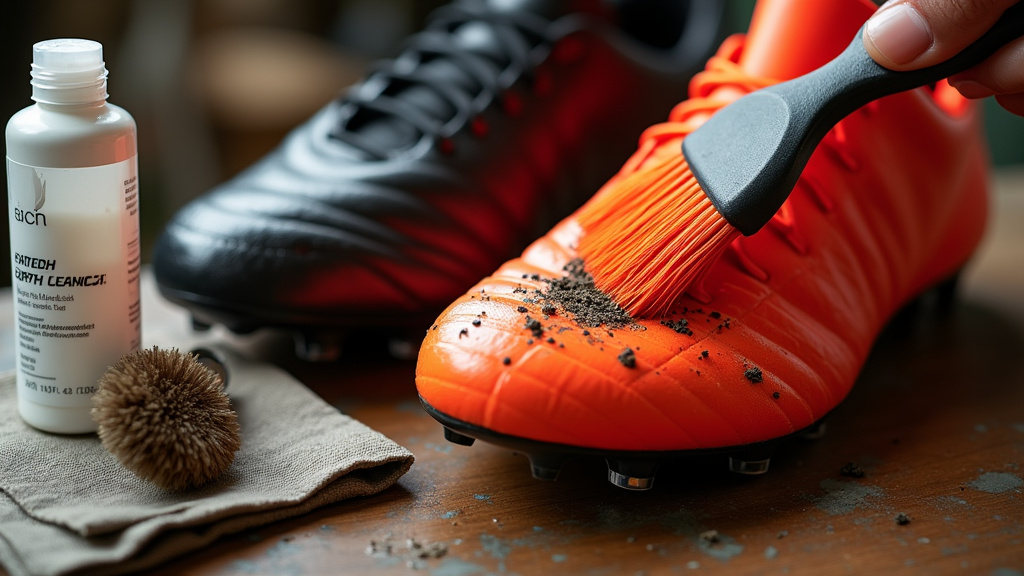
Cleats are wear items. The average pair for a regular player lasts 5 to 10 months. The studs wear down, the upper fatigues, and materials break down. You can extend that.
- Clean After Every Use. Knock off mud and debris with a soft brush. For leather, use a damp cloth and a dedicated leather cleaner. For synthetic, mild soap and water work.
- Dry Naturally, Never With Heat. Stuff them with newspaper to absorb moisture from the inside out. Never put them on a radiator, in a clothes dryer, or in direct sun. Heat cracks leather and warps synthetics.
- Rotate If Possible. Having a second pair, even an old one, for training allows each pair to fully dry and decompress between uses. This dramatically extends life.
- Inspect Stud Wear. Once the studs are visibly rounded and shorter, traction is gone. It’s time to replace them. Playing on worn studs is as bad as using the wrong type.
Common mistake: Storing wet cleats in a sealed gym bag, within 48 hours, the interior will develop a permanent mildew smell that no amount of washing will remove. The materials break down faster, too.
Frequently Asked Questions
What is the difference between AG and TF cleats?
AG cleats are for modern, long-pile synthetic turf with rubber infill. They have numerous short studs to distribute pressure. TF (Turf) shoes are for hard, short-pile surfaces like astroturf or dirt; they have rubber nubs or a flat waffle sole for surface grip without stud penetration.
Can I use FG cleats on artificial grass?
No. This is strongly discouraged and often against league rules. FG studs are too long and concentrated for turf, creating excessive rotational traction that significantly increases the risk of knee (ACL) and ankle injuries. Always use AG-specific cleats on artificial grass.
How tight should soccer cleats be?
They should fit very snugly, like a second skin, with no more than 5mm (a thumbnail’s width) of space at the toe when your heel is all the way back. They will feel tight and may be slightly uncomfortable when new, especially synthetic models which won’t stretch.
Are leather cleats better than synthetic?
It’s a trade-off, not a ranking. Kangaroo leather offers a superior, moldable fit and ball feel but requires more care and gets heavier when wet. Synthetic uppers are lighter, water-resistant, more durable, and offer consistent performance with little break-in. The “best” material is the one that suits your preference for feel versus convenience.
Do I need different cleats for my position?
Not really. Marketing categories (speed, control, power) highlight design tendencies, but no boot will make you faster or a better passer. The most important factor is a perfect fit. A defender can wear Mercurials, and a striker can wear Predators. Comfort and proper surface selection matter infinitely more.
What should I look for in cleats for ankle support?
Traditional high-top cleats are rare in soccer. Support comes from a proper, snug fit that locks down your heel and midfoot. Some players opt for ankle support cleats or use external ankle braces. The best support is a well-fitted boot that prevents your foot from sliding and rolling inside.
The Bottom Line
Choosing the right soccer cleat isn’t about chasing the flashiest new release. It’s a practical exercise in matching tool to task. Let the surface you play on dictate the soleplate. Let the shape of your foot dictate the brand and model. Prioritize a surgically snug fit over any marketing story about speed or control.
A great cleat is the one you forget you’re wearing. It provides confident traction without threatening your ligaments, and it connects you to the ball without distraction. Whether you’re selecting cleats for linebackers who need a stable base or cleats for defensive players in general, the core principles remain. Skip the hype. Find your fit. Then go play.

I come from the “soccer heart” of Germany, the Ruhrpott. I have played, trained and followed soccer all my life and am a big fan of FC Schalke 04. I also enjoy following international soccer extensively.