What is a Goal Kick? Defining the Soccer Rule and Its Uses
A goal kick is a method of restarting play in soccer, awarded when the entire ball crosses the goal line after last being touched by an attacking player and a goal is not scored. The ball is placed anywhere within the goal area, kicked by a defending player, and is in play the moment it is kicked and clearly moves.
Most people think a goal kick is just a long boot upfield by the goalkeeper. That misses the point. The modern goal kick is a tactical weapon, governed by a rule change in 2019 that reshaped how teams build from the back.
This guide walks through Law 16 of the game. We’ll cover when it’s awarded, how to take one, the recent rule change that broke a century-old habit, and the mistakes that cost amateur teams possession every weekend.
Key Takeaways
- The ball must be stationary anywhere inside the six-yard box before the kick.
- Opponents must stay outside the penalty area until the ball is in play.
- A goal can be scored directly against the opposing team from a goal kick.
- There is no offside offense directly from a goal kick.
- The 2019 rule change allows teammates to receive the ball inside the penalty area before it leaves the box.
When is a Goal Kick Awarded?
The trigger is specific. The entire ball must cross the goal line, on the ground or in the air, and the last player to touch it must be from the attacking team. If a defender touches it last, the restart is a corner kick.
Watch the linesman. Their flag points downward toward the corner flag for a corner, or straight out parallel to the goal line for a goal kick. The referee’s signal is a pointed finger aimed at the six-yard box. Get this wrong in a tense match and you’re arguing for a corner you don’t deserve.
The official goal kick soccer rule definition in Law 16 states the ball is out of play only when it has wholly crossed the goal line between the goalposts and under the crossbar, provided no goal is scored.
The goal line is the final judge. Spin and bounce don’t matter. If any part of the ball is over the line, it’s still in play. I’ve seen defenders stop playing, assuming a goal kick, only for an attacker to tap in a ball that never fully crossed. Play to the whistle.
TL;DR: A goal kick happens when the whole ball crosses the goal line after an attacker’s final touch. Anything else is a corner or a goal.
Where Do You Take a Goal Kick From?
You take it from within the goal area. That’s the small rectangle inside the penalty area, also called the six-yard box.
The ball can be placed anywhere inside that space. Most goalkeepers take it from one of the front corners of the six-yard box to open up the angle for a pass or a long kick. You are not required to take it from the center. Use the whole box.
| Area | Dimensions | Key Rule |
|---|---|---|
| Goal Area (Six-Yard Box) | 6 yards (5.5m) from each goalpost, 6 yards into the field | Ball must be placed and stationary here for the kick. |
| Penalty Area (18-Yard Box) | 18 yards (16.5m) from each goalpost, 18 yards into the field | Opposing players must remain outside this area until the ball is in play. |
The penalty area rules are separate but critical here. All opposing players must be outside the penalty area when the kick is taken. They can rush in the moment the ball is played. Your own teammates, however, can be anywhere—even inside your own penalty area. That’s the tactical shift.
Common mistake: Taking the kick from outside the six-yard box — the referee will order a retake, killing your team’s momentum and giving the opposition a free chance to reset their defensive shape.
Who Can Take a Goal Kick?
Any player from the defending team can take it. The goalkeeper usually does because they’re already in position. In youth or amateur games, you might see a center-back with a stronger foot take it instead.
The kicker cannot touch the ball again until another player has touched it. If they do, the referee awards an indirect free kick to the opposition from the spot of the offense. If that second touch is a deliberate handball inside their own penalty area, it’s a penalty kick.
I once saw a goalkeeper in a lower-league match try a clever short pass to himself off the post. He touched the ball twice. Indirect free kick six yards out. It was a tap-in goal. Don’t be that keeper.
The 2019 Rule Change That Changed Everything
Before 2019, the ball was not in play until it left the penalty area. Teammates had to wait outside the box. This led to endless long balls and wasted possession.
The new rule is simple: the ball is in play the moment it is kicked and clearly moves. Teammates can now receive a pass inside the penalty area. This one change transformed the goal kick from a hopeful clearance into a structured build-up play.
Teams like Manchester City and Barcelona exploit this. The goalkeeper rolls the ball to a center-back standing just a few yards away, inside the box. That defender now has time and space to turn and pick a pass. The high press has to commit players into your penalty area to stop it, which opens huge spaces elsewhere.
The old rule wasted time. Goalkeepers would dawdle, opponents would linger on the edge of the box. The new rule speeds up the game and rewards technical skill. It’s a better rule.
TL;DR: Since 2019, the ball is live as soon as it’s kicked, letting teammates receive passes inside their own penalty area and turning goal kicks into a possession tool.
How to Take a Goal Kick: The Pro Technique
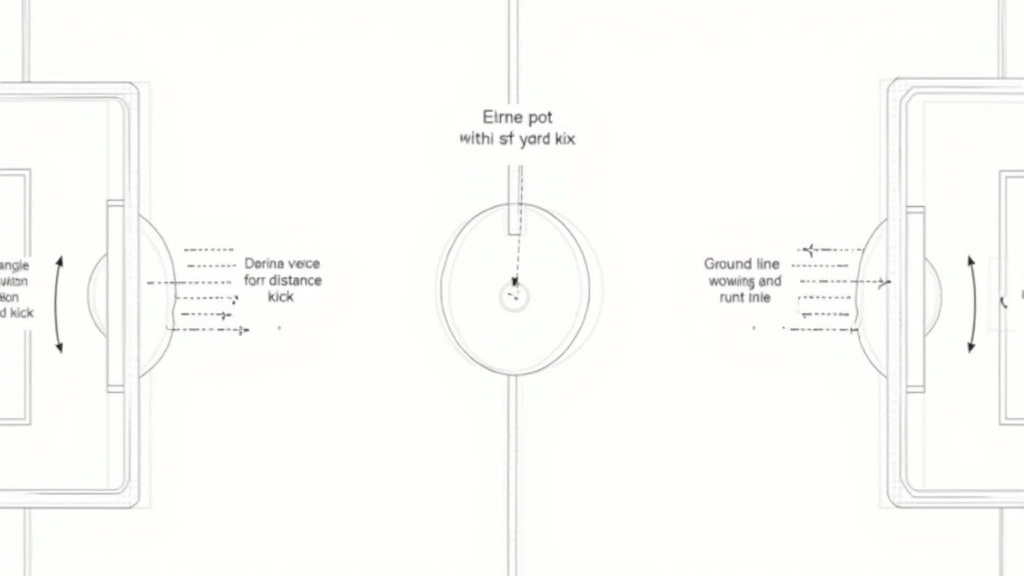
Taking a good goal kick is a skill. It’s not just about power.
For a long kick (aiming for a target near midfield):
- Place the ball on a firm spot of turf within the six-yard box.
- Take 5-6 steps back, then 2 steps to your side for the angle.
- Strike through the bottom half of the ball with your laces.
- Lean back slightly and follow through toward your target.
- The ball should gain height quickly but carry distance.
For a short, building pass:
- Communicate with your intended receiver before you place the ball.
- Use the inside of your foot for accuracy.
- Pass firmly along the ground to their feet.
- Move immediately to offer a return pass option.
The YouTube clips of pros show a consistent technique: a solid plant foot, a clean strike under the ball’s center, and full hip rotation. The last part is what amateurs miss. You generate power from the core, not just the leg.
I won’t recommend the driven pass to a fullback under pressure for amateur keepers. The margin for error is a few inches. At our level, that pass gets intercepted in the penalty area more often than not. Play the safer, longer option until your touch in training is perfect.
Wind matters. A strong wind in your face kills distance. Take one less step back and focus on keeping the ball low. A tailwind can send the ball too far, so ease off the power.
Can You Score from a Goal Kick?
Yes, but only against the opposing team. You can score directly from a goal kick. If the ball goes directly into the opponent’s goal, it counts.
It is incredibly rare. The distance is over half the field. You need a massive kick, a lucky bounce, and a goalkeeping error. It’s called an Olympic goal when it happens from a corner kick; from a goal kick it has no special name, just a moment of pure shock.
You cannot score an own goal directly from a goal kick. If you kick the ball and it goes directly into your own net, the restart is a corner kick to the opposition. The logic is that a goal kick is a restart for your team, so scoring against yourself makes no sense within the laws.
Common Infringements and Their Consequences
The laws are strict here. Get them wrong and you hand the initiative back to the other team.
| Infringement | By | Result |
|---|---|---|
| Ball not stationary in goal area | Kicker | Retake. |
| Opponent enters penalty area early & touches ball | Opponent | Retake. |
| Opponent enters penalty area early & doesn’t touch ball | Opponent | Play on (if no impact). |
| Kicker touches ball twice before another player | Kicker | Indirect free kick to opponents. |
| Kicker handles ball on second touch (in own box) | Kicker | Penalty kick. |
| Teammate receives ball inside penalty area (pre-2019) | Teammate | Retake. |
The indirect free kick for a double touch is the most common foul at amateur levels. The keeper takes a quick goal kick, it deflects off an attacker’s back, and the keeper instinctively kicks it again. Whistle. Indirect free kick from where the second touch happened, which is often a very dangerous position.
Referees are instructed to be lenient if an opponent cannot physically leave the penalty area in time—like if they were battling for a header right on the line. But if they’re just loitering, the kick is retaken.
The Offside Rule and Goal Kicks
This is a key exception. There is no offside offense directly from a goal kick. A player can be in an offside position when the kick is taken and still receive the ball legally.
This is why you see strikers camped on the halfway line during a goal kick. They are waiting for the long ball over the top, knowing they can’t be called offside. It stretches the defense and creates a direct option for the goalkeeper.
The offside rule resets on a goal kick. Use it.
Goal Kick vs. Other Restarts
It’s easy to confuse a goal kick with other set pieces. Here’s the breakdown.
Goal Kick vs. Corner Kick
- Goal Kick: Ball went out over goal line, last touched by attacker. Taken by defender from goal area.
- Corner Kick: Ball went out over goal line, last touched by defender. Taken by attacker from corner arc.
Goal Kick vs. Free Kick
- Goal Kick: Restart from a ball out of play. No whistle needed to take it once set.
- Free Kick: Restart from a foul or infringement. Requires referee’s whistle in most cases. Can be direct or indirect.
Goal Kick vs. Throw-in
- Goal Kick: Ball went out over the goal line.
- Throw-in: Ball went out over the touchline (sideline).
The distinction matters for strategy. A goal kick offers a chance to build from the back. A corner kick is an immediate attacking opportunity. Knowing the difference changes how you position your players.
Referee Signals for a Goal Kick
The signal is straightforward. The referee points with an outstretched arm at the goal area from which the kick will be taken. No whistle is needed to take the kick once the ball is placed.
The assistant referee (linesman) will also signal by raising their flag straight out, parallel to the goal line, and then pointing it downward toward the corner flag on their side. This indicates the ball left the field of play and which team gets the restart.
Play doesn’t stop for a goal kick signal. The referee points, and the defending team fetches the ball and sets up. There’s no mandatory pause unless there’s a substitution or an injury.
Frequently Asked Questions
What happens if a goal kick goes out of bounds without being touched?
If the ball goes directly out of play over the touchline (sideline) from a goal kick without another player touching it, the restart is a throw-in for the opposing team from where it crossed the line. If it goes over the goal line (but not into the goal), it’s a corner kick if a defender touched it last, or a retake if no one touched it.
Can a goal kick be taken quickly?
Yes. Once the ball is placed within the goal area and is stationary, the kick can be taken at any time. You do not need to wait for the referee’s explicit signal, but you should wait for opponents to be outside the penalty area. A quick kick can catch a team napping.
Why was the goal kick rule changed in 2019?
The International Football Association Board (IFAB) changed Law 16 to promote faster play and reduce time-wasting. The old rule forced the ball to leave the penalty area, which encouraged long, hopeful kicks and allowed defending teams to slow the game down. The new rule, detailed in the official football laws document, encourages shorter passing and building attacks from the back.
Is there a time limit for taking a goal kick?
There is no specific time limit in the laws. However, referees can caution a player for delaying the restart of play if they are deemed to be wasting time. Typically, keepers are given 6-8 seconds to put the ball back into play after gaining control.
Can you be offside from a goal kick in your own half?
No. The offside rule does not apply on any part of the field directly from a goal kick. A player can be in an offside position in the opponent’s half when the kick is taken and still receive the ball legally.
Before You Go
A goal kick is more than a routine clearance. It’s a strategic restart defined by Law 16. The 2019 rule change flipped a century of habit, turning it from a defensive hoof into a possession platform.
Remember the three non-negotiables: ball inside the six-yard box, opponents outside the 18-yard box, and the ball is live on the kick. Forget the old rule about it leaving the area. Use the offside exception. And for your own sanity, never try a clever pass to yourself.
Master the basics, understand the recent changes, and you’ll stop giving the ball away cheaply. You’ll start attacks instead of just ending them.

I come from the “soccer heart” of Germany, the Ruhrpott. I have played, trained and followed soccer all my life and am a big fan of FC Schalke 04. I also enjoy following international soccer extensively.