Pros and Cons of Using the 4-4-2 Formation in Modern Soccer
The 4-4-2 formation’s advantages are defensive solidity from two flat banks of four, attacking width, and simplicity for players. Its primary disadvantage is a vulnerability to midfield overload against three-man midfields, which requires specific player roles or tactical adaptations like the diamond to counter.
Most people think the 4-4-2 is a rigid, old-school system best left in the 1990s. They see two flat lines and assume it’s predictable. The real issue isn’t the shape itself. It’s failing to adapt it.
This guide breaks down where the 4-4-2 wins, where it loses, and the exact modern tweaks that keep it competitive against today’s dominant three-man midfields.
Key Takeaways
- The 4-4-2’s core strength is its two compact banks of four, which are extremely difficult to play through centrally and force opponents wide.
- Its biggest weakness is the 2v3 battle in central midfield, making possession difficult against formations like the 4-3-3.
- Modern adaptations like the 4-4-2 diamond or using a defensive “double pivot” directly address the midfield numbers game.
- Player profiles are non-negotiable: you need two natural strikers and extremely fit wide midfielders who can defend and attack.
- The formation’s simplicity provides a psychological advantage in high-pressure games or with less tactically drilled squads.
The Structural Foundation: Two Banks of Four
Look at a team sheet drawn up in a 4-4-2. You see four defenders, four midfielders, two forwards. It looks basic. The magic happens in the distances.
The back four and the midfield four each operate as a flat, connected unit. The space between these two lines is intentionally tight, often between 10 and 15 yards when the team is out of possession. This creates a vertical compactness that is a nightmare to penetrate with short, intricate passes. Opponents are funneled towards the touchlines. From there, your team has numerical superiority, your winger and full-back against their isolated wide player.
The 4-4-2 creates two distinct defensive blocks. The distance between the defensive line (back four) and the midfield line (midfield four) is typically compressed to 10–15 yards in a mid-block, denying central passing lanes and forcing play into wide areas where the defending team can outnumber the attacker.
That’s the theory. In practice, maintaining those two perfect flat lines requires immense discipline. If one midfielder steps up to press and the line doesn’t shift as one, a channel opens. A single line-breaking pass from the opponent, and your entire structure is bypassed.
TL;DR: The 4-4-2 is built on two flat, compact lines of four that deny central space and force play wide, but it demands perfect synchronicity from all eight defensive players.
The Core Weakness: Midfield Overload
Put two central midfielders against three. That’s the 4-4-2’s fundamental mathematical problem against a 4-3-3, a 3-5-2, or any formation with a central trio.
Your two midfielders are outnumbered. They get stretched horizontally covering the width of the pitch and vertically trying to connect with the forwards. The opponent’s spare midfielder always has time and space to receive the ball, turn, and dictate play. You lose the midfield battle. You lose possession. You spend the game chasing.
I learned this the hard way watching my own team. We played a flat 4-4-2 against a decent 4-3-3 side. Our center-mids, both good players, ran themselves into the ground by the 60th minute. They were trying to cover the space of three men. We had 38% possession and lost 2-0 from two shots that originated from that free man in midfield. The game felt like a constant 2v3 puzzle we couldn’t solve.
Common mistake: Deploying a flat 4-4-2 against a technical 4-3-3 without a plan, your central midfield gets overrun within 20 minutes, you concede possession, and you’re pinned in your own half for the rest of the match.
This weakness is why the formation fell out of favor at the highest levels of possession-based football. You simply cannot control the game if you’re consistently outnumbered in the engine room. It’s also the reason any serious discussion about the tactical relevance of the 4-4-2 today focuses on how to solve this exact problem.
| Opponent Formation | Midfield Match-up | Likely Outcome for 4-4-2 |
|---|---|---|
| 4-3-3 | 2 vs 3 | Outnumbered, loses possession |
| 4-2-3-1 | 2 vs 2 (plus a #10) | Struggles to mark the #10 |
| 3-5-2 | 2 vs 3 (or 5) | Overwhelmed in central areas |
| 4-4-2 (mirror) | 2 vs 2 | Balanced, battle of execution |
The table shows the problem. Against most modern systems, you start at a numerical disadvantage. This makes a comprehensive soccer tactics guide essential for coaches who want to use this shape.
Attacking Strengths: Width and the Two-Up-Top Threat

While it struggles to keep the ball in midfield, the 4-4-2 is brutally effective without it. Its attacking philosophy is direct and physical.
You have two strikers. This alone occupies both opposing center-backs, preventing them from stepping into midfield. One forward can drop deep to link play, dragging a center-back with him and creating space for the other to run in behind. It’s a constant 2v2 battle at the heart of the defense.
Then there’s the width. With two traditional wingers and overlapping full-backs, you can stretch a defense to its breaking point. The cross-and-attack method is simple but devastating when executed with pace. A whipped ball into a box where you have two forwards attacking against two defenders is a high-percentage chance.
The formation also excels on the counter-attack. Win the ball in your compact defensive block, play it quickly wide to a winger, and suddenly you have two forwards sprinting against a backpedaling defense with support arriving from midfield. It’s why pragmatic coaches like Diego Simeone have clung to variations of the 4-4-2 for years.
TL;DR: The 4-4-2 attacks through wide overloads and early crosses, leveraging two strikers to pin center-backs and create chaos in the penalty area, making it a potent counter-attacking system.
Modern Adaptations: The Diamond & The Pendulum
You don’t just roll out a basic 4-4-2 and hope. You adapt it. Two main variations fix the midfield problem.
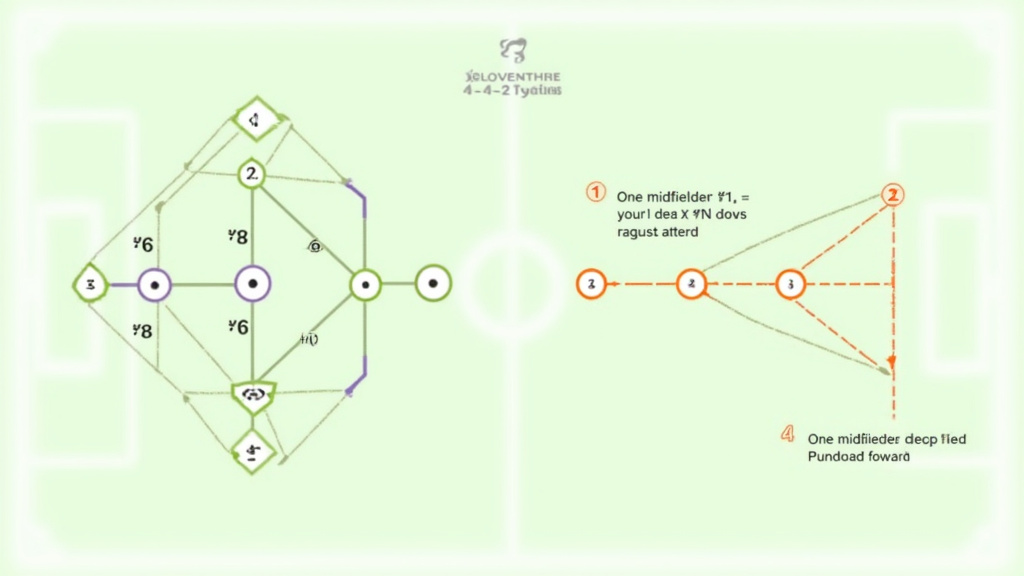
The first is the 4-4-2 diamond. This abandons traditional wingers. The midfield becomes a single pivot (a #6), two shuttling central midfielders (#8s), and an attacking midfielder (#10) at the tip. You now have a 3v2 or 3v1 advantage in the center of the pitch. The trade-off is a complete lack of natural width. Your full-backs must provide all the attacking width, which leaves you exposed to counters down the flanks. It requires incredibly intelligent and fit players.
The second is the “pendulum” or “double pivot” system within a flat 4-4-2. Here, your two central midfielders are not a flat pair. One holds deep as a defensive anchor while the other has license to join the attack. They rarely advance together. This creates a more staggered midfield presence and protects against counters. Pep Guardiola’s Manchester City used a version of this where the nominal wingers (often midfielders like Phil Foden) tucked inside to form a de facto midfield four, blurring the lines of the formation entirely.
I prefer the double-pivot adaptation for youth and semi-pro teams. The diamond asks too much of full-backs who aren’t world-class athletes. With a pendulum, you give one midfielder clear defensive responsibility and the other a green light to support the strikers. It’s simpler to coach and execute under pressure.
These adaptations are the difference between the 4-4-2 being a nostalgic relic or a strategically viable system. They directly answer the question posed when comparing the 4-4-2 versus the 4-3-3.
Player Profiles: Who Fits the 4-4-2?
You cannot force a squad into this shape. The formation demands specific types of players.
- The Two Strikers: They must be a partnership. A classic “big man, little man” combo works, but so do two mobile forwards who interchange. At least one needs to be competent at holding up the ball. Two pure poachers who never drop or link play will isolate your midfield.
- The Wide Midfielders: This is the most physically demanding role on the pitch in a flat 4-4-2. They must sprint back to defend as a fourth defender and then sprint forward to provide width in attack. Their fitness ceiling dictates your team’s performance in the final 20 minutes.
- The Central Midfielders: In a flat two, you need at least one destroyer, a player who wins tackles and shields the back four. The other should be a box-to-box engine. In a diamond, the single pivot is your most important player; he must read the game perfectly.
- The Full-Backs: Their role changes dramatically based on the variation. In a flat 4-4-2, they provide supporting width. In a diamond, they are the sole source of width and must have the stamina of marathon runners.
Get these profiles wrong, and the system collapses. A slow winger leaves your full-back exposed. A lightweight central midfield pair gets bullied. This is why the formation’s simplicity is a double-edged sword, it’s easy to understand but brutally exposes individual weaknesses.
When to Use It (And When to Avoid It)
The 4-4-2 isn’t for every game or every squad. Use it as a tactical tool, not a default.
Use the 4-4-2 when:
- You have two in-form strikers who work well together.
- You are facing a team that also plays with two strikers (a 4-4-2 mirror match).
- You are the underdog and plan to defend deep and counter-attack.
- Your team lacks tactical sophistication but has great team spirit and work ethic.
- You need a clear, simple structure for a cup final or a high-pressure must-win game.
Avoid the 4-4-2 when:
- You are facing a dominant 4-3-3 or 3-5-2 with a technical midfield three.
- Your opponent’s full-backs are their primary attacking threat (you’ll be outnumbered out wide).
- Your wide midfielders are not supremely fit.
- You want to control possession and dominate the game.
It shares some defensive principles with a defensive 5-3-2 formation, but the 5-3-2 adds an extra center-back for more security. Conversely, if you crave more attacking firepower, an attacking 3-4-3 formation might be a better fit, though it sacrifices midfield presence differently.
Frequently Asked Questions
Is the 4-4-2 formation outdated?
No, but its basic form is. The flat 4-4-2 with two strict wingers is rarely seen at the elite level because of the midfield overload issue. However, modern adaptations like the 4-4-2 diamond or systems using inverted wingers (like Guardiola’s City) keep the core two-striker principle alive and competitive. Its simplicity also makes it a go-to for national teams in short tournament camps.
What is the main disadvantage of the 4-4-2?
The central midfield battle. With only two central midfielders, you are consistently outnumbered against the three-man midfields common in modern football. This leads to a loss of possession and control in the most important area of the pitch.
Can the 4-4-2 work against a 4-3-3?
It can, but it requires a specific plan. You must either drop one striker into midfield to create a 4-5-1 out of possession, or use a diamond midfield to match the numbers. Letting a flat 4-4-2 battle a 4-3-3 head-on usually ends with the 4-4-2 team chasing shadows.
What is a 4-4-2 diamond?
It’s a variation where the midfield four forms a diamond shape: one defensive midfielder at the base, two central midfielders slightly ahead, and an attacking midfielder at the tip behind two strikers. It wins the midfield numbers game but sacrifices all natural width, placing huge demands on the full-backs.
How do you beat a 4-4-2 formation?
Exploit the space between the lines with a creative number 10 playing against the two flat banks. Dominate the flanks if their wide midfielders are lazy tracking back. Most effectively, overload the central midfield with a three-man unit to create a permanent 3v2 advantage.
The Bottom Line
The 4-4-2 formation is a blueprint, not a prison sentence. Its advantages, defensive compactness, attacking width, and intuitive roles, are timeless. Its fatal flaw, the midfield numbers game, is solvable with smart adaptations like the diamond or a disciplined double pivot.
It thrives with the right player profiles and a clear understanding of its limitations. Deploy it as a deliberate tactical choice against two-striker systems or when you need a rock-solid defensive structure. Avoid it when you aim to control possession against a technical midfield three. In the end, a formation is just a starting point. The 4-4-2 gives you a clear one, which is sometimes the biggest advantage of all.

I come from the “soccer heart” of Germany, the Ruhrpott. I have played, trained and followed soccer all my life and am a big fan of FC Schalke 04. I also enjoy following international soccer extensively.