Comparing The Regista And Deep Lying Playmaker Role (53)
The difference between a deep lying playmaker and a regista is one of style and era, not position. A deep lying playmaker (DLP) is the broad tactical role of a midfielder who orchestrates play from deep. A regista is a specific, elegant subtype of DLP, exemplified by Andrea Pirlo, defined by a languid style, minimal defensive movement, and supreme passing artistry. The modern game has largely evolved past the pure regista, demanding DLPs who are also press-resistant and defensively active.
Most discussions get tangled in translation. They hear the Italian term regista and assume it’s just a fancy word for a deep midfielder. That’s the surface level. The real confusion starts when you try to fit a player like Manchester City’s Rodri into the same box as 2012-era Andrea Pirlo. The game has changed, and the role has mutated under the pressure of gegenpressing.
This guide cuts through the jargon. We’ll define each term with clear examples, trace the role’s necessary evolution, and show you how to spot the differences in any game you watch. You’ll learn why the classic regista is nearly extinct and what the modern DLP must do to survive.
Key Takeaways
- Regista is a style, DLP is a job description. Every regista is a deep lying playmaker, but not every DLP (like Rodri) is a regista.
- The classic regista archetype is defined by economy of movement. Players like Pirlo conserved energy for passing, often remaining stationary as the game flowed around them.
- Modern high pressing killed the pure regista. Today’s DLP must be press-resistant, physically robust, and an active defender, not just a passer.
- Defensive contribution is the clearest differentiator. A regista defended with positioning and interceptions. A modern DLP adds tackles, aerial duels, and aggressive ball recoveries.
- The tactical requirements for a central midfield partnership changed because of this evolution. You can no longer field a pure passer without defensive cover.
The Core Definition: What Is a Regista?
The term comes from Italian, meaning “director.” On the pitch, it meant one thing: Andrea Pirlo between 2011 and 2015. His game defined the archetype. A regista is the team’s metronome, stationed just in front of the defense, whose primary, and often sole, focus is to dictate tempo and initiate attacks with unparalleled passing range.
The regista operates as a stationary pivot in the deep midfield zone, leveraging exceptional vision and technical passing to bypass opposition lines with minimal physical exertion. Their defensive role is anticipatory, focused on intercepting passes through positioning rather than engaging in tackles.
This role required a specific ecosystem. At Juventus, Pirlo had Arturo Vidal and Claudio Marchisio beside him, two indefatigable shuttlers who covered every blade of grass. Their relentless running created a protective bubble. Pirlo’s job was to receive, turn, and deliver. He averaged over 100 touches per game, but his defensive sprint numbers were negligible. His defending was cerebral: a step into a passing lane, a subtle body position to force an opponent wide.
Common mistake: Calling any deep-lying passer a regista. Luka Modrić, for all his genius, is not a regista. He is a central midfielder who drives with the ball. The regista is defined by a deliberate, almost lazy elegance. They make the game look slow because they slow it down in their mind.
TL;DR: A regista is a deep-lying playmaker characterized by a stationary playing style, exquisite long passing, and minimal defensive running, requiring specific tactical protection from teammates.
The Deep Lying Playmaker: The Broader Role
The deep lying playmaker is the overarching tactical function. This is the job title: the player who links defense to attack from a deep midfield position. Their core responsibilities are universal, whether they’re a regista or not.
| Core Responsibility | What It Looks Like | What Happens If It’s Missing |
|---|---|---|
| Tempo Control | Holding possession under pressure, switching the point of attack, deciding when to play forward. | The team loses rhythm, plays in a frantic, reactive state, and gives the ball away cheaply in dangerous areas. |
| Build-Up Progression | Being the first passing option for center-backs, breaking lines with forward passes. | Attacks stall, forwards become isolated, and the team resorts to long balls, ceding possession. |
| Defensive Screening | Positioning to intercept passes, blocking passing lanes into the striker, slowing counter-attacks. | The center-backs are exposed directly to opposing playmakers and runners, leading to constant defensive emergencies. |
Every top team needs one. The system falls apart without that central hub. In a midfield diamond in a 3-5-2, the base of the diamond is always a DLP. In a double pivot in the 4-2-3-1, one of the two is typically tasked with this playmaking duty.
The key difference from the regista is that the DLP role does not prescribe a style. It prescribes an output. You can fulfill the DLP function by being a physical monster like Rodri or a graceful passer like Pirlo. The regista is simply one way, the most artistically extreme way, of doing the DLP job. This is why a solid soccer tactics guide will list the DLP as a key role but might treat the regista as a historical footnote.
Side-by-Side: Regista vs. Modern DLP

This table shows how the ideal attributes for the role have shifted. It’s the clearest way to see the evolution.
| Attribute | Classic Regista (Pirlo Archetype) | Modern DLP (Rodri Archetype) |
|---|---|---|
| Primary Weapon | Long, diagonal, defense-splitting passes. | Relentless, accurate, progressive short-to-medium passing under pressure. |
| Defensive Role | Positioning and interception. Avoids tackles. | Active engagement. High tackles, aerial duels, and aggressive ball recovery. |
| Movement | Economical, often static. “The game moves around me.” | Dynamic, constantly adjusting position to receive and to cover defensive space. |
| Physical Profile | Lean, not reliant on strength or pace. | Powerful, strong in the challenge, with greater stamina for box-to-box coverage. |
| Press Resistance | Relied on first touch and vision to pass before the press arrived. | Uses close control, body strength, and quick turns to ride challenges and retain possession. |
| Best-Fit System | A midfield with two dedicated ball-winners (e.g., Juventus’ 3-5-2). | A single-pivot system in a possession-based team (e.g., Manchester City’s 4-3-3). |
Notice the defensive shift. The modern DLP is now the first line of security. This is non-negotiable. As teams play with higher defensive lines, the space behind the midfield becomes a killing zone. The DLP must protect it. This is why you see Rodri making more tackles and interceptions than Pirlo ever did, it’s a requirement of the modern tactical blueprint.
TL;DR: The modern DLP is a hybrid: part passer, part destroyer. The regista was a pure conductor.
The Modern Evolution: Why the Pure Regista Vanished
The extinction event was the rise of coordinated, high-intensity pressing. Coaches like Jürgen Klopp and Pep Guardiola designed systems to hunt the ball in packs the moment it reached a team’s deep-lying passer. A stationary regista became a target.
Common mistake: Trying to deploy a Pirlo-style regista against a high-pressing Premier League side. The press will swarm him within two touches, force a turnover in his own half, and create a high-quality chance within 10 seconds. I saw this happen repeatedly to technically gifted passers who lacked the physical adaption.
The modern DLP had to evolve two key survival traits: press resistance and defensive output.
Press resistance isn’t just good technique. It’s a mindset. Players like Rodri and Alexis Mac Allister receive the ball with their body already oriented to shield it. They use one-touch passes to bypass the first pressor, or a quick drop of the shoulder to create half a yard. Vitinha at PSG is another prime example, consistently completing over 90% of his passes while being the most pressed midfielder in Ligue 1. He doesn’t have time for Pirlo’s leisurely look-up; his processing speed is instantaneous.
Defensive output is now measured. The modern DLP is expected to contribute to the dirty work. Rodri’s numbers are startling for a “playmaker”: he regularly tops his team’s charts for ball recoveries and tackles. This allows his team to play a midfield double pivot with more freedom, or even a single-pivot system, because he is the anchor. This evolution directly impacts how you structure a three-man midfield system. You no longer need two dedicated destroyers.
The player who best symbolizes this hybrid evolution is Alexis Mac Allister. At Brighton and now Liverpool, he operates as a #6 but with the passing range of a #10. He reads the game to intercept passes (a regista trait) but also commits to tackles and covers ground (a modern DLP requirement). He is the new blueprint.
Which Players Exemplify Each Role Today?
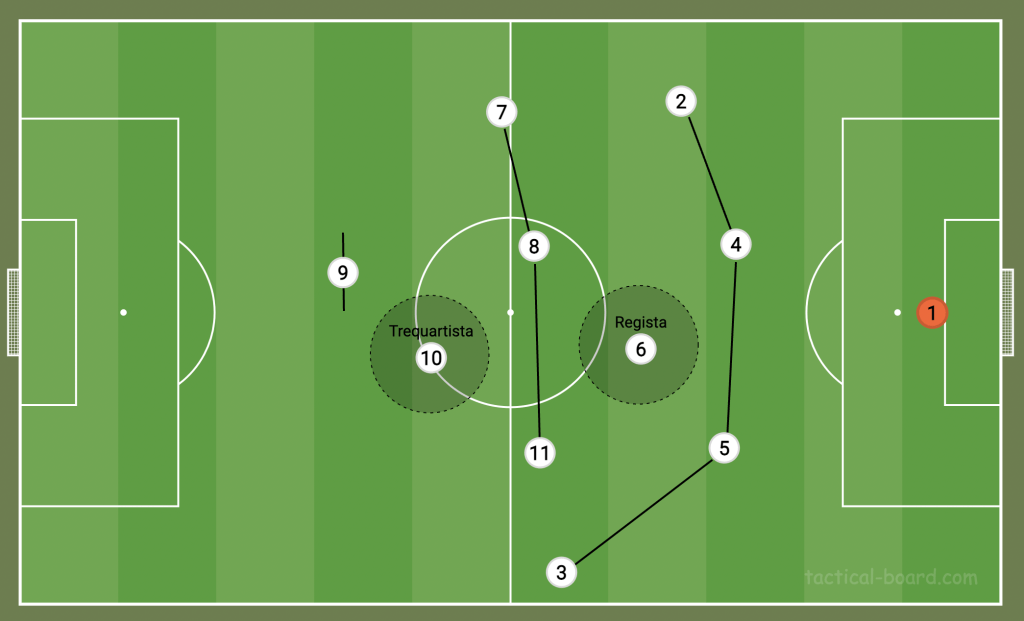
Let’s move from theory to the current game. You can’t find a pure Pirlo-esque regista at the elite level anymore. The players we call “registas” today are actually modern DLPs with a stylistic flourish.
- The Modern DLP (The Standard): Rodri. He is the definitive model. His pass completion rate is consistently above 90%, he scores crucial goals, and he is a defensive pillar. He controls without the overt aesthetic of a Pirlo, his game is about power, precision, and relentless efficiency.
- The Hybrid (The New Blueprint): Alexis Mac Allister. He blends the deep-lying distribution with unexpected forward runs and tenacious defending. His tactical understanding for coaches to study is how he adapts his positioning game-by-game.
- The Stylistic Heir (Closest to Regista): Toni Kroos in his later years. Even Kroos, the closest successor to Pirlo’s passing throne, adapted. At Real Madrid, he played deeper but was always supported by Casemiro (and later Tchouaméni) doing the heavy defensive lifting. His retirement leaves a void that clubs are scrambling to fill with more robust players.
- The Next Generation: Vitinha (PSG) & Aleix García (Girona). These players represent the data-driven modern DLP. They top European charts for pass attempts and progressive passes per 90 minutes. Their game is built on constant availability and rapid circulation, not Hollywood passes.
If you’re a young player using a player position guide to find your ideal soccer position, look at this list. The path for a deep-lying creator now runs through the gym and defensive drills as much as passing practice.
Tactical Implications for Coaches and Teams

Understanding this difference isn’t just for fans. It changes how you build a team.
- You cannot build around a pure regista anymore. The tactical cost is too high. You must dedicate two other midfielders solely to protection, limiting your attacking flexibility. Most modern midfield setups in the 4-3-3 demand all three midfielders contribute defensively.
- The single-pivot system is only possible with a modern DLP. Pep Guardiola’s Manchester City structure relies entirely on Rodri’s ability to be the lone #6. A regista in that role would be exposed and overrun. This is the ultimate proof of the evolution.
- Scouting has changed. Clubs no longer search for the “next Pirlo.” They search for the “next Rodri”, players with the physical and technical profile to do both jobs. This shifts the entire talent identification model for the central midfield roles.
- It affects formation choice. A 4-4-2 formation with a two-man midfield almost certainly cannot accommodate a regista. Both central players need athleticism. The 3-5-2 formation, with its extra center-back, is the last formation that could theoretically hide one, but even there, the demand for pressing makes it a risk.
For a deeper dive into these structural choices, any serious football tactics books published in the last five years will detail the death of the specialist and the rise of the hybrid midfielder.
Frequently Asked Questions
Are regista and deep lying playmaker the same thing?
No. A deep lying playmaker is the general tactical role. A regista is a specific, stylistically distinct type of deep lying playmaker, characterized by a languid playing style, minimal defensive movement, and an emphasis on long, artistic passing. All registas are DLPs, but not all DLPs are registas.
Who is the best modern example of a regista?
There are no pure registas at the highest level of modern football. The player whose style was most reminiscent was Toni Kroos, but even he operated within a system that provided significant defensive cover. Today’s deep-lying creators, like Rodri, are modern DLPs who combine passing with defensive duties.
What killed the classic regista role?
The widespread adoption of high-intensity, coordinated pressing. Teams now aggressively target the opposition’s deepest midfielder to force turnovers in dangerous areas. A stationary regista cannot survive this pressure without being a defensive liability. The role evolved to require press resistance and physical engagement.
Can a team still succeed with a regista today?
It is highly unlikely at the elite professional level. The tactical sacrifice is too great, requiring two other midfielders to provide constant defensive protection, which limits attacking options. It might work in leagues with a slower tempo or against specific opponents, but as a foundational tactic, it is obsolete.
What should a young player focus on to become a modern DLP?
Develop three things equally: 1) Passing range and speed of decision-making under pressure, 2) Physical strength and stamina to protect the ball and cover ground, and 3) Defensive intelligence, learning to intercept passes and position yourself to break up attacks. Ignoring any of these three areas will limit your potential.
The Bottom Line
The deep lying playmaker is alive and well; it’s just wearing a different kit. The regista, in its purest, most artistic form, is a relic of a bygone era, a beautiful tactical artifact we watch in highlights of Andrea Pirlo. The modern game’s demand for intensity, pressing, and defensive solidity from every player forced the role to evolve.
Today’s DLP is a conductor and a construction worker. They must orchestrate the attack with their passing while also laying the defensive foundation with their tackling. This isn’t a downgrade; it’s an adaptation. The romance of the regista is giving way to the relentless efficiency of players like Rodri. The next time you watch a game, don’t just look for the long pass. Watch the battle in the center circle. That’s where the modern deep lying playmaker is born.

I come from the “soccer heart” of Germany, the Ruhrpott. I have played, trained and followed soccer all my life and am a big fan of FC Schalke 04. I also enjoy following international soccer extensively.