Comparing the MLS and Premier League Formats & Differences
The difference between MLS and Premier League format boils down to structure, calendar, championship system, financial model, and competitive balance. MLS uses a closed, playoff-based system with a salary cap and geographic conferences. The Premier League uses an open, single-table league with promotion and relegation, awarding its title based on points.
Most people think soccer leagues are the same everywhere. They aren’t. The Premier League operates on a model that’s been refined over a century, while MLS built a system designed for survival and growth in a crowded sports market. This creates two fundamentally different experiences for fans, players, and owners.
Let’s break down the seven key structural differences that separate these two powerhouses.
Key Takeaways
- MLS splits its 29 teams into Eastern and Western Conferences for a regular season, while the Premier League uses a single-table league of 20 clubs.
- The Premier League champion is the team with the most points after 38 games. The MLS champion is decided through a playoff tournament culminating in MLS Cup.
- The Premier League relegates its bottom three teams and promotes three from the Championship each season. MLS has no promotion or relegation.
- MLS’s calendar runs from February/March to December, with playoffs. The Premier League season runs from August to May.
- MLS operates under a single-entity system with a salary cap to promote parity. Premier League clubs are independently owned and operate in a free market.
- Premier League revenue dwarfs MLS, leading to a higher average player salary and a wider global talent pool.
- MLS’s format creates more parity, with 10-12 realistic contenders each year. The Premier League typically sees only 2-4 clubs competing for the title.
The Core Format: League Structure
The Premier League is a single-table league. All 20 clubs play each other twice, home and away. It’s simple. Every match counts equally toward the final points tally that determines the champion, European qualification spots, and relegation.
MLS is a two-conference league. The 29 teams are divided into Eastern and Western Conferences based on geography. The regular season is not a pure league competition where every team plays every other team twice. Instead, teams play more matches against conference rivals. This structure is borrowed from other American sports leagues.
A Premier League fixture list is symmetrical, 38 matches, 19 home, 19 away, each opponent twice. The MLS schedule is asymmetrical, weighted toward conference games to reduce travel costs and build regional rivalries.
The Premier League’s structure is locked into the wider English football pyramid. Promotion and relegation connect the top flight to the EFL Championship, League One, and League Two. MLS’s closed league formats operate as an isolated ecosystem. This isolation is a deliberate choice, stemming from its MLS single-entity system where the league owns player contracts and centrally manages club operations. It allows for controlled growth but prevents the organic, meritocratic movement found in global league structures.
TL;DR: The Premier League is a pure, open league of 20 teams. MLS is a closed, two-conference league of 29 teams designed for geographic efficiency and financial control.
How Champions Are Crowned

This is the most visible difference. In the Premier League, the champion is the team that finishes with the most points after 38 matches. It’s a marathon. Consistency over a full season is rewarded. Winning the league is the ultimate prize.
In MLS, the regular season determines seeding for the postseason. The team with the most points across both conferences wins the Supporters’ Shield, a respected trophy, but not the league championship. The league champion is crowned through the MLS playoff format. The top nine teams from each conference enter a knockout tournament. Single-elimination matches culminate in MLS Cup.
Common mistake: Calling the MLS Supporters’ Shield winner the “league champion”, that title belongs exclusively to the MLS Cup winner. The Shield winner is the regular-season champion, a distinction that matters in trophy history and playoff seeding.
The playoff system injects drama but also randomness. A team that dominates the regular season can lose in a single playoff match. It rewards peak performance in a short tournament, not sustained excellence. This system shapes team strategy. Premier League clubs must manage resources over a long campaign. MLS teams can sometimes prioritize peaking for the MLS Cup playoffs over consistent weekly results.
The difference in championship determination directly influences how each league is perceived globally. The Premier League’s points-based title is the standard in world football. MLS’s playoff-based title is often viewed as an American adaptation.
Promotion, Relegation, and the Closed Loop

Premier League promotion and relegation from the Premier League are fundamental. The bottom three teams are demoted to the Championship each season. Three teams from the Championship are promoted up. This system creates constant pressure at both ends of the table. Every match matters, even for mid-table clubs fighting to avoid the drop.
MLS has no such system. There is no path for a lower-division club to earn a spot in MLS through performance. Expansion is controlled by the league, based on market size, ownership group wealth, and stadium plans. This closed league format protects franchise valuations and investor stability. It’s a business model first.
I watched FC Schalke 04, my club, fight relegation battles that felt like life or death. The tension in those final matchdays is unmatched. In MLS, a club finishing last faces no existential threat beyond fan disappointment. The stakes are fundamentally different.
The absence of relegation changes everything. It removes the financial catastrophe of dropping out of the top flight. It allows teams to rebuild over multiple seasons without panic. It also, critics argue, removes a key driver of competitive intensity for clubs outside the title race. The English relegation system is a brutal meritocracy. MLS’s model is a managed monopoly.
TL;DR: Premier League clubs face the existential threat of relegation. MLS clubs operate in a closed system with no promotion or relegation, prioritizing franchise stability.
Season Calendar and Physical Demands

The Premier League season runs from mid-August to late May. It aligns with the traditional European football calendar, avoiding the peak summer heat. The break allows players to participate in summer international tournaments.
The MLS season structure traditionally runs from late February or early March to mid-October, with playoffs ending in early December. This schedule places many regular-season matches in the summer. It also creates a clash with the international calendar, as players often leave for summer tournaments during the MLS season.
MLS is planning a significant shift. By 2027, the league intends to align its calendar with the global standard, running from July to May. This will reduce summer matches and better integrate with international competitions.
The calendar difference creates different physical demands. Premier League players contend with a colder, wetter winter period. MLS players, especially in southern cities, deal with high summer heat and humidity. Add in the prevalence of artificial turf in many MLS stadiums and the extensive travel distances across North America, and the physical profile of an MLS season is unique.
| League | Season Start | Season End | Key Physical Factors |
|---|---|---|---|
| Premier League | Mid-August | Late May | Cold, wet winter matches; minimal travel within England. |
| MLS (Current) | Late Feb / Early Mar | Early Dec (after playoffs) | Summer heat & humidity; artificial turf; long-distance travel. |
| MLS (2027 Target) | July | May | Aligns with global calendar; reduced summer matches. |
Financial Models and Player Quality

Money is the engine. The Premier League is the richest domestic soccer league in the world, with revenue projected to hit $7 billion in 2025. MLS revenue is around $1.85 billion. This gap is the root cause of most other differences.
The Premier League operates as a collection of independently owned, wealthy clubs. They compete in a free market for players, paying transfer fees and salaries dictated by global demand. The average Premier League player salary is over $4 million.
MLS operates under a MLS single-entity system. The league owns all player contracts. Clubs are franchise owners within that structure. This allows for centralized control mechanisms like the salary cap, allocation money, and the draft. The average MLS player salary is around $580,000.
Common mistake: Assuming MLS’s salary cap is a hard ceiling like in the NBA. MLS’s cap is softer, with mechanisms like Designated Player slots that allow clubs to pay three players far above the cap. This creates a tiered talent system within the league.
The financial disparity translates directly to player quality and tactical sophistication. Premier League squads are deeper, filled with international stars. The pace of play is faster. Tactical systems are more complex, implemented by world-class managers. MLS has improved dramatically, but the ceiling is lower. The number of MLS games in a season is similar, but the consistency of technical quality from match to match is not.
A 2026 CNS Maryland MLS vs Premier League analysis detailed this financial gap and its impacts on everything from academy investment to global prestige.
Competitive Balance and Parity
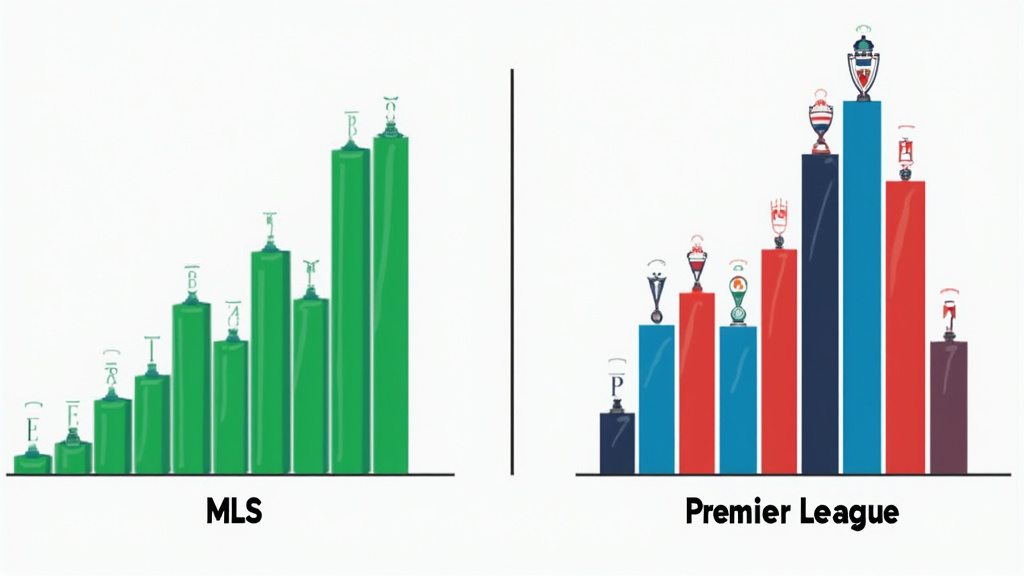
MLS’s structure is engineered for parity. The salary cap, allocation mechanisms, and even the playoff format are designed to prevent dynasties and keep more teams in contention. Typically, 10-12 MLS teams have a realistic shot at the title each season.
The Premier League has become a league of giants. Financial power has concentrated at the top. In recent seasons, only 2-4 clubs genuinely compete for the title. Manchester City’s four consecutive titles from 2021 to 2024 showcased a level of dominance nearly impossible in MLS’s playoff system.
| Competitive Factor | MLS | Premier League |
|---|---|---|
| Realistic Title Contenders (Annual) | 10-12 teams | 2-4 teams |
| Mechanism for Balance | Salary cap, allocation money, playoff randomness | Financial dominance of top clubs |
| Risk of Dynasty | Low — playoff format can upset regular-season dominators | High — financial & squad depth allow sustained dominance |
This shapes the fan experience. In MLS, hope is more widely distributed. In the Premier League, fans of mid-table clubs often measure success by European qualification or avoiding relegation, not by title dreams.
TL;DR: MLS’s rules create more parity and wider competition. The Premier League’s financial model leads to concentrated power and fewer true title contenders.
Global Perception and Growth Trajectory
The Premier League is the pinnacle of domestic club soccer. Its global viewership, prestige, and talent pool are unmatched. MLS is a growing league in a country where soccer’s best days are still ahead.
This difference in standing affects everything from transfer market activity to media coverage. A player moving from the Premier League to MLS is seen as stepping down. A player moving from MLS to the Premier League is seen as a major step up.
MLS is on a strong growth trajectory. Expansion, stadium development, and the 2027 calendar shift are signs of ambition. The Premier League, while dominant, has less room for further explosive growth. It’s already at the top.
The constant tinkering with the MLS playoff format, the number of teams, the bracket structure, is often criticized as “un-soccerlike” by traditionalists. But it’s a symptom of a league still searching for its ideal competitive product, unlike the settled, century-old traditions of the English league system.
The two leagues serve different roles. The Premier League is the established global standard. MLS is the ambitious challenger building a distinct model. Understanding their formats is key to understanding their place in the world of football.
Frequently Asked Questions
Which league has more teams, MLS or Premier League?
MLS has more teams. In 2023, MLS had 29 teams split into two conferences. The Premier League has 20 teams in a single-table format.
Does MLS have promotion and relegation like the Premier League?
No. MLS does not have a promotion and relegation system. It is a closed league. The Premier League relegates three teams to the Championship and promotes three teams up each season.
How is the champion determined in each league?
The Premier League champion is the team with the most points after 38 matches. The MLS champion is the winner of the MLS Cup playoff tournament. The team with the most points in the MLS regular season wins the Supporters’ Shield, but not the league championship.
When do the MLS and Premier League seasons run?
The Premier League season runs from mid-August to late May. The MLS season traditionally runs from late February/early March to early December (including playoffs). MLS plans to shift to a July-May calendar by 2027.
Why is there such a big difference in player salaries between MLS and the Premier League?
The Premier League’s revenue is vastly higher (projected $7 billion in 2025 vs. MLS’s $1.85 billion). This allows Premier League clubs to pay higher transfer fees and salaries. MLS also operates with a salary cap as part of its single-entity structure, which limits overall spending.
The Bottom Line
The MLS and Premier League formats are built for different worlds. The Premier League’s open, points-based, promotion-and-relegation model is the traditional European standard. MLS’s closed, playoff-based, conference-structured model is an American adaptation designed for parity and controlled growth.
If you value a pure league competition where every match counts equally toward a single title, the Premier League’s format is for you. If you prefer a system that keeps more teams in contention and culminates in a high-stakes knockout tournament, MLS’s format delivers that.
Neither system is universally “better.” They reflect different histories, economics, and cultural expectations about how a sports league should operate. Knowing the difference lets you appreciate what each league is trying to achieve.

I come from the “soccer heart” of Germany, the Ruhrpott. I have played, trained and followed soccer all my life and am a big fan of FC Schalke 04. I also enjoy following international soccer extensively.