Elite Soccer Academies in Europe and the USA: Your Options
Your options for elite soccer academies in Europe and the USA hinge on aligning three critical factors: the player’s developmental readiness, the family’s academic and financial framework, and the targeted professional or collegiate pathway. Europe offers professional immersion, while the USA centers on the college scholarship model.
Choosing an elite soccer academy option in Europe or the USA requires matching three things: the player’s developmental stage, the family’s academic and financial parameters, and a clear-eyed assessment of the professional or collegiate pathway desired. The European path offers daily immersion in a professional club’s culture with higher competition density, while the elite U.S. path is structured around the college scholarship model with defined NCAA rules.
Most families get this wrong because they chase the label “elite” or the geography “Europe” without auditing their player’s actual fit for that specific system. They see the success story and miss the thousand smaller players who didn’t make it, or who struggled off the pitch. The romantic idea of a European academy often overshadows the gritty reality of visas, language barriers, and being a 16-year-old far from home.
This guide strips away the marketing. We’ll compare the training, the competition, the academics, and the hidden costs of both systems. You’ll get a framework to evaluate any academy, not just a list of names. The goal is a decision based on evidence, not prestige.
Key Takeaways
- “Elite” in Europe means club integration. True elite European academies are part of a professional club’s youth system, like Girona FC’s setup. They train daily, play in competitive youth leagues, and live the club’s tactical philosophy. Short-term “academy experiences” are often glorified camps.
- The U.S. system is built for college. Top U.S. academies like MLS Next or elite ECNL clubs develop players with the NCAA scholarship as a primary target. The calendar, coaching licenses, and style of play are optimized for that outcome, not for a direct professional contract in Europe.
- Language and tactics are country-specific. Spain teaches positional play and ball circulation. Germany emphasizes transition speed and physicality. Picking a country is picking a football education. A player suited for Spain might flounder in England.
- The biggest obstacle isn’t talent, it’s paperwork. For non-EU players under 18, FIFA’s Article 19 restricts international transfers. Navigating this, plus national immigration law and potential NCAA eligibility loss, requires legal help. Dual citizenship (e.g., a U.S. and EU passport) changes everything.
- Academic integration is non-negotiable. The best programs, like those partnered with Arizona State University, bake academics into the schedule. A program that treats school as an afterthought is a red flag. Your child’s education is the backup plan for 99% of players.
What Defines an ‘Elite’ Academy in Europe vs. the USA?
Head design changes the entire process. Look at the business end of your trimmer.
The core difference is foundational purpose. A genuine elite European academy exists to feed players into its parent club’s professional system. Its metrics are first-team debuts and transfer fees. The environment is a daily apprenticeship within a professional organization, complete with its own distinct culture, like the gegenpressing intensity of a Bundesliga club’s youth setup.
An elite European football academy is a fully integrated youth department of a professional club, providing daily training under UEFA-licensed coaches, competition in structured national youth leagues, and holistic support within a residential or closely monitored framework, with the explicit aim of player development for the professional game.
The U.S. model, at its highest level in MLS Next academies, is professional in quality but collegiate in destination. While MLS clubs sign homegrown players, the system’s broader ecosystem, including the vast majority of elite club soccer, is geared toward the NCAA scholarship as the prized outcome. The coaching, the seasonal calendar (aligned with the school year), and even the substitution rules often mirror the college game.
This creates a tangible gap in training density and competitive urgency. A 17-year-old at a top Bundesliga academy might have 10-12 training sessions and a competitive youth league match per week. A similarly aged top U.S. academy player might have 4-5 sessions and a weekend match, with the rest of the time dedicated to school and recovery. The European player accumulates more high-intensity repetitions in the specific game model they’ll be expected to execute as a pro.
TL;DR: Europe’s elite academies are professional apprenticeships; America’s are professional-grade pipelines to college soccer. One is not inherently better, but they are built for different end goals.
The 7-Step Evaluation for a European Academy
Do not trust a website’s claims. Trust the club’s official academy pyramid and its published player pathway. Here is how to vet a European opportunity beyond the brochure.
Step 1: Verify Club Integration. Is the academy listed on the professional club’s official website under “Academy” or “Youth Sector”? Academies that operate under a club’s name but are run by a separate “soccer experiences” company are intermediaries, not true integrations. The difference is access to the club’s full-time technical directors and facilities.
Step 2: Audit the Weekly Schedule. Request a sample weekly schedule for the appropriate age group. You are looking for volume and quality: how many field sessions, how many gym sessions, and what is the focus of each? A serious program will have a periodized plan. If the schedule is vague or light, it’s a camp, not an academy.
Step 3: Identify the Competition. Who do they play? The academy’s youth teams should compete in a recognized national youth league (e.g., Spain’s División de Honor Juvenil, Germany’s A-Junioren Bundesliga). “Friendly matches against local clubs” is a major red flag; it indicates a lack of integration into the competitive structure.
Step 4: Scrutinize the Coaching Credentials. Coaches should hold at minimum the UEFA B License, with the head coach likely holding a UEFA A License. These are standardized, federation-issued qualifications. Be wary of “Director of Coaching” titles with no listed license or with licenses from unrecognized private organizations.
Step 5: Inspect the Living Conditions. Where do players live? Is it a supervised residential complex, host families vetted by the club, or an unsupervised apartment? Who manages meals, transportation, and evening routines? The off-field structure is what prevents a talented 16-year-old from getting lost.
Step 6: Map the Academic Pathway. How is school handled? The best options are either an integrated international school on-site or a formal partnership with an online institution like Arizona State University. The academic workload must be structured, monitored, and result in a real diploma or credits.
Step 7: Understand the Exit Strategy. What happens after the academy? Does the club have a B team or U-23 team to bridge to the first team? What is their track record of placing players in colleges if the pro path doesn’t materialize? A reputable academy has a plan for both outcomes.
Common mistake: Choosing an academy based on the fame of its parent club (e.g., “Real Madrid”) without checking if the program is a short-term camp for foreigners, your player gets a photo in a famous kit but zero pathway to that club’s actual youth teams, and the development value is minimal.
Skipping any of these steps is like buying a car without checking the engine. You might get a shiny exterior, but it won’t get you where you need to go. The due diligence is the entire process.
| Evaluation Criteria | European Elite Academy (True Integration) | European “Academy Experience” (Camp Model) | Top U.S. Academy (MLS Next/ECNL) |
|---|---|---|---|
| Primary Goal | Develop players for club’s professional team | Generate revenue; provide cultural experience | Develop players for NCAA collegiate soccer |
| Training Frequency | 10-12 sessions per week (technical, tactical, physical) | 4-6 sessions per week, often with large groups | 4-6 sessions per week, aligned with school |
| Competition Level | Official national youth league fixtures | Friendly matches vs. local amateur sides | MLS Next/ECNL league matches; national showcases |
| Coaching Standard | UEFA B/A License mandatory for lead coaches | Variable; often local coaches without top licenses | U.S. Soccer A/B License or equivalent |
| Academic Handling | Integrated international school or accredited online program | Left to player/family to arrange | Traditional high school; sometimes hybrid schedules |
| Pathway Clarity | Documented progression to B team/U-23s | No defined pathway | Documented track record of college placements |
Academic Integration: School vs. Soccer

The player who neglects academics is betting their entire future on a 1% chance. Smart programs don’t allow that bet. They build the classroom into the day.
European academies have evolved. The old model of “football only” is extinct at serious institutions. Now, you’ll find three main academic models. The first is the integrated international school, often on or near the training complex, with classes scheduled around morning and evening training sessions. The curriculum is typically International Baccalaureate or a similar standard, taught in English.
The second is the formal university partnership, ideal for post-high school players. Programs like the one offered by International Soccer Academy with Arizona State University allow players to earn U.S. college credits online while training daily in Europe. This protects NCAA eligibility and provides a tangible academic credential.
The third model, the gap year, is a structured bridge. It’s a year of intensive training and competition, often with some academic coursework, designed to prepare a player for either a professional contract or a stronger entry into college soccer. It’s not a year off; it’s a year on, in a professional environment.
In the U.S., the academic model is more rigid but familiar. Players attend traditional high schools or universities, with training fitted around the standard school day. The advantage is stability and a well-understood path to a degree. The disadvantage is that the football environment is often separate from the academic one, unlike the total immersion of a European residential academy.
The choice here is philosophical. Do you want education and football fully woven together in a single, intense environment? Or do you want them in separate, stable compartments? There’s no right answer, only the right answer for your child’s learning style and resilience.
TL;DR: The academy must have a legitimate, accredited academic plan that runs parallel to training, not as an afterthought. If they can’t show you the syllabus and the daily schedule, walk away.
The Hidden Costs and Obstacles (Beyond Tuition)
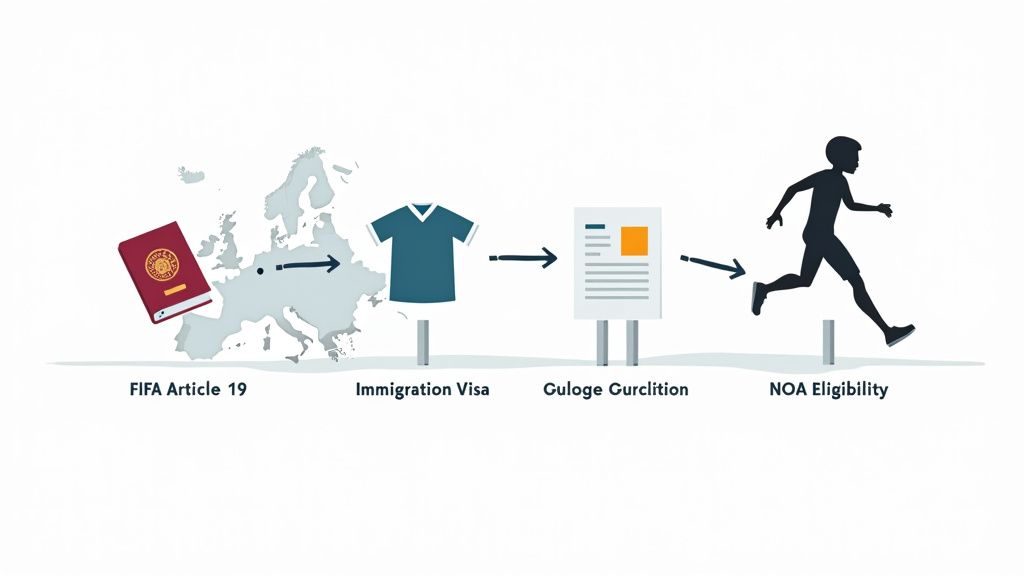
The brochure price is the entry fee. The real cost includes the legal retainers, the flights home for holidays, the private language tutoring, and the potential derailment of a U.S. college opportunity.
The most formidable hurdle is regulatory. For non-EU players under 18, FIFA’s Article 19 restricts international transfers. Exceptions exist, but they are narrow and require meticulous documentation. Clubs are often reluctant to navigate this for an unproven foreign youth. This is why many “academy” programs for internationals are structured as long-term camps, they circumvent transfer rules because the player isn’t officially registered with the national federation.
Immigration is the next wall. A student visa may allow training but not official competition. A sports visa requires the club to prove the player is of exceptional talent and that no EU player can fill the role. For a 16-year-old, that’s a very high bar. This legal maze is why having a U.S. and EU passport is such a massive, often decisive, advantage.
Then there’s the NCAA risk. If a player accepts any compensation beyond basic expenses, like housing or flights, from a foreign club or its linked academy, they can jeopardize their amateur status and future U.S. college eligibility. The lines are blurry. This requires pre-emptive consultation with the NCAA Eligibility Center.
Finally, the emotional cost. A teenager moving to a new country faces isolation, language pressure, and the intense scrutiny of a professional environment. The academy must have a visible support system: a designated mentor, mental health resources, and a clear protocol for players who are struggling. If they can’t describe this system in detail, they don’t have one.
I’ve seen a highly touted American midfielder, a dual national, sign with a Portuguese club’s U-19s. The football was good, but the club placed him in an unmonitored apartment with two other foreign players. Within six months, his grades collapsed, he was homesick, and he started missing training. The club released him. He came home, his confidence shot, and he struggled to find a college spot. The football environment was elite. The life environment was a disaster.
The total cost isn’t just the tuition invoice. It’s the sum of legal fees, travel, ancillary support, and the opportunity cost of the path not taken. Budget for all of it.
Country-by-Country Breakdown: More Than Just Spain

Spain is the default answer for many, and for good reason. Its coaching education is superb, emphasizing tactical intelligence, positional play, and comfort in tight spaces. For a technical, intelligent player, it’s a perfect fit. But Europe isn’t monochrome.
Germany offers a contrasting model. The focus is on physical robustness, explosive transitions, and relentless gegenpressing. The youth league system is highly competitive, and the pathway from academy to first team is perhaps the most transparent in Europe, thanks to the Bundesliga’s 50+1 rule and emphasis on youth development. It suits a powerful, athletic player who thrives in a fast, direct style.
Portugal has become a powerhouse for developing and exporting talent. The technical level is high, the competitive environment is fierce, and clubs are exceptionally savvy at navigating the international transfer market for young players. It can be a ruthless business, but for a player with clear pro ambitions, it’s a fantastic incubator.
The United Kingdom presents a paradox. The coaching education and facilities are world-class, but the path to first-team football at Premier League academies is notoriously blocked by expensive foreign signings. The emphasis is often on athleticism. For an American player, the lack of a language barrier is a plus, but the competition for places is extreme.
| Country | Tactical Philosophy | Best For Player Type | Key Regulatory Note for Non-EU |
|---|---|---|---|
| Spain | Positional possession, building from the back, tactical discipline | Technical, patient, high soccer IQ | Difficult visa for minors; dual EU citizenship is a major advantage |
| Germany | High-intensity pressing, rapid vertical transitions, physical power | Athletic, aggressive, strong work rate | Possible via youth player visa if club sponsors; requires exceptional talent proof |
| Portugal | Technical flair, adaptability, strong focus on individual skill development | Creative, skillful, mentally resilient | More accessible visa routes for football development; strong agent network |
| United Kingdom | Pace, power, direct attacking, set-piece strength | Physically dominant, fast, adaptable | Points-based system; extremely difficult for academy players without EU passport |
Choosing a country is choosing a football education. A player who needs to develop physical resilience might thrive in Germany. A player who needs to improve tactical patience might be best served in Spain. The decision should be as specific as a position selection guide, it matches attributes to environment.
The American Alternative: MLS Next and the College Pathway
The elite American pathway is no longer a consolation prize. MLS Next academies are professional environments. They train at MLS club facilities, under full-time coaches, and play a national schedule. For the player whose end goal is a top NCAA Division I program, and potentially an MLS homegrown contract, it is a direct and effective route.
The structure is built for that outcome. The season aligns with the academic calendar. Coaches are deeply networked with college programs. The showcase events are designed for college scouts. The player develops while maintaining their U.S. academic standing and NCAA eligibility seamlessly. It’s a streamlined system.
The financial equation is different. While European academies charge tuition, top MLS academies are typically free for players. The cost is then the family’s responsibility for travel to matches and showcases. Compare this to the total cost of a European academy (€30,000-€50,000+ per year for tuition and housing), and the U.S. path can be significantly less expensive upfront.
However, the ceiling is different. The competition density, the number of truly high-stakes, high-pressure matches, is generally lower than in a European youth league. The tactical focus can vary widely between clubs, unlike the consistent club philosophy a player absorbs in a European system. And while the path to an MLS first team exists, the path from an MLS academy directly to a top European club remains rare.
It’s a choice of ecosystems. The U.S. system is a closed, well-marked loop: academy to college to MLS draft/professional. The European system is an open, high-risk, high-reward ocean: integrate into a club’s culture, fight for a pro contract, and navigate the global transfer market. One offers security and a degree. The other offers a pure football immersion with a steeper fall.
TL;DR: The U.S. elite academy path is a professionalized route to college soccer and potentially MLS. It’s lower cost, lower regulatory hassle, and offers a clear academic backup. It is not, however, a direct pipeline to the European professional game.
Frequently Asked Questions
What is the best age to try for a European academy?
The ideal window is 16-18 years old. By 16, a player’s physical and technical potential is clearer, and they can handle a residential program. Before 16, FIFA’s international transfer rules for minors (Article 19) create major barriers, and the emotional challenge of moving abroad is significantly greater.
Can you get a scholarship to a European soccer academy?
Yes, but not in the NCAA “full-ride” sense. Some academies, like those partnered with PlayAbroad, offer internal merit-based scholarships that reduce tuition costs. However, families should still budget for living expenses, flights, and insurance. “Full scholarships” covering everything are exceptionally rare for international players.
Does going to a European academy hurt NCAA eligibility?
It can, if you’re not careful. Accepting benefits beyond “actual and necessary expenses” from a club or its linked academy can compromise amateur status. To protect eligibility, use an NCAA-approved academic partner (like ASU online), pay all expenses yourself where possible, and file frequent updates with the NCAA Eligibility Center.
How do I know if a European academy is legitimate?
Cross-reference three things: its listing on the professional club’s official website, the league its youth teams compete in (should be a national federation-sanctioned league), and the UEFA license level of its head coaches. If any of these are missing or vague, it’s likely an intermediary program, not a true club academy.
Is the gap year in Europe worth it?
For a player who has graduated high school but wants a year of intense, professional training before college, a structured gap year with a program like International Soccer Academy can be transformative. It’s not a vacation. It’s a daily professional immersion that accelerates tactical understanding and physical readiness for the college game. It is worth it if the program is authentic and the player is disciplined.
The Bottom Line
Forget the word “elite” for a moment. The real question is fit. Does the daily reality of that academy, its training, its competition, its life structure, fit your player’s development needs and personality? Does its end goal match your family’s academic and professional expectations?
The European path offers a pure, immersive football education with a higher risk and a higher potential reward. It demands thorough due diligence, legal preparation, and a player with uncommon mental resilience. The American path offers a professional-grade development route within a stable, familiar system aimed at a college degree, with a clearer, safer trajectory.
The worst decision is the one made for prestige. The best decision is the one made from a clear-eyed audit of the player, the program, and the paperwork. Visit if you can. Talk to alumni families. Read the federation’s fine print. The right choice isn’t about Europe or America. It’s about the specific environment where your player will grow, both on the pitch and off it. That’s the only elite that matters.

I come from the “soccer heart” of Germany, the Ruhrpott. I have played, trained and followed soccer all my life and am a big fan of FC Schalke 04. I also enjoy following international soccer extensively.