How Does Champions League Qualification Work? Full Guide
Champions League qualification works by filling a 36-team league phase with 29 direct qualifiers and 7 teams from qualifying rounds. Teams enter at different stages based on their domestic league finish and their national association’s UEFA ranking. The qualifying rounds split into a Champions Path for domestic winners and a League Path for non-champions, with eliminated teams dropping into the Europa League or Conference League.
Most people think a top-four finish in England or Spain guarantees a spot. That’s true for the league phase. But the fourth-place team in France doesn’t get that luxury, they start in the third qualifying round. The difference is a single UEFA ranking point.
This guide walks through the league phase size, the direct qualifiers, the two qualifying paths, and the complex rules that shuffle spots when a titleholder wins their domestic league too.
Key Takeaways
- The UEFA Champions League league phase now features 36 teams, with 29 qualifying directly and 7 coming through three qualifying rounds and a play-off.
- Your club’s starting point depends on two things: its domestic league finish and its national association’s UEFA ranking.
- Qualification splits into two paths after the first round: the Champions Path for domestic winners, and the League Path for non-champions from stronger leagues.
- Teams eliminated in qualifying don’t just disappear, they drop into the UEFA Europa League or UEFA Conference League at predetermined stages.
- Special “European Performance Spots” reward the two best-performing associations each season, and a rebalancing rule gives a league phase spot to a high-coefficient champion if a titleholder qualifies domestically.
The New 36-Team League Phase
The old 32-team group stage is gone. Since the 2024/25 season, the UEFA Champions League league phase has 36 clubs. They play eight matches against opponents drawn from four seeded pots, with the top eight advancing directly to the round of 16. The middle sixteen teams face a knockout playoff, and the bottom twelve are eliminated.
The league phase is a single-table competition where each club plays two teams from each of four seeded pots, one home, one away, for a total of eight fixtures. Finishing positions 1-8 qualify directly for the round of 16; positions 9-24 enter a playoff round; positions 25-36 exit the tournament.
That expansion created more direct qualification spots. But it didn’t simplify the entry process. The path to those 36 seats is a maze of coefficients, domestic results, and two separate qualifying tournaments.
TL;DR: The Champions League now has 36 teams in its initial league phase, not 32. More spots exist, but the route to them is more complex than ever.
How Do Teams Enter the League Phase?
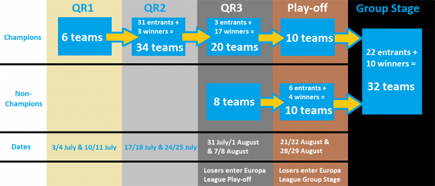
Twenty-nine of those 36 spots are filled directly. No qualifying matches. Those clubs go straight into the league phase draw based on their domestic league performance and their association’s ranking.
The remaining seven spots are fought over in qualifying. Three qualifying rounds and a play-off round filter teams down to those final seven. Where a club starts that journey, or whether it bypasses it entirely, is decided by a formula.
Your club’s domestic finish is the first variable. A champion from Portugal enters differently than a runner-up from Portugal. The second variable is your national association’s UEFA ranking. England’s fourth-place team goes directly to the league phase. France’s fourth-place team starts in the third qualifying round. The difference is one ranking position.
The access list for the 2026/27 season, published by UEFA, shows this in cold numbers.
| Association Rank | Direct League Phase Qualifiers | Qualifying Round Entry |
|---|---|---|
| 1–4 (England, Italy, Spain, Germany) | Top 4 teams | None |
| 5 (France) | Top 3 teams | 4th place → 3rd qualifying round (League Path) |
| 6 (Netherlands) | Top 2 teams | 3rd place → 3rd qualifying round (League Path) |
| 7–10 (Portugal, Belgium, Czech Rep., Turkey) | Champion only | Runner-up → 3rd qualifying round (League Path); Turkey’s 2nd → 2nd qualifying round |
| 11–14 (Norway, Greece, Austria, Scotland) | None | Champion → Play-off round (Champions Path); 2nd place → 2nd qualifying round (Champions Path) |
| 15 (Poland) | None | Top 2 clubs → 2nd qualifying round (Champions Path) |
The ranking is a sliding scale. Higher-ranked associations get more direct spots and later entry points for their non-champions. Lower-ranked associations send only their champion, and that champion starts earlier in the qualifying gauntlet.
Common mistake: Assuming all “top four” leagues work the same. England’s fourth place gets a direct spot, but France’s fourth place must win a two-legged tie in the third qualifying round. Missing that distinction costs clubs millions in early-season revenue.
I watched Schalke navigate this for years. Finishing fourth in the Bundesliga meant a direct ticket. Finishing sixth meant nothing. The gap between those two positions was a financial canyon.
TL;DR: Twenty-nine teams enter the league phase directly based on domestic league finish and association rank. The other seven come from qualifying rounds, where entry points are also determined by those same two factors.
The Two Paths: Champions vs League
After the first qualifying round, the tournament splits into two parallel competitions. This is the single biggest point of confusion for fans.
The Champions Path is for domestic league winners who didn’t get a direct league phase spot. Think the champion of Norway or Greece. They fight through a bracket reserved exclusively for champions.
The League Path is for non-champions from stronger leagues. This is where France’s fourth-place team or the Dutch third-place team enters. They compete against other clubs that qualified through their league position but didn’t win the title.
Five of the seven qualifying spots come from the Champions Path. Two come from the League Path. The paths never cross. A champion from Austria will never face France’s fourth-place team in qualifying. They’re in separate tournaments until the league phase draw.
The reason is historical. UEFA wanted to protect champions from smaller nations, giving them a dedicated route to the top competition. The League Path exists because stronger leagues have multiple qualification slots, and those slots need a funnel.
| Path | Who Qualifies | Spots Available | Typical Entry Point |
|---|---|---|---|
| Champions Path | Domestic league winners from associations without direct spots | 5 | Play-off round or 2nd/3rd qualifying round |
| League Path | Non-champions from associations with multiple spots (e.g., 4th in France, 3rd in Netherlands) | 2 | 3rd qualifying round |
The paths also have different consequences for failure. Losing in the Champions Path third qualifying round sends you to the Europa League play-off round. Losing in the League Path third qualifying round sends you directly to the Europa League league phase. That’s a tangible difference in prestige and revenue.
TL;DR: Qualifying splits into a Champions Path for domestic winners and a League Path for non-champions from top leagues. They award five and two spots respectively, and losing in one path sends you to a different stage of the Europa League.
Where Do Eliminated Teams Go?
A club that loses in qualifying doesn’t just go home. UEFA’s system relegates them to a lower competition, either the UEFA Europa League or the UEFA Conference League. The drop point depends on which round you lost and which path you were on.
This relegation ladder is fixed. The Wikipedia entry on Champions League qualifying details the exact drop points for each round.
- First qualifying round (Champions Path) losers → UEFA Conference League second qualifying round.
- Second qualifying round (both paths) losers → UEFA Europa League third qualifying round.
- Third qualifying round (Champions Path) losers → UEFA Europa League play-off round.
- Third qualifying round (League Path) losers → UEFA Europa League league phase.
- Play-off round (both paths) losers → UEFA Europa League league phase.
That last one is crucial. Losing in the play-off round of either path still gets you a seat in the Europa League league phase. It’s a consolation prize worth tens of millions.
I followed Fenerbahce through this in 2023. They lost in the Champions League play-off round. The next week they were preparing for the Europa League league phase. The switch wasn’t optional, it was automatic.
The system ensures European football continues for almost everyone. Only the very earliest losers drop to the Conference League. Everyone else gets a Europa League berth. This maintains revenue flow for clubs and satisfies UEFA’s commitment to a broad European calendar.
TL;DR: Losing in Champions League qualifying automatically relegates you to either the Europa League or Conference League, depending on the round and path. Play-off round losers go straight into the Europa League league phase.
The Rebalancing Rule That Changed Shakhtar’s Fate

One spot in the league phase is reserved for the previous season’s Champions League titleholder. Another is reserved for the Europa League titleholder. If those clubs also qualify for the Champions League through their domestic league, those reserved spots don’t just vanish. They trigger a complex rebalancing rule.
The reserved spot goes to the domestic champion with the highest individual club coefficient from associations ranked 11 through 55 who hasn’t already qualified directly for the league phase.
For the 2026/27 season, both Champions League finalists. Paris Saint-Germain and Arsenal, qualified domestically. Their reserved spots were vacant. Shakhtar Donetsk, the Ukrainian champion with a high club coefficient, got the automatic league phase spot. They skipped all qualifying.
I won’t recommend betting on this rule for your club. The coefficient calculation is opaque, and the list of associations 11-55 changes yearly. Shakhtar got it because Ukraine’s association rank fell after the war, placing them within the 11-55 band, and their club coefficient is among the highest in that group. It’s a lottery with one winner.
This isn’t a common occurrence. But when it happens, it reshapes the entire qualifying landscape. A champion from a mid-ranked association jumps straight to the league phase, bypassing the gauntlet. That changes the math for every other club in the Champions Path.
The rule exists to fill the vacancy without expanding the tournament beyond 36 teams. It also rewards clubs that have performed consistently well in Europe over recent seasons, even if their domestic league isn’t highly ranked.
TL;DR: If the Champions League or Europa League titleholder qualifies domestically, their reserved league phase spot goes to the highest-coefficient domestic champion from associations ranked 11-55. Shakhtar Donetsk got this spot for 2026/27.
European Performance Spots: England and Spain’s Bonus
Two extra league phase places are awarded each season to the associations with the best collective performance in the previous year’s UEFA club competitions. These are called European Performance Spots (EPS).
For 2026/27, those spots went to England and Spain. Their clubs performed best across the Champions League, Europa League, and Conference League the season before. This means England and Spain each get a fifth direct qualifier to the league phase.
The EPS is calculated using a points system based on all results from all clubs from an association. It’s not about one team winning the Champions League. It’s about the collective strength of every English and Spanish club in Europe that season.
This creates a feedback loop. Strong associations get more spots, which means more clubs earning points for that association, which helps them win the EPS again next year. It’s a structural advantage that reinforces the dominance of leagues like the Premier League and La Liga.
The EPS spots are added to the direct qualification tally. They don’t come from the qualifying rounds. So for 2026/27, England has five direct spots, Spain has five, and the qualifying rounds still produce seven winners.
TL;DR: Two additional direct league phase spots are awarded to the two best-performing associations from the previous season. For 2026/27, England and Spain earned these European Performance Spots, giving each a fifth direct qualifier.
How Coefficients Decide Your Fate
UEFA club coefficients are a five-year rolling score of your club’s European results. Your national association coefficient is a similar five-year score of all clubs from your country. These numbers decide almost everything.
Your association coefficient determines how many spots your league gets and where those spots enter. A higher coefficient means more direct spots and later entry points. England’s coefficient is high, so its fourth-place team goes straight in. Turkey’s coefficient is lower, so its second-place team starts in the second qualifying round.
Your club coefficient determines your seeding in every draw. A higher club coefficient means you’re more likely to face weaker opponents in qualifying. It also decides who gets that rebalancing spot if titleholders qualify domestically. Shakhtar won because their club coefficient was the highest among eligible champions.
Coefficients are updated after every round. Winning a qualifying tie boosts your club’s score. Winning a league phase match boosts it more. This creates a snowball effect for successful clubs.
Common mistake: Thinking your club’s domestic league position is the only thing that matters. Your club’s UEFA coefficient decides your seeding in every draw, and your association’s coefficient decides whether your fourth place is a direct spot or a qualifying battle.
I’ve seen clubs with strong domestic performances get tough qualifying draws because their coefficient was low. They faced seeded opponents early and lost. The coefficient is the silent gatekeeper.
TL;DR: UEFA club and association coefficients dictate entry points, seeding, and rebalancing outcomes. A high coefficient means easier draws and sometimes a direct ticket when vacancies occur.
What Happens in a Qualifying Tie?
Every qualifying round tie is played over two legs, one home, one away. The team with the higher aggregate score after both matches advances. If the aggregate score is tied after 180 minutes, the match goes to extra time. If still tied after extra time, it goes to a penalty shootout.
There is no “away goals rule” anymore. UEFA abolished it. A 1-1 draw at home and a 0-0 draw away means a 1-1 aggregate tie. Extra time follows immediately.
Seeding for each draw is based on club coefficients at the start of the season. Higher-coefficient teams are seeded and generally face lower-coefficient opponents. This isn’t always a guarantee, the draw can still produce a tough matchup for a seeded team.
The schedule is tight. The first qualifying round starts in early July. The play-off round concludes in late August. Clubs that go deep must play six matches across two months before the league phase even begins. It’s a physical and logistical marathon.
Winning a tie means moving forward. Losing means dropping to a specific stage of the Europa League or Conference League, as outlined earlier. There’s no ambiguity.
TL;DR: Qualifying ties are two-legged matches with no away goals rule. Seeding is based on club coefficients. Winning advances you; losing relegates you to a predetermined stage of a lower UEFA competition.
Frequently Asked Questions
What happens if the Champions League winner also qualifies through their domestic league?
Their reserved league phase spot is vacated. It is then awarded to the domestic champion with the highest club coefficient from associations ranked 11-55 who hasn’t already qualified directly. This is the rebalancing rule that gave Shakhtar Donetsk their 2026/27 league phase spot.
Do all top-four teams from big leagues qualify directly?
No. Only associations ranked 1-4 (England, Italy, Spain, Germany) get four direct spots. For association rank 5 (France), the top three qualify directly; the fourth-place team enters the third qualifying round via the League Path.
What’s the difference between the Champions Path and the League Path?
The Champions Path is exclusively for domestic league winners from associations without direct league phase spots. The League Path is for non-champions from associations with multiple qualification slots (like fourth place in France). They are separate competitions with different entry points and different relegation destinations.
Where do eliminated teams go?
They drop into either the UEFA Europa League or UEFA Conference League. The specific stage they enter depends on which qualifying round they lost in and which path they were on. Play-off round losers go directly to the Europa League league phase.
How are the European Performance Spots awarded?
Two extra direct league phase spots are given to the two associations whose clubs collectively performed best across all UEFA competitions the previous season. Performance is measured by a points system based on wins, draws, and progression. For 2026/27, England and Spain earned these spots.
The Bottom Line
Champions League qualification is a system of slots, coefficients, and paths. Twenty-nine teams enter the league phase directly. Seven come through a qualifying tournament split into a Champions Path and a League Path.
Your club’s journey depends on its domestic finish and its association’s UEFA ranking. Losing in qualifying doesn’t end your European season, it relegates you to the Europa League or Conference League.
Special rules like European Performance Spots and titleholder rebalancing add late twists. They reward collective association strength and high individual club coefficients.
The new 36-team format created more direct spots, but the qualifying maze remains complex. Knowing your association’s rank, your club’s coefficient, and which path you’re on is the only way to map the route.

I come from the “soccer heart” of Germany, the Ruhrpott. I have played, trained and followed soccer all my life and am a big fan of FC Schalke 04. I also enjoy following international soccer extensively.