How Does La Liga Work in Soccer? Format, Rules & Structure
La Liga works in soccer as a 20-team, double round-robin league where the team with the most points after 38 matches wins the title. The bottom three teams are relegated, and the top four qualify for the UEFA Champions League. The governing body, LALIGA, enforces financial controls and organizes the competition.
Most newcomers think it’s just about winning matches. They miss the uniquely Spanish twist in the rulebook and the massive, unseen machinery that keeps the league solvent. That’s where the real game is played.
This guide breaks down the format, the critical tie-breaker everyone gets wrong, the brutal reality of promotion and relegation, and how the league’s financial backbone shapes its future.
Key Takeaways
- The head-to-head record is the first tie-breaker, not overall goal difference. This rule has decided championships.
- Three teams go down automatically. The fight to avoid 18th place is often fiercer than the title race in the final weeks.
- European qualification is a complex dance between league position and the Copa del Rey winner. Fifth place doesn’t always mean Europa League.
- LALIGA is not just a scheduler. It’s a financial regulator, a global marketer, and a tech company that sells its software worldwide.
- The league’s financial controls, like squad cost limits, are stricter than in England. This prevents collapses but also limits spending power.
The 38-Game League: Points, Tie-Breakers, and the Title
The season runs from late August to late May. Each of the 20 teams plays every other team twice, once at home, once away. That’s 38 matches. The math is simple: 3 points for a win, 1 for a draw, 0 for a loss. The team with the most points after matchday 38 lifts the trophy. There is no final, no playoff. The table never lies.
La Liga’s tie-breaking procedure prioritizes direct head-to-head results between the tied teams (points, then goal difference in those matches) before considering overall goal difference, total goals scored, or fair play criteria. This rule adds a layer of strategic importance to every direct clash.
This is the part that catches out fans used to the English or German systems. In La Liga, if two teams finish level on points, the first decider is their results against each other. Did you take four points off your rival? You finish above them, even if they have a better goal difference against the rest of the league. Only if the head-to-head is perfectly level does the league then look at overall goal difference.
TL;DR: Win your head-to-head matches. They count double in a tie-break, and that’s decided titles.
European Qualification: More Than Just Top Four
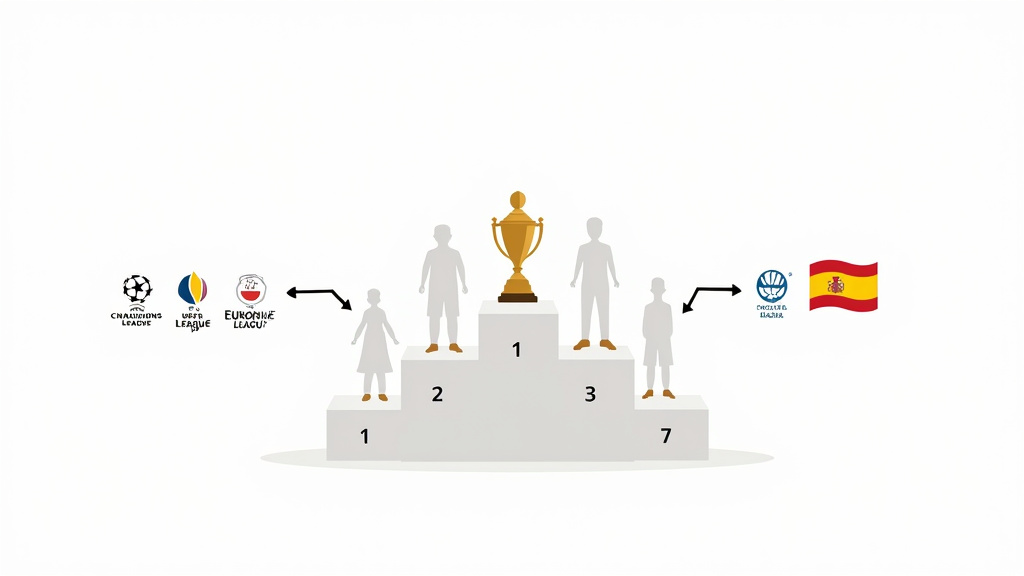
The race for European football drives the entire second half of the season. The rewards are financial and prestigious. The slots are allocated through a combination of league finish and domestic cup success, creating scenarios that can shift the goalposts for sixth or even seventh place.
| League Finish | Typical European Qualification | The Caveat |
|---|---|---|
| 1st – 4th | UEFA Champions League group stage | Secure and automatic. The holy grail. |
| 5th | UEFA Europa League group stage | Almost always secure, unless the Copa del Rey winner finishes outside the top six. |
| 6th | UEFA Europa Conference League playoff | This spot is fluid. It usually goes to 6th, but can go to 7th if the Copa del Rey winner finishes 5th or 6th. |
The wildcard is the Copa del Rey. The winner earns a Europa League group stage ticket. If that winner has already qualified for Europe via their league position (e.g., they finish in the top six), their Europa League spot does not disappear. It gets passed down to the next highest-placed team in the league that hasn’t already qualified. This is why you’ll see fans of a seventh-placed team cheering for a giant to win the cup.
Common mistake: Assuming sixth place always gets European football, if the Copa del Rey winner finishes seventh or lower, they take the Europa League spot from sixth place, bumping the Conference League spot down to seventh.
This system creates a more dynamic and interconnected competition, linking cup success directly to league fortune. It’s a stark contrast to a closed MLS vs. Premier League model where playoffs decide everything.
Promotion, Relegation, and the Fight for Survival

This is where dreams are made and broken. The system is a brutal meritocracy. Three teams from La Liga go down. Three teams from the Segunda División come up. The mechanics, however, have a twist.
The bottom three teams in La Liga, places 18, 19, and 20, are automatically relegated to the Segunda División, now branded as LaLiga Hypermotion. There is no playoff safety net. The final months of the season are dominated by this “descenso,” a psychological war of attrition often more compelling than the title race.
Promotion from the second tier works like this:
1. The teams finishing 1st and 2nd in the Segunda División are promoted automatically.
2. Teams finishing 3rd through 6th enter a playoff. The format is a mini-tournament: 3rd vs 6th and 4th vs 5th in two-legged semifinals. The winners meet in a two-legged final.
3. The winner of that final becomes the third promoted team.
This Segunda División promotion playoff is pure theater. A team that finished sixth can win two ties and find themselves in the top flight, while a consistent third-place team can stumble at the last hurdle. It’s a system designed for drama and is a key part of understanding global league structures. It’s also distinct from, say, the Bundesliga promotion playoff, which pits the 16th-place Bundesliga team against the 3rd-place 2. Bundesliga team.
LALIGA: The Engine Behind the Competition
Most fans see the matches. They don’t see the operator. La Liga is the competition. LALIGA (the Liga Nacional de Fútbol Profesional) is the private sports association that runs it. This distinction matters. LALIGA’s role exploded under president Javier Tebas. It’s no longer just about fixtures and referees.
Its core pillars are:
* Financial Control: The league enforces strict squad cost limits, tying a club’s spending to its revenue. This prevented a total financial meltdown during the pandemic, but it’s also why Barcelona had to leverage future assets to sign players. It’s a different philosophy from the English football pyramid, which uses parachute payments to soften relegation blows.
* Centralized Audiovisual Rights: LALIGA sells the TV rights for all clubs collectively, distributing the revenue more evenly than the old individual deals. It’s why Getafe earns more from TV than they could alone, though the gap with the giants remains.
* Internationalization & Technology: This is the growth engine. LALIGA opens offices worldwide to build the brand. More interestingly, it spun off LALIGA Tech, selling its data analytics and integrity software (like the anti-match-fixing Tyche system) to other leagues. The league is literally selling its own operating system.
The 2021 strategic agreement with CVC Capital Partners, dubbed “LaLiga Impulso,” injected billions for infrastructure and digital transformation. Clubs traded a small percentage of future TV rights for immediate capital. It’s a controversial but defining move for the league’s modern era.
How La Liga Compares to Other Major Leagues
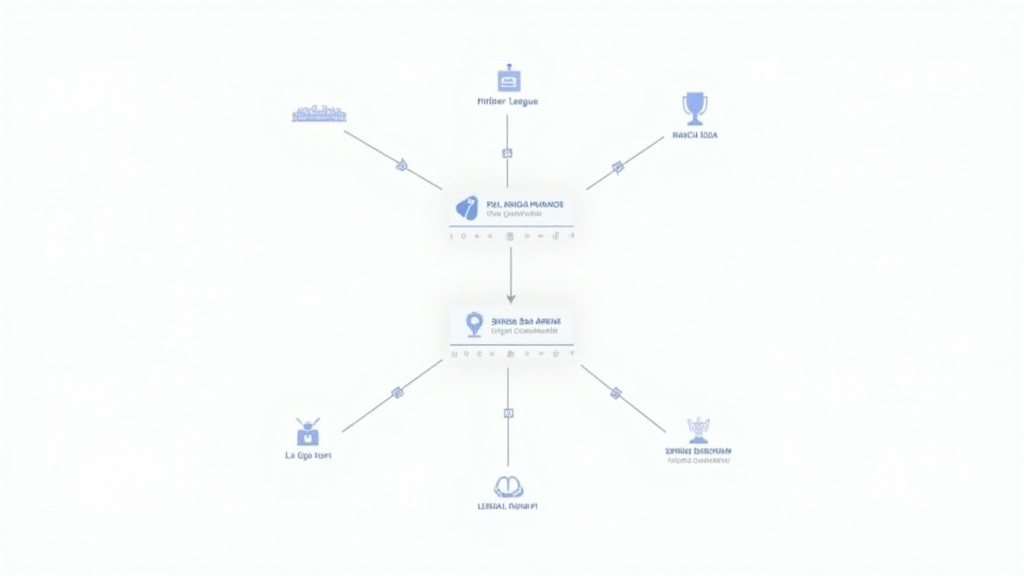
Every league has a personality. La Liga’s is defined by technical football, financial prudence, and a two-club dynasty punctuated by the rise of Atlético Madrid. The structure, however, shares a common European blueprint with key differences.
- vs. Premier League: Both have 20 teams and promote three/relegate three. The financial gap is the story. The Premier League’s global TV deal and parachute payments create a financial superleague. A relegated English club is wealthier than most La Liga mid-table sides. The Premier League promotion path is also purely sporting, without the same centralized financial oversight.
- vs. Serie A: Italy’s top flight, Italy’s Serie A, also uses head-to-head as a primary tie-breaker. Their Serie A season structure is identical in length. The difference is historical dominance. Juventus’s streak was broken by a multi-club scramble, unlike the Madrid-Barcelona axis.
- vs. Bundesliga: Germany has 18 teams, not 20. Relegation sends two teams down automatically, with a playoff for the 16th spot, a different kind of drama than La Liga’s three-auto-down rule. The 50+1 ownership rule makes its club culture fundamentally different.
- vs. Ligue 1: The French Ligue 1 has been dominated by PSG’s state-backed project in a way no single club has dominated Spain. The league structures are similar, but the competitive balance and financial power sources are worlds apart.
The common thread is the open system of promotion and relegation, a stark contrast to North American closed leagues. You can trace the entire philosophy from the Wikipedia entry on La Liga to the Liga Nacional de Fútbol Profesional page that details its governance.
Frequently Asked Questions
What is the difference between La Liga and LALIGA?
La Liga is the name of the top-flight Spanish football competition itself. LALIGA is the official name of the governing body that organizes and commercializes the competition (Liga Nacional de Fútbol Profesional). Think of La Liga as the product and LALIGA as the company that produces it.
How does relegation work in La Liga?
The three teams that finish in 18th, 19th, and 20th place at the end of the 38-match season are automatically relegated to the Segunda División. There is no relegation playoff for a lifeline. This makes the fight to avoid 18th place incredibly intense. The financial and sporting consequences are immediate and severe.
Can a team qualify for the Champions League by winning the Europa League?
Yes, but it’s a separate path. Winning the UEFA Europa League grants an automatic berth in the following season’s UEFA Champions League group stage. This qualification is independent of a team’s finish in La Liga. For example, if Sevilla wins the Europa League but finishes 7th in La Liga, they still go to the Champions League.
Why do Real Madrid and Barcelona dominate La Liga?
Historical success, global brand revenue, and the structure of Spanish football culture have created a durable duopoly. While Atlético Madrid has broken through, and Valencia and Sevilla have challenged, the two giants’ financial power from their own TV deals (before centralization) and commercial empires built a long-term advantage. LALIGA’s current financial controls aim to bridge the gap, but the legacy advantage is immense.
What happens if teams are tied on points at the end of the season?
La Liga uses head-to-head results as the first tie-breaker, not overall goal difference. The league looks at the points each team took from their two direct matches. If that is equal, it then looks at the goal difference from those matches. Only if still tied does it proceed to overall goal difference, then total goals scored.
The Bottom Line
Understanding how La Liga works means looking past the 22 players on the pitch. It’s a 38-game marathon where head-to-head clashes carry extra weight. It’s a financial ecosystem with stricter rules than its rivals, engineered to prevent insolvency at the cost of raw spending power. The path to Europe is a puzzle where the Copa del Rey piece can change the picture. And the drop to the second division is a three-team freefall with no safety net.
The league’s identity is caught between its historic technical brilliance and a modern, global business model. It may not have the Premier League’s bottomless wealth, but its fight for sustainability and its unique sporting rules make it a compelling, complex competition. Follow the table, but remember the machinery behind it.
I come from the “soccer heart” of Germany, the Ruhrpott. I have played, trained and followed soccer all my life and am a big fan of FC Schalke 04. I also enjoy following international soccer extensively.