How Does the FA Cup Work? The -26 Format Explained
The FA Cup works as a 12-round knockout tournament organized by England’s Football Association, open to over 700 clubs from the Premier League down to amateur levels. It starts with six qualifying rounds in August, followed by six ‘Proper’ rounds where professional teams enter in stages. The winner qualifies for the UEFA Europa League.
Most guides explain the rounds but miss the financial earthquake that just hit the lower leagues. They’ll tell you about giant-killings but not why a tiny club’s dream payday just got a lot harder to find.
This guide walks through the current format, the controversial rule changes, and the real stakes, financial and romantic, for every club that enters.
Key Takeaways
- The FA Cup is the world’s oldest national football competition, first held in 1871-72, and operates on a pure knockout, single-elimination basis.
- Replays have been scrapped from the First Round Proper onwards as of the 2024-25 season. Drawn matches now go to extra time and penalties on the day, a change that significantly impacts lower-league finances.
- Entry is staggered: Non-league clubs start in August qualifying; League One and Two clubs enter in the First Round Proper; Championship and Premier League clubs enter in the Third Round Proper in January.
- All draws are completely random with no seeding, which is the mechanism that creates the possibility for famous ‘giant-killing’ upsets.
- The financial rewards increase dramatically each round, with the 2025-26 winners earning over £2 million, but for small clubs, a single televised match can be more transformative than the prize money.
The FA Cup Format: A 12-Round Knockout Journey
The competition is a straight knockout. Lose once, and you’re out. This simplicity creates its magic and its cruelty. The structure is a 12-round gauntlet, split into two phases: six qualifying rounds and six rounds labelled “Proper”.
The qualifying rounds, running from August to October, involve only clubs from the National League System, that’s levels 5 to 10 of the English football pyramid. Think of it as the tournament’s underground. Hundreds of semi-pro and amateur clubs battle here for just 32 spots in the First Round Proper. Winning a couple of qualifying matches is a massive achievement for these clubs, both in prestige and prize money.
The FA Challenge Cup’s first round proper historically begins in November, marking the entry of the 48 clubs from EFL League One and League Two. This phase transitions the competition from its grassroots qualifying foundation to its nationally televised profile.
The “Proper” rounds are where the country tunes in. The First and Second Rounds feature those qualifying survivors against the lower professional leagues. The big moment comes in early January with the Third Round Proper. This is when the 20 Premier League and 24 Championship clubs, the giants of the English game, enter the draw. The random draw means a non-league club that has fought through four qualifying rounds could be plucked out of the hat to host Manchester United. That possibility is the tournament’s heartbeat.
TL;DR: It’s a 12-round, lose-and-you’re-out tournament. Non-league clubs start in summer qualifying; the big Premier League clubs don’t join the party until the Third Round in January.
Understanding “Proper” Rounds and Entry Points
It’s easier to see the journey in a table. This shows where each tier of English football enters the fray.
| Round | Clubs Entering | Typical Month |
|---|---|---|
| Extra Prelim. Round | Levels 9-10 (Non-League) | August |
| Preliminary Round | Levels 8-9 (Non-League) | August |
| Qualifying Rounds (1-4) | Levels 5-8 (Non-League) | August-October |
| First Round Proper | 32 Qualifiers + EFL League One & League Two (48 clubs) | November |
| Second Round Proper | Winners from First Round | December |
| Third Round Proper | Premier League & Championship clubs enter | January |
| Fourth Round Proper | Winners from Third Round | January/February |
| Fifth Round Proper | Winners from Fourth Round | February/March |
| Quarter-Finals | Winners from Fifth Round | March |
| Semi-Finals | Winners from Quarter-Finals (played at Wembley) | April |
| Final | Winners from Semi-Finals (played at Wembley) | May |
The jump from the qualifying rounds to the First Round Proper is a chasm. For a club like FC United of Manchester or South Shields, making it to the First Round means a potential televised match against a League Two side, a significant cash injection, and a place in national football conversation. The gap between the Second and Third Round is even wider. It’s the difference between playing a League One side and possibly hosting Arsenal.
This staggered entry is why the FA Cup is unique among major English domestic cup competitions. The other, the EFL Cup, involves only the 92 professional clubs from the Premier League down to League Two. The FA Cup’s inclusivity is its defining feature.
The Draw, Fixtures, and the End of Replays
Three rules define the fixture list: random draws, no seeding, and, as of 2024, no replays after the qualifying rounds. This last change is the biggest shift in decades.
Every single tie is decided by a random draw. There is no seeding to protect the big clubs. When the balls are pulled for the Third Round, Manchester City has the same chance of drawing a non-league minnow away from home as they do of drawing Chelsea at Stamford Bridge. This absolute randomness is the engine of chaos. It’s also why you’ll never see a true “FA Cup fixture schedule” released at the start of the season, you only know the next opponent after the previous round is completed.
The drawn fixture is played at the home ground of the first club drawn out of the hat. The semi-finals and final are the only exceptions, always held at the neutral Wembley Stadium. Home advantage in the early rounds can be colossal for a smaller club. A packed, muddy non-league ground on a cold Tuesday night is a classic FA Cup leveller.
Common mistake: Assuming a draw means a lucrative replay. For all rounds from the First Round Proper onward, a draw after 90 minutes now leads directly to 30 minutes of extra time and then a penalty shootout. The replay payday is gone.
The abolition of replays from the First Round Proper onwards is a seismic change. For over a century, a draw meant the teams would do it all again a week or so later, usually at the other team’s stadium. This was a financial lifeline for smaller clubs. A draw against a Premier League giant meant a second payday, often with a share of television rights and a packed stadium.
The official reason from The FA and the Premier League is to ease fixture congestion, especially with expanded UEFA competitions. More matches can now be televised in unique slots, theoretically generating more broadcast revenue to be shared down the pyramid. The reality feels different in boardrooms from League Two down. The chance of that transformative replay payday, however slim, has been removed. In the past decade, there have only been 12 replays where a lower-league club hosted a Premier League side, and none since 2020. But hope is a powerful currency in football. That hope has been legislated away.
This change makes the tournament more like a European two-legged tie in its decisiveness, but condensed into one match. There’s no second chance to set the aggregate score. It’s do or die, on the day.
Prize Money and Why It Matters

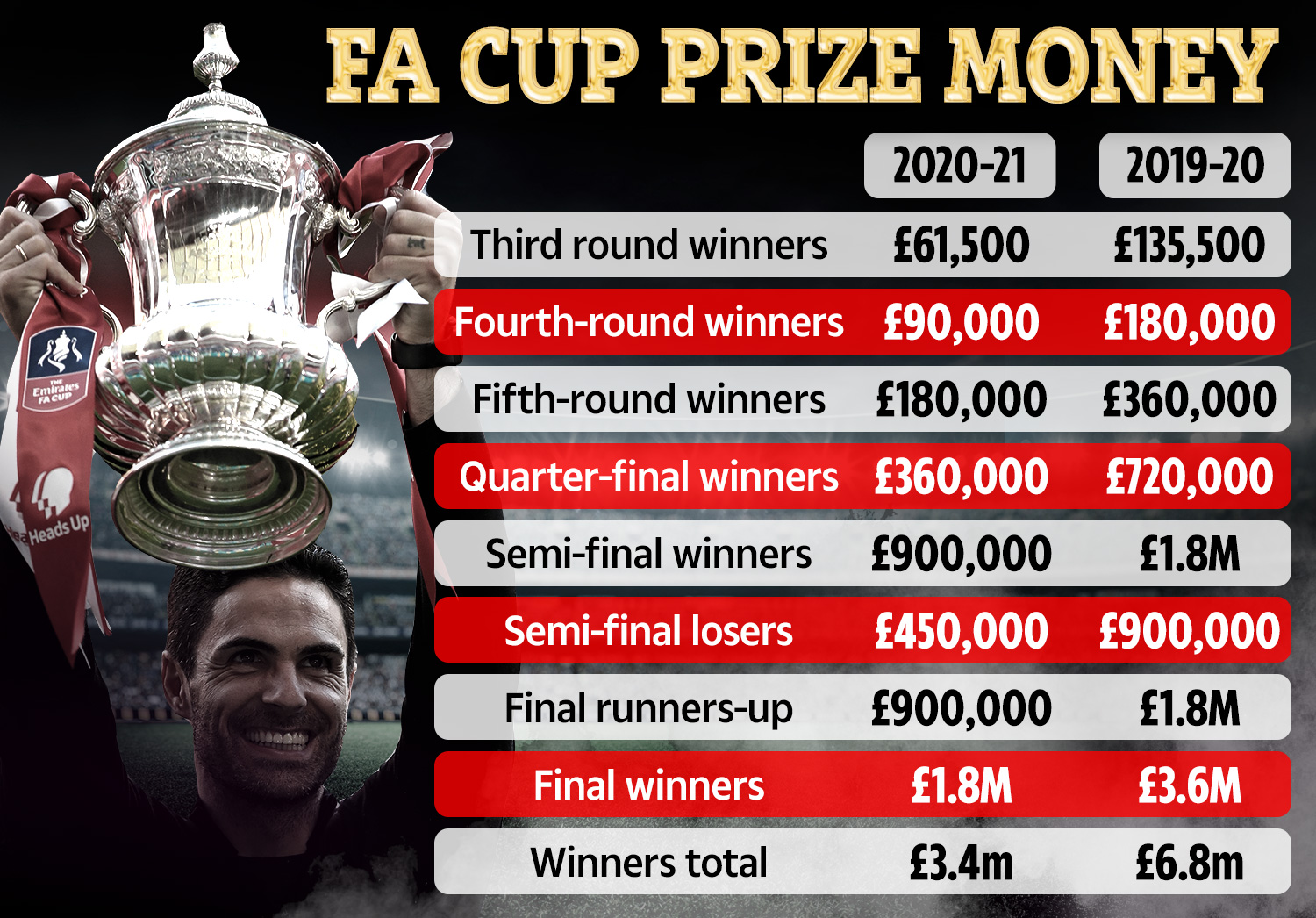
The FA Cup prize fund is a ladder. Each club receives a set sum for winning a round, with the amounts escalating sharply as you progress. The 2025-26 figures from The FA’s official fund show this gradient clearly.
For a non-league club winning in the First Qualifying Round, the prize is £2,250. That might cover a month’s wages for a part-time player. Win in the First Round Proper, and it’s £47,750. That can fund an entire season’s operating costs for some clubs. The sums become astronomical at the top: the 2025-26 champion receives £2,120,000, with the runner-up getting £1,060,000.
| Round Reached (and won) | Prize Money (2025-26) |
|---|---|
| First Round Proper Winner | £47,750 |
| Second Round Proper Winner | £67,500 |
| Third Round Proper Winner | £105,000 |
| Fourth Round Proper Winner | £120,000 |
| Fifth Round Proper Winner | £225,000 |
| Quarter-Final Winner | £450,000 |
| Semi-Final Winner | £1,000,000 |
| FA Cup Runner-Up | £1,060,000 |
| FA Cup Champion | £2,120,000 |
But the published prize money is only part of the story. For clubs below the Championship, gate receipts and broadcast fees are often more significant. A League Two club drawn at home against a Premier League team in the Third Round will sell out its stadium, with the revenue shared 45% to each club and 10% to The FA. If the match is chosen for live television by TNT Sports or the BBC, which is highly likely for such a tie, each club receives a flat fee of around £85,000.
This is where the replay removal hits hardest. Before, a draw in that dream tie meant a second sell-out and a second broadcast fee. Now, it means 30 minutes of extra time and the lottery of penalties. The financial safety net is gone. The pressure to win in 90 minutes is immense, mirroring the high-stakes tension of a promotion to the Premier League playoff final.
For a club facing relegation from the top flight, the FA Cup prize money is a nice bonus. For a National League North club, it’s existential. This financial disparity is the backdrop to every giant-killing story.
What Makes the FA Cup Special? Giant-Killings and History
The magic phrase is “giant-killing.” It’s when a club from a lower division defeats a far more prestigious, wealthier opponent. The random draw and one-off match format make this possible. A Premier League team can’t have an off day. The smaller team only needs one perfect performance.
History is full of examples. Sutton United of the Conference (non-league) beating Coventry City (then in the First Division) in 1989. Wrexham, a non-league club, beating Arsenal at home in 1992. More recently, Lincoln City reaching the Quarter-Finals in 2017 as a National League club. These aren’t flukes; they are systemically enabled by the tournament’s design. The smaller team gets to play on a usually ramshackle home pitch, in front of a frenzied crowd, against millionaires who might not fancy it. The conditions are perfect for an upset.
The tournament’s history adds weight. First played in 1871-72, it’s the oldest national football competition in the world. The famous trophy, the FA Cup, is an instantly recognizable icon. Winning it confers a unique prestige, often seen as more romantic than winning the Premier League. It’s a day out at Wembley, a history book entry. For the bigger clubs, it’s a route back into European football, with the winner qualifying for the UEFA Europa League group stage.
This history also includes moments of remarkable sportsmanship, like the 1999 incident between Arsenal and Sheffield United mentioned in the research, where a rematch was offered after a controversial goal. That ethos feels from a different age compared to today’s financial calculations.
The competition also serves as a rare common thread between the elite global league structures and England’s unique pyramid. Most countries don’t have a cup that includes truly amateur teams. The FA Cup does, and that connection is its soul.
Rules and Logistics: VAR, Eligibility, and Broadcasting
The practicalities of running the tournament are complex. Key rules often get glossed over.
Video Assistant Referee (VAR) is only used in matches played at Premier League stadiums. So if a non-league club hosts a Premier League team at their own small ground, there is no VAR. If the same tie is moved to the Premier League team’s stadium for safety or capacity reasons, VAR will be in operation. This creates an uneven technological playing field within the same round.
Player eligibility has a crucial deadline. Players must be registered with their club by 12:00 noon on the Friday before the Third Round Proper to be eligible to play in that round. This stops big clubs from hastily registering new signings specifically for a cup tie. Loan players are also eligible to play against their parent club in the FA Cup, which is not always the case in league matches.
Broadcasting in the UK is split between TNT Sports (which holds the primary live rights) and the BBC (which shows a selection of live matches and highlights). The BBC’s involvement, particularly its Saturday evening highlights show “Match of the Day,” is crucial for the tournament’s cultural reach. It brings the giant-killings and the drama into living rooms.
The winner’s reward, aside from the trophy and the money, is that place in the following season’s UEFA Europa League. If the winner has already qualified for the Champions League via their league position, the Europa League spot passes to the next highest-placed Premier League team who hasn’t already qualified for Europe. This rule ensures the European place is almost always used.
Frequently Asked Questions
What’s the difference between the FA Cup and the EFL Cup (Carabao Cup)?
The FA Cup is older, includes hundreds of non-league clubs (over 700 total), and offers a Europa League spot. The EFL Cup involves only the 92 professional clubs in the Premier League and EFL, and offers a UEFA Conference League spot. The formats are both knockout, but the FA Cup’s inclusivity and history give it a different stature.
Do FA Cup matches ever go to a replay?
As of the 2024-25 season, replays only happen in the qualifying rounds (before the First Round Proper). From the First Round Proper through to the final, all drawn matches go to extra time and then a penalty shootout on the same day.
How does a small club get into the FA Cup?
club must be in Level 9 of the English football league system or higher and be affiliated with their county Football Association. They enter the competition in the Extra Preliminary or Preliminary Rounds in August, depending on their league status from the previous season. They must then win through multiple qualifying rounds to reach the First Round Proper.
Why was the away goals rule never used in the FA Cup?
The away goals rule was a tiebreaker for two-legged ties in European competitions. The FA Cup has always been a series of one-off matches, so the rule was never applicable. The recent abolition of away goals in UEFA competitions doesn’t affect the FA Cup format.
Can a non-league team win the FA Cup?
In theory, yes. In practice, it’s virtually impossible in the modern era. The last time a club from outside the top division won was West Ham United (then in the Second Division) in 1980. A non-league team has never won the FA Cup in its modern format. The deepest run by a non-league team in recent history was Lincoln City’s quarter-final appearance in 2017.
What happens to the FA Cup winner?
They lift the trophy at Wembley, qualify for the following season’s UEFA Europa League group stage, and their name is engraved on football history. They also receive the winner’s share of the multi-million-pound prize fund.
The Bottom Line
The FA Cup works because it is brilliantly, ruthlessly simple: win or go home. That formula has produced over 150 years of drama, financing grassroots football and creating legends. The current format, with its controversial removal of replays, prioritizes the calendar of the elite but risks straining the tournament’s lifeblood, the dreams of its smallest entrants.
Understanding it means seeing both the glossy Wembley final and the muddy qualifying round pitch in August. It’s a competition where financial survival and sporting romance exist in constant tension. Follow the draws from August onwards. That’s where the real story starts, long before the Premier League clubs even begin to care.

I come from the “soccer heart” of Germany, the Ruhrpott. I have played, trained and followed soccer all my life and am a big fan of FC Schalke 04. I also enjoy following international soccer extensively.