A Complete Beginner’s Guide to How Soccer Works and Gameplay
Soccer works by having two teams of 11 players compete to score more goals than their opponent within 90 minutes of play. The core rules forbid using hands, enforce an offside line to prevent goal-hanging, and use a system of free kicks, penalty kicks, and cards to manage fouls and misconduct. The team with the most goals when time expires wins.
Most guides for beginners bury the one thing that actually matters first: how time works. They’ll explain offside for three paragraphs but skip the fact the clock never stops. You watch your first match, see the referee hold up a board with “4” on it, and have no idea why the game isn’t over at 90:00. That single confusion makes everything else feel alien.
This guide starts with the clock, the field, and the absolute non-negotiables. You’ll learn what the players are trying to do, what they’re allowed to do, and how the referee enforces it all. By the end, you’ll not only follow the action but also understand why a coach is screaming about a throw-in deep in the opponent’s half.
Key Takeaways
- A full soccer match lasts 90 minutes of running time, split into two 45-minute halves, with added stoppage time for injuries and delays.
- The offside rule exists to stop attackers from camping near the opponent’s goal; a player is offside if they are beyond the second-last defender when the pass is made.
- Only the goalkeeper can legally use their hands, and only within their own penalty area. Any other handball results in a free kick or penalty.
- Play restarts with specific set-pieces: throw-ins for sidelines, goal kicks or corner kicks for goal lines, and free kicks for fouls.
- The referee controls the game with a whistle, yellow cards for warnings, and red cards for ejections, with the Video Assistant Referee (VAR) used in top leagues to review critical decisions.
The Absolute Basics: Objective, Players, and Time
Forget formations and tactics for now. The foundation is three numbers: 11, 90, and 1.
Each team fields 11 players at a time, one of whom is the designated goalkeeper. A match cannot continue if a team has fewer than seven players on the pitch. The full squad size including substitutes is larger, but those are the active participants for any given moment.
The game’s total length is 90 minutes. This is divided into two 45-minute halves, with a 15-minute halftime break in between. Here’s the first major difference from American sports: the clock counts up and never stops. When the ball goes out or a player is injured, the referee mentally notes the delay. That lost time is added at the end of each half as stoppage time (or “injury time”). You’ll see the fourth official hold up an electronic board indicating how many added minutes will be played.
The International Football Association Board (IFAB) Laws of the Game state the duration of a match is two equal halves of 45 minutes, with allowance made for time lost in either half. The referee is the sole timekeeper.
The objective of soccer is simple: score more goals than the other team. A goal is scored when the entire ball crosses the goal line between the posts and beneath the crossbar. The entire ball must be over the entire line. Goal-line technology and VAR now check this millimeter-perfect in professional games, but the principle remains the same for a kickabout in the park.
TL;DR: Two teams of 11 play for 90 running minutes to score the most goals; the referee adds stoppage time for delays.
Understanding the Soccer Pitch
The game happens on a rectangular field called a pitch. While dimensions can vary, a standard pitch for international matches is between 110-120 yards long and 70-80 yards wide. The lines are part of the field, so if the ball is touching the line, it’s still in play.
You need to know five key areas. First, the goal itself: 8 yards wide and 8 feet high. Directly in front of it is the goal area (the six-yard box). This is where goal kicks are taken. The larger box extending 18 yards from the goal line is the penalty area. This is the goalkeeper’s domain, they can use their hands here, and any defensive foul inside this box results in a penalty kick.
The penalty mark (the spot) is 12 yards from the goal line, centered. The half-way line splits the pitch, and at its center is the center circle (10 yards in radius), used for kick-offs. Finally, at each corner is a corner arc, a one-yard quarter-circle where the ball is placed for a corner kick.
| Pitch Area | Key Purpose | Critical Rule |
|---|---|---|
| Goal Area (6-yd box) | Origin point for goal kicks. | The ball must be stationary and within the area for the kick. |
| Penalty Area (18-yd box) | Goalkeeper’s hand-use zone; foul location for penalty kicks. | A defender’s foul here concedes a penalty; the keeper can handle the ball here. |
| Center Circle | Teams assemble here for kick-offs to start each half and after a goal. | Opposing players must remain outside the circle until the ball is kicked. |
| Corner Arc | Placement zone for corner kicks. | The ball must be inside or touching the arc when the kick is taken. |
| Touchline & Goal Line | Define the boundary of play. | The whole ball must cross the whole line to be out of play or a goal. |
The Flow of Play and Key Rules

Play is continuous. The ball is live from the opening kick-off until the referee blows the whistle for halftime, a foul, a goal, or the end of the period. When the ball fully crosses a boundary line, play stops and restarts in one of four ways.
If it crosses the sideline (touchline), the game restarts with a throw-in. The team that did not touch it last gets to throw it back in. The thrower must have both feet on or behind the line, use both hands, and deliver the ball from behind and over their head. Get it wrong, and you hand possession right back.
If the ball crosses the goal line and was last touched by an attacker, the restart is a goal kick. The defending team places the ball anywhere within their six-yard box and kicks it back into play. If the ball was last touched by a defender, the restart is a corner kick for the attacking team, taken from the nearest corner arc.
Common mistake: Taking a throw-in with a running start or one hand, the referee will call a foul throw and award the throw to the other team every single time.
Inside the field, the two most critical rules govern the use of hands and player positioning. The handball rule is straightforward for field players: don’t touch the ball deliberately with your hand or arm (the boundary is the bottom of the armpit). It’s not always about intent; if your arm is in an unnatural position and the ball hits it, especially if it blocks a shot or pass, it’s usually called. The goalkeeper is the exception, but only within their own penalty area.
The offside rule exists to prevent attackers from gaining an unfair advantage by waiting near the opponent’s goal. A player is in an offside position if they are nearer to the opponent’s goal line than both the ball and the second-last defender (usually the last outfield player) at the moment the ball is played to them by a teammate.
Being in an offside position is not a foul. It only becomes an offense if the player becomes actively involved in play, by touching the ball, interfering with an opponent, or gaining an advantage from being in that position. No offside is called on throw-ins, goal kicks, or corner kicks.
I spent my first season as a youth coach diagramming offside on a chalkboard. The moment it clicked for the kids was during a drill where we froze play. The forward was level with the last defender, the midfielder played the pass, and the forward took one step too early. The assistant referee’s flag went up. That step, the timing of the run versus the timing of the pass, is the entire rule.
Players, Positions, and the Referee’s Role
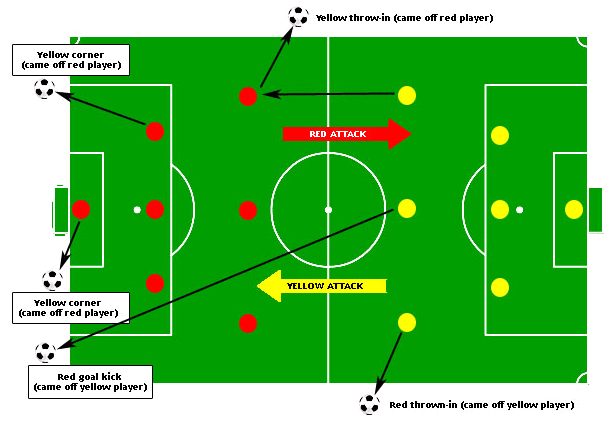
While all players on the field share the same basic rules, they have specialized roles. Traditionally, they are grouped into defenders, midfielders, and forwards (or attackers), with the goalkeeper as a unique position.
Defenders protect their goal. Midfielders link defense and attack, often covering the most ground. Forwards focus on scoring. However, modern soccer is fluid. In a common 4-4-2 formation, you’d see four defenders, four midfielders, and two forwards, but those midfielders will often sprint back to defend and push up to attack.
The referee is the ultimate authority on the pitch. They enforce the Laws of the Game, control the clock, and have the final say on all decisions. They are assisted by two assistant referees (linesmen) on the touchlines, who primarily signal offside and indicate which team gets throw-ins and corner kicks.
| Infraction | Typical Restart | Card Consequence |
|---|---|---|
| Minor Foul (e.g., tripping, pushing) | Direct or Indirect Free Kick | Possible Yellow Card |
| Handball (Non-Goalkeeper) | Direct Free Kick (Penalty if in own box) | Yellow if deliberate/denies chance |
| Reckless Challenge | Direct Free Kick | Yellow Card |
| Serious Foul Play / Violent Conduct | Direct Free Kick | Red Card (Ejection) |
| Denying Obvious Goal-Scoring Opportunity (DOGSO) | Direct Free Kick (Penalty if in box) | Red Card (Ejection) |
The referee’s tools are the whistle, the cards, and, in top-tier matches, the Video Assistant Referee (VAR). A yellow card is a caution for unsporting behavior, reckless challenges, persistent infringement, or delaying the restart. A red card means immediate dismissal from the game. The player cannot be replaced, so their team must play a person down for the remainder of the match. Two yellow cards to the same player also equal a red.
VAR is a remote official who reviews clear and obvious errors in four match-changing situations: goals, penalty decisions, direct red card incidents, and mistaken identity. They don’t re-referee the game but intervene for blatant mistakes. You’ll see the referee make a TV-screen gesture when a review is underway.
How a Match Progresses to a Winner
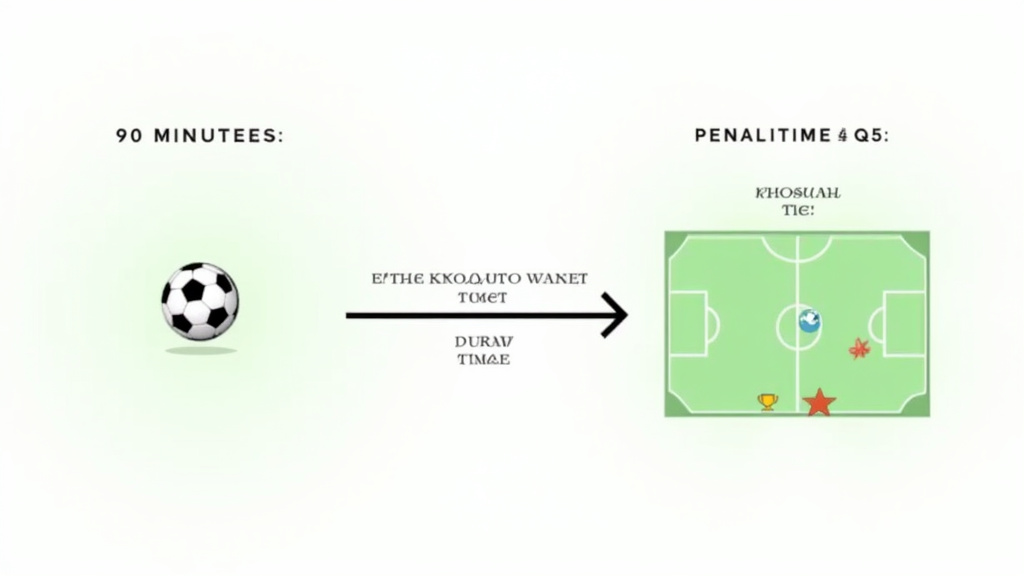
A standard league match can end in a win, loss, or draw. If the score is tied after 90 minutes plus stoppage time, the result is a draw, and each team gets one point in a league standings (three points for a win, zero for a loss).
Common mistake: Assuming every tied game goes to extra time, that only happens in knockout tournaments like the World Cup or domestic cups where a winner must be determined on the day.
In knockout competitions, a tie at the end of regulation forces extra time: two additional 15-minute periods. If the score remains tied, the match proceeds to a penalty kick shootout. Each team takes five alternating kicks from the penalty mark. The goalkeeper must stay on the goal line until the ball is kicked. The team with more successful kicks after five rounds wins. If still tied, it continues in sudden-death rounds.
The journey from kick-off to final whistle follows a clear rhythm:
1. Kick-off: Starts each half and follows every goal. The ball must move forward into the opponent’s half.
2. Open Play: Teams attack and defend, using passes, dribbles, and shots.
3. Stoppage: The referee halts play for a foul, out-of-bounds ball, injury, or goal.
4. Restart: Play resumes via the appropriate method (throw-in, free kick, etc.).
5. Halftime/Full-time: The referee ends the period. Stoppage time is played at the end of each 45-minute half.
Substitutions allow fresh legs. Currently, teams are allowed up to five substitutions per match, which must be made within a maximum of three substitution windows (halftime substitutions don’t count toward this window limit). A substituted player cannot return to the field.
Frequently Asked Questions
What’s the difference between a direct and indirect free kick?
direct free kick means you can score directly from the kick. These are awarded for most fouls (kicking, tripping, pushing, handball, etc.). An indirect free kick requires the ball to touch another player before a goal can be scored. These are given for less serious offenses, like dangerous play or obstruction. The referee will signal an indirect free kick by holding one arm straight up in the air until the ball touches a second player.
Can the goalkeeper score a goal?
Yes, but it’s rare. A goalkeeper can score from a goal kick or by kicking the ball from their hands, but it must go the full length of the pitch and into the opponent’s net without another player touching it. They cannot score by throwing the ball directly into the opponent’s goal.
Why do players swap jerseys at the end of the game?
It’s a traditional sign of sportsmanship and respect between opponents. Players will often exchange jerseys with a direct marker or a particularly respected rival. It’s not mandatory, just a long-standing custom.
What happens if a player gets injured and their team has used all substitutions?
The team must play with fewer players. There is no exception for injury after all substitutions are used. This is why managers are strategic about when to make their changes.
Is the ball out of play if it bounces on the line?
No. For the ball to be out of play, the entire ball must cross the entire line, whether it’s on the ground or in the air. If any part of the ball is over the line, it is still in play. This is why assistant referees watch the ball’s curvature, not its shadow.
What is “advantage” in soccer?
If a foul occurs but the fouled team retains a promising attacking opportunity, the referee can choose not to blow the whistle immediately. They will call out “play on!” or raise both arms forward. This allows the attack to continue. If the advantage doesn’t materialize within a few seconds, the referee will blow the whistle and bring play back for the original foul.
Before You Go
Soccer’s beauty is in its simplicity and universal language. You now know the clock runs, the offside rule stops cherry-picking, and only the keeper can use hands. You can identify a corner kick setup and understand why a defender’s foul in the box leads to a penalty.
Watch a match with these basics in mind. Focus on how play restarts after the ball goes out. Notice where the assistant referee’s flag goes for offside. Listen for the referee’s whistle for a foul and watch their signal. The game will start to make structural sense. The drama, the skill, and the passion, that comes next. Just find a game and watch. The rest will follow.
I come from the “soccer heart” of Germany, the Ruhrpott. I have played, trained and followed soccer all my life and am a big fan of FC Schalke 04. I also enjoy following international soccer extensively.