How Soccer Was Invented: A Brief History
This post contains affiliate links. As an Amazon Associate, we earn from qualifying purchases.
When you kick a soccer ball today, you’re participating in a tradition stretching back millennia—not a single moment of invention but a fascinating evolution that transformed simple kicking games into the world’s most popular sport. Understanding how soccer was invented reveals humanity’s enduring connection to organized play, with 265 million registered players now spanning 209 countries. This journey from chaotic village battles to precision-engineered World Cup matches shows how cultures worldwide contributed to creating the beautiful game we know today.
The story of how soccer was invented isn’t about one genius inventor but centuries of incremental innovation across continents. Ancient Chinese soldiers kicked feather-filled leather balls for military training, medieval English villagers battled across parish boundaries with pig bladder balls, and Victorian university students finally codified the rules we recognize today. Each civilization added crucial elements that shaped modern soccer, transforming a primal human impulse to kick objects toward targets into a globally standardized sport.
Chinese Military Training That Started It All

Cuju: Soccer’s Earliest Recognizable Ancestor
Chinese soldiers practicing Cuju during the Han Dynasty (2nd-3rd century BC) created soccer’s first codified kicking game. Military commanders developed this “kick ball” activity using leather spheres filled with feathers and hair, with players forbidden from using hands to propel balls through bamboo net goals. Archaeological evidence reveals remarkably standardized balls measuring 30-40 cm in diameter—proof of sophisticated manufacturing techniques millennia before modern soccer.
Imperial courts quickly adopted Cuju for entertainment, with players mastering precise footwork and ball control that established techniques still fundamental to today’s game. This ancient Chinese practice demonstrates how soccer’s core concept—kicking a ball toward a target—emerged independently across civilizations as humans naturally gravitated toward organized kicking games.
Why Cuju Matters for Modern Soccer History
Cuju’s significance in understanding how soccer was invented lies in its standardized rules and equipment. Unlike earlier informal kicking games, Cuju had defined objectives, consistent ball specifications, and structured gameplay that directly influenced later developments. When you watch Lionel Messi weave through defenders today, you’re witnessing skills that trace their lineage back to Chinese soldiers perfecting ball control on ancient training grounds.
Medieval Chaos Before Codification
Village vs. Village Battles Across Europe
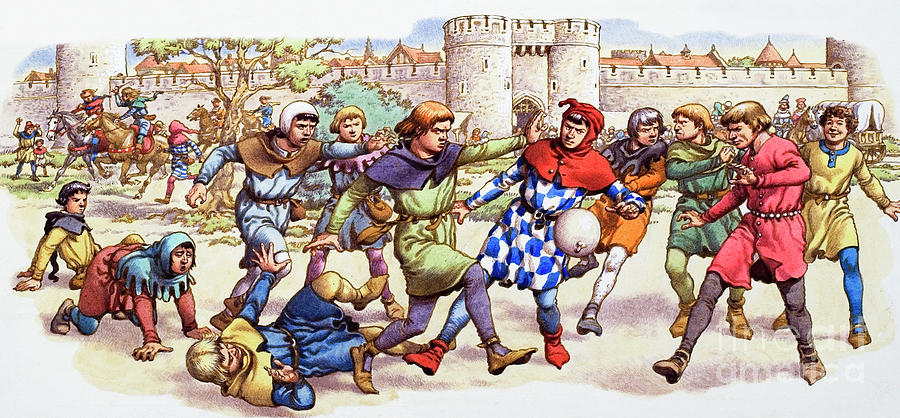
Medieval European folk football (800-1600 CE) bears almost no resemblance to modern soccer but represents a critical evolutionary stage in how soccer was invented. Entire villages participated in matches spanning miles between parish boundaries, with unlimited team sizes and minimal rules beyond prohibiting murder. Games could last entire festival days, using balls made from inflated pig bladders or leather-stuffed rags that bounced unpredictably.
Regional variations like England’s Shrovetide football in Ashbourne, Scotland’s Ba game in Kirkwall, and France’s La Soule in Brittany all shared common elements: massive playing fields, community-wide participation, and minimal restrictions. These chaotic contests served as social pressure valves while reinforcing community identities—proving that humans across cultures shared an innate desire to kick objects toward goals.
How Medieval Mayhem Shaped Modern Rules
The transition from chaotic folk games to standardized soccer required centuries of refinement. Local authorities gradually imposed limits on match duration and established safer boundaries, while the concept of goals naturally evolved from parish boundary markers. When you follow modern soccer’s precise offside rules, remember they emerged from communities recognizing the need for standardized regulations to prevent injuries and disputes during these violent medieval contests.
The Cambridge Rules That Changed Everything

University Students Create Soccer’s First Codification
Cambridge University students in 1848 established soccer’s first systematic rules, marking a pivotal moment in how soccer was invented. The Cambridge Rules transformed chaotic folk games into recognizable soccer by:
– Limiting teams to maximum 20 players
– Prohibiting carrying the ball (separating from rugby)
– Introducing throw-ins for out-of-bounds balls
– Standardizing goal dimensions at 8 feet high by 8 yards wide
Students from different schools reconciled their varying house rules, creating a consistent framework for inter-school competitions. This critical codification step transformed soccer from a collection of regional games into a standardized sport with universal principles that could spread globally.
Freemason’s Tavern: Where Soccer Was Officially Born
The definitive moment in understanding how soccer was invented occurred on October 26, 1863, at London’s Freemason’s Tavern. Ebenezer Cobb Morley from Barnes Club drafted the original 13 laws that created modern soccer by:
– Completing the split from rugby football (prohibiting handling entirely)
– Standardizing ball circumference at 27-28 inches
– Establishing 11-player teams
– Defining soccer as the “dribbling game” versus rugby’s “handling game”
This meeting created the Football Association, establishing soccer as a distinct sport with codified rules. When you watch today’s Premier League matches, you’re seeing the direct descendant of these 1863 laws that finally answered the question of how soccer was invented.
Global Standardization and Professionalization
IFAB Ensures Worldwide Consistency
The International Football Association Board (IFAB), formed in 1886 by England, Scotland, Wales, and Ireland, prevented rule fragmentation as soccer spread internationally. This British-led initiative maintained uniform laws globally through quarterly meetings that continue refining soccer’s 17 fundamental laws—from ball specifications to VAR implementation.
Without IFAB’s oversight, how soccer was invented might have resulted in dozens of incompatible regional variants instead of one globally recognized sport. The organization’s persistence ensured that a child in Brazil plays by the same basic rules as a player in Japan, creating soccer’s universal language.
FIFA Launches Soccer’s Global Expansion
FIFA (Fédération Internationale Football Association) established itself in 1904 with seven founding nations, accelerating soccer’s transformation from a British pastime to a worldwide phenomenon. Initial purposes included overseeing international competitions and standardizing rules across continents—a mission that expanded as FIFA grew from seven to 209 member associations by 2024.
The English Football League’s 1888 launch with 12 founding clubs like Aston Villa and Blackburn Rovers created soccer’s professional framework, introducing standardized scheduling, player contracts, and commercial revenue models that became the global template.
Women’s Soccer Overcomes Systemic Exclusion
50-Year Ban That Delayed Women’s Soccer History
Women’s soccer faced systematic suppression that nearly derailed its development in how soccer was invented. The Dick, Kerr Ladies FC drew 53,000 spectators in 1920—prompting the English FA to ban women’s soccer until 1971. This 50-year setback delayed the women’s game but couldn’t extinguish demand, as proven by the 1999 US Women’s World Cup final attracting 90,185 fans—a record that still stands for women’s sports attendance.
FIFA’s 2023 commitment of $1 billion to women’s soccer development signals genuine progress toward equality. Today’s 30 million registered female players worldwide prove soccer’s universal appeal transcends gender, completing the picture of how soccer was invented as a truly global sport for all.
Why Soccer’s Evolution Matters Today
The Cultural Impact of Soccer’s 4,000-Year Journey
Soccer’s cultural integration produces staggering statistics that reveal how soccer was invented as humanity’s shared passion:
– 265 million registered players worldwide
– 150,000+ youth academies globally
– 300,000+ professional clubs
– Camp Nou Stadium seating 99,354 fans
These numbers demonstrate soccer’s evolution from ancient military exercises to the world’s most popular sport. When you understand how soccer was invented through this lens, you appreciate why it captivates billions—answering humanity’s universal desire to kick objects toward goals in organized, meaningful ways.
The Future Built on Ancient Foundations
Soccer continues evolving through technology like VAR and data-driven tactics, but the basic joy remains unchanged since Chinese soldiers first kicked Cuju balls 2,000 years ago. The next time you watch a match, remember you’re witnessing 4,000 years of human innovation—from ancient rituals to billion-dollar spectacles. Understanding how soccer was invented isn’t just about historical curiosity; it reveals why this simple game of kicking a ball toward a target continues to unite humanity across cultures and centuries.
The complete history of how soccer was invented shows us that while rules, balls, and stadiums have changed dramatically, the fundamental human impulse to play organized kicking games remains constant—a testament to soccer’s enduring place in our collective experience.

I come from the “soccer heart” of Germany, the Ruhrpott. I have played, trained and followed soccer all my life and am a big fan of FC Schalke 04. I also enjoy following international soccer extensively.