Long Passing Technique in Soccer Explained: The 5 Key Passes
A long pass in soccer is a controlled, aerial strike to switch play or bypass defenders. The five key types are the driven pass, lofted pass, outside-curve, inside-curve, and the long through ball. Each uses specific foot contact and body shape to blend power and accuracy for distances over 40 yards.
To execute a long pass in soccer, you strike the ball with your instep (laces) while leaning your body back slightly, using a full follow-through for power and a controlled arc for accuracy. The plant foot points at the target, your ankle stays locked, and you connect with the middle-to-lower half of the ball. It’s not a kick. It’s a controlled strike that sends the ball 40 yards on a line.
Most players think a long pass is about how hard you can swing your leg. They wind up and boot it. The ball sails over the touchline, or worse, dies at the opponent’s feet. The real mistake is treating power and accuracy as separate things. They’re the same motion with two adjustments: where you plant your foot, and which part of the ball your laces hit.
This guide walks through the five passes that break lines, the non-negotiable mechanics behind them, and the drills that build the muscle memory to pick the right one under pressure.
Key Takeaways
- Strike the ball with the hard bone on top of your foot, just below the laces, not your toes. A toe-poke loses all control and spin.
- Your plant foot dictates everything. Place it 15cm beside the ball, toes aimed at your target. Too close and you hook it; too far and you slice it.
- There are five distinct long passes: the driven pass (low and fast), the lofted pass (over defenders), the through ball (into space), the diagonal (changing angles), and the crossfield (switching play). Each has a different foot strike.
- Power comes from your core and hip rotation, not your leg swing. A big follow-through adds speed, but an uncontrolled one sends the ball anywhere.
- Practice with your weaker foot twice as much. Game day always finds your weak side.
The Mechanics of a 40-Yard Pass
Head down. Ankle locked. Follow through.
The non-kicking foot (plant foot) must be placed approximately 15cm beside the ball, with the toes pointing directly at the intended target. This alignment ensures the hips open correctly and the striking foot follows through on the correct line, preventing the ball from veering left or right off the target.
Forget everything you think you know about kicking a ball far. The long pass is a full-body throw that starts at your standing leg. Get that wrong and nothing else matters.
Plant foot placement is non-negotiable. Fifteen centimeters beside the ball. Toes pointing exactly where you want the ball to go. If your plant foot is behind the ball, you’ll lean back too far and sky it. If it’s in front, you’ll lean forward and drive it into the ground. That 15cm spot is the pivot point. Your hips rotate around it, and your kicking leg swings through it.
Your striking surface is the instep, the hard, flat bone on the top of your foot, right below where your laces are. Not your toes. Not the inside of your foot. The instep gives you a large, flat surface to connect with the ball’s sweet spot. Lock your ankle, point your toes down like you’re trying to touch the ground with them, and keep that rigid shape from the moment your foot starts moving until after it’s followed through.
TL;DR: Place your plant foot 15cm beside the ball, toes on target, and strike through the ball’s center with a locked ankle and full follow-through.
Why Your Long Passes Fail (The 3 Fixes)
The ball balloons over the bar. It scuffs along the ground. It slices wildly to the right. These aren’t random errors. They’re diagnostics.
You’re looking at the target, not the ball. Your head comes up a split second before contact. Your foot adjusts subconsciously, and the connection point shifts by a centimeter. On a 40-yard pass, that centimeter at your foot becomes three yards of error at the receiving player. Keep your eyes on the ball until your follow-through is complete. The target isn’t moving.
You’re swinging from the knee. Power in a long pass comes from hip rotation and core engagement, not how fast you swing your lower leg. Think of your body as a whip, your torso is the handle, your leg is the cracker. If you only move from the knee down, you get a weak, slappy contact. Rotate your hips through the strike. That’s where the distance comes from.
Your follow-through is short or across your body. A stunted follow-through kills power and accuracy. Your leg should swing smoothly through the ball and toward your target, not chop at it. If your follow-through swings across your body to the left (for a right-footed player), you’ve cut across the ball and imparted side-spin. That’s fine if you want a bending crossfield pass. It’s a disaster if you wanted a straight driven ball down the channel.
Common mistake: Striking with the toe to get more power, the ball rockets off at an unpredictable angle, often slicing out of play, and you’ll feel a sharp sting in your toes for the next ten minutes.
The 5 Types of Long Pass and When to Use Them
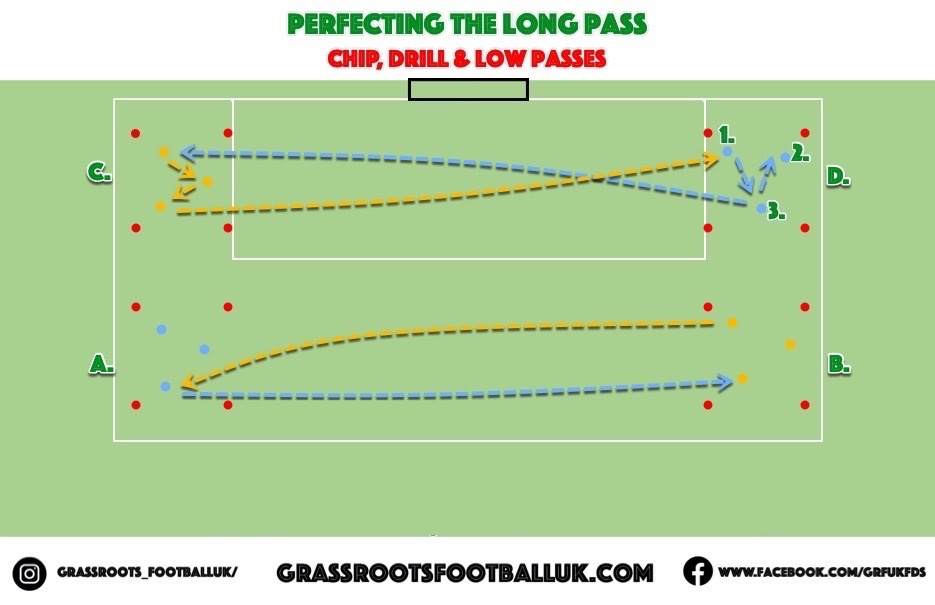
A 60-yard hoof upfield and a 25-yard through ball into the channel are both long passes. They are not the same technique.
| Pass Type | Best For | Foot Strike & Body Position |
|---|---|---|
| Driven Pass | Low, fast passes that stay on the ground; bypassing a crowded midfield. | Strike through the center of the ball. Lean slightly forward. Ankle locked, toes down. |
| Lofted Pass | Lifting the ball over a defender’s head or into a target area. | Get your foot under the ball. Lean back. Follow through upward. |
| Through Ball (Weighted Pass) | Playing a teammate into space behind the defensive line. | Strike the lower half with pace, but add enough lift to clear the first defender. Lean neutral. |
| Diagonal Ball | Switching the point of attack at a 45-degree angle. | Strike across the ball slightly with the inside of your instep. Body opens toward the target. |
| Crossfield Pass | Moving the ball from one flank to the other, covering maximum width. | Use the outside of your instep. Strike across the ball to generate bend (curl). |
The driven pass is your workhorse. You use it when you need to get the ball from point A to point B as quickly as possible, preferably on the ground. Think of a central defender finding a midfielder between the lines. You strike through the center of the ball, leaning your body forward a touch. This keeps the trajectory low. If you want the ball to stop dead for your teammate, you can cut slightly under the ball to generate backspin. That backspin makes the ball grip the turf on the first bounce.
The lofted pass is your escape valve. A high press is smothering you, and the only outlet is the space behind their fullback. You don’t have the time or angle for a driven pass. You get your foot well under the ball, lean back, and follow through upward. The ball climbs quickly and drops steeply. The risk is hang time, it gives defenders time to adjust.
The through ball, or weighted pass, is the killer. It’s not about pure distance; it’s about weight and timing. You’re striking the lower half of the ball with enough pace to reach the space before the defender, but with enough lift to skip over the first pressing player. It’s the most feel-based pass on the list. Get it right, and you’ve broken the entire defensive structure.
Diagonal and crossfield passes are about changing the angle of attack. The diagonal uses the inside of your instep to slice across the ball, sending it on a straight but angled line. The crossfield uses the outside of your instep to wrap around the ball, creating a bending flight path that can arc around defenders. Both require you to open your body toward the target, which feels unnatural at first. Your plant foot points where you want the ball to start, but your hips and shoulders rotate to face where you want it to finish.
I spent a season trying to hit crossfield passes with the inside of my foot, like a giant sweep. The ball always drifted, dying at the opponent’s feet. A coach finally stopped me: “You’re a right-footer on the right side. Use the outside of your boot, wrap your foot around it.” The next ten attempts were ugly. The eleventh landed on my winger’s chest without him breaking stride. The muscle memory is different.
TL;DR: Match the pass type to the tactical need: driven for speed, lofted for height, through ball for space, diagonal for angle, crossfield for width.
Receiving a Long Pass: The Forgotten Half of the Equation

A perfect 50-yard pass is worthless if the receiver miscontrols it. The first touch decides the play.
For a driven pass arriving on the ground, cushion it. Don’t stop it dead. Use the inside of your foot or your chest to redirect the ball’s momentum into the space you want to move into. If the pass has backspin, it will sit up, be ready to take it on the half-volley if a defender is closing.
For a lofted pass dropping from the sky, judge the flight early. Get your body between the ball and the nearest opponent. Use your thigh, chest, or foot to kill the pace and drop it at your feet. The worst thing you can do is let it bounce. A bouncing ball is unpredictable, and you lose a half-second.
Common mistake: Trying to control a high, dropping ball with the top of your foot, it skids off and rolls to an opponent 90 percent of the time, killing the attacking move you just spent 10 seconds building.
A through ball is about timing your run, not just receiving it. You’re often sprinting onto it. Don’t try to control it fully. Your first touch should be a directional one, pushing the ball ahead into the space behind the defender. It’s a continuation of your momentum.
This is where understanding your team’s soccer tactics guide is crucial. If the system calls for quick transitions, your first touch must be forward and into space. If the plan is to recycle possession, you might cushion it and shield.
The 7-Step Progression for Power and Accuracy
You don’t learn to hit a 40-yard pass by standing 40 yards away and whiffing. You build it in layers.
- Wall Passes (5 yards). Find a solid wall. Pass the ball firmly against it, focusing on clean contact with your instep. Catch the rebound and repeat. Do 50 with your strong foot, then 100 with your weak foot. This isn’t about power. It’s about repetition and consistent contact point.
- Static Target (15 yards). Place a cone or a backpack 15 yards away. Hit it ten times in a row with your strong foot. Move it to 20 yards. Hit it ten times. Now switch to your weak foot and start again at 15 yards. The goal is ten consecutive hits.
- The Follow-Through Arc. Without a ball, practice the full striking motion. Plant foot at 15cm, swing through, and hold your follow-through position. Do twenty reps. Your muscle memory needs to know where your leg should finish.
- Lofted Pass Drill. Place a target (a cone, a bin) 25 yards away. Practice lofting the ball so it lands inside the target area. The challenge isn’t distance; it’s precision. Can you drop it in the bucket?
- Moving Target. Have a partner jog slowly across the field 30 yards away. Call for the ball and hit a driven pass ahead of them so they don’t break stride. This adds the element of timing and weight.
- Pressure Passing. Set up two gates 40 yards apart with a defender (or a passive cone) in the middle. You have three seconds to receive a pass, turn, and hit a long pass through the gate. The defender isn’t tackling, but their presence simulates game pressure.
- Crossfield Switch. Place two cones on opposite touchlines, 50 yards apart. Practice switching the ball from one cone to the other, using the outside of your foot to bend the pass. This is where a soccer rebounder is invaluable, you can practice alone, and the net returns the ball with varying pace.
Each step has a consequence if you skip it. Jump from static targets to pressure passing, and you’ll revert to just booting the ball under stress. You haven’t built the composure. Spend a month on this progression, twice a week, and your pass completion rate from deep areas will jump.
TL;DR: Start close with perfect technique, add distance, then add movement, then add pressure. Never move to the next step until you’ve mastered the current one ten times in a row.
Drills That Build Game Intelligence
Technique is useless without vision. You need to see the pass before it’s there.
Scanning Drill. Before you even receive the ball, you should know your options. During any passing drill, force yourself to look over your shoulder twice: once as the pass is coming to you, and once just before you receive it. This habit, drilled from the ActiveSG long passing technique guide, is what separates a reactive player from a proactive one. You’re not looking at things; you’re looking for space, for runners, for the opponent’s shape.
4v2 Rondo in a Large Grid. Play keep-away in a 20×20 yard grid with two defenders. The two outside players on each team must stay wide, forcing you to hit longer, driven passes across the grid to switch play. This drill ingrains the decision to go long when the short option is marked.
Long Ball Counter-Attack. Set up a small-sided game (5v5) on a half-pitch. One team defends deep, wins the ball, and has three passes to score. The rule? The scoring pass must travel at least 30 yards. This mimics the transition moments in a real match where a long pass is the only option to break a compact block, a common scenario in a 5-3-2 formation.
These drills train your brain and your feet together. The physical act of the pass becomes secondary. You’re thinking about weight, angle, and timing.
How to Train Your Weak Foot
Your weak foot isn’t weak. It’s untrained.
Double the reps. If you do fifty wall passes with your right foot, do one hundred with your left. The awkwardness is just unfamiliarity. Start with short, simple passes. Focus on the plant foot placement, it will feel wrong. That’s the point.
Use a soccer rebounder for weak-foot training. It never gets tired, and it returns the ball unpredictably, forcing you to adjust your stance and strike with your off-side. This builds adaptability.
Play small-sided games where you’re only allowed to use your weak foot. It’s frustrating and humbling. You’ll miss easy passes. Your shots will be pathetic. After four weeks, you won’t panic when the ball rolls to your left side in a game. You’ll have a plan.
The Mental Game: Seeing the Pass Before It Exists
The difference between a good long passer and a great one happens before the ball arrives.
You’re a central defender. You receive the ball under light pressure. Most players look for the safe, short pass to the fullback. The great ones have already scanned. They saw the opposing fullback push high three seconds ago. They saw their winger start a diagonal run. The space is there. The pass is on. They take one touch to set the ball, and the 50-yard diagonal is already in flight before the opponent’s midfield can shift.
This vision is trained. It starts with scanning, but it grows into pattern recognition. You learn the cues: a high defensive line means space in behind; a compact midfield means the wings are open; a tired opponent’s body shape turns slower. These are the principles you study in any comprehensive soccer tactics guide.
Confidence is the final layer. You must believe you can make the pass. If you hesitate, the window closes. This is why the repetitive drills matter. When your technique is automatic, your brain is free to make the decision. You see the pass, and your body executes it without a second thought. That’s when a long pass stops being a risky hail-mary and becomes a weapon.
Frequently Asked Questions
What’s the most common mistake beginners make with long passes?
They try to kick the ball too hard. Power comes from technique and body rotation, not leg strength. Swinging wildly sacrifices accuracy and often results in a toe-poke that sends the ball anywhere.
How do I get more power on my long passes without losing accuracy?
Focus on your plant foot placement and hip rotation. A solid base (plant foot 15cm beside the ball, pointed at the target) allows your core and hips to generate force efficiently. A full, controlled follow-through in the direction of your target channels that power accurately.
Should I use the inside or outside of my foot for a long pass?
For straight, driven passes, use the instep (the flat top of your foot). For bending passes, like a crossfield switch, use the outside of your instep to wrap around the ball. The inside of the foot is for shorter, more precise passes, not for maximum distance.
How can I practice long passes by myself?
rebounder net is the best tool. You can practice driven passes, lofted passes, and even bending passes against it, and it returns the ball with varying pace and spin. Alternatively, use a wall and mark targets at different heights and distances to simulate different pass types.
When is the wrong time to attempt a long pass?
When you’re under immediate pressure with no time to set your body. When all your attacking players are marked or static. When your team has just won possession and is disorganized, a misplaced long pass gives the ball right back. Look for the short, safe option first, then go long if the opportunity opens.
How does long passing fit into different formations like a 4-4-2 or 3-5-2?
In a flat 4-4-2 formation, long diagonal passes from fullbacks to wingers are key for switching play. In a 3-5-2 formation, the wing-backs provide width, and long, vertical passes from the center-backs or defensive midfielder can bypass a crowded midfield to find them. The system dictates which type of long pass you’ll use most.
Before You Go
A long pass isn’t a last resort. It’s a calculated risk that stretches the game and creates chances nothing else can. It starts with a scan, is built on a plant foot, and finishes with a follow-through. Practice the five types separately. Double your weak-foot reps. And remember, the best long pass is the one your teammate can control with their first touch. Power without purpose is just a clearance.
I come from the “soccer heart” of Germany, the Ruhrpott. I have played, trained and followed soccer all my life and am a big fan of FC Schalke 04. I also enjoy following international soccer extensively.