Soccer Field Dimensions in Feet and Meters
This post contains affiliate links. As an Amazon Associate, we earn from qualifying purchases.
You’re standing on a patch of grass, measuring tape in hand, trying to mark a soccer field for your child’s upcoming tournament. The coach says the field needs to be “regulation size,” but when you search online, you find conflicting measurements—some in yards, others in meters, and conversion tools giving you slightly different results. This confusion happens daily to groundskeepers, coaches, and parents who need precise soccer field dimensions in feet and meters to avoid costly rework and ensure fair play.
Knowing exact conversion between measurement systems prevents wasted time and materials while guaranteeing compliance with league regulations. Whether you’re preparing a U8 practice field or planning a high school stadium renovation, this guide delivers the specific dimensions you need with accurate feet-to-meters conversions for every scenario.
FIFA’s Exact Soccer Field Dimensions in Feet and Meters
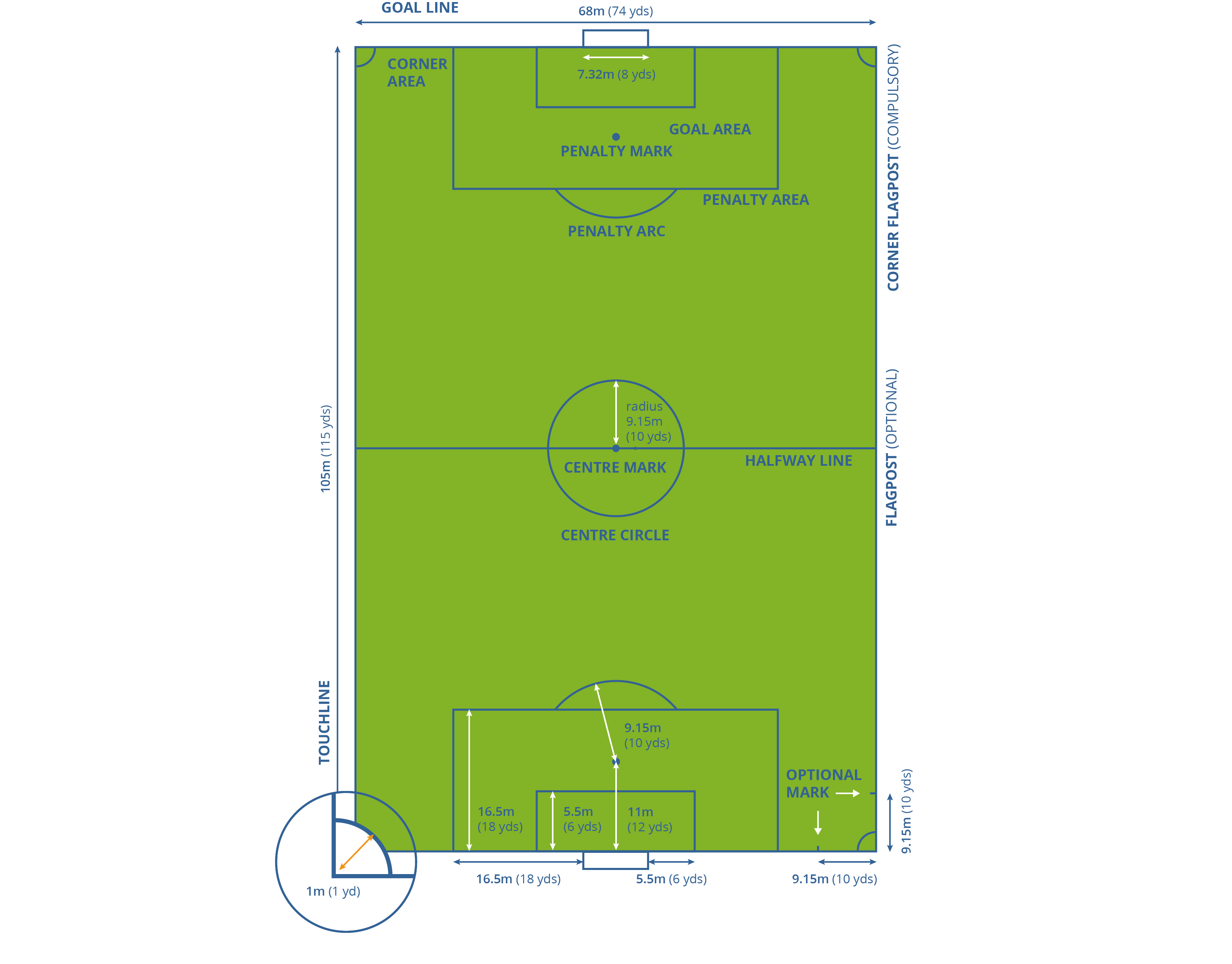
The international standard for professional soccer fields centers on specific measurements that balance competitive fairness with player safety. While FIFA regulations provide minimum and maximum ranges, most elite competitions worldwide have converged on identical dimensions for consistency.
Why 105m × 68m Became the Global Standard
The precise 105 meters × 68 meters configuration (344.49 feet × 222.97 feet) has become the universal benchmark for international competitions. Every World Cup stadium since 2002 uses these exact measurements, creating familiarity for players regardless of venue. This standard ensures consistent tactical approaches across tournaments while accommodating broadcast requirements for accurate graphics and analysis.
Minimum and Maximum Allowable Dimensions for International Play
FIFA permits some flexibility for international matches with minimum dimensions of 100 yards (300 feet/91.44 meters) in length and 50 yards (150 feet/45.72 meters) in width. The maximum allowable size reaches 130 yards (390 feet/118.87 meters) long and 100 yards (300 feet/91.44 meters) wide. However, top-tier competitions almost always use the standard 105m × 68m dimensions for competitive consistency.
Youth Soccer Field Measurements: Feet to Meters by Age Group

Youth soccer requires progressive field sizing that matches children’s physical development and skill levels. Each age group needs specific dimensions to maintain appropriate player density while encouraging proper technical development.
U6-U8 Fields: 75-105 Feet (22.86-32m) Length Guidelines
For the youngest players, fields should measure 25-35 yards (75-105 feet) in length, equivalent to 22.86-32.0 meters. Width ranges from 15-25 yards (45-75 feet/13.72-22.86 meters). These compact dimensions increase ball touches per player, building fundamental skills without overwhelming young athletes with excessive running distances.
U9-U10 Transition Fields: 165-195 Feet (50.29-59.44m) Dimensions
As children develop endurance, fields expand to 55-65 yards (165-195 feet/50.29-59.44 meters) in length and 35-45 yards (105-135 feet/32.0-41.15 meters) in width. This transition supports the move from 5v5 to 7v7 formats, introducing basic tactical concepts while maintaining manageable passing distances for developing players.
U11-U12 Near-Regulation: 210-240 Feet (64-73.15m) Requirements
Fields for this age group measure 70-80 yards (210-240 feet/64.0-73.15 meters) long and 45-55 yards (135-165 feet/41.15-50.29 meters) wide. These dimensions represent approximately 70% of a full-size field, preparing players for 11v11 competition while still emphasizing skill development over results.
U13-U14 Full Transition: 300-330 Feet (91.44-100.58m) Specifications
By early adolescence, players need fields measuring 100-110 yards (300-330 feet/91.44-100.58 meters) in length and 55-65 yards (165-195 feet/50.29-59.44 meters) in width. These near-regulation dimensions build the stamina and tactical understanding required for high school competition while maintaining slightly reduced spaces for optimal learning.
High School and College Field Dimensions in Feet and Meters
American educational institutions maintain distinct regulations that align with player development stages while accommodating varying campus constraints and budgets.
NFHS High School Standards: 300-360 Feet (91.44-109.73m) Length
High school fields follow NFHS regulations with lengths between 100-120 yards (300-360 feet/91.44-109.73 meters) and widths from 55-80 yards (165-240 feet/50.29-73.15 meters). Most competitive programs standardize around 330 feet × 210 feet (100m × 64m) to balance regulation compliance with available campus space.
NCAA College Requirements: 345-360 Feet (105.16-109.73m) Precision
College soccer demands stricter adherence with NCAA regulations specifying lengths of 115-120 yards (345-360 feet/105.16-109.73 meters) and widths of 70-75 yards (210-225 feet/64.0-68.58 meters). This narrower range reflects institutional investment in quality facilities and prepares players for potential professional careers.
Critical Soccer Field Markings Converted to Feet and Meters
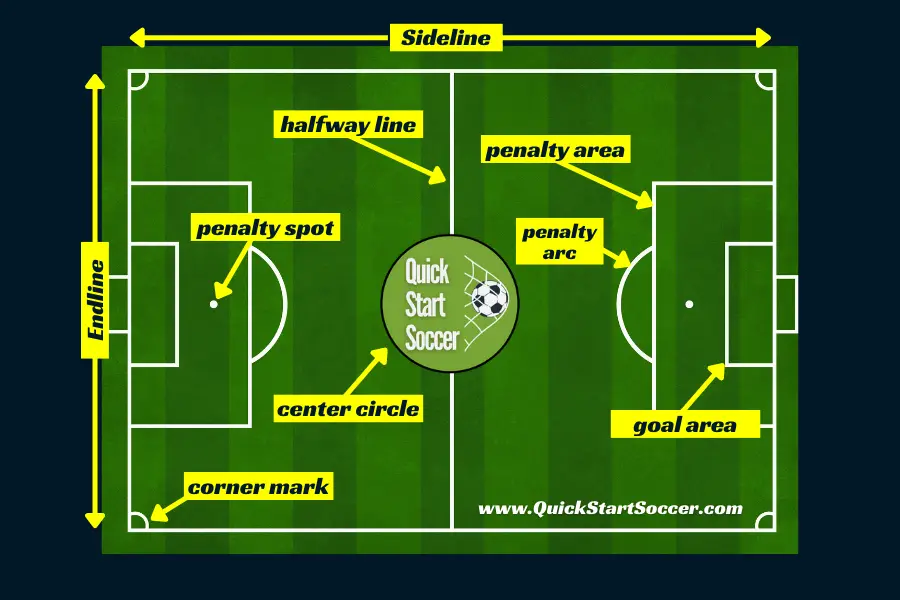
Beyond boundary lines, soccer fields require specific markings that define gameplay zones with precise placement critical for regulation compliance.
Penalty Area Dimensions: 54 Feet (16.46m) from Goal Line
The penalty area extends 18 yards (54 feet/16.46 meters) from the goal line with a total width of 44 yards (132 feet/40.23 meters). This 18-yard box determines where penalty kicks are taken and defines the space where goalkeepers may handle the ball with their hands.
Goal Area Measurements: 18 Feet (5.49m) Depth Requirements
The smaller goal area extends 6 yards (18 feet/5.49 meters) from the goal line with a width of 20 yards (60 feet/18.29 meters). This 6-yard box marks where goalkeepers may handle the ball during defensive plays and where goal kicks are properly taken.
Center Circle Specifications: 30 Feet (9.14m) Radius Standard
The center circle has a precise radius of 10 yards (30 feet/9.14 meters), creating a diameter of 60 feet (18.29 meters). During kickoffs, opposing players must remain outside this circle until the ball is kicked, ensuring fair restarts without immediate pressure.
Goal Size Progression from Feet to Meters

Goal dimensions evolve alongside field sizes, ensuring age-appropriate scoring challenges while building fundamental goalkeeper skills.
Standard Adult Goals: 24 Feet (7.32m) Width and 8 Feet (2.44m) Height
The regulation goal measures exactly 8 yards (24 feet/7.32 meters) wide and 8 feet (2.44 meters) high—a dimension unchanged since 1863. This 3:1 width-to-height ratio creates the optimal balance between scoring opportunities and goalkeeper challenges that defines professional soccer.
Youth Goal Scaling: U6-U8 to U11-U12 Dimension Changes
Youth goals scale progressively:
– U6-U8: 6.5-12 feet wide (2-3.66m) × 4-6.5 feet high (1.22-2m)
– U9-U10: 18.5-21 feet wide (5.64-6.4m) × 6.5 feet high (2m)
– U11-U12: 21 feet wide (6.4m) × 7 feet high (2.13m)
This graduated sizing prevents young goalkeepers from developing poor habits due to oversized equipment while maintaining realistic save opportunities as players develop.
Practical Field Calculation Tools for Feet and Meters
Accurate planning requires understanding how to convert between measurement systems and calculate practical requirements for construction and maintenance.
Area Calculation Formulas for Square Feet and Square Meters
Calculate field area using:
– Square feet = Length (feet) × Width (feet)
– Square meters = Length (meters) × Width (meters)
A standard FIFA field (344.49ft × 222.97ft) covers 76,825 square feet (7,140 square meters), requiring approximately 2.5 acres of level ground for proper construction.
Perimeter Measurement Conversions for Fencing and Boundaries
Determine perimeter with:
– Feet: 2 × (Length + Width) in feet
– Meters: 2 × (Length + Width) in meters
A regulation field perimeter equals 1,135 feet (345.8 meters), critical information for estimating fencing materials, security planning, and boundary maintenance.
Field Construction Guidelines: Slope and Orientation
Proper field construction extends beyond dimensions to include environmental factors affecting play quality and safety.
Optimal North-South Orientation to Minimize Sun Glare
Fields should align north-south to prevent players from facing directly into sunlight during critical moments. This orientation is particularly important for afternoon matches when sun angles create the most problematic glare for defenders and goalkeepers.
Surface Slope Requirements: 1% Maximum (1 Foot per 100 Feet)
For proper drainage without creating unfair advantages, maintain:
– Maximum allowable slope: 1% (1 foot drop per 100 feet length)
– Preferred slope: 0.5% or less
On a 330-foot field, a 1% slope creates just a 3.3-foot elevation difference from end to end—barely perceptible to players but sufficient for effective water management during rain.
Knowing exact soccer field dimensions in feet and meters prevents costly construction errors and ensures regulation compliance across all playing levels. Whether you’re marking a U8 practice field or planning a professional stadium, these precise conversions provide the foundation for quality soccer experiences. Bookmark this guide for quick reference during field construction, league planning, or international tournament preparation—your accurate measurements today create better soccer experiences for players tomorrow.

I come from the “soccer heart” of Germany, the Ruhrpott. I have played, trained and followed soccer all my life and am a big fan of FC Schalke 04. I also enjoy following international soccer extensively.