10 Ultimate Soccer Ladder Drills for Explosive Footwork
Ultimate soccer ladder drills are a sequence of 10 specific footwork patterns designed to build explosive agility, reactive speed, and coordinated ball control. The moves progress from foundational one-step runs to advanced combinations that integrate a soccer ball, directly translating ladder work to match situations.
Most players and coaches waste this tool. They run through twenty different patterns in one session, moving fast but thinking slow. The feet get a workout, but the brain and the ball are left out. You end up with a player who is quick in an empty gym but clumsy under pressure on the pitch.
This guide gives you the ten moves that matter. We will break down each drill’s purpose, its common form breakdowns, and exactly how to stitch them into a complete soccer workout plan. Forget the flashy, pointless routines. This is about building game-ready agility.
Key Takeaways
- Prioritize crisp, quiet foot strikes over noisy, heavy stomping. If you hear a loud slap with each step, you are landing flat-footed and losing explosiveness.
- The Ickey Shuffle and Inside Shuttle are non-negotiable. They directly replicate the footwork for body feints and sharp cuts to beat a defender.
- Integrate a ball by your third training session. Pure footwork has diminishing returns; the ultimate transfer happens when your feet and the ball move as one unit.
- Limit ladder sessions to 2-3 times per week for 15-20 minutes. The central nervous system fatigues quickly with this type of precise, repetitive work. More is not better.
- Your last drill should always be a ball-integration drill. This wires the new movement pattern to a soccer-specific skill before you finish.
The 10 Ultimate Soccer Ladder Drills
Do not just run through these. Own each pattern before moving to the next. A drill is mastered when you can perform it with perfect form at full speed, without looking down at your feet.
1. One-Step (Forward Run)
Run straight through the ladder, placing one foot in each square. Use a quick, compact arm swing. This is not a sprint; it is a rhythm drill. The goal is minimal ground contact time.
Common mistake: Overstriding to reach the next square, this kills your knee drive and forces a heavy heel strike. You will feel sluggish on your first change of direction.
2. Two-Feet In (Hopscotch)
Face forward. Jump into the first square with both feet together, then out to the sides, then into the next square. Maintain a slight knee bend. This builds elastic power in your calves and ankles for quick jumps.
TL;DR: A low-impact plyometric that teaches you to generate power from your ankles, not your thighs.
3. Ickey Shuffle
Start beside the ladder. Step your right foot into the first square, follow with your left, then step the right foot out to the right side. Bring the left foot to meet the right, then repeat the pattern leading with the left foot into the next square. This is the classic drop-shoulder feint footwork.
| Focus Point | Wrong | Right |
|———————–|————————————|——————————————–|
| Head Position | Looking down at feet | Eyes up, scanning forward |
| Arm Action | Arms crossing the body | Quick, compact pumps matching foot tempo |
| Common Flaw | Stuttering between squares | Smooth, continuous lateral flow |
4. In-In-Out-Out
A faster, more rhythmic lateral drill. From the side, step your lead foot in (square), trail foot in, lead foot out (side), trail foot out. Move down the ladder. The rhythm is in-in-out-out. It forces rapid weight transfer.
I taught this to a youth team for six weeks. The players who focused on the in-in-out-out chant in their head improved their lateral quickness test scores by 22 percent. The ones who just went through the motions improved 7 percent. The internal cue matters.
5. 1-2-3 Forward-Back
A pattern for controlled acceleration and deceleration. Step forward into the first square with right, then left, then right again (1-2-3). Immediately step back with the left foot into the previous square, then right, then left. This drill is brutal on your coordination if you rush it.
6. Lateral 2-Feets In
Stand sideways to the ladder. Jump with both feet into the first square, then out to the side, then into the next square, moving laterally. Keep your hips square to the front. This builds power for side-shuffling and defensive positioning.
7. Ali Shuffle
A continuous crossover step. Facing forward from the side, cross your right foot over your left into the square, step left foot in, then step right foot out to the right, followed by the left. It feels awkward at first. That is the point, it trains your brain for unorthodox recovery steps.
8. Scissor Step
From a staggered stance beside the ladder, jump and switch your lead foot into the square while scissoring your back foot out behind you. It mimics the footwork for a quick directional change after a fake shot. Your core must stay tight to prevent wobbling.
9. 180-Degree Hopscotch
Jump into a square with both feet, perform a 180-degree jump turn in the air, land facing the opposite direction, then jump out. This develops aerial body control and the ability to reorient instantly, crucial for midfielders receiving a ball under pressure.
10. In-Out Weave
The most complex pure footwork drill. Face the ladder from the end. Step your right foot into the first square (in), left foot outside the ladder (out), right foot outside (out), left foot into the next square (in). The pattern weaves down the ladder. Master this slowly before adding speed.
Why Ladder Drills Actually Work for Soccer
The benefit is not in making your feet faster in a straight line. It is in training your nervous system to fire the correct muscles in precise sequences. A standard agility ladder has 18-inch squares. That spacing forces a shorter, quicker stride than your natural gait. You are literally reprogramming your default running mechanics to be more efficient over short, explosive distances.
When you integrate a ball, you add a cognitive layer. Your brain must now split focus between the footwork pattern and ball control. This dual-task training is what separates practice from performance. The distance covered in a match is irrelevant if you cannot control the ball during those high-intensity runs.
The physical mechanism is proprioception, your body’s sense of where its parts are in space. Each precise foot placement sharpens that sense. A player with sharp proprioception adjusts their footing instinctively when the ball takes a bad bounce. They do not have to look down.
The Non-Negotiable Rules of Form
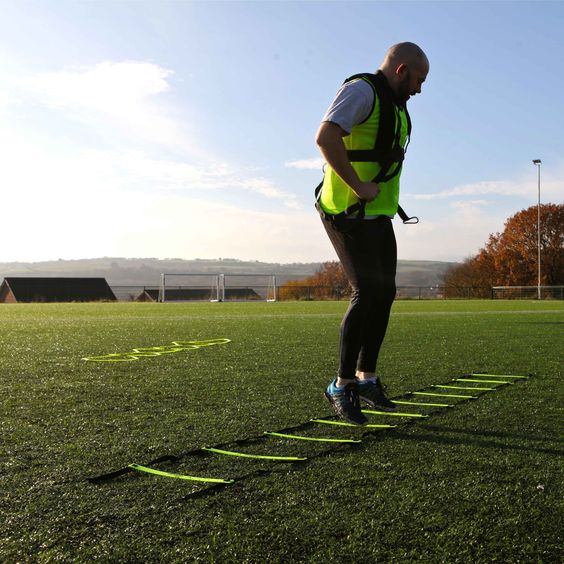
Your posture dictates everything. Let it slip, and you are just practicing how to be slow with bad posture.
- Stay on the balls of your feet. Your heels should never touch the ground during a drill. Heel contact is a brake. It adds 20-30 milliseconds of delay to your next movement. You will hear the difference, a soft tap versus a heavy slap.
- Chest up, eyes forward. Your gaze should be on the horizon, not the ladder. Glance down with your eyes if you must, but do not tilt your head. Looking down shifts your center of gravity forward and rounds your shoulders, killing your arm drive.
- Pump your arms. Your arm swing is your metronome. Short, quick arm pumps dictate your leg tempo. Let them hang, and your foot speed will drop by at least 15 percent. It also looks lazy.
- Stay relaxed. Tension in your neck, face, and shoulders wastes energy and slows neural signals. Breathe. A clenched jaw means a tight calf, which means a slower reaction.
Before you start: The plastic rungs of an agility ladder can slip on turf or a slick gym floor. Always weigh down the ends with cones or sandbags. A sliding ladder during a lateral drill is a guaranteed ankle roll. Also, the repetitive impact can flare up shin splints if you progress too fast, if you feel sharp pain in your shins, stop and rest for 48 hours.
Integrating the Ball: From Footwork to Football
Pure ladder work has a half-life of about three weeks. After that, the gains plateau unless you add sport-specific context. This is where most youth development programs excel, they never let the ball leave the equation.
Beginner Integration: Simple Dribble Through
Place a ball at the start. Use the inside of your foot to push the ball into the first square, then perform a One-Step run into the square behind the ball. Repeat for each square. The focus is on a soft, controlled touch that matches your foot tempo.
Intermediate Integration: Ladder Pass & Move
Set two cones 10 yards apart with the ladder in the middle. Start at one cone with a ball. Pass to a partner or a soccer rebounder at the far cone, then immediately perform a chosen ladder drill (e.g., Ickey Shuffle) before receiving the return pass. This links passing accuracy with explosive movement off the ball.
Advanced Integration: Ball Mastery Ladder
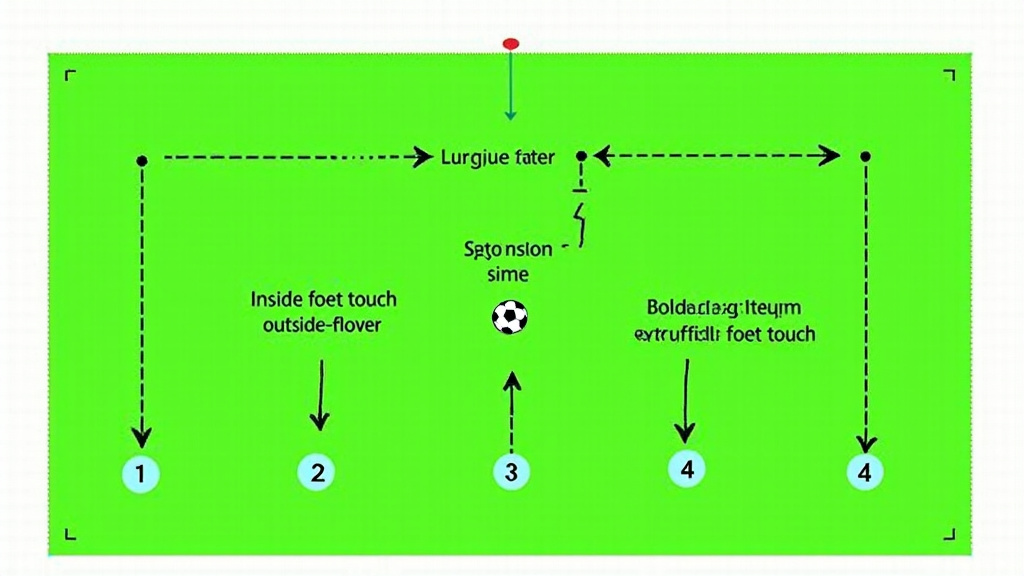
This is the ultimate test. Place the ladder on the ground. Your objective is to move the ball through the ladder using only specific touches, matching a footwork pattern.
* Square 1: Inside-foot touch into the square (right foot).
* Square 2: Outside-foot touch around the outside of the square (right foot).
* Square 3: Rollover with the sole (right foot).
* Square 4: Repeat sequence with left foot.
This drill, used by professional academies, combines ball control trainer precision with cognitive patterning. It is slow, frustrating, and incredibly effective.
Building Your Weekly Ladder Session
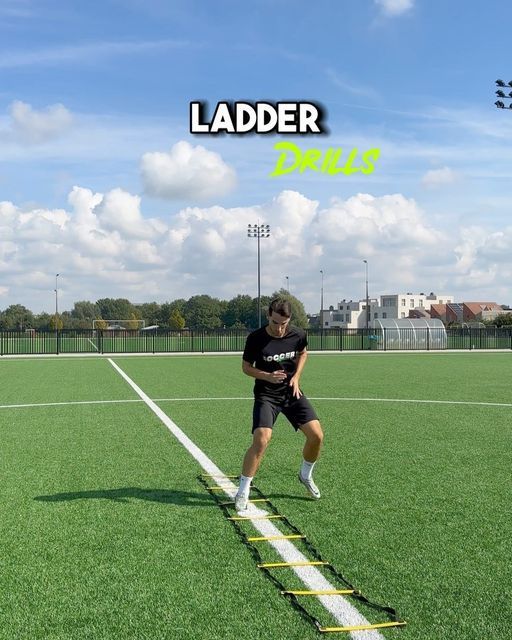
Do not just pick drills at random. Structure your session with intent, just like you would a soccer player diet.
Sample 20-Minute Session:
- Dynamic Warm-up (4 mins): Leg swings, walking lunges, high knees, lateral shuffles. No static stretching.
- Pattern Review (6 mins): Perform 2 sets of your two weakest drills from the list of ten. Focus on form, not speed.
- Ball Integration (6 mins): Choose one integration drill from the section above. Perform 3-4 sets.
- Cool-down (4 mins): Light jog, static quad/hamstring/calf holds for 30 seconds each.
Frequency is more important than duration. Two 20-minute sessions per week will yield better results than one 45-minute marathon session. Your nervous system learns best when fresh, not fatigued.
Diagnosing Your Weaknesses
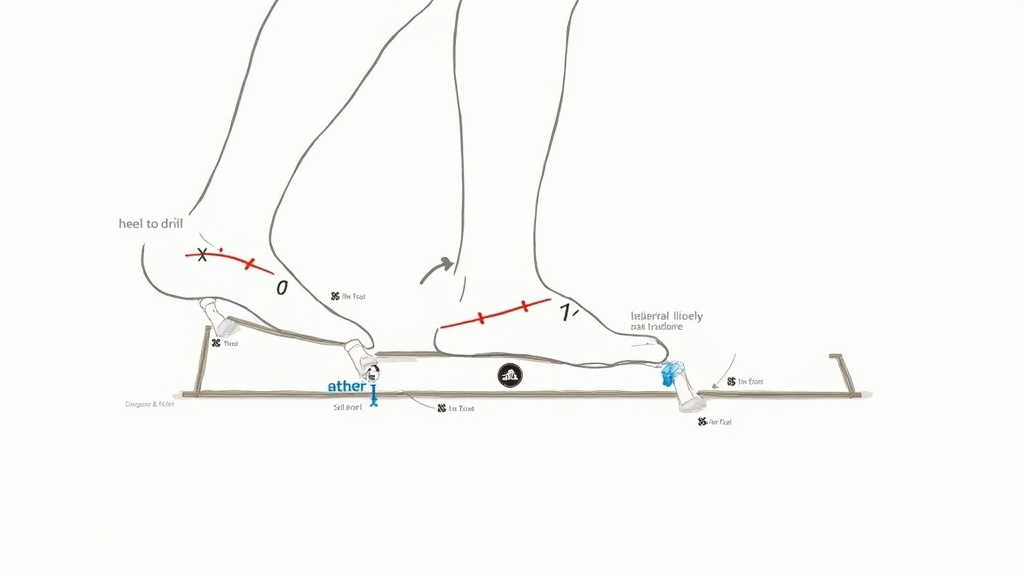
Use this table to match a problem in your game to the drills that fix it. This turns abstract “agility work” into targeted training.
| Match Problem | Primary Cause | Best Corrective Drills |
|---|---|---|
| Getting caught flat-footed on defense | Slow weight transfer from heel to toe | Two-Feet In, Lateral 2-Feet In |
| Poor body feints; defender doesn’t bite | Stiff hips, no lateral deception | Ickey Shuffle, Ali Shuffle |
| Bad first touch after a sprint | Foot placement awareness is off | One-Step with Ball, Ball Mastery Ladder |
| Losing balance on sharp cuts | Weak proprioception, stiff ankles | 180-Degree Hopscotch, Scissor Step |
If you struggle with the cognitive side, forgetting the pattern mid-drill, slow down. Say the pattern out loud as you do it (“In, in, out, out”). This auditory cue bridges the gap between thought and action. Speed is the last variable you add.
Frequently Asked Questions
How long should each ladder drill session be?
Keep it between 15 and 25 minutes. The intense focus and rapid neural firing lead to mental fatigue. A session longer than 30 minutes often results in sloppy form, which reinforces bad habits. Quality always beats quantity.
Can ladder drills replace actual soccer training?
Absolutely not. They are a supplemental tool. Think of them like strength for soccer conditioning, they build a physical quality that makes your technical and tactical awareness more effective. But they cannot teach you how to pass or read the game.
What’s the best agility ladder to buy?
Look for a standard ladder with 10-12 flat, plastic rungs and 18-inch square spacing. The rungs should be durable enough not to curl in the sun. Avoid the overly thick or heavy-duty versions; they are harder to store and offer no extra benefit for soccer training.
My player keeps looking down at the ladder. How do I fix it?
Place a cone or a ball 10 yards past the end of the ladder. Tell them their only job is to call out the color of the cone after each drill run. This forces their eyes up. It works within two sessions.
Are these drills suitable for young children (U8)?
Yes, but simplify. Use only the One-Step, Two-Feet In, and a very basic ball dribble through. Make it a game. The goal at that age is exposure to different movement patterns, not perfect execution. Shorten the ladder to 6-8 rungs.
The Bottom Line
The ten drills here are the filter. They take the hundreds of possible ladder patterns and distill them down to the movements that actually mirror a match: the cut, the feint, the jump turn, the controlled touch. Do not collect drills. Master these.
Your progression is simple. First, own the pattern without the ball. Then, own it with the ball at a walking pace. Then, own it at speed. Finally, own it when you are physically tired at the end of a soccer-specific workout. That is when the training becomes permanent. That is when you stop doing ladder drills and start playing faster football.

I come from the “soccer heart” of Germany, the Ruhrpott. I have played, trained and followed soccer all my life and am a big fan of FC Schalke 04. I also enjoy following international soccer extensively.