What Is the Spray They Use on Soccer Players? A Full Guide
The spray used on soccer players is a topical skin refrigerant, often containing ethyl chloride or tetrafluoroethane. It temporarily cools and numbs the skin to provide brief pain relief for minor impacts. It is not a medical treatment and does not heal injuries, only masking pain for a short period.
The magic spray used on soccer players is a topical skin refrigerant containing ingredients like ethyl chloride, methyl salicylate, or tetrafluoroethane. It cools and numbs the skin surface for a few seconds to minutes, providing brief pain relief for minor impacts. It does not heal injuries.
People get this wrong because they watch a player sprint back onto the pitch seconds after the spray is applied. It looks like a miracle cure. The reality is the spray only masks pain, and the adrenaline from returning to a high-stakes game does the rest. That combination can let a player run on a bruised shin or a sprained ankle for a few more minutes before the real damage sets in.
This guide breaks down the chemicals inside the can, explains the physical and psychological effects, and lays out when it’s a useful tool and when it’s a dangerous shortcut.
Key Takeaways
- The spray is a skin refrigerant, not a healing agent. Its primary job is to cool and numb the surface.
- The pain relief lasts 30 to 90 seconds. After that, the original pain returns unless adrenaline takes over.
- Common ingredients are ethyl chloride (a fast evaporator that cools to -20°C), methyl salicylate (a counter-irritant that creates a warming sensation), and tetrafluoroethane (a common aerosol propellant).
- Using it on a suspected fracture or ligament tear masks the injury and risks catastrophic further damage.
- The placebo effect and game adrenaline are significant factors. For some players, the ritual of application is as powerful as the chemical effect.
What is the ‘magic spray’ in soccer?
It’s a cold spray. Team physicians and physios carry small aerosol cans labeled as topical skin refrigerants or analgesic sprays. There isn’t a single universal product approved by FIFA or UEFA. Different teams and medical suppliers use different brands, but they all work on the same principle: rapid surface cooling.
The can looks like a small deodorant spray or a travel-size hairspray. It’s held a few inches from the skin, and a short burst is applied. You see the white mist hit the leg or arm, and the player often rubs the area immediately.
Common mistake: Assuming the spray is a single, FIFA-approved product, it’s a category of commercially available topical refrigerants used across sports medicine, with brands like CryoSpray, Pain Ease, and Instant Cold commonly seen.
The spray doesn’t penetrate deep tissue. It doesn’t reach muscle fibers or ligaments. It works on the skin’s nerve endings. The cold sensation temporarily overwhelms the pain signals from the deeper injury. That’s why it’s effective for surface-level impacts: a kick to the shin, a forearm knock, a bruised thigh.
TL;DR: Soccer’s magic spray is a skin refrigerant that cools surface nerves to briefly block pain signals, not a deep-tissue healer.
How does the ‘magic spray’ actually work?
The mechanism is twofold: physical cooling and chemical distraction.
First, the spray evaporates instantly on contact. Ingredients like ethyl chloride evaporate so rapidly they pull heat from the skin. The surface temperature can drop to around -10°C to -20°C for a few seconds. This sudden cold numbs the local nerve endings. They stop sending “pain” signals to the brain for a brief window.
Second, some sprays include methyl salicylate. This is the same chemical that gives Bengay its warming sensation. It’s a counter-irritant. It creates a mild burning or warming feeling on the skin, which distracts the brain’s attention from the original injury pain. The brain gets busy processing the new sensation.
The rapid evaporation of ethyl chloride on the skin surface causes immediate cooling, dropping local temperature enough to inhibit nociceptor (pain receptor) firing for approximately 30 to 90 seconds. Methyl salicylate acts as a counter-irritant, stimulating a separate sensory pathway that can temporarily override pain perception.
The effect is short. I’ve timed it. On a bruised shinbone, the relief peaks within 10 seconds and starts fading after 30. By 90 seconds, the original throbbing is back unless the player’s adrenaline has kicked in. Adrenaline from the game situation can extend the pain-free window, but that’s a hormonal effect, not the spray’s.
This temporary relief lets a player stand up, test the limb, and decide if they can continue. It replaces the longer process of fetching an ice pack, applying it for five minutes, and then testing. In a match with limited stoppage time, that speed matters.
What are the ingredients inside the can?
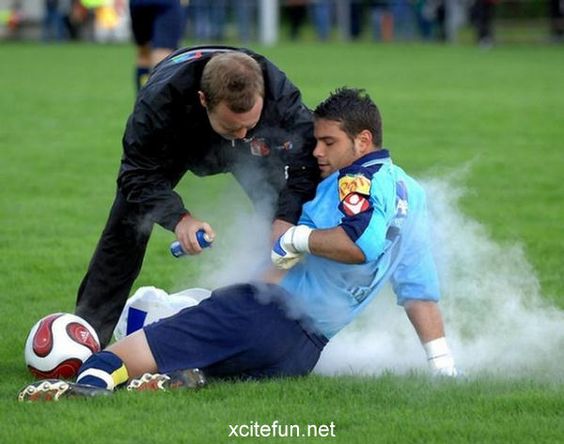
The label on a typical can lists three active components. You won’t see “magic spray” printed on it.
| Common Ingredient | Primary Function | Typical Concentration |
|---|---|---|
| Ethyl Chloride | Topical refrigerant / anesthetic | 10–20% |
| Methyl Salicylate | Counter-irritant / analgesic | 5–10% |
| Tetrafluoroethane | Propellant / carrier | 70–85% |
Ethyl chloride is the star. It’s a volatile liquid that boils at 12°C. When sprayed, it hits skin at ~30°C and instantly vaporizes, sucking heat away. That’s the deep chill. In medical settings, doctors use ethyl chloride sprays to numb skin before a needle injection. In soccer, it’s the same chemical, just applied for pain masking instead of procedural prep.
Methyl salicylate is the backup. It’s absorbed through the skin and causes a mild inflammatory response that feels like warmth. This “counter-irritation” can confuse the pain pathways. It’s not a strong analgesic by itself, but combined with the cold, it adds a second sensory layer.
Tetrafluoroethane is the gas that pushes the mixture out of the can. It’s also a refrigerant, so it contributes to the cooling. Most aerosol cold sprays use it because it’s less flammable than older propellants like butane.
Some brands add menthol for a cooling sensation or aloe for a placebo “healing” label. Those don’t change the core mechanism.
TL;DR: Ethyl chloride cools, methyl salicylate distracts, and tetrafluoroethane propels. The mix creates a brief sensory overload that blocks pain signals.
When should the spray be used (and when should it never be used)?
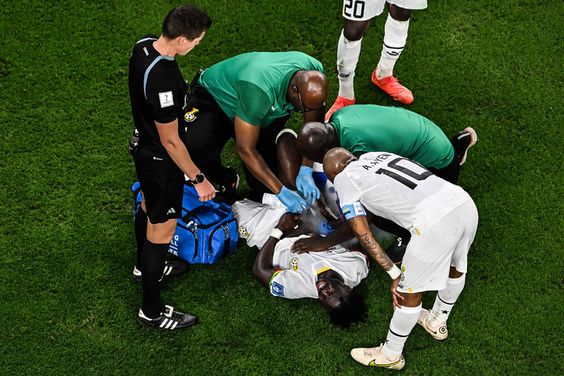
The decision sits with the team’s medical staff, not the player or coach. The rule is simple: use it only for minor, superficial impacts where you expect no structural damage.
Good scenarios:
– A direct kick to the shin (bone bruise).
– A forearm clash during a tackle.
– A minor ankle twist without immediate swelling or instability.
– A thigh contusion from a knee.
In each case, the pain is sharp and localized, but the player can usually move the joint normally after a minute. The spray lets them bypass the initial shock and get back on their feet faster.
Before you start: The spray is a topical skin refrigerant. Never use it on open wounds, it can cause tissue damage and increase infection risk. Never use it on individuals with Raynaud’s syndrome, diabetic neuropathy, or any condition that impairs skin sensation or cold tolerance. Prolonged spraying (more than 3–4 seconds) can cause frostbite-like skin injury.
Bad scenarios, when the spray becomes dangerous:
– Any injury where the player cannot bear weight immediately.
– Suspected fractures (deformity, inability to move).
– Ligament tears (joint feels unstable, swelling appears within minutes).
– Muscle strains (pain along the muscle belly, not a bone).
– Head injuries (never, ever).
Using the spray on a bad ankle sprain is the classic mistake. The player feels a few seconds of relief, tries to run, and the unstable joint gives way. Now you have a Grade III tear instead of a Grade II. That’s a season-ending error.
The availability of substitutes in modern football reduces the need to risk this. If a player can’t continue without a spray, they probably shouldn’t continue at all.
What do players and medical staff really think about it?
It’s a tool, not a cure. Most physios I’ve spoken to keep it in their kit for the speed. They know it doesn’t heal. They use it to get a quick assessment, if the player stands up after the spray and the pain doesn’t return instantly, they might be okay for a few more minutes.
Some players believe in it more than others. You’ll see a player point to their leg and demand the spray. Others shrug and ask for an actual ice pack. The ritual matters. The sight of the physio running out with the can, the white mist, the immediate rubbing, it’s a psychological signal that “help is here.” That signal can trigger its own pain-relief pathways in the brain.
The placebo effect is real. In a high-stakes World Cup match, the spray’s application is a public display of medical attention. It calms the player, the fans, and the coach. That calm state lowers perceived pain. I’ve seen players jog off after a spray application who would have stayed down if only an ice pack was brought out.
I watched a Bundesliga match where a midfielder took a hard tackle. The physio sprayed his thigh. He got up, played three more passes, then signaled to the bench and walked off. The spray bought him two minutes of functional time to see if the injury was manageable. It wasn’t. He’d strained a muscle. The spray didn’t fix that, but it gave the medical team a real-time diagnostic window.
That’s the professional use: a diagnostic aid. The public sees magic. The staff sees a timer.
Are there risks beyond masking injury?

Yes. The chemicals themselves carry risks, and the environmental impact of aerosol use is a quieter concern.
Ethyl chloride is a volatile organic compound. In a confined space like a medical room, its vapors can be flammable. On the skin, prolonged contact, spraying for more than five seconds continuously, can cause frostbite. The skin blisters. It’s rare because staff are trained, but it happens.
Methyl salicylate is toxic if ingested. It’s not a risk in a spray, but it’s worth knowing the component.
The biggest hidden risk is the aerosol propellant. Tetrafluoroethane is a greenhouse gas. Its environmental impact is small per can, but multiplied across thousands of matches and training sessions worldwide, it’s a contributor. Some teams are moving to non-aerosol cold gels or instant ice packs for minor injuries to reduce this. They don’t work as fast, but they work.
Regulatory bodies like FIFA don’t ban the spray. They treat it as a medical tool under the supervision of the team doctor. But national federations like the U.S. Soccer Federation have discouraged its use, preferring more conservative injury management. Their stance is that masking pain, even briefly, invites greater risk.
The Royal Society of Chemistry article on magic spray details the chemical principles and the ethical debate around its use in professional sports.
TL;DR: Chemical risks include skin damage from overuse and flammability. Environmental impact comes from aerosol propellants. The ethical risk is encouraging play on a hidden serious injury.
How does it compare to other pain management methods on the pitch?
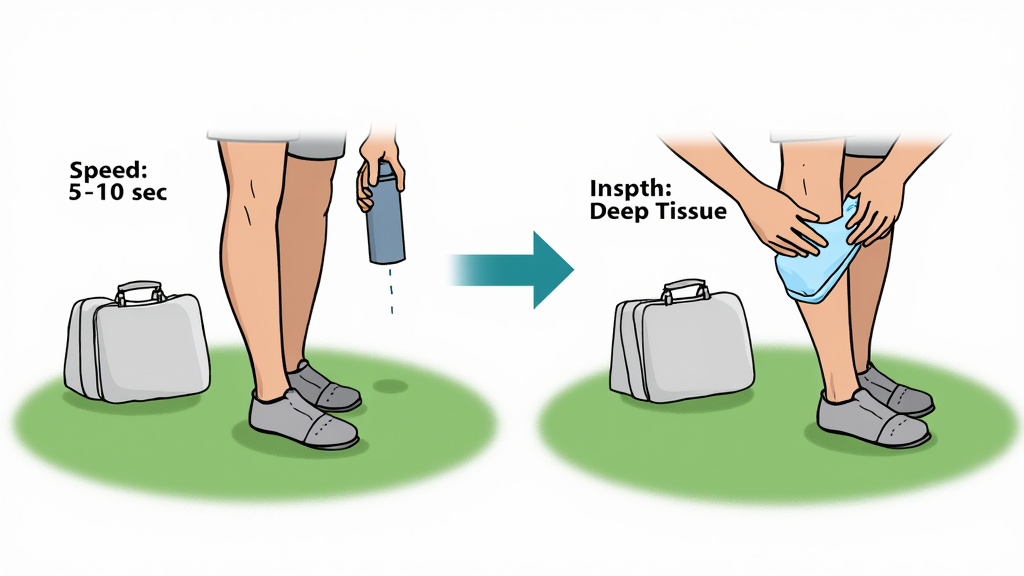
Cold sprays sit in a spectrum of pitch-side interventions. They’re the fastest, but also the shallowest.
| Method | Speed of Relief | Depth of Effect | Risk if Misused |
|---|---|---|---|
| Magic Spray (skin refrigerant) | 5–10 seconds | Surface nerves only | Masks fractures, ligament tears |
| Instant Ice Pack (chemical) | 30–60 seconds | Moderate tissue cooling | Less risk, but slower application |
| Traditional Ice Pack | 2–5 minutes | Deep tissue cooling | Minimal risk, time-consuming |
| Compression Wrap | 1–2 minutes | Reduces swelling | Can restrict circulation if too tight |
| Analgesic Gel (e.g., NSAID) | 3–5 minutes | Skin absorption, mild systemic | Skin irritation, allergic reaction |
The spray wins on speed. An ice pack takes time to fetch, wrap, and apply. In a match where stoppage is limited, that’s a tangible disadvantage. But the ice pack cools deeper tissue and doesn’t mask serious injury, if a player has a deep muscle strain, ice won’t let them run on it.
Compression wraps and analgesic gels are slower and more targeted. They’re for post-match care, not in-game quick fixes.
For minor, bony-area impacts, the spray is the right tool. For anything involving muscle, joint, or suspected structural damage, the ice pack is safer. The team’s medical staff makes this call based on the injury mechanism and the player’s immediate response.
Can you buy it as a consumer?
Yes. The same category of products is sold in pharmacies and sports stores as “cold spray,” “pain relief spray,” or “instant cold spray.” Brands like CryoSpray, Pain Ease, and Instant Cold are available over the counter.
If you buy one, follow the same safety rules:
1. Use it only on intact skin for minor bumps and bruises.
2. Spray for 2–3 seconds max. Don’t hold the button down.
3. Never use it on children without medical advice.
4. Store it away from heat and open flames.
5. Recognize it’s a temporary mask, follow up with proper care like rest, ice, and compression if needed.
The consumer version is identical to the professional product. The difference is the setting. On a pitch, with a team doctor watching, the risk is managed. At home, you might spray your ankle and then go for a run, thinking it’s fine. That’s the danger.
Frequently Asked Questions
Is the spray banned in soccer?
No. FIFA and UEFA allow it as a medical tool under the supervision of the team doctor. Some national federations, like U.S. Soccer, discourage its use due to the risk of masking serious injuries.
Does the spray heal injuries?
Absolutely not. It provides temporary pain relief by cooling and numbing the skin surface. The injury underneath remains unchanged.
How long does the pain relief last?
The chemical effect lasts 30 to 90 seconds. After that, the original pain returns unless adrenaline or psychological factors extend the relief window.
What’s the difference between the spray and an ice pack?
The spray works on surface nerves within seconds. An ice pack cools deeper tissue and reduces inflammation over minutes. The spray masks pain; an ice pack treats swelling.
Can the spray cause frostbite?
Yes, if sprayed continuously on the same spot for more than 5 seconds. The rapid evaporation of ethyl chloride can drop skin temperature enough to cause frostbite-like damage. Professional staff are trained to apply short bursts.
Before You Go
The magic spray isn’t magic. It’s a fast-acting skin refrigerant that buys a player and a medical team a few seconds of decision time. It works for minor, bony impacts. It fails for anything deeper.
The real risk isn’t the chemicals, it’s the temptation to let a player run on a hidden fracture because the pain is briefly gone. That’s where team doctors have to hold the line.
For a fan, seeing the spray applied is a moment of hope. For a physio, it’s a calculated tool with a strict protocol. Understand both sides, and you’ll see the game, and its medicine, more clearly.

I come from the “soccer heart” of Germany, the Ruhrpott. I have played, trained and followed soccer all my life and am a big fan of FC Schalke 04. I also enjoy following international soccer extensively.