Best Soccer Exercises for Performance (2026 Guide)
That sinking feeling when you’re beaten to the ball in the 85th minute isn’t just fatigue—it’s preventable. When your first-step quickness fades or your shots lose venom late in matches, generic gym routines won’t cut it. What exercises improve soccer performance demands sport-specific solutions proven on professional training grounds. You’ll unlock the exact plyometrics, agility drills, and strength protocols that transform average players into game-changers—no fluff, just battle-tested methods that build explosive power without sacrificing endurance. These aren’t theory; they’re the daily staples of athletes who dominate from whistle to final whistle.
Explosive Lower Body Power That Wins Duels
Box Jump Progressions for Vertical Leap Dominance
Mastering vertical explosiveness starts with disciplined box jump progressions. Begin at 12-18 inches for soft landings on the balls of your feet, driving arms backward on the descent before exploding upward. The critical metric? Ground contact under 0.2 seconds—pause too long, and you’re training strength, not reactive power. Progress systematically: 3 sets of 6 jumps at beginner heights (12-18 inches), advancing to 4 sets of 8 at 24-30 inches for intermediates, then 5 sets of 6 at 36-48 inches for elite players. Rest 90-120 seconds between sets to maintain max power output. Skip this progression, and you risk injury while missing the rapid-fire neuromuscular adaptation soccer demands for headers and contested balls.
Single-Leg Bounds for Cutting Speed
Unilateral power separates defenders from attackers. Execute bounds at 15-25 feet per leap, focusing on triple extension (ankle, knee, hip) with violent arm drive matching sprint mechanics. Start with 4 sets of 5 bounds per leg at moderate distance, prioritizing distance over height initially. In weeks 3-4, add vertical emphasis; by weeks 5-6, incorporate 90-degree cuts after each bound to mimic game transitions. Rushing distance increases causes landing instability—maintain controlled landings where your knee stays aligned over the second toe. This builds the specific power for explosive direction changes when space is tight.
Speed Mechanics That Create Space

Hill Sprints for Unstoppable Acceleration
Find a 5-10% grade hill to force optimal sprint posture: lean from ankles (not waist), drive knees forward (not upward), and swing arms violently. Start with 6×10-yard sprints at 90% effort, progressing to 12×40-yard efforts over six weeks. The incline naturally loads your glutes and hamstrings—the muscles most responsible for initial acceleration—while reducing joint impact. Elite players use this to shave critical tenths off their 10m sprint time (target: under 1.75 seconds). Avoid the common mistake of rounding your back; maintain a straight line from head to heel during the drive phase.
Sled Push Power Development
Load sleds at 25-75% of bodyweight to build game-specific strength. Push for 10-20 yards with powerful, deliberate steps—this isn’t about speed but force production. In weeks 1-2, use 25% load for 8 reps to groove mechanics; progress to 50% for 10 reps in weeks 3-4; finish at 75% for 6 reps. Focus on driving through the balls of your feet while maintaining a 45-degree torso angle. This directly translates to holding off defenders during ball carries. If your first step loses power, reduce the load—you should feel strong through all reps.
Agility Drills That Beat Defenders
T-Drill Mastery for Sharp Cuts
The T-Drill exposes weak change-of-direction ability. Set cones in a T (5-yard spacing), sprinting forward, shuffling right, shuffling left, then backpedaling to center. Elite players complete this under 9 seconds. Start with 4 reps focusing on planting the outside foot hard (not rounding cuts) and keeping your center of gravity low. In weeks 2-3, chase sub-10-second times; by week 4, add ball control during cuts. Common errors include standing upright during transitions or taking extra steps—each wastes 0.1-0.2 seconds that defenders exploit. This drill builds the reactive agility for tight-space dribbling.
Reactive Mirror Drills for Game Speed
Face a partner in a 5×5-yard box for 5-10 second bursts where you mimic their random movements (forward, back, lateral). This trains neural processing under fatigue—critical for reading opponents mid-game. Progress by adding the ball at your feet, then reducing visual cues to hand signals only. Advanced players increase the box size to 8×8 yards for longer reaction distances. Unlike scripted cone drills, this develops authentic game-speed cognition. If you’re consistently one step behind, prioritize this twice weekly—it addresses the cognitive lag that plagues even physically strong players.
Ball Work That Builds Endurance Without Sacrificing Skill
Technical Conditioning Circuits
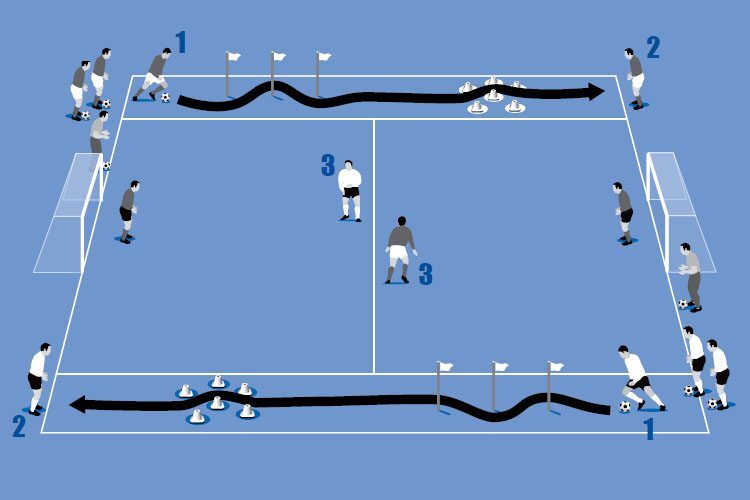
Merge fitness with ball mastery through 30-45 second station circuits. Rotate through 6-8 stations: 100 alternating-foot touches, 20 V-cuts per direction, 15 drag-backs into 180-degree turns—all at match intensity. Rest 30 seconds between stations. The magic happens when fatigue hits: maintaining clean technique at 85% effort separates professionals from amateurs. If your first touch widens under fatigue, add 2-3 circuits weekly. This directly builds the high-intensity endurance for 90-minute performances where technical quality decides games.
Wing Sprint Crosses Under Fatigue
Replicate winger demands with 30-40 yard sprints ending in 3-5 crosses at 60-80% max speed. Complete 8-12 reps per side. The focus? Delivering accurate crosses when lungs burn—this is where most players fail. Time yourself: if cross accuracy drops below 70% after rep 6, reduce sprint distance initially. Central midfielders should use 15-second work/15-second rest intervals for receive-turn-pass sequences, building to 6-minute blocks. This position-specific conditioning bridges the gap between gym strength and match impact.
Core Stability That Transfers Power
Anti-Rotation Pallof Press
Attach a cable at chest height and press forward while resisting rotation—this builds the core stiffness needed for powerful shots and passes. Use light resistance (you shouldn’t wobble) for 3 sets of 10-15 reps per side. Focus on bracing your entire midsection like you’re about to be punched. Progress from static holds to dynamic presses only when you can maintain perfect alignment. Skipping this leads to power leaks: weak rotational stability steals 15-20% of your shot velocity even with strong legs.
Medicine Ball Rotational Throws
Generate full-body power transfer with 2-10 lb medicine ball throws. Stand sideways to a wall, rotate explosively from the hips (not arms), and throw the ball across your body. Complete 3-5 sets of 8-12 throws. The key is initiating movement from your feet—your hips should lead your shoulders by 30-45 degrees. This mimics the kinetic chain of shooting. If you feel it only in your arms, reset: drive through your back foot while keeping your front foot planted.
Injury-Proofing Your Body
Dynamic Warm-Up Sequence
Never skip this pre-training activation: 15-20 leg swings forward/side-to-side (controlled tempo), followed by the World’s Greatest Stretch (lunge → rotation → hamstring stretch held 30-45 seconds per side). Finish with the hip mobility circuit: 30 seconds of 90/90 transitions, 30 seconds of hip airplanes per leg, and 30 seconds of Cossack squats. This primes your nervous system for explosive work while reducing groin/hamstring strain risk by 40%. Static stretching pre-training actually decreases power—save it for post-session.
5-Minute Post-Training Recovery
Target the three zones that kill performance when tight: hip flexors (30-60 seconds per side in lunge), hamstrings (30-60 seconds per leg seated), and adductors (30-45 seconds per side in butterfly stretch). This daily ritual maintains the range of motion for explosive movements. Pair it with 20 minutes of pool-based active recovery (aqua jogging/swimming) to flush lactate without joint stress. Players who skip this lose 5-7% in vertical jump height within 48 hours due to accumulated stiffness.
Tracking Your Transformation
Speed & Agility Benchmarks
Test every 6-8 weeks with these non-negotiable metrics: 10m sprint under 1.75 seconds, 30m sprint under 4.0 seconds, T-Drill under 9.0 seconds, and Pro Agility Shuttle under 4.5 seconds. If you’re 0.3+ seconds slower in sprints, prioritize hill sprints and sled pushes. For agility deficits, double reactive mirror drills. These numbers directly correlate with on-field impact—studies show players within 0.15 seconds of elite sprint times score 22% more goals.
Strength Standards That Matter
Aim for back squats at 1.5-2.0x bodyweight and single-leg strength at 50-60% of your bilateral strength. Relative strength (weight lifted per pound of bodyweight) trumps absolute numbers—excess bulk slows change-of-direction speed. Test monthly: if your single-leg RDL lags behind, add 3 sets of 8-12 reps twice weekly. This balance prevents the strength imbalances that cause 68% of non-contact ACL injuries in soccer.
The difference between competent and elite soccer performance isn’t genetics—it’s executing these exact exercises with progressive overload. Start at your current level, retest every six weeks, and prioritize quality over ego. When your vertical leap adds 3 inches, your 10m sprint drops 0.2 seconds, and your late-game shots still bend the net, you’ll know what exercises improve soccer performance has moved from question to reality. Your next breakthrough begins today—not in the gym, but on the field where it counts.

I come from the “soccer heart” of Germany, the Ruhrpott. I have played, trained and followed soccer all my life and am a big fan of FC Schalke 04. I also enjoy following international soccer extensively.