What Made Pele Great At Soccer?
Pelé’s greatness in soccer stemmed from his exceptional skill, vision, and goal-scoring ability, combined with his creativity, sportsmanship, and impact on the global stage. He mastered dribbling, passing, and finishing, excelled under pressure, and led Brazil to three World Cup titles, showcasing unmatched flair and passion that revolutionized the game.
When Pelé stepped onto the pitch, defenders immediately tightened. Goalkeepers subconsciously shifted their stance. Teammates felt their confidence surge. There was something unmistakable about watching him play—a rare fusion of physical gifts, technical brilliance, and creative genius that made even the most difficult soccer moves look effortless. The question “what made Pelé great at soccer” isn’t just about statistics or trophies; it’s about understanding how one player redefined the boundaries of what seemed possible on a soccer field.
Pelé didn’t just play soccer—he transformed it. His three World Cup victories, 1,283 career goals, and revolutionary techniques weren’t accidental achievements. They resulted from specific, identifiable elements that separated him from every other player of his era and beyond. What made Pelé great at soccer was his unique combination of explosive athleticism, technical mastery, visionary thinking, and mental resilience that worked together in perfect harmony.
Explosive Speed That Defied Defensive Strategies
How Pelé’s Acceleration Created Space Instantly
Pelé’s first three steps from a standing position generated separation that left defenders grasping at air. Unlike modern speedsters who rely on track-style straight-line acceleration, Pelé mastered short-distance bursts in tight spaces—the exact moments that decide games. When receiving the ball with his back to goal, he could pivot and explode past markers before they even set their feet.
His low center of gravity, developed through years of barefoot play on uneven Brazilian streets, gave him an advantage no shod player could match. This wasn’t just raw speed—it was intelligent acceleration that worked within the flow of the game. Defenders who could match his top speed still couldn’t anticipate when he’d unleash his signature burst, making him perpetually one step ahead.
Balance That Turned Tackles Into Opportunities
Defenders in Pelé’s era played with minimal restrictions—they targeted ankles, pulled shirts, and used any physical tactic allowed. Yet Pelé turned these challenges into advantages through supernatural balance. When opponents lunged at his legs, he absorbed contact while maintaining perfect ball control, often using the defender’s momentum against them.
This balance extended to his aerial game. Even when shoved mid-jump, he adjusted his body to maintain heading accuracy. The famous 1970 World Cup leap over the Italian defender showcased this—while being pushed backward, he still directed his header with surgical precision. His core strength and spatial awareness allowed him to finish plays that would leave most players tumbling to the ground.
Technical Mastery That Rewrote Soccer Possibilities
Two-Footed Control That Confused Defenders
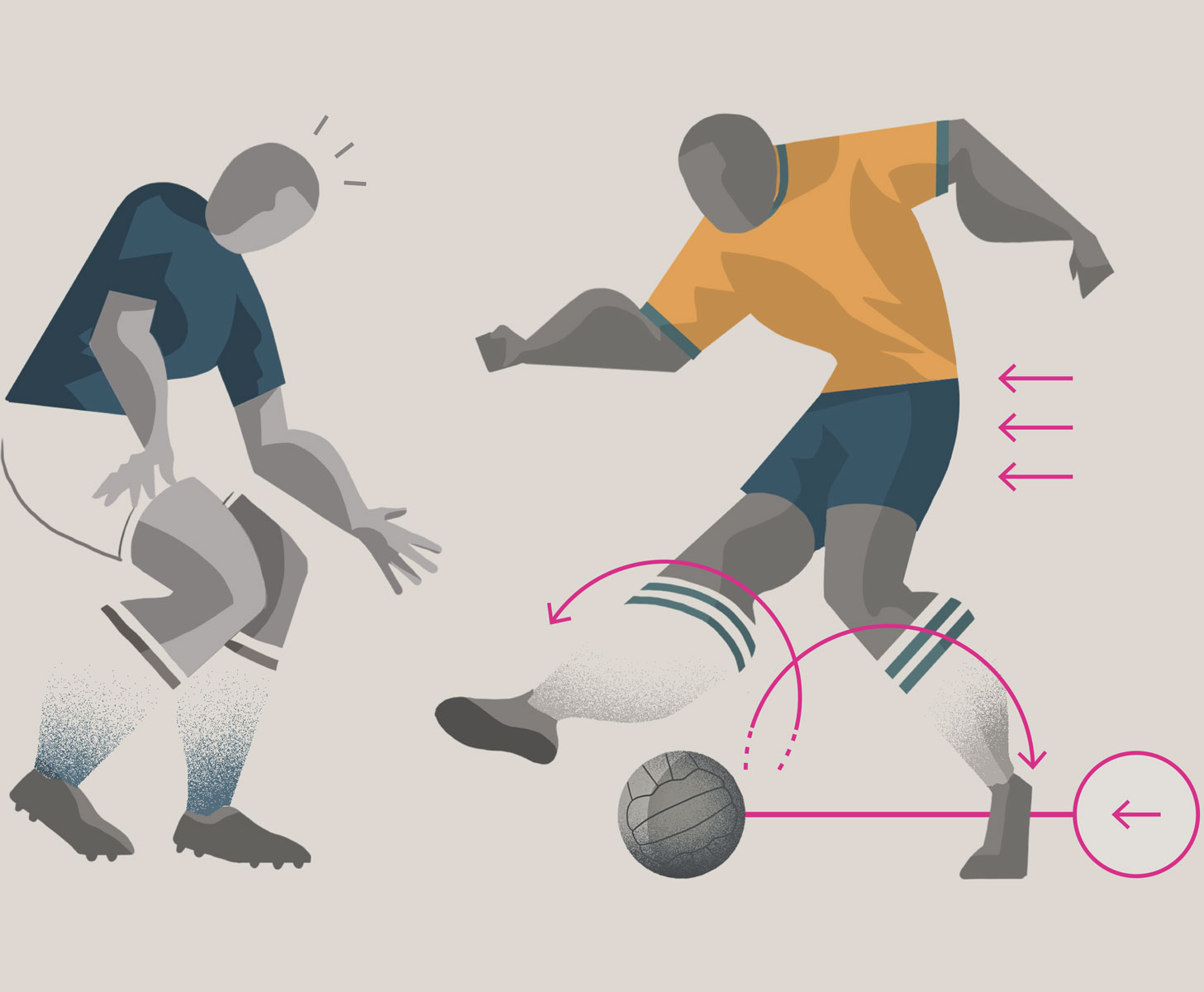
While most players develop a dominant foot, Pelé treated both feet as equals. His left foot wasn’t just competent—it was lethal. This ambidextrous ability meant he could receive, turn, and shoot without adjusting his body position, giving him split-second advantages in tight spaces that defenders couldn’t anticipate.
His dribbling utilized every surface of his feet: inside for tight control, outside for sudden direction changes, sole for stopping momentum, and laces for explosive acceleration. This complete foot vocabulary let him improvise solutions mid-dribble, turning broken plays into scoring chances. Modern players still study his technique to understand how he made defenders commit and then exploited their imbalance.
First Touch That Controlled Game Tempo
Pelé’s first touch did more than control the ball—it dictated the game’s rhythm. A gentle cushion killed 80-mph passes dead. A subtle redirect sent defenders the wrong way. A deft flick set up teammates without looking. This wasn’t just technique; it was telepathy with the ball itself.
Developed through childhood barefoot training on rough surfaces, his touch sensitivity allowed him to control imperfect balls that would trip up shod players. When he received proper equipment, his control became almost unfair—like giving a Formula 1 driver a go-kart track. Opposing teams quickly learned that Pelé’s first touch often decided the play before defenders could react.
Vision That Anticipated Plays Before They Happened
360-Degree Awareness While Dribbling at Full Speed
Pelé possessed what teammates called “eyes in the back of his head.” While dribbling toward goal at full speed, he simultaneously tracked nine other players’ positions. This spatial awareness let him thread passes through seemingly impossible gaps, knowing exactly where teammates would be three seconds later.
His famous assist in the 1970 World Cup final exemplified this. Sprinting right with the ball at his feet, he spotted Carlos Alberto’s run on the opposite flank without looking. The resulting goal wasn’t luck—it was calculated vision that began the moment he received possession. Most players see what’s happening; Pelé saw what would happen.
Decision Speed That Beat Defenders’ Reactions
Every touch presented three options: shoot, pass, or dribble. Pelé’s brain processed these choices faster than defenders could react. In the penalty area, he’d hesitate just long enough to freeze goalkeepers, then slot home. Faced with two defenders closing in, he’d wait until they committed, then slip between them with impossible timing.
This decision speed came from obsessive mental preparation. Before matches, he visualized every possible scenario. When those moments arrived in games, his responses were pre-programmed excellence rather than panic decisions. Modern neuroscience confirms what defenders experienced—Pelé’s brain processed soccer information significantly faster than average players.
Mental Resilience That Thrived Under Pressure
Performing When Millions Expected Miracles
The entire planet expected Pelé to deliver miracles. Brazil’s 1970 team carried national expectations that would crush most athletes. Yet pressure energized him. In crucial matches, his performance elevated while others crumbled. The bigger the stage, the brighter he shone.
This mental strength emerged early. At 17, in the 1958 World Cup final, he scored a hat-trick against hardened Swedish professionals in their home stadium. Most teenagers would wilt under such pressure. Pelé announced his arrival with three goals that made the world take notice. His ability to separate personal performance from external expectations created unshakeable focus.
Creativity That Evolved Faster Than Defensive Tactics
Defenders studied his every move. Teams designed entire tactical systems to stop him. Yet Pelé invented new techniques faster than opponents could adapt. When they figured out his step-overs, he added shoulder feints. When they anticipated his passes, he introduced no-look assists that became standard decades later.
His creativity wasn’t random—it was calculated innovation. Each new move solved specific defensive challenges, keeping him perpetually ahead of tactical evolution. Modern players have video analysis; Pelé had pure instinct and imagination that anticipated defensive trends before they fully developed.
Signature Techniques That Changed Soccer Forever
Bicycle Kick Perfection That Combined Art and Tactics
While others attempted bicycle kicks, Pelé turned them into strategic weapons. His technique was biomechanically perfect—body position, timing, contact point, and follow-through synchronized like choreography. More importantly, he understood when to use it strategically rather than as showboating.
The famous 1968 bicycle kick against Belgium wasn’t just athletic—it was tactical genius. With his back to goal and defenders closing, any other touch would lose possession. The bicycle kick became both escape route and scoring opportunity. Pelé didn’t just perform spectacular moves; he made them essential tools in his attacking arsenal.
Dribbling Innovations That Became Soccer Fundamentals
Pelé didn’t just develop tricks—he created foundational techniques that every player now learns. The step-over, now standard in every player’s arsenal, was his innovation developed to solve specific defensive challenges. By perfecting the timing and deception, he made defenders commit their weight, creating space for explosive cuts.
His shoulder-drop feint became another fundamental move. A subtle shoulder movement sent defenders lunging the wrong way, creating passing lanes that didn’t exist moments earlier. These techniques weren’t just effective—they became required learning for future generations, proving what made Pelé great at soccer extended far beyond his playing days.
Pelé’s greatness wasn’t any single attribute—it was the seamless integration of physical gifts, technical mastery, creative genius, and unshakeable mental strength. His ability to maintain world-class performance across three decades, adapting as his body changed while opponents studied his every move, demonstrates a level of soccer intelligence rarely matched. What made Pelé great at soccer wasn’t just how he played the game, but how he expanded its possibilities, inspiring generations to believe in the beautiful game’s artistic potential. When you watch modern stars like Messi or Neymar, you’re seeing the legacy of Pelé’s innovations—proof that his influence continues to shape soccer’s evolution long after his final match.
I come from the “soccer heart” of Germany, the Ruhrpott. I have played, trained and followed soccer all my life and am a big fan of FC Schalke 04. I also enjoy following international soccer extensively.