Most World Cup Wins by Country Ranked (List)
The countries with the most World Cup wins are Brazil (5), Germany (4), Italy (4), Argentina (3), France (2), Uruguay (2), England (1), and Spain (1). Only these eight nations have ever won the FIFA World Cup, with Brazil holding the record for the most titles.
The ranked list of countries with the most World Cup wins is led by Brazil with five titles, followed by Germany and Italy with four each, Argentina with three, then France and Uruguay with two, and finally England and Spain with one title each. Only these eight nations have ever lifted the trophy.
Most fans can name the top two or three, but the real story lives in the gaps between the numbers. They forget that Germany has reached more finals than anyone yet sits second. They overlook that Italy hasn’t even qualified for the last two tournaments despite being a four-time champion.
This guide ranks every World Cup-winning nation by total titles. We will break down each champion’s golden eras, the iconic players who defined them, and the harsh reality that for over 90 years, football’s ultimate prize has never left two continents.
Key Takeaways
- Brazil’s five titles are unmatched, but their current 24-year drought equals their longest ever.
- Germany and Italy are tied with four wins, but Germany’s eight final appearances are a record.
- Argentina’s 2022 victory, led by Lionel Messi, moved them into sole possession of third place.
- Only eight nations have ever won the World Cup, all from Europe or South America.
- Distinguishing between final appearances and actual wins is critical; the Netherlands holds the record for most finals (3) without a victory.
The Definitive Ranking: Who Has the Most World Cup Wins?
The hierarchy of world football is written in gold. Since 1930, the Jules Rimet Trophy and its successor have been lifted by just eight national teams. The ranking is not just about counting trophies. It is about sustained excellence, iconic generations, and moments that define the sport.
Brazil holds the record with five FIFA World Cup titles (1958, 1962, 1970, 1994, 2002). Germany (including West Germany) and Italy are tied for second with four championships each. Argentina sits third with three titles, most recently in 2022.
The table below lays out the undeniable pecking order. Notice the stark drop-off after the top three.
| Rank | Country | Titles | Winning Years | Key Fact |
|---|---|---|---|---|
| 1 | Brazil | 5 | 1958, 1962, 1970, 1994, 2002 | Only nation to play in every World Cup. |
| 2 | Germany | 4 | 1954, 1974, 1990, 2014 | Holds record for most final appearances (8). |
| 2 | Italy | 4 | 1934, 1938, 1982, 2006 | First nation to win back-to-back titles. |
| 3 | Argentina | 3 | 1978, 1986, 2022 | Lionel Messi’s 2022 win completed his legacy. |
| 4 | France | 2 | 1998, 2018 | 1998 win came as host on home soil. |
| 4 | Uruguay | 2 | 1930, 1950 | Won the inaugural tournament in 1930. |
| 5 | England | 1 | 1966 | Only win came as tournament host. |
| 5 | Spain | 1 | 2010 | First European side to win outside Europe. |
TL;DR: Brazil is the all-time leader with five World Cup wins. Germany and Italy follow with four, but Germany’s consistency in reaching finals is unmatched.
1. Brazil: The Unmatched Standard (5 Titles)
The Brazilian national team’s legacy is the benchmark. Their five titles span eras defined by different footballing philosophies. The 1958 and 1962 teams introduced the world to a 17-year-old Pelé and the magic of Garrincha. The 1970 squad, often called the greatest team ever, played a fluid, attacking style that seemed from another planet.
Their 1994 and 2002 wins were triumphs of pragmatism blended with individual genius. Romário and Bebeto, then Ronaldo and Rivaldo. Yet, for all their history, Brazil’s current title drought is palpable. They haven’t won since 2002, matching the 24-year gap between their 1970 and 1994 victories. The pressure on every Brazil’s past World Cup performances since has been immense.
Common mistake: Assuming Brazil’s attacking flair means they neglect defense. Their 1994 title was built on a rock-solid backline and Dunga’s midfield control, they conceded just three goals in seven matches.
2. Germany & Italy: The Four-Time Titans
Germany and Italy are locked on four titles, but their paths could not be more different.
Germany’s World Cup history is a story of relentless efficiency and reinvention. Their first win as West Germany in 1954 was the “Miracle of Bern.” The 1974 team, led by Franz Beckenbauer, defined Total Football. The 1990 victory was a last hurrah for a divided nation. The 2014 triumph in Brazil was a masterclass in tactical evolution under Joachim Löw. Germany’s eight final appearances underscore a consistency Brazil cannot claim. They are always there.
Italy’s four championships are bookended by unique achievements. Vittorio Pozzo remains the only manager to win two World Cups, leading them to back-to-back titles in 1934 and 1938. Their 1982 win, sparked by Paolo Rossi’s redemption arc, is legendary. Their 2006 victory, sealed by Marcello Lippi’s tactical mastery and Andrea Pirlo’s passing, is their most recent. The contrast is stark today. While Germany remains a perennial contender, Italy’s past World Cup performances have cratered; they failed to qualify for the 2018 and 2022 tournaments.
3. Argentina: The Land of Diego and Lionel (3 Titles)
Argentina’s World Cup victories are narratives of individual divinity. The 1978 win, led by Mario Kempes on home soil, had its own magic. But the 1986 tournament belonged to one man: Diego Maradona. His “Hand of God” and “Goal of the Century” against England defined an era and delivered the title. It took 36 years and another generational talent to add the third star.
Lionel Messi’s coronation in Qatar 2022 felt like a destined closing of a circle. That victory moved Argentina past Uruguay and France into clear third place on the all-time list. The emotional weight of that campaign, detailed in our look at Argentina’s national team achievements, is a modern football epic.
What About Finals Appearances vs. Actual Wins?
This is where casual fans trip up. Reaching the final is an incredible achievement, but it is not the same as winning. The Netherlands is the ultimate example of this distinction, they have played in three finals (1974, 1978, 2010) and lost them all.
Germany’s record of eight final appearances is a testament to their tournament mentality. They find a way to the last game. But they have lost four of those eight. Brazil has seven final appearances and won five of them, a superior conversion rate that cements their status.
The heartbreak of finishing second is a unique pain. It places nations like the Netherlands and Hungary (finalists in 1938 and 1954) in a separate category of “nearly men.” Their absence from the winners’ table does not diminish their quality, but it permanently alters their historical standing.
TL;DR: Germany has been in the most finals (8) but has fewer wins than Brazil. Making the final guarantees nothing, as the Netherlands’ three runner-up finishes prove.
The Runners-Up and Nearly Men
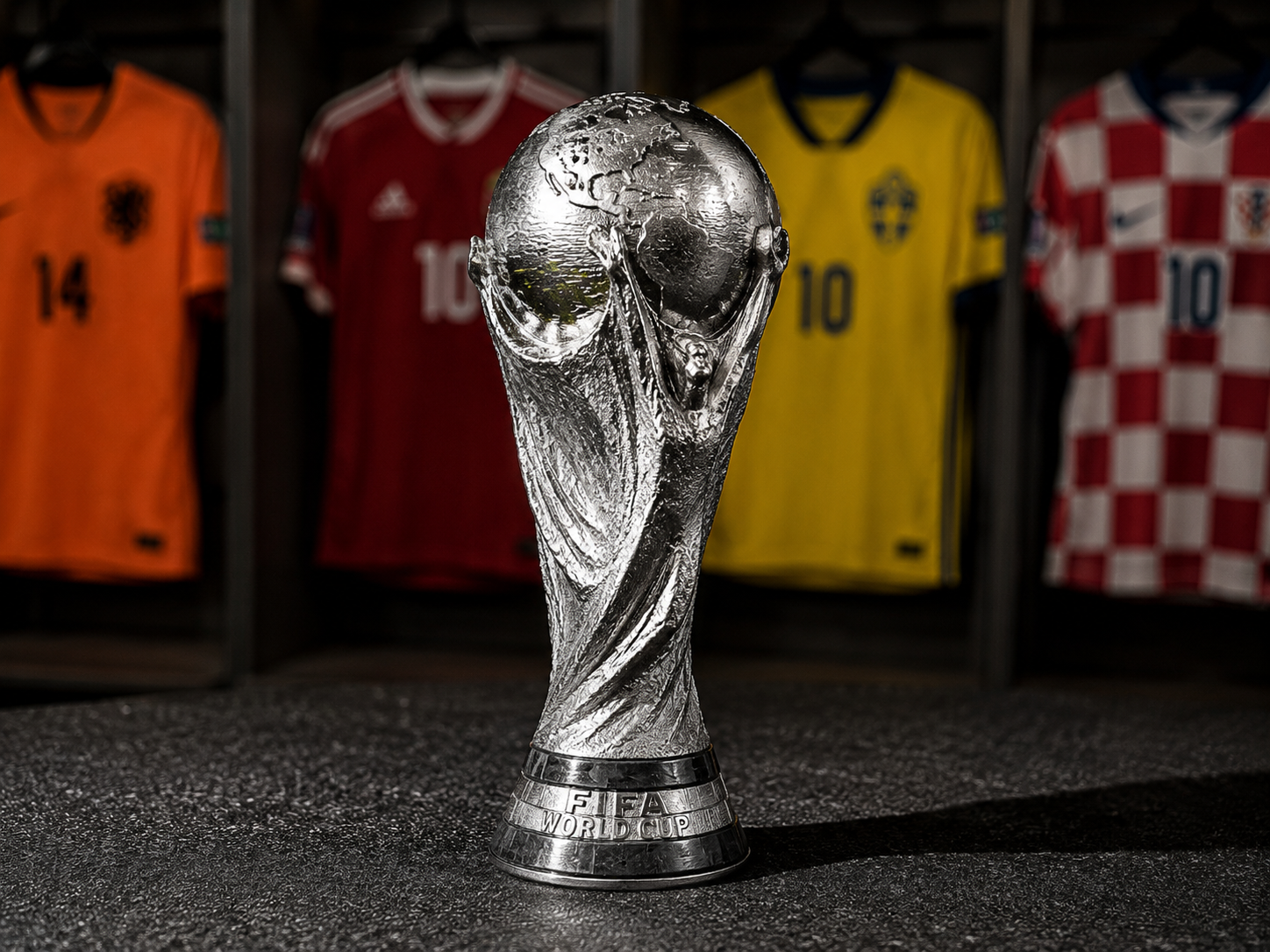
The list of champions is exclusive, but the group of contenders is larger. Several nations have come agonizingly close, shaping tournament drama without claiming the ultimate prize.
- The Netherlands (3 finals, 0 wins): The pioneers of Total Football in the 70s and the 2010 team with Arjen Robben and Wesley Sneijder. Their technical brilliance is undisputed, but the trophy cabinet remains empty.
- Hungary (2 finals, 0 wins): The Magnificent Magyars of the 1950s, featuring Ferenc Puskás, were arguably the best team in the world but lost the “Miracle of Bern” final to West Germany in 1954.
- Sweden (1 final, 0 wins): Hosts and runners-up in 1958, the tournament where a young Pelé announced himself to the world.
- Croatia (1 final, 0 wins): Their stunning run to the 2018 final, led by Luka Modrić, is a modern Cinderella story.
Their stories are integral to the World Cup’s fabric. They provide the tension, the upsets, and the narratives that make the champion’s victory feel earned. For a deeper dive into these dramatic near-misses, our ranking of every World Cup final ranked analyzes the most compelling championship matches.
I’ve lost count of the times I’ve seen a brilliant Dutch team unravel at the final hurdle. In 2010, Robben’s missed one-on-one against Iker Casillas in the 62nd minute still haunts me. Spain scored the winner 28 minutes later. That’s the margin.
The Managers, The Eras, and The “Golden Generations”
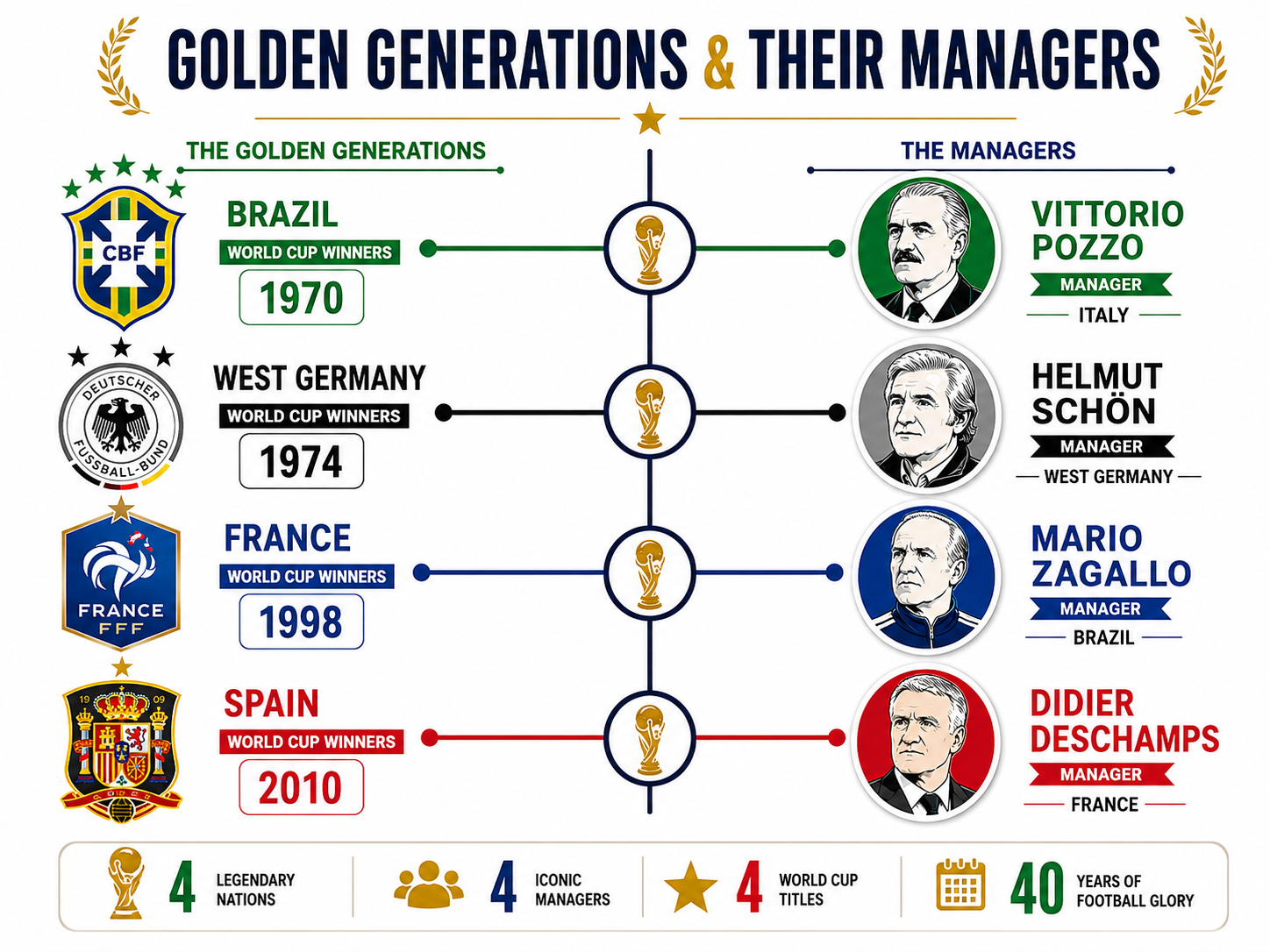
Titles are won by players, but they are orchestrated by managers. Vittorio Pozzo’s double with Italy is the pinnacle. Others have defined eras: Helmut Schön with West Germany in 1974, Mario Zagallo as a player and coach for Brazil, and Didier Deschamps, who captained France’s 1998 win and coached their 2018 triumph.
Each champion nation had a “golden generation” that peaked at the right time.
* Brazil 1970: Pelé, Jairzinho, Tostão, Carlos Alberto. The aesthetic ideal.
* West Germany 1974: Beckenbauer, Gerd Müller, Sepp Maier. The embodiment of Total Football.
* France 1998: Zinedine Zidane, Didier Deschamps, Thierry Henry. A multi-ethnic team uniting a nation.
* Spain 2010: Xavi, Andrés Iniesta, Iker Casillas. The tiki-taka masters who dominated world football.
These groups blended individual talent with a cohesive tactical identity. Their success was not accidental. It was the product of a footballing culture peaking simultaneously, a rare alignment that every nation strives for. The careers of the stars from these eras are chronicled in records like the list of all-time World Cup top scorers.
Has a Host Nation Ever Won the World Cup?
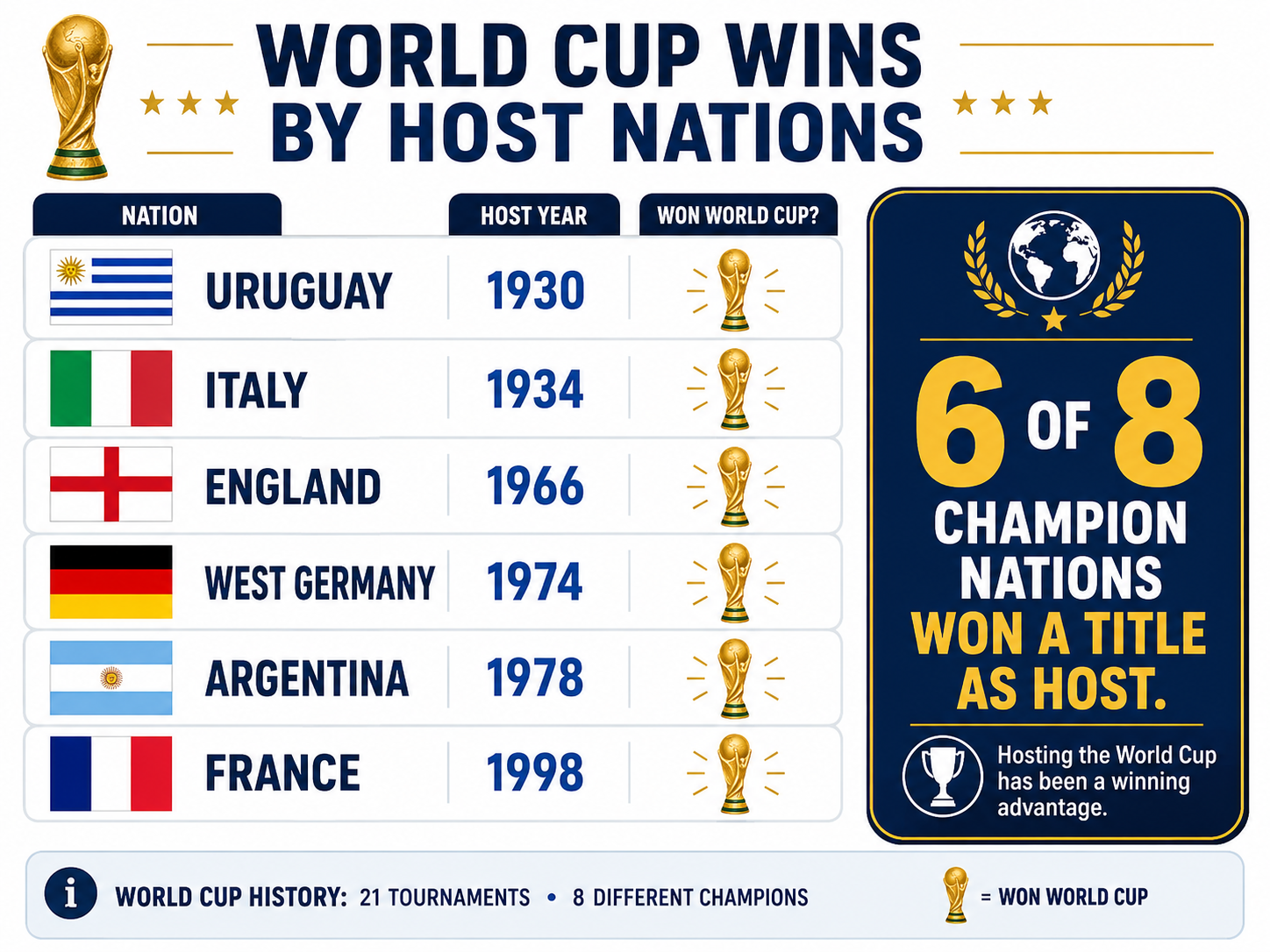
Yes, and it happens more often than you might think. Winning on home soil creates an immortal connection between a team and its country.
- Uruguay (1930): Won the very first tournament as host.
- Italy (1934): Won their first title as host.
- England (1966): Their only title came as host.
- West Germany (1974): Won as host.
- Argentina (1978): Won as host.
- France (1998): Won their first title as host.
The pattern is clear. Home advantage, familiarity, crowd support, less travel, provides a significant boost. Six of the eight champion nations have won at least one of their titles while hosting. This adds another layer to England’s 1966 victory and France’s World Cup victories; they are forever tied to a specific time and place in their national consciousness.
TL;DR: Six World Cup winners, including England and France, won their first title while hosting the tournament. Home advantage is a proven factor in football’s biggest event.
Frequently Asked Questions
Which country has won the most World Cup titles?
Brazil has won the most FIFA World Cup titles, with five championships (1958, 1962, 1970, 1994, 2002). They are the only nation to have participated in every single tournament since its inception in 1930.
How many World Cups does Germany have?
Germany has four World Cup titles. They won as West Germany in 1954, 1974, and 1990, and as a unified Germany in 2014. They also hold the record for the most final appearances, with eight.
Is Italy still a 4-time World Cup champion?
Yes, Italy remains a four-time World Cup champion (1934, 1938, 1982, 2006). However, they have not qualified for the last two tournaments (2018 and 2022), which has sparked debate about the current state of their national team despite their rich Italy’s national team legacy.
Who has more World Cups, Argentina or France?
Argentina has more World Cup titles than France. Argentina has three wins (1978, 1986, 2022), while France has two (1998, 2018). Argentina’s 2022 victory moved them definitively ahead.
How many countries have never won the World Cup?
The vast majority of countries have never won the World Cup. Only eight nations have ever won it: Brazil, Germany, Italy, Argentina, France, Uruguay, England, and Spain. All other participating nations, including footballing powers like the Netherlands and Portugal, are still seeking their first title.
Which player has won the most World Cups?
Only one player has won the World Cup three times: Brazilian legend Pelé (1958, 1962, 1970). Twenty other players have won it twice, mostly from Italy’s 1934/1938 squads and Brazil’s 1958/1962 teams.
The Bottom Line
The ranking of most World Cup wins by country is a history lesson written in victories. Brazil’s five stars set a high bar that has stood for over two decades. Germany and Italy’s four titles speak to sustained European power, though their current trajectories are diverging. Argentina’s third star, freshly polished, cements their place among the gods.
Remember, this list has only eight names. For all the global growth of the sport, the trophy has never traveled to Africa, Asia, or North America. That fact alone tells you everything about the concentration of football history and the scale of the challenge facing the next generation.
The numbers are fixed, but the stories behind them, the greatest World Cup moments, the missed penalties, the tactical revolutions, are what keep us watching every four years. The quest to join this list, or to climb it, is the drama that defines the sport.

I come from the “soccer heart” of Germany, the Ruhrpott. I have played, trained and followed soccer all my life and am a big fan of FC Schalke 04. I also enjoy following international soccer extensively.