Explaining Why the Away Goals Rule Was Removed From Soccer
The away goals rule was removed from all UEFA club competitions in June 2021 because it had become counterproductive. UEFA’s data showed home advantage had drastically declined since the rule’s 1965 introduction, and the rule now encouraged defensive play from home teams fearful of conceding a decisive away goal. Ties level on aggregate now proceed directly to extra time and penalties.
For decades, that rule was the invisible hand shaping every two-legged European tie. Coaches built entire strategies around it, and a single away goal could feel heavier than three scored at home. The problem wasn’t the math. It was the psychology.
The rule’s abolition changed the tactical DNA of the Champions League and Europa League overnight. This guide walks through the official reasons, the data that backed the decision, and what it actually means for the drama of knockout football.
Key Takeaways
- UEFA abolished the away goals rule in June 2021, effective from the 2021/22 season.
- The primary reason was the rule’s unintended effect: it made home teams too defensive, afraid to concede a critical away goal.
- Statistical analysis showed home advantage in European competitions had plummeted from 61% home wins in the 1970s to 47%.
- Level aggregate scores now trigger 30 minutes of extra time, then a penalty shootout—the away goals rule is no longer a tiebreaker.
- The rule is still used as a secondary criterion to separate teams tied on points in the group stage.
The Official Reasons UEFA Gave
UEFA President Aleksander Čeferin didn’t mince words. He stated the away goals rule‘s impact now ran “counter to its original purpose.” Introduced in 1965 to encourage adventurous play from visiting teams, it had flipped. By the 2010s, it was the home team that often parked the bus.
The away goals rule was introduced in 1965 to encourage attacking play from visiting sides in two-legged ties. After decades of use, UEFA’s analysis concluded it now produced the opposite effect, with home sides becoming excessively cautious to avoid conceding a potentially decisive away goal.
The fear was tangible. A 1-0 home win in a first leg was once a great result. Under the away goals rule, it became a nervy, fragile lead. Concede once at home, and your opponent leaves with a critical away goal and the momentum. This led to first legs often being cagey, tactical stalemates.
TL;DR: UEFA scrapped the rule because it backfired, making home teams defensive instead of encouraging away teams to attack.
The Data on Dying Home Advantage
UEFA’s decision wasn’t based on a feeling. It was backed by a clear statistical trend tracked over 50 years. Home advantage in European club competitions had eroded dramatically.
| Era | Home Win Percentage | Average Home Goals/Match | Key Factors |
|---|---|---|---|
| Mid-1970s | 61% | 2.02 | Poor away travel, variable pitch conditions, intense local crowds. |
| 2021 (Pre-abolition) | 47% | 1.58 | Standardized pitches, VAR, comfortable travel, global TV coverage. |
The gap had nearly vanished. The intimidating, uneven pitches and grueling bus journeys of the 1960s were gone. Modern stadiums are uniform, travel is by chartered flight, and Video Assistant Referees (VAR) reduce the impact of partisan crowds. The original problem the rule solved didn’t exist with the same force.
Common mistake: Thinking the away goals rule was removed just because it was unpopular. The decision was data-led, following a measurable collapse in home advantage that undermined the rule’s very premise.
How the Rule Actually Changed Team Behavior
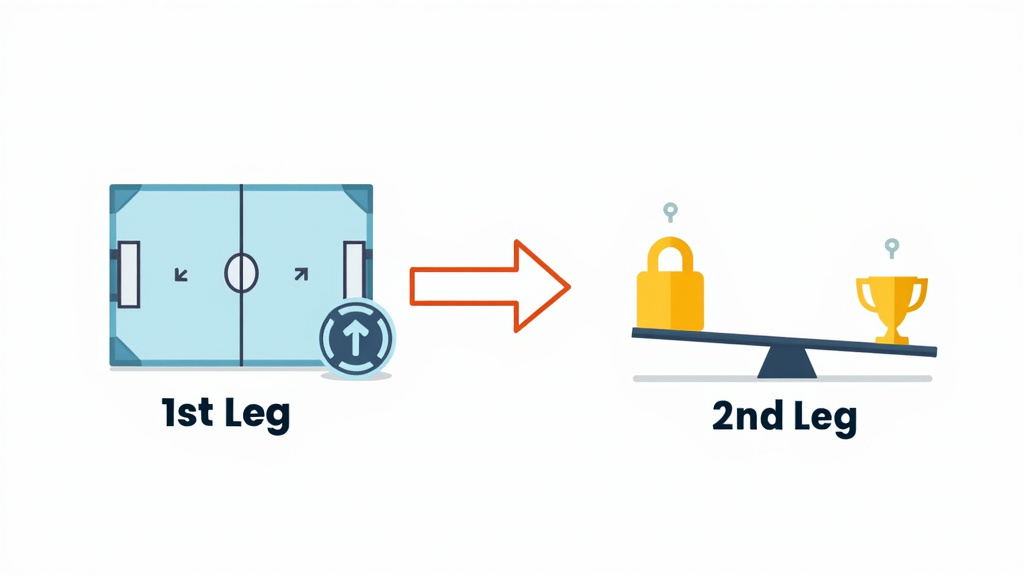
Watch a first leg from the 2010s. The home team, even a superior one, frequently starts conservatively. The priority isn’t to build a lead; it’s to secure a clean sheet. A 0-0 draw at home was often seen as a better result than a risky 2-1 win. This was the rule’s perverse incentive at work.
Away teams, knowing the value of any goal, would sometimes play for a single counter-attack. The spectacle suffered. The rule meant a 2-2 draw wasn’t equal—the away team celebrated. A 1-0 home win felt incomplete. It warped the natural flow of a two-match contest.
The second leg introduced another quirk: the “away goals in extra time” asymmetry. If a tie went to extra time in the second leg, the away team had a full 30 minutes to score a golden away goal. The home team, having already played its away leg, had no such equivalent chance. Coaches like Diego Simeone and Arsene Wenger had long called this unfair.
What Replaced the Away Goals Rule?
The new procedure is simpler and, in UEFA’s view, fairer. When two teams finish their two-legged knockout tie with an equal aggregate score, the away goals rule is not consulted.
The current tie-breaking sequence is:
- Two 15-minute periods of extra time are played immediately.
- If the score remains level after 120 total minutes, a penalty shootout determines the winner.
- There is no intermediate “away goals count double” step.
This change applies to every UEFA club competition: the Champions League, Europa League, UEFA Conference League, and their women’s and youth equivalents. It makes planning straightforward. A 2-1 home win followed by a 1-0 away loss now sends the tie to extra time at 2-2 on aggregate, instead of eliminating the home team on away goals.
It’s worth noting the aggregate score calculation itself hasn’t changed. You still add the goals from both matches. Only the tiebreaker applied to that total is different.
Where the Away Goals Rule Still Exists
The rule is not completely dead in European football. It survives in one specific niche: the group stage.
In UEFA competitions, if two or more teams finish a group with the same number of points, their head-to-head record is the first tiebreaker. If they remain tied after that, the next criterion is goal difference in the head-to-head matches. If that is also equal, the tiebreaker is goals scored away from home in the head-to-head matches.
So, while it’s gone from the knockout drama, the away goals rule still quietly influences who finishes second or third in a group. This nuance is often missed in discussions about its abolition.
A Rule Born from a Different Era
To understand why it was removed, you have to understand why it was created. European club travel in the 1960s was an ordeal. Teams took long train or bus journeys to away matches, often played on muddy, poorly maintained pitches in front of hostile crowds. The disadvantage was massive. The away goals rule was a handicap, a way to balance the scales and give the traveling team a reason to attack.
I remember older coaches in the Ruhrpott talking about European trips in the 70s. The stories weren’t about tactics; they were about survival. Getting a 0-0 draw away was a heroic result. The rule made sense then.
By 2021, a team from London flies to Milan in a private cabin, recovers in a similar five-star hotel, and plays on a pristine, standardized pitch under identical floodlights. The sporting disadvantage is minimal. The original justification had evaporated.
The Fan and Expert Reaction

The decision split opinion, as any major rule change does. Purists lamented the loss of a unique strategic layer. They argued the away goals rule created iconic, tension-filled moments and rewarded tactical discipline on the road.
Many coaches and analysts, however, welcomed it. The consensus was that football had evolved. Arsene Wenger had been a vocal critic, arguing the rule was outdated. The removal has led to more aggressive first-leg approaches, particularly from big clubs at home. They now play to win, not just to avoid conceding.
The change also reframes the value of a draw. An away draw, once a fantastic result, is now just a decent one. The incentive is squarely on winning both legs.
Frequently Asked Questions
When was the away goals rule officially removed?
UEFA announced the abolition on June 24, 2021. The change took effect starting with the qualifying rounds of the 2021/22 season for all UEFA club competitions.
What happens if the aggregate score is tied now?
The match goes directly to extra time—two periods of 15 minutes each. If the tie remains level after extra time, it is decided by a penalty shootout. The away goals rule is not used.
Do other leagues or competitions still use the away goals rule?
Yes. UEFA’s decision only applies to its own competitions (Champions League, Europa League, etc.). Other international tournaments, like the CONCACAF Champions Cup, and some domestic cup competitions in various countries may still use the rule. Always check the specific competition regulations.
Why is it still used in the group stage?
In the group stage, it acts as a secondary tiebreaker after head-to-head points and goal difference. It provides a clean, existing metric to separate teams without requiring additional matches like extra time, which are only feasible in knockout rounds.
Has the change made matches more exciting?
That’s subjective. Data suggests first legs are slightly more open, as home teams attack more. The elimination of the “away goal in extra time” quirk is generally seen as fairer. The drama has shifted from the calculation of away goals to the raw tension of extra time and penalties.
Could the rule ever come back?
It’s highly unlikely. Rule changes in football, especially ones backed by extensive data and approved by UEFA’s executive committee, are rarely reversed. The trend globally is also moving away from the away goals rule.
Before You Go
UEFA’s move was a recognition that football is a living sport. A rule designed for the muddy pitches and train journeys of 1965 didn’t fit the globalized, standardized game of the 21st century. Its removal was a correction, not an attack on tradition.
The new landscape is simpler. Win your home match, try to win away, and if you’re tied, prove it in extra time and penalties. It places the emphasis back on pure sporting contest over a complex arithmetic equation. The physical nature of soccer is now the ultimate decider, not a historical footnote in the rulebook.
I come from the “soccer heart” of Germany, the Ruhrpott. I have played, trained and followed soccer all my life and am a big fan of FC Schalke 04. I also enjoy following international soccer extensively.