World Cup Group F Scenarios: Qualification Paths Explained
This post contains affiliate links. As an Amazon Associate, we earn from qualifying purchases.
To qualify from World Cup 2026 Group F, a team must finish in the top two positions or rank among the eight best third-placed teams across all twelve groups. The Netherlands, Japan, and Tunisia are confirmed, joined by the winner of a European play-off between Northern Ireland, Wales, and the Republic of Ireland. Advancement hinges on points, then a cascade of tie-breakers starting with head-to-head results.
Most analysis stops at the simple “top two go through” rule. That misses the entire strategic layer introduced by the new 48-team format. The real puzzle isn’t just winning your group, it’s navigating the third-place rankings that span a dozen different mini-leagues.
This guide breaks down every possible qualification scenario for Group F. You’ll see the exact point targets for safety, the tie-breakers that decide close calls, and what the knockout bracket looks like for each finishing position.
Key Takeaways
- Third place with 4 points is a near-certain ticket; 3 points is probable but requires a positive goal difference.
- Head-to-head results only break ties within Group F. Comparing third-placed teams across different groups uses overall goal difference.
- The Group F winner faces a group runner-up, an easier path than the Group F runner-up, who draws a group winner.
- Fair play points (yellow/red cards) are the fifth tie-breaker. A single straight red card can be the difference between going home and advancing.
- The final group matches kick off simultaneously to prevent collusion over specific results that could influence the third-place table.
How Do Teams Advance from Group F?
The 2026 World Cup’s expanded format changes the calculus completely. Sixteen additional teams mean twelve groups of four. From each group, the top two finishers, 24 teams total, march directly into the Round of 32.
The remaining eight spots are filled by the best third-placed teams from across the tournament. This system, borrowed from the European Championships, turns every group into a double race: compete for the top, but also benchmark your performance against every other third-placed team globally.
The advancement rules for the 2026 World Cup group stage are defined by FIFA’s 48-team format: 12 groups (A-L) of four teams each. The top two teams from each group (24 teams) qualify automatically. The eight best third-placed teams, ranked by points, then overall goal difference, then goals scored, fill the remaining Round of 32 slots.
TL;DR: Finish first or second and you’re in. Finish third and you need a better record than at least four other third-placed teams worldwide.
The Confirmed Group F Contenders
Three of the four slots are locked. The Netherlands brings its typical technical pedigree and pressing game. Japan counters with relentless organization and pace, a nightmare for any team having an off day. Tunisia offers disciplined defensive structure and quick transitions.
The final spot belongs to the winner of the European play-off path. This pits Northern Ireland’s physicality, Wales’s Gareth Bale-less new generation, and the Republic of Ireland’s direct approach against each other. Whoever emerges will be the group’s wildcard, likely adopting a low-block, counter-attacking soccer tactic to scrape points.
| Team | Key Qualification Strength | Primary Weakness |
|---|---|---|
| Netherlands | Positional play, high press | Can be vulnerable to rapid counters |
| Japan | Team cohesion, midfield energy | Sometimes lacks a physical presence |
| Tunisia | Defensive organization, set pieces | Can struggle to create against deep blocks |
| Play-off Winner | Motivation, underdog spirit | Likely the least technical squad |
The group draw avoids a true “Group of Death,” but it creates a fascinating tactical clash. You’ll see a high Dutch line tested by Japan’s runs in behind. You’ll see Tunisia trying to break a Japanese press. The play-off winner will park the bus. It’s a strategist’s dream.
The Head-to-Head Tie-Breaker That Trumps Everything
If two or more teams finish level on points, the first thing FIFA does is ignore the other groups. They create a mini-table involving only the tied teams. The ranking in this mini-table decides who finishes higher.
The criteria for this mini-table are sequential:
1. Points earned in the matches between the tied teams.
2. Goal difference in those matches.
3. Goals scored in those matches.
Only if teams remain tied after these three steps does the tie-breaker move to overall group goal difference. This rule makes every direct duel a potential double-whammy, you lose three points and also cede the primary tie-breaker.
Common mistake: Assuming overall goal difference is the first tie-breaker, it’s not. Head-to-head record isolates the matches between the tied teams and ranks them first. A team that wins its direct clash holds a massive advantage, even with a poorer overall goal difference.
Imagine Japan, Tunisia, and the play-off winner all finish on 4 points. The Netherlands won the group with 7. Japan beat Tunisia but lost to the play-off winner. Tunisia beat the play-off winner but lost to Japan. The play-off winner beat Japan but lost to Tunisia. All three have 3 points in the mini-table, with a goal difference of 0. It would then go to goals scored in those specific games. A single goal in a 1-0 win becomes monumental.
This system rewards teams that show up in the biggest games. It punishes those who pile up goals against weaker opposition but fail in direct clashes. For a team like Tunisia, stealing a win against Japan could be more valuable than a draw against the Netherlands.
The Critical Third-Place Race
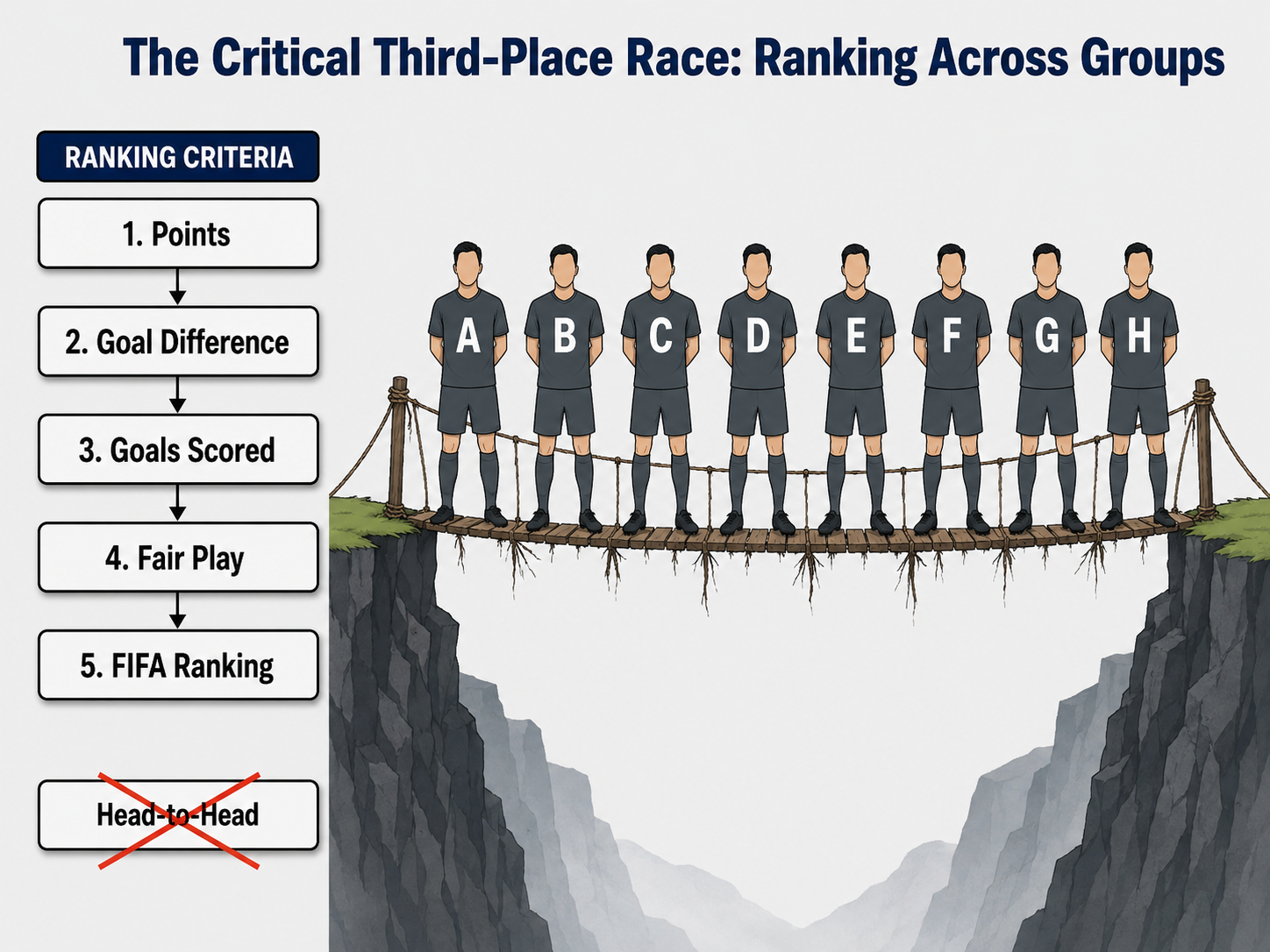
Finishing third is no longer a death sentence. It’s a lifeline, but one attached to a very thin rope. Your fate isn’t just in your hands; it’s in the hands of eleven other groups.
The ranking of the eight best third-placed teams uses a different, simpler set of criteria:
1. Points
2. Overall goal difference
3. Overall goals scored
4. Fair play points
5. FIFA World Ranking
Notice what’s missing: head-to-head results. FIFA does not compare who beat whom across different groups. A third-placed team with 4 points and a +1 goal difference will always rank above a third-placed team with 3 points and a +4 goal difference. Points are king.
| Third-Place Points | Likelihood of Advancing | Critical Factor |
|---|---|---|
| 4 Points | Very High (>95%) | Almost always enough; goal difference rarely matters. |
| 3 Points | Likely (~65%) | Positive goal difference is usually mandatory. |
| 2 Points | Possible but Risky (~25%) | Requires a very strong goal difference (+2 or better) and favorable results elsewhere. |
| 1 Point | Extremely Unlikely (<5%) | Would require multiple groups where all third-placed teams also have 1 point. |
The push for goals in the final group game becomes a brutal calculus. A team sitting on 3 points with a 0 goal difference might need to chase a second or third goal in a tight match, opening itself up to a counter-attack that could seal its elimination. I’ve seen teams in the Euros knock themselves out by over-attacking for the goal difference they thought they needed, only to concede on the break.
The expanded format means more teams are still alive on the final matchday. This creates more simultaneous pressure across multiple stadiums. The team that advances from third place is often the one that manages this pressure best, not necessarily the one with the most talent.
What Does Each Team Need to Qualify?
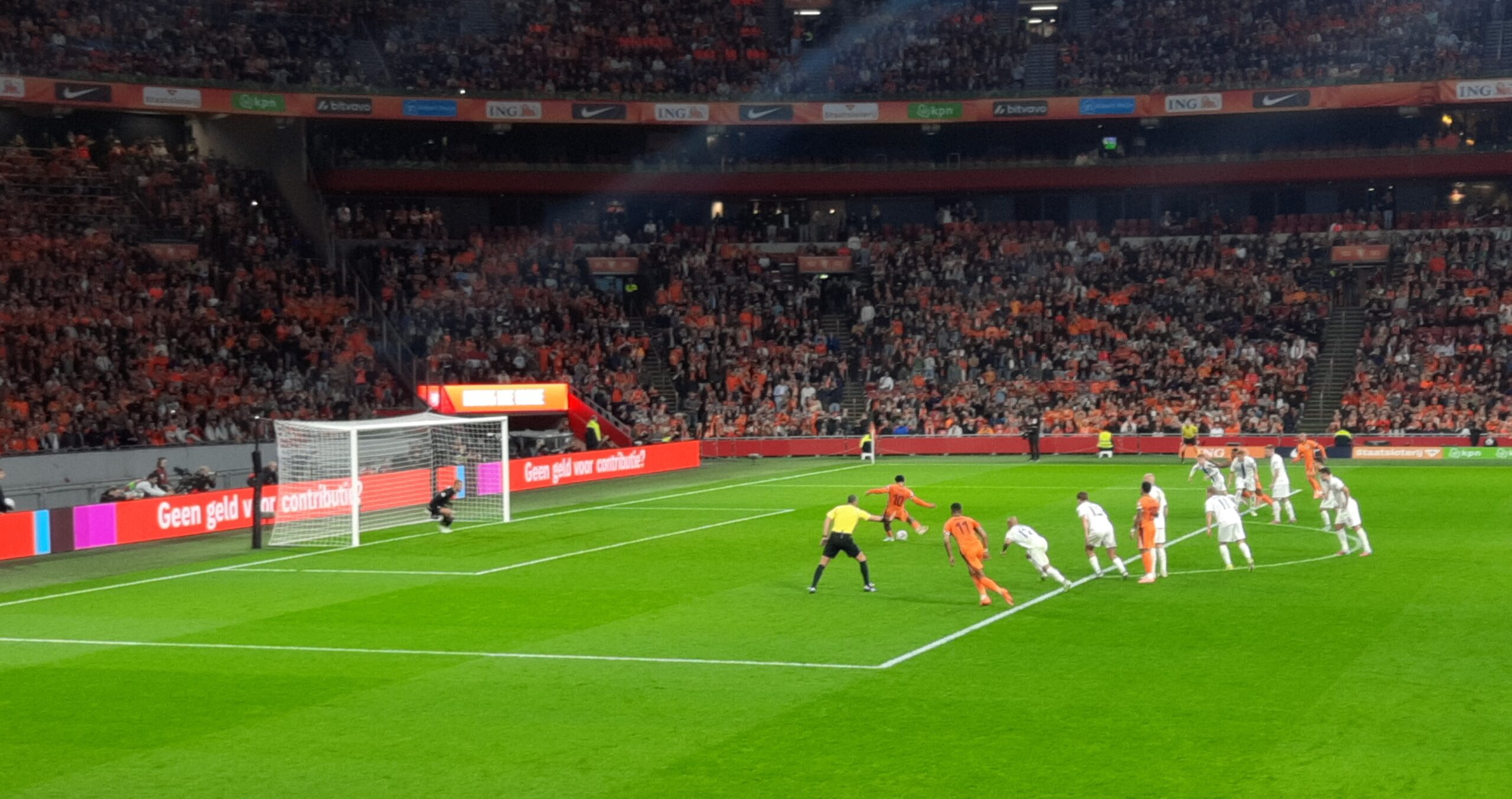
Photo: Ciell / Wikimedia Commons / CC BY-SA 4.0

Projecting scenarios requires looking at team strengths and the schedule. While the exact fixture order isn’t set, we can model the likely pathways.
Netherlands’ Path: The Dutch should target winning the group. Their quality makes 7 points a realistic goal. Even 5 points (a win and two draws) should secure a top-two finish. The nightmare scenario is a loss to Japan and a draw with Tunisia, leaving them on 4 points and reliant on tie-breakers or the third-place lottery. They have the talent to avoid that.
Japan’s Path: Japan’s key match is likely against the Netherlands. A draw there sets them up beautifully. Beating Tunisia and the play-off winner would then see them top the group. More realistically, they’ll aim for 5 points: beat the play-off winner, draw with Tunisia and the Netherlands. That total almost certainly secures advancement, likely in second place.
Tunisia’s Path: Tunisia’s mission is to be the group’s disruptor. Beating the play-off winner is non-negotiable. Stealing a point from either Japan or the Netherlands would put them on 4 points, a very strong position for either second or third. Their defensive solidity is built for these tight, low-scoring games where a single set-piece goal can decide everything.
Play-off Winner’s Path: The objective is simple: survive. A draw against anyone would be a massive result. The most likely path to relevance is a 0-0 grind against Tunisia, maybe snatching a 1-0 win if they catch a break. Three points might be enough for a third-place comparison. Their entire tournament could hinge on a single goal difference swing in a match played 2,000 miles away in another group.
I remember watching Costa Rica in 2014. They were drawn with Uruguay, Italy, and England, a certain group of death. Everyone wrote them off. They won the group with 7 points. The play-off winner in Group F has that same potential for a storybook run, but it starts with believing one point is a building block, not a failure.
Where Do Group F Teams Go in the Knockouts?
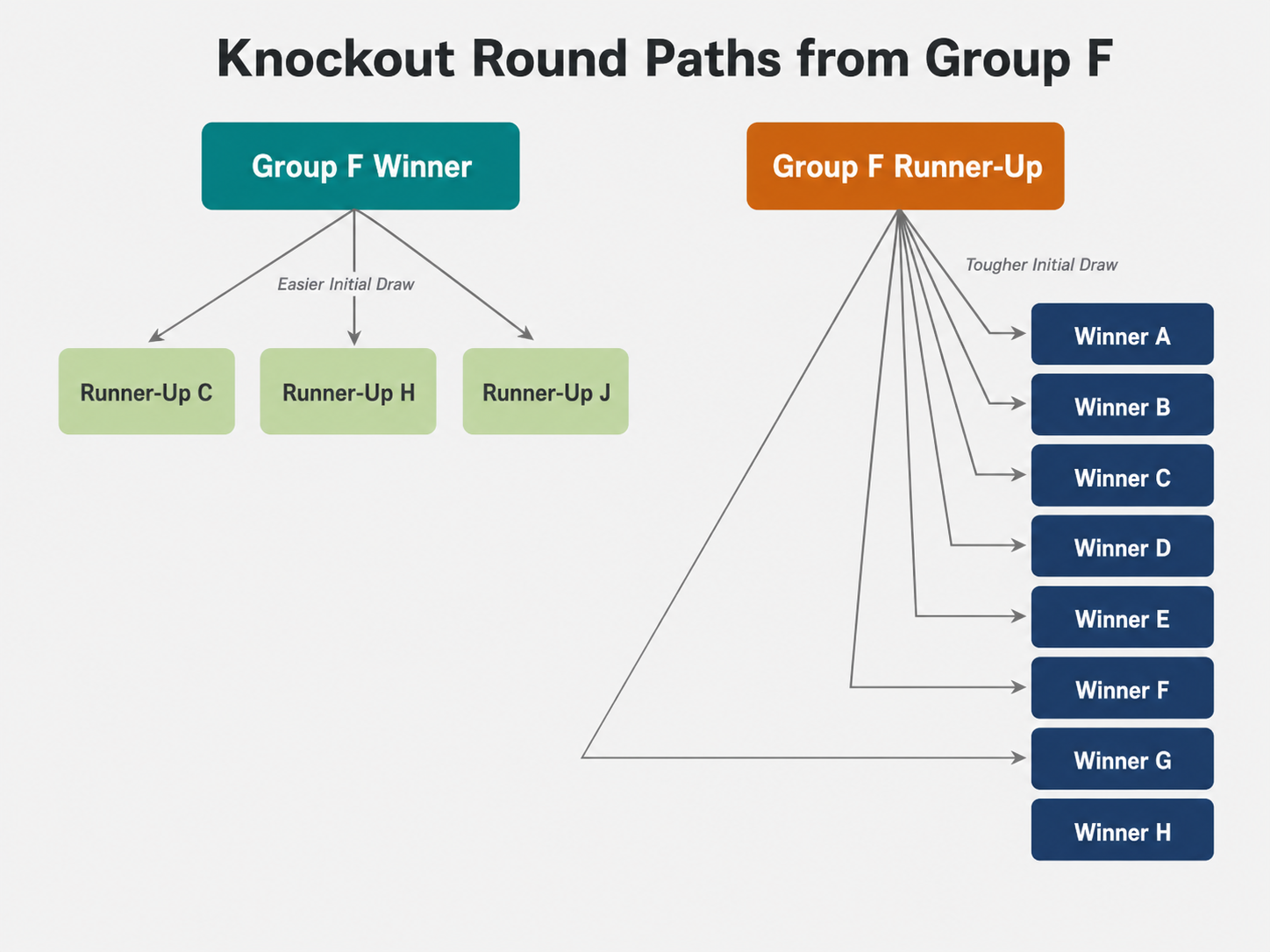
Qualification is only half the battle. Where you finish in the group determines your opponent in the Round of 32, which in turn sets your path through the tournament.
The Group F winner has a significantly easier initial draw. They will face a runner-up from one of three specific groups: C, H, or J. Avoiding other group winners in the first knockout round is a massive advantage in a tournament where fatigue accumulates quickly.
The Group F runner-up gets a much tougher assignment. They will be paired with a group winner, likely from Groups A, B, D, E, G, I, K, or L. This could mean facing a tournament favorite like Brazil, France, or Argentina in the very first knockout match.
A third-placed qualifier faces a group winner, but not necessarily the strongest one. The bracket is structured to avoid early rematches from the group stage. This means a third-placed team from Group F could land a slightly more favorable matchup against a group winner from a weaker pool.
TL;DR: Winning Group F is worth fighting for. It likely means facing a second-placed team you can beat, rather than a group champion who can end your tournament in 90 minutes.
The Travel and Rest Factor
The 2026 World Cup is spread across North America. A team that wins Group F might play its Round of 32 match in Vancouver. The runner-up might have to fly to Guadalajara. A third-placed team could be sent to Miami. The difference in time zones, climate, and travel distance is a real competitive factor that isn’t shown on the bracket graphic.
FIFA’s scheduling aims to provide adequate rest, but a team that finishes second and has to cross three time zones for its next match is at a tangible disadvantage. This adds another layer to the final group game: is it worth exhausting your starters to win the group and get a better opponent, if it means they’re less fresh for the travel ordeal?
Frequently Asked Questions
What is the minimum points needed to advance from Group F?
Historically, in tournaments with best third-place teams, 4 points guarantees advancement. Three points is usually enough, but there is a small risk if many other groups produce high-point third-place finishers. Two points is the absolute minimum with a chance, requiring a very strong goal difference and chaos elsewhere.
Do head-to-head results matter for third-place teams?
No, not when comparing third-placed teams from different groups. The ranking of the eight best third-placed teams uses overall points, then overall goal difference, then overall goals scored. Head-to-head is only used to break ties within a single group’s standings.
Who will the Group F winner play in the Round of 32?
The Group F winner will face the runner-up from either Group C, Group H, or Group J. This is a favorable draw, as it avoids other group winners in the first knockout round.
Can a team with a negative goal difference advance in third place?
It’s possible but highly unlikely. With 4 points, a negative goal difference might still be okay. With 3 points, a negative goal difference makes advancement very difficult, as you will be behind any other 3-point team with a zero or positive difference.
How do fair play points work?
Fair play points are a deduction system. A yellow card costs -1 point, an indirect red card (two yellows) costs -3 points, and a direct red card costs -4 points. These totals are used as the fifth tie-breaker, after points, goal difference, goals scored, and head-to-head. A single red card at the wrong moment can be the difference between going home and advancing.
Where can I find the latest qualification updates?
For the most current view of the evolving picture, the BBC Sport qualification overview provides reliable, up-to-date tracking of which teams are close to securing their spot.
The Bottom Line
Understanding World Cup 2026 Group F scenarios means looking beyond the simple table. It’s about the head-to-head duels that decide ties, the goal difference chase that decides third-place fates, and the bracket destiny that rewards the group winner.
For the Netherlands, anything less than top spot is a disappointment. For Japan, it’s a chance to prove they belong with the second tier. For Tunisia, it’s an opportunity to spring an organized upset. For the play-off winner, it’s a dream just to be there, with everything to gain.
The matches will be tense, the calculations will be live, and the margins will be razor-thin. That’s the beauty of the new format. More teams have hope, and more fans have reason to watch until the very last second of the group stage.
I come from the “soccer heart” of Germany, the Ruhrpott. I have played, trained and followed soccer all my life and am a big fan of FC Schalke 04. I also enjoy following international soccer extensively.