5-3-2 Soccer Formation: The Complete Tactical Guide
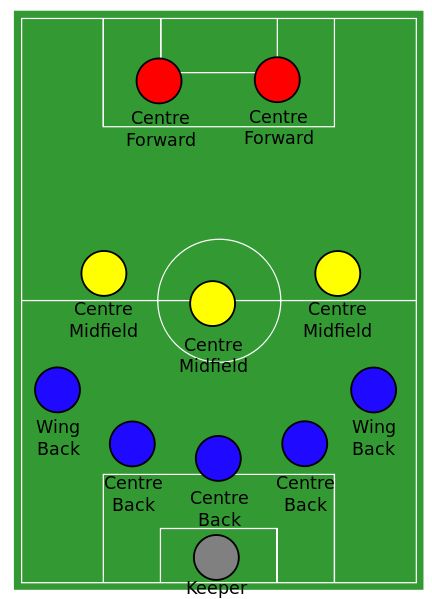
The 5-3-2 soccer formation is a defensive system using five defenders, three midfielders, and two forwards. Its strength is a solid back line and quick counter-attacks via wing-backs and strikers. Execution demands immense stamina from wide defenders and strict tactical discipline from the entire team.
The 5-3-2 formation in soccer is a balanced defensive-attacking system built on five defenders, three central midfielders, and two forwards. Its core strength is defensive solidity through a back five, which provides numerical superiority in your own half, paired with rapid counter-attacks launched through a dedicated strike partnership and advancing wing-backs. Success hinges on the stamina of your wide defenders and the disciplined coordination of the entire unit.
Most teams get this wrong by treating the 5-3-2 as a passive, low-block bunker. They park the bus, invite pressure, and hope for a lucky break. That’s a sure way to lose 1-0 after conceding in the 89th minute. The real 5-3-2 is a spring-loaded trap. It absorbs pressure deliberately, but only to snap forward the moment the opponent overcommits.
This guide breaks down the system from the ground up. You’ll get the specific player roles, the pressing triggers that actually work, the adjustments you must make against common formations like the 4-3-3, and the training drills that build the required collective understanding.
Key Takeaways
- The 5-3-2’s primary advantage is central compactness and defensive overloads, making it extremely difficult for opponents to play through the middle.
- Wing-backs are the system’s engine; they must possess elite stamina to fulfill defensive duties in a back five while providing the team’s only wide attacking threat.
- This formation excels in transitional moments, shifting from a compact 5-3-2 block to a 3-5-2 in attack faster than most teams can reorganize.
- It is vulnerable to quick switches of play and teams that can isolate your wing-backs one-on-one, requiring intelligent midfield shuffling.
- Implementing it successfully is less about individual talent and more about drilling collective movement until the unit shifts as one organism.
The Core 5-3-2 Player Roles and Responsibilities
Forget generic labels like “defender” or “midfielder.” In a finely tuned 5-3-2, every position has a specific, non-negotiable function. The system fails if one player misunderstands his job.
The 5-3-2 formation organizes ten outfield players into three distinct lines: a defensive line of five, a midfield line of three, and an attacking line of two. The three center-backs form a central barrier, with the two wide center-backs responsible for covering the half-spaces. The wing-backs operate as hybrid defenders and wingers, dropping to form a back five defensively and providing width in attack. The three midfielders control the central corridor, with roles typically divided between a defensive anchor, a box-to-box shuttler, and an advanced playmaker. The two forwards work in tandem to press, hold up play, and finish transitions.
The back three are your foundation. The central center-back is your organizer, often stepping into midfield with the ball. The two outer center-backs must be comfortable defending large spaces in the channel, the area between the center and the touchline. They are not full-backs. Their first job is to stay compact, not chase wingers to the corner flag.
The wing-backs are your most physically demanding players. In a single match, a top-level wing-back in this system will cover over 11 kilometers. Their defensive starting position is level with the back three, forming a flat line of five. When the team wins possession, their first thought is to sprint forward into the space vacated by the opposing full-back. They are the sole providers of width.
Common mistake: Using traditional full-backs as wing-backs, they lack the aerobic capacity for the constant sprints and will be caught upfield, leaving the back three exposed to a simple switch of play. You’ll see the gap by the 60th minute, and the opponent will score from it.
The midfield trio requires clear role definition. One sits as a single pivot just ahead of the defense, protecting Zone 14, the area in front of your penalty box. The other two must be complementary: one to carry the ball forward and one to make late runs into the box. This is not a committee. If all three try to do the same thing, you lose control.
TL;DR: Assign specific, complementary roles to each of your three midfielders and invest in athletes, not just technicians, for the wing-back positions.
Why the 5-3-2 Works: Strengths and Inherent Weaknesses
This formation is a tool for specific jobs. It’s not universally brilliant, but in the right context, its strengths are overwhelming.
Its greatest strength is defensive overload and central control. With five defenders and three central midfielders, you have eight players naturally positioned to clog the middle of the pitch. This forces opponents wide into less dangerous crossing positions, where your aerially dominant center-backs can deal with the ball. It’s a nightmare for teams that rely on playing through a central playmaker.
The system is also a transition monster. When you win the ball deep, you immediately have two forwards ready to run in behind, supported by three midfielders and two wing-backs arriving at pace. The shift from a 5-3-2 defensive shape to a 3-5-2 attacking shape happens in three passes. I’ve seen lower-league teams using this defensive setup tear apart possession-heavy sides because they practiced that transition relentlessly.
But the weaknesses are real and punishable.
– Lack of natural width in possession: If your wing-backs are pinned back or simply tired, your attack becomes narrow and predictable. The two strikers can get isolated.
– Vulnerability on the flanks during transitions: When your wing-back is caught high, the opposing winger has a 1v1 against your outer center-back in a huge space. A quality cross from there is lethal.
– Midfield can be overrun: Against a midfield four (like in a 4-4-2), your trio can be stretched horizontally, creating gaps between the lines.
| Strength | Mechanism | Risk If Neglected |
|---|---|---|
| Central Defensive Overload | Five defenders + three midfielders crowd the middle third. | Opponents will play through you if the lines are too far apart. |
| Rapid Counter-Attacks | Two strikers stay high, ready for direct passes on turnovers. | Becomes hopeless long-ball if midfield doesn’t support the link-up. |
| Flexibility in Game States | Can sit in a low block or step up to press with a back-three base. | Indecisiveness leads to players being caught between two instructions. |
| Strong in Both Boxes | Multiple defenders on set-pieces; two strikers for attacking crosses. | You concede the midfield battle and can’t get the ball to your strikers. |
I once tried to implement a 5-3-2 with a team that had slow, technical wing-backs. We were fantastic for 30 minutes, compact, dangerous on the break. Then the opponents started targeting our right side. By halftime, my right wing-back was exhausted, and their left winger had scored twice from cut-backs. We lost 3-0. I learned the hard way: the system is only as strong as its weakest engine.
The 5-3-2 vs. the 3-5-2: It’s About Defensive Starting Points
This is the most common point of confusion. While they look similar in attack, their defensive philosophies are different.
The 5-3-2 formation is defined by its defensive starting shape of five. The wing-backs begin deep, alongside the three center-backs. Their first responsibility is to defend. The team’s default is a back five. This makes it a more conservative, stable base, ideal for teams expecting sustained pressure or looking to counter-attack from a deep block.
The 3-5-2 system, in contrast, usually defends with a back three. The wing-backs (or wing midfielders) start higher and are responsible for tracking back to help the wide center-backs. This is a more aggressive, possession-oriented shape that seeks to control the game higher up the pitch. The risk is that if the wing-backs don’t recover, the back three is easily stretched.
Choosing between them isn’t about which is better. It’s about your team’s mentality and physical profile. The 5-3-2 asks for defensive discipline first. The 3-5-2 asks for aggressive running and technical security. Many modern teams, like Antonio Conte’s Chelsea, famously used a 3-5-2/5-3-2 hybrid, but their defensive organization was always based on a back five without the ball.
How to Coach the 5-3-2: Drills and Match Preparation
You can’t just draw this on a whiteboard and expect it to work. The coordination demands specific, repetitive training.
Start with the defensive block. Use a conditioned game where your back five and midfield three (eight players) defend against a full attacking unit (eight or nine opponents) in one half of the pitch. The rule: the defensive unit must stay within 25 yards of their goal. This drills the compactness. The moment the distance between the defensive and midfield line exceeds 15 yards, stop the play. That’s the gap where opponents play.
Develop wing-back stamina and timing. The classic “box-to-box” drill is perfect. Set up a 30×30 yard grid. The wing-back starts at one corner, receives a pass, drives to the opposite corner, plays a one-two with a striker (stationed there), then must sprint back to defend a 1v1 against a winger starting from the adjacent corner. Repeat for 90-second intervals. It’s brutal. It’s necessary.
Coordinate the strike partnership. Your two forwards are your first line of defense. Their pressing must be synchronized. Drill the trigger: when an opponent center-back receives a pass with his back to play, the nearest striker closes him down. The other striker immediately cuts off the passing lane to the other center-back and the defensive midfielder. This funnels play predictably toward your overloaded flank.
| Training Drill | Focus | Key Coaching Point |
|---|---|---|
| Defensive Shadow Play | Compact shape and lateral shifting. | Ensure the back five and midfield three move as a single unit, with no gaps. |
| Transition Rondo | Quick ball recovery and forward release. | 6v2 in a tight space; on winning the ball, find one of two target strikers outside the grid. |
| Wing-Back Overloads | Defending 2v1 situations. | Teach the wing-back when to engage the winger and when to show him inside to the center-back. |
| Striker Link-Up Play | Hold-up and combination passing. | Drill the physical striker in using his body to shield, then playing a one-touch pass to his partner. |
The psychological discipline is the hardest part to coach. Every player must trust that his teammate will cover his run. The center-back must trust the wing-back will recover. That only comes from hundreds of repetitions. You’re building a collective instinct, not teaching a play.
Adapting the 5-3-2 Against Common Opponents
A static game plan is a losing one. Here’s how to tweak the system based on who you’re facing.
How to Defend Against a 4-3-3
The 4-3-3 loves to attack with width from its wingers. Your 5-3-2 is built to counter this. The key is your wing-back’s decision. If the opposing winger stays wide, your wing-back matches him, forming a 1v1 with cover from the outer center-back. Your midfield three must focus on blocking passes into the opposing central striker and the #8 midfielders. The trigger to press is when the ball goes to the opposing full-back, your nearest striker and wing-back can double-team him.
How to Defend Against a 4-4-2
This is trickier. A 4-4-2’s midfield four can outnumber your three. The solution is to create a double pivot in midfield. Your deepest midfielder stays central, while one of the other two tucks in alongside him, creating a 2-man base. This sacrifices some attacking support but ensures you aren’t overrun. Your wing-backs must be aware of the opposing wide midfielders and not get caught too high.
When You Need a Goal
The 5-3-2 can become a 3-5-2 or even a 3-4-3. Push one of your central midfielders higher, almost as a #10, creating a front three. One of your wing-backs can be given a permanent advanced role. The risk is obvious, but chasing a game requires it. The key is to make one change at a time and see how the opponent reacts.
TL;DR: Against a 4-3-3, use your wing-back to engage their winger. Against a 4-4-2, drop a midfielder to form a double pivot. Never change more than one tactical element at once.
Frequently Asked Questions
Is the 5-3-2 a defensive formation?
It is a defensively solid formation, but not a purely defensive one. Its structure prioritizes defensive stability as a platform for fast, effective counter-attacks. With two dedicated strikers and wing-backs pushing on, it has more inherent attacking threat than a 4-5-1 or a 5-4-1.
What kind of players do I need for a 5-3-2?
You need three aerially strong, mobile center-backs. You need two wing-backs with the stamina of midfielders and the defensive awareness of full-backs. You need a disciplined defensive midfielder to anchor the middle. You need two forwards who complement each other, one physical, one quicker. Technical ability is secondary to tactical understanding and physical fitness for most roles.
Can you play possession football with a 5-3-2?
Yes, but it’s not its natural strength. Possession requires the wing-backs to be high, which turns it into a 3-5-2. The three center-backs and the single pivot midfielder provide a stable base for circulation, but the lack of natural wide players in the final third can make it hard to break down deep defenses.
What’s the main weakness of the 5-3-2?
The distance your wing-backs must cover. If they are not supremely fit or are caught out of position, your team is vulnerable to quick switches of play to the opposite flank. The opposing winger will have space and time to deliver a cross before your defense can shift over.
How is the 5-3-2 different from a 5-4-1?
The 5-4-1 uses a bank of four midfielders and a lone striker. It is more defensive, with the midfield four focusing on protecting the back five. The 5-3-2 commits two players to the attack, making it more potent in transition but potentially leaving the midfield trio outnumbered.
Before You Go
The 5-3-2 formation is a blueprint for organized chaos. It gives you a structured, difficult-to-break-down defense and a clear, direct route to goal. Its success isn’t magical, it’s built on the specific, exhausting work of the wing-backs and the drilled coordination of the entire unit.
Don’t choose it because it looks secure on paper. Choose it if your players have the physical capacity to run it and the mental discipline to maintain its shape for 90 minutes. Start by drilling the defensive block until it’s automatic. Then, and only then, layer on the attacking patterns. When it clicks, there are few systems more satisfying to watch, or more frustrating to play against.

I come from the “soccer heart” of Germany, the Ruhrpott. I have played, trained and followed soccer all my life and am a big fan of FC Schalke 04. I also enjoy following international soccer extensively.