Home Soccer Agility Drills: 5 Quick No-Equipment Workouts
Soccer agility drills at home require no special gear, just a clear patch of floor, a couple of household markers, and a focus on three movement fundamentals: explosive changes of direction, low center of gravity, and sharp deceleration. You build game speed by training your body to stop and start faster, not by running longer distances.
Most players and parents think they need cones, ladders, or a full pitch to train effectively. They waste time looking for the perfect setup instead of using the hallway line or the edge of the driveway. The real barrier isn’t equipment; it’s knowing which five movements translate directly to beating a defender on the wing.
This guide walks you through the exact drills Bundesliga academy coaches use in limited-space environments, how to structure a potent 15-minute session, and the critical mistake that turns productive agility work into a fast track to shin splints.
Key Takeaways
- Use what you have: Shoes, water bottles, or a chair are perfect markers. Your training surface is any flat, clear area over 10 feet long.
- Form before speed: Drilling the proper athletic stance, knees bent, hips back, weight on the balls of your feet, prevents knee strain and makes you faster. Adding speed to bad form just ingrains bad habits.
- Short and focused beats long and sloppy: A 15-minute session, done 3 times a week with full effort and full rest between reps, improves agility more than an hour of half-hearted jogging.
- Add the ball early: Once the footwork pattern is clean, immediately integrate a soccer ball. Agility without ball control is just athleticism; the game demands both at the same time.
- Listen to your shins: If you feel a sharp pain on the front of your lower leg during deceleration or hopping drills, stop. You’re landing too hard. Switch to slower, controlled movements for a week.
Why Your Living Room is a Better Agility Lab Than You Think
Forget the myth that you need a gym membership or a garage full of gear. The most effective agility training manipulates your body weight against gravity and momentum. That physics problem doesn’t care if your floor is polished concrete or pristine grass.
Agility in soccer is the product of reactive strength, your muscles’ ability to absorb force and immediately redirect it. A study on youth soccer players found that 8 weeks of plyometric training, which includes jumps and hops, improved change-of-direction speed by over 5% without any equipment changes. The stimulus is the movement, not the tool.
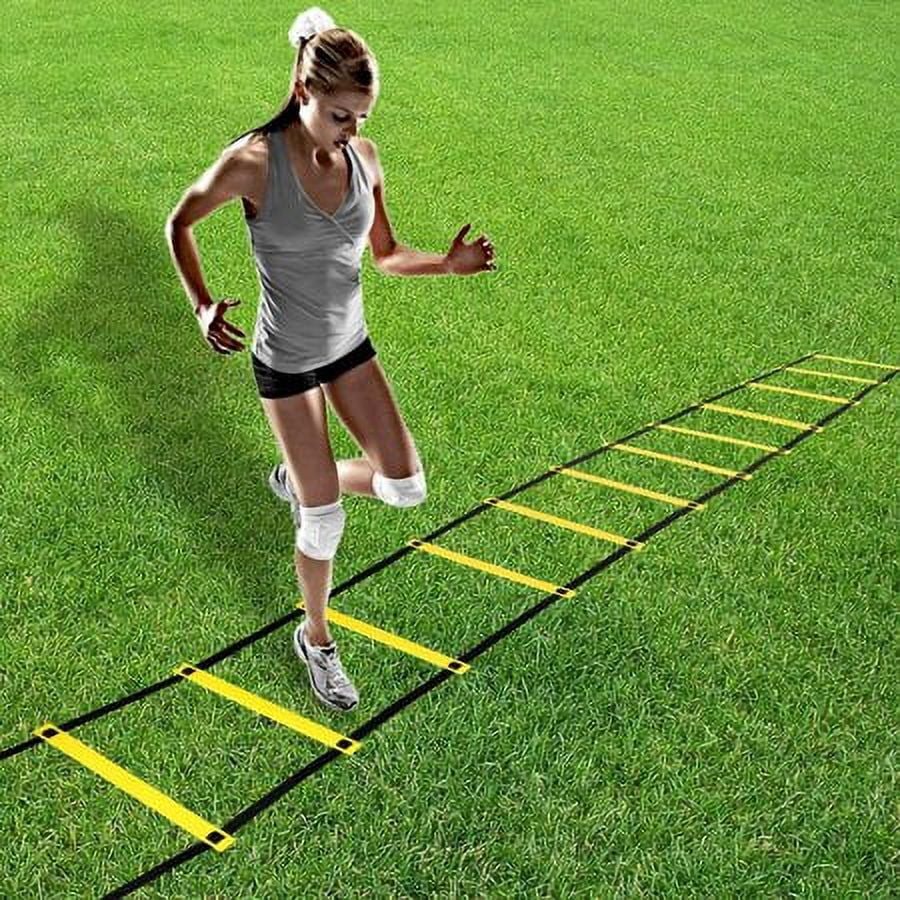
I learned this the hard way training during a German winter. The local Turnhalle was booked, and the pitch was frozen. Stuck in my apartment, I marked distances with paperback books and used a dining chair for the Figure Eight drill. After six weeks, my first-step quickness in tight spaces was noticeably sharper. The constraint forced a focus on quality I’d been skipping outdoors.
The foundation of every drill here is the athletic stance. Knees are soft, not locked. Hips sit back as if you’re about to sit in a low chair. Your weight is on the balls of your feet, heels lightly kissing the ground. Chest is up, eyes forward. Hold that position. Feel the tension in your quads? Good. That’s your spring-loaded starting position for every explosive move.
TL;DR: Your body is the equipment. Agility is a neurological skill trained by repeating precise, explosive movements from a proper athletic stance, which you can drill anywhere.
The 5 Essential No-Equipment Agility Drills
These drills progress from foundational lateral movement to complex, multi-directional patterns. Perform each for 30-45 seconds, rest for 30 seconds, and move to the next. Master the pattern slowly before adding speed.
1. Side Shuffle (Lateral Power)
Place two markers 15 big steps apart. Start at one marker in your athletic stance. Shuffle sideways to the far marker without crossing your feet. Think of pushing off the inside edge of your trail foot. Once you reach the marker, stop completely for a one-count, then explode back to the start.
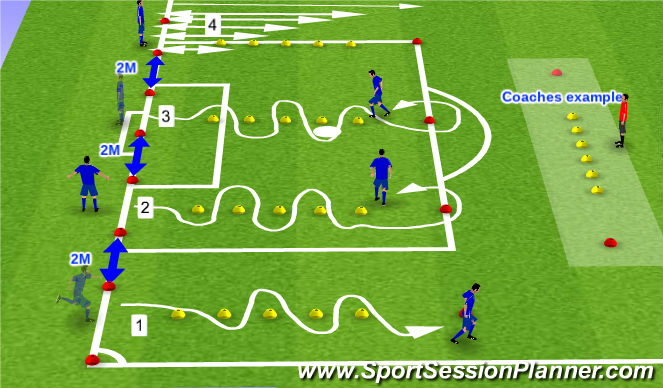
Why it works: This isolates the lateral push-off power you use to shadow a winger. The deliberate stop forces a full deceleration before re-acceleration, which is where most players lose a step. If you just glide continuously, you’re missing the key training stimulus.
Common mistake: Letting your feet cross or come together, this narrows your base and you’ll stumble the first time a opponent bumps you. Keep your feet wider than your shoulders for the entire shuffle.
2. Carioca (Hip Mobility & Coordination)
Use the same markers. Start sideways. Cross your right foot in front of your left, then step your left foot out to the side. Now cross your right foot behind your left, and step out again with the left. Move down to the far marker this way, then lead back with the opposite foot. Your hips should rotate freely with each cross.
Why it works: This drill unlocks the hip rotation necessary for sharp turns and backpedaling into a sprint. Tight hips make your movements wooden. The cross-behind step is particularly valuable for the drop-step move central defenders use to turn and chase a through ball.
3. 5-10-5 Pro Agility Shuttle (Game-Ready Change of Direction)
This is the gold standard. Set up three markers in a line with five yards between each. Start straddling the middle marker.
1. Sprint 5 yards to your right marker and touch the ground with your right hand.
2. Immediately pivot and sprint 10 yards across to the far left marker. Touch with your left hand.
3. Pivot again and sprint 5 yards back through the middle marker
Frequently Asked Questions
What if I don’t have any cones or markers at all?
You can use virtually any safe, stable household item. A pair of shoes, water bottles, or books work perfectly. The goal is simply to create visual reference points on your floor; the specific object is irrelevant for developing the movement patterns and reactive strength you need.
How do I know if my form is correct during these drills?
Focus on maintaining a low center of gravity with your hips back and knees bent, ensuring you land softly on the balls of your feet. If you feel strain in your knees or sharp pain in your shins, your form is likely breaking down. It’s better to perform the movement slowly and correctly than to rush with poor posture.
Can these drills actually help me beat a defender in a real game?
Absolutely. The drills are designed to train the exact explosive changes of direction and sharp decelerations used to create space from an opponent. By practicing these movements consistently, you train your neuromuscular system to react faster and more efficiently in game situations, translating directly to on-field agility.
Is it better to do one long session or several short ones each week?
Multiple short, focused sessions are far more effective. Aim for 15-minute sessions, 3 times per week, with full recovery between reps. This approach prioritizes quality and maximum effort, which drives adaptation, whereas a longer session often leads to fatigue, sloppy form, and diminished returns.

I come from the “soccer heart” of Germany, the Ruhrpott. I have played, trained and followed soccer all my life and am a big fan of FC Schalke 04. I also enjoy following international soccer extensively.