Soccer Field Dimensions in Feet & Meters: The 3 Standards
Soccer field dimensions in feet and meters are defined by FIFA’s Law 1, offering a range: 100-110 meters long (110-120 yards) and 64-75 meters wide (70-80 yards) for international matches. The most common professional standard is 105m x 68m (115 yds x 74 yds).
Most people think every elite pitch is identical. They’re not. That variation isn’t an accident—it’s a tactical lever managers pull. A narrow pitch at Anfield feels like a cage. A wide pitch at the Allianz Arena becomes a runway.
This guide breaks down the official dimensions in both units, explains why leagues choose different sizes, and shows you how to mark every line from the center circle to the penalty arc.
Key Takeaways
- International matches have a tighter size range (100-110m x 64-75m) than general adult play (90-120m x 45-90m).
- UEFA mandates 105m x 68m for its club competitions, making it the de facto global professional standard.
- Field size directly influences tactics; wider pitches favor attacking width, narrower ones condense midfield battles.
- All lines must be equal width, not exceeding 12 cm (5 inches), and must be continuous.
- Youth field sizes scale down dramatically, with U6 pitches as small as 25m x 15m.
The Official Range: FIFA’s Law 1 Dimensions
The International Football Association Board (IFAB) writes the Laws of the Game. Law 1 covers the field. It provides flexibility, not a single number. You need to know which set of rules your match falls under.
The touchline is always longer than the goal line. Get that wrong and you’re not playing soccer.
The field of play must be rectangular. The two longer boundary lines are touchlines. The two shorter lines are goal lines. For international matches, the touchline length must be 100–110 m (110–120 yds) and the goal line length 64–75 m (70–80 yds). All lines must be of the same width, which must not exceed 12 cm (5 in).
TL;DR: FIFA allows a size range; international matches use a narrower, standardized range within those limits.
General Adult Match Dimensions
For non-international adult football—your local Sunday league, amateur tournaments, and many professional leagues—the rules are more generous. The pitch can be anywhere from a near-square to a long rectangle.
| Dimension | Minimum | Maximum |
|---|---|---|
| Length (Touchline) | 90 m (100 yds) | 120 m (130 yds) |
| Width (Goal Line) | 45 m (50 yds) | 90 m (100 yds) |
This range exists for practical reasons. Older municipal grounds, parks with space constraints, and multi-sport facilities all host matches. A league must accommodate them. A 90m x 45m pitch feels cramped and direct. A 120m x 90m field is a marathon for midfielders.
The lines themselves have a strict spec. They must be continuous and uniform. White is standard, but any contrasting color works on artificial turf. The width cap of 12 cm (5 inches) matters for official pitch lines because a thicker line effectively shrinks the playable area.
International Match Standards
When a FIFA or continental confederation badge is on the line, the dimensions tighten. This ensures a consistent playing field—literally—for the world’s best.
The international range is 100-110 meters long by 64-75 meters wide. Most federations and top leagues pick a specific size within this band and stick to it for all sanctioned matches.
UEFA, for its Champions League and Europa League tournaments, mandates an exact size: 105 meters long by 68 meters wide. That’s 115 yards by 74 yards. This isn’t a suggestion. Teams failing to meet this standard for a knockout match risk forfeit or moving the fixture.
CONMEBOL and other confederations often follow suit. The 105×68 standard creates a known quantity. Coaches build game models around it. Players develop spatial awareness for it. It removes one variable from high-stakes competition.
Breaking Down the Pitch: Key Areas and Markings
A soccer field is a structured canvas. Every marking has a precise definition and a direct impact on the laws. Misplace the penalty spot by half a meter and you change the dynamics of the game’s biggest moment.
Let’s walk the pitch from the center spot to the corners.
The Center Circle and Halfway Line
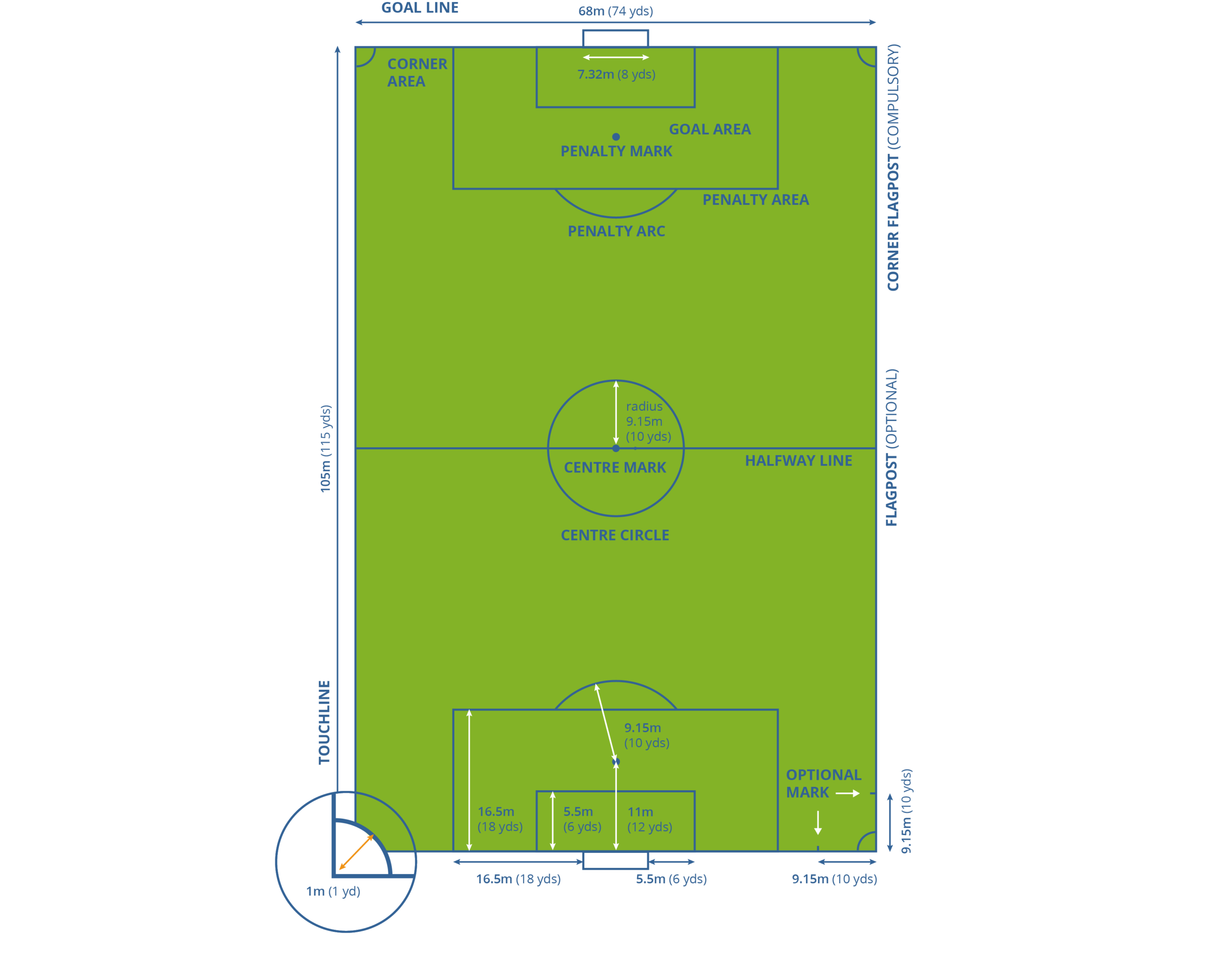
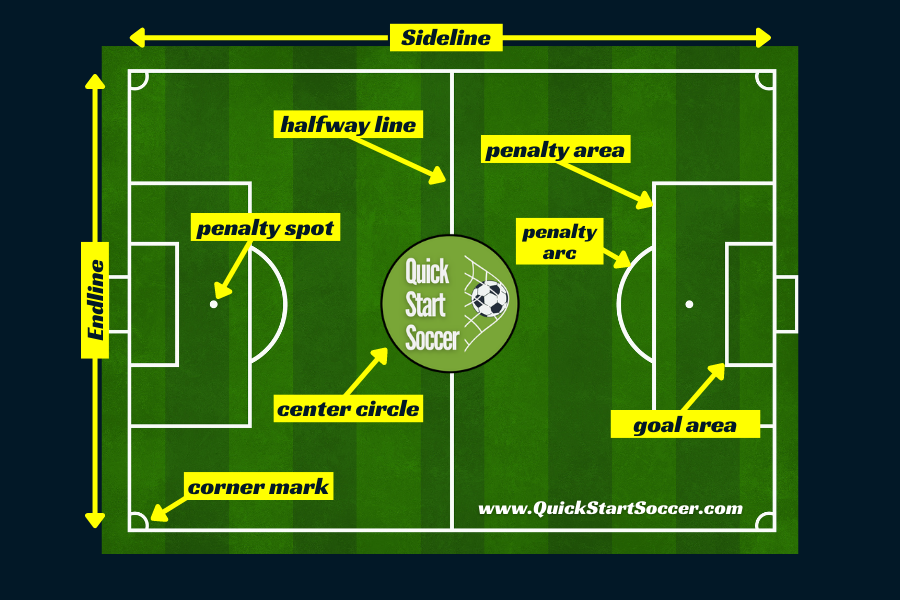
The halfway line splits the field into two halves. It connects the midpoints of the two touchlines. The center mark sits at its exact midpoint. This is where kickoffs are taken.
Around the center mark is the center circle, with a radius of 9.15 meters (10 yards). This circle’s sole purpose is to enforce the kickoff rule: opposing players must remain outside it until the ball is played. It’s a small distance with a huge psychological effect, creating immediate territorial separation.
Goal and Penalty Area Specifications
The goal is the focal point. Its dimensions are non-negotiable worldwide.
* Width (inside of posts): 7.32 meters (8 yards)
* Height (ground to crossbar underside): 2.44 meters (8 feet)
* Post/Crossbar depth & width: Max 12 cm (5 inches)
The goal area, or six-yard box, extends 5.5 meters (6 yards) from each goalpost and 5.5 meters into the field. Goal kicks are taken from anywhere within this area. Its small size forces goalkeepers to play the ball quickly.
The penalty area is the 18-yard box. It’s 16.5 meters (18 yards) from each post and extends 16.5 meters forward.
Its rules are critical:
* The goalkeeper can handle the ball here.
* Defensive fouls here result in a penalty kick.
* The penalty mark is 11 meters (12 yards) from the goal line, centered.
* The penalty arc, with a 9.15m radius from the penalty mark, ensures players stay back during a spot kick.
The penalty area dimensions are a key differentiator from other football codes, where the equivalent area serves a completely different purpose.
Corner Arcs and Flagposts
Each corner gets a flagpost. It must be at least 1.5 meters (5 feet) high with a non-pointed top. Around it, a quarter-circle with a 1-meter (1-yard) radius is drawn on the field. This is the corner arc.
The ball must be placed inside this arc for a corner kick. That tiny one-meter zone dictates the angle of attack for every set piece from the corner. Flagposts themselves are in play; a ball striking one and rebounding onto the field remains live.
How Top Leagues Measure Up
While FIFA sets the rules, each league exercises its own preference within the allowed range. These choices are rarely arbitrary. They reflect playing philosophy, stadium constraints, and sometimes, historical accident.
Common mistake: Assuming all Premier League pitches are 105x68m. Clubs like Fulham (100x65m) and Crystal Palace (101x68m) use smaller dimensions, altering the pace and physicality of home games.
The Bundesliga tends toward the larger side of the spectrum, favoring the 105×68 standard or wider. This suits a league known for high-pressing, transition-based football that uses the full width. The Bundesliga playoff system for relegation is often decided on these expansive pitches.
La Liga also largely adheres to 105x68m. The technical, possession-dominant style prevalent in Spain benefits from a standardized, spacious field that allows for patient buildup. The La Liga promotion system brings teams up into this consistent environment.
Major League Soccer (MLS) pitches are generally sized between 110-115 yards long and 70-75 yards wide. This often places them at or slightly above the FIFA international maximums. The larger surface accommodates a physically demanding, athletic style of play.
| League/Competition | Typical Length | Typical Width | Notes |
|---|---|---|---|
| UEFA Champions League | 105 m (115 yds) | 68 m (74 yds) | Mandatory for all matches. |
| English Premier League | 100-105 m (110-115 yds) | 64-68 m (70-74 yds) | Club-specific; significant variation. |
| German Bundesliga | 105 m (115 yds) | 68 m (74 yds) | Very consistent across clubs. |
| MLS | 105-110 m (115-120 yds) | 68-72 m (74-79 yds) | Often at the larger end of the spectrum. |
| FIFA World Cup | 105 m (115 yds) | 68 m (74 yds) | Uniform standard for all host stadiums. |
The Premier League promotion system brings teams into this varied landscape. A newly promoted club accustomed to a smaller Championship pitch must suddenly adapt to the dimensions of Old Trafford or the Etihad. It’s a subtle but real competitive hurdle.
Impact of Field Size on Gameplay
Dimensions are a tactical tool. A manager doesn’t just inherit a pitch size; he uses it. The difference between a 64-meter-wide and a 72-meter-wide pitch changes everything about player selection and game plan.
Wide pitches are an attacking manager’s dream. They stretch the opponent horizontally, creating gaps between defenders for wingers and overlapping fullbacks. Teams like Bayern Munich or Manchester City, who dominate possession and seek to create width, prefer these dimensions. It gives their creative players more room to operate and isolates defenders in one-on-one situations.
Narrow pitches are a defensive bulwark. They compress the playing area, reducing space between the lines. This favors teams that defend in a compact block and look to counter-attack quickly through the middle. Long balls into channels are less effective. The game becomes more physical, with more tackles and aerial duels. The crowd feels closer, amplifying pressure.
Midfield control is directly linked to width. On a narrow field, a single defensive midfielder can cover more ground laterally. On a wide field, you might need two. This simple geometric fact influences multi-million-euro transfer decisions. A club’s chosen dimensions signal its intended style of play within its global league structures.
Youth Soccer Field Dimensions
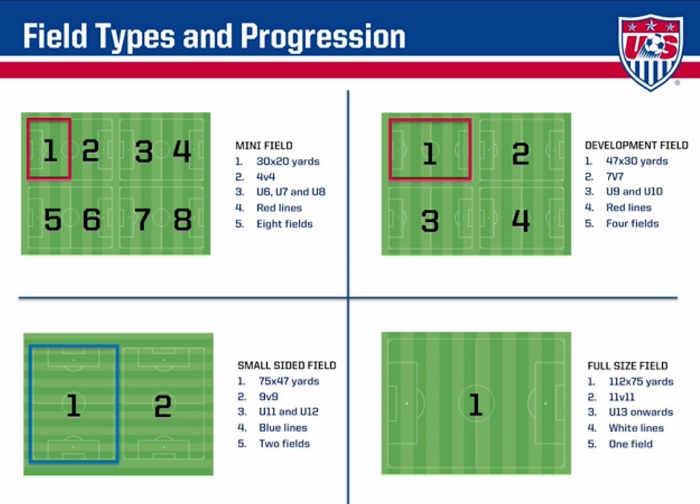
Children don’t play on full-sized pitches. Scaling down the field is the first and most important step in age-appropriate player development. An eight-year-old on a full pitch will touch the ball a dozen times a game. On a scaled field, they get hundreds of touches.
Small-sided games are the foundation. Organizations like US Youth Soccer and the English FA have detailed guidelines that shrink the field and the number of players simultaneously.
Here’s a practical breakdown by age group:
| Age Group | Format | Typical Length | Typical Width | Goal Size |
|---|---|---|---|---|
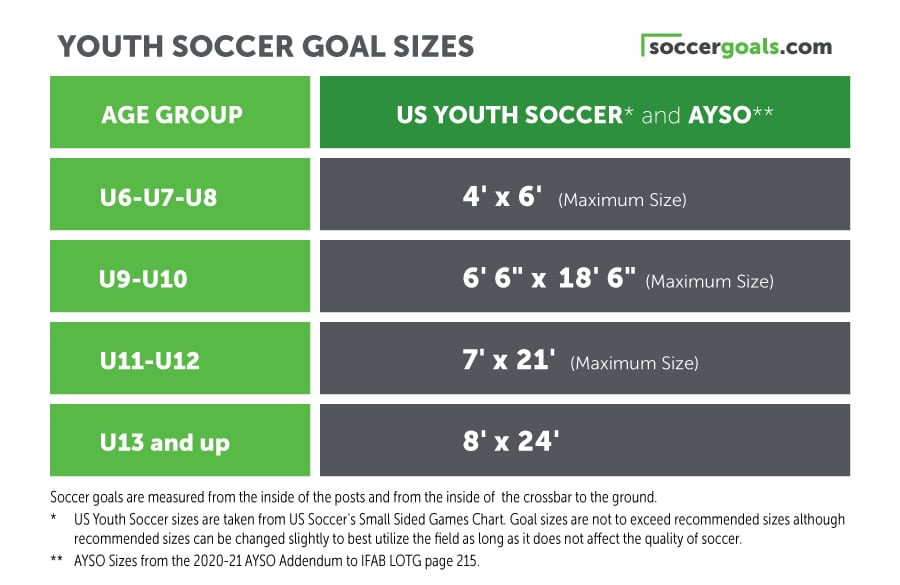
| U6 (4-5) | 3v3 or 4v4 | 25-30 m (27-33 yds) | 15-20 m (16-22 yds) | 1.5 x 0.9 m (5 x 3 ft) |
| U8 (6-7) | 5v5 or 7v7 | 35-45 m (38-49 yds) | 25-35 m (27-38 yds) | 1.8 x 1.2 m (6 x 4 ft) |
| U10 (8-9) | 7v7 | 55-65 m (60-71 yds) | 35-45 m (38-49 yds) | 3.6 x 1.8 m (12 x 6 ft) |
| U12 (10-11) | 9v9 | 70-80 m (77-87 yds) | 45-55 m (49-60 yds) | 4.8 x 2.1 m (16 x 7 ft) |
| U14+ (13+) | 11v11 | 90-100 m (100-110 yds) | 55-65 m (60-71 yds) | Full Size (7.32 x 2.44 m) |
The progression is logical. As players grow in physical capacity and tactical understanding, the field expands to introduce new challenges: longer passes, wider switches of play, and greater endurance demands. By the time they reach the full English football pyramid, the dimensions are second nature.
Maintenance and Surface Standards
The best dimensions mean nothing on a mud bath or a concrete-like artificial turf. Pitch quality is a science. The surface must be flat, firm, and consistent across its entire area. No divots, no puddles, no seams.
Natural grass is the traditional surface. Modern hybrid pitches, like Desso GrassMaster or SIS Grass, weave synthetic fibers into the soil. This provides incredible stability and wear resistance, allowing groundskeepers to maintain a perfect surface through a long season. The famous pitches at Anfield and the Emirates Stadium use this technology.
Artificial turf is fully permitted by FIFA if it meets the FIFA Quality Pro or Quality certification. These surfaces offer perfect consistency and all-weather playability. The ball rolls truly, but the bounce and the way it skids on a slide tackle differ from grass. Top-tier leagues still prefer natural grass, but many lower-division and community clubs rely on synthetic surfaces.
The rules are clear about markings. On natural grass, you use lime or water-based paint. On artificial turf, the lines are often woven in. If a club needs to add temporary lines for a different sport, those lines must be a different, distinguishable color. Players can’t be confused. Making unauthorized marks on the pitch is a bookable offense.
Line width uniformity isn’t just aesthetics. A wonky, thick penalty area line gives the referee a marginal decision on whether a foul was inside or outside the box. At the professional level, that’s a game-changing error. Groundskeepers use precise string lines and spray markers to get it right every time.
Frequently Asked Questions
What are the official dimensions of a FIFA soccer field?
For international matches, the official FIFA soccer field dimensions are 100-110 meters (110-120 yards) in length and 64-75 meters (70-80 yards) in width. The most commonly used professional standard is 105 meters by 68 meters. You can find the definitive specifications in the official soccer field dimensions on Wikipedia, which summarizes FIFA’s Law 1.
What is the standard size of a Premier League pitch?
There is no single standard. Premier League pitches must fall within the international range, but clubs choose their specific dimensions. The most common size is 105m x 68m, but pitches like Fulham’s Craven Cottage (100m x 65m) and Tottenham’s stadium (105m x 68m) show the variation. This can influence a team’s home tactics significantly.
How big is a soccer field compared to an American football field?
regulation American football field is 120 yards long (including end zones) and 53.3 yards wide. A standard international soccer field (115 yds x 74 yds) is notably wider and, in playing area, slightly shorter. The gridiron vs soccer field comparison highlights the different marking philosophies for each sport.
Why are some soccer fields bigger than others?
Field size variation is allowed within FIFA rules. Clubs may be limited by stadium architecture, like Fulham’s riverside location. Others choose dimensions that suit their playing style—wider for expansive play, narrower for a compact defense. Historical reasons and multi-use stadiums also play a role.
What happens if a field is too small for a match?
If a field does not meet the minimum dimensions for the level of competition (e.g., an international match), the game cannot be played there. The fixture would be moved to a compliant stadium, or the home team could face a forfeit. League and competition rules are strict on this point for fairness.
How are soccer field dimensions enforced?
Before a competition, officials from the governing body (FIFA, UEFA, FA) will inspect and measure the pitch. They use long tapes to verify length, width, and all key markings like the penalty area and center circle. Certification is required for hosting sanctioned matches.
Before You Go
Soccer field dimensions in feet and meters are a blend of strict law and strategic choice. Remember the three tiers: the broad range for general play, the tight band for internationals, and the exacting standards of competitions like the Champions League. The 105m x 68m pitch is the world’s stage.
Those dimensions shape the game you watch. A wide Bundesliga pitch invites flying wingers. A narrow Premier League ground turns the midfield into a scrap. The next time you see a team struggling away from home, check the pitch dimensions. That missing five meters of width might be the reason.
Understanding this isn’t just trivia. It’s reading the game at a deeper level. It connects the league promotion rules that bring teams up, the relegation battle they fight, and the very canvas upon which that drama is painted. Now you know the measurements.

I come from the “soccer heart” of Germany, the Ruhrpott. I have played, trained and followed soccer all my life and am a big fan of FC Schalke 04. I also enjoy following international soccer extensively.