How to Kick a Soccer Ball Correctly for Power and Accuracy
To kick a soccer ball correctly, you must match three things: the correct foot surface (the instep/laces), a locked ankle, and a complete follow-through. The non-kicking ‘plant’ foot dictates direction and must be placed level with the ball, pointing at your target. This technique, called the instep drive, generates both power and accuracy for shots and long passes.
Most players get this wrong by focusing on their swinging leg alone. They forget that power and direction are set before the foot even touches the ball. The plant foot’s placement and the ankle’s rigidity decide everything.
This guide breaks down the instep drive into seven repeatable steps. We’ll cover why it’s the foundational skill, how to build power, and how to fix the three most common mistakes that ruin shots and passes.
Key Takeaways
- The instep drive (laces kick) is the most important kicking skill in soccer, used for powerful shots and driven passes.
- Your plant foot placement is the steering wheel — place it level with the ball, 6-8 inches to the side, toes pointing at your target.
- A locked ankle turns your foot into a rigid club; a floppy ankle leaks all your power and sends the ball anywhere.
- Follow-through is non-negotiable for power; stopping your leg at contact is like slamming on the brakes mid-swing.
- Train both feet equally from the start, even if it feels awkward. One-footed players are predictable and easy to defend.
Why the Instep Drive is Your Most Important Skill
Coaches call it the instep drive. Kids call it the laces kick. It’s the one technique that separates hopeful kicks from intentional strikes. Every powerful shot from outside the box, every driven long pass to switch play, and every penalty relies on this motion.
The instep drive uses the top of the foot, specifically the hard metatarsal bones covered by the laces, to strike the center of the ball. This surface area provides control for accuracy while the locked ankle and leg-swing mechanics transfer maximum kinetic energy from the body into the ball.
You can’t chip or pass your way to goals from 20 yards out. You need the penetrating force of a proper instep kick technique. It’s the skill that turns possession into threat. Skipping mastery here means your shots will always be tame, your long passes will float, and defenders won’t respect your ability to beat the keeper from distance.
TL;DR: Master the instep drive first. It’s the foundation for power shooting and long passing, and every other kick builds from its mechanics.
The 7-Step Instep Drive Technique
Follow this sequence for a stationary ball. Moving balls use the same mechanics with a modified approach.
1. The Angled Approach
Don’t run straight at the ball. Approach from a slight angle, about 30 degrees. Take three or four relaxed steps to gauge distance. Your final step before planting is the “commitment step” — make it a longer, airborne stride. This builds forward momentum that converts into kicking power. A long, sprinting approach often causes you to overrun the ball.
2. Plant Foot Placement
This step is your steering and stability system. As you take your commitment step, plant your non-kicking foot firmly on the ground. It should be level with the ball, not behind or in front of it. Place it roughly 6 to 8 inches to the side of the ball. Point the toes of your plant foot directly at your target. Where those toes point, the ball will generally go.
Common mistake: Placing the plant foot too close to the ball — this forces your kicking foot to scrape the ground or makes you lean back, sending the ball skyward.
3. Ankle Lock and Leg Swing
As you begin your kicking leg’s swing, focus on your ankle. Pull your toes back toward your shin. This “locks” the ankle, creating a firm, flat striking surface with the laces. Your entire leg should act like a swinging pendulum, with your knee driving forward toward the ball. Keep your eyes on the ball, not the target.
4. Strike Through the Center
Contact happens with the hard bone just above your big toe, on the laces. Strike the absolute center of the ball. Your knee should be directly over the ball at the moment of impact. This keeps your body weight forward and prevents you from “leaning back,” which causes the ball to rise uncontrollably. You should hear a solid, clean “thump,” not a slapping sound.
5. The Full Follow-Through
Your leg’s job isn’t finished at contact. Continue the swing upward and across your body. Your kicking foot should finish high, with your body’s momentum carrying you forward. You should land on your kicking foot. This follow-through ensures all the energy from your swing transfers into the ball. Stopping your leg at contact robs the ball of power and often causes mis-hits.
TL;DR: Angle your approach, plant your foot level with the ball, lock your ankle, strike the center, and follow through completely. The sequence is non-negotiable.
How to Generate Real Power (It’s Not Just Strength)
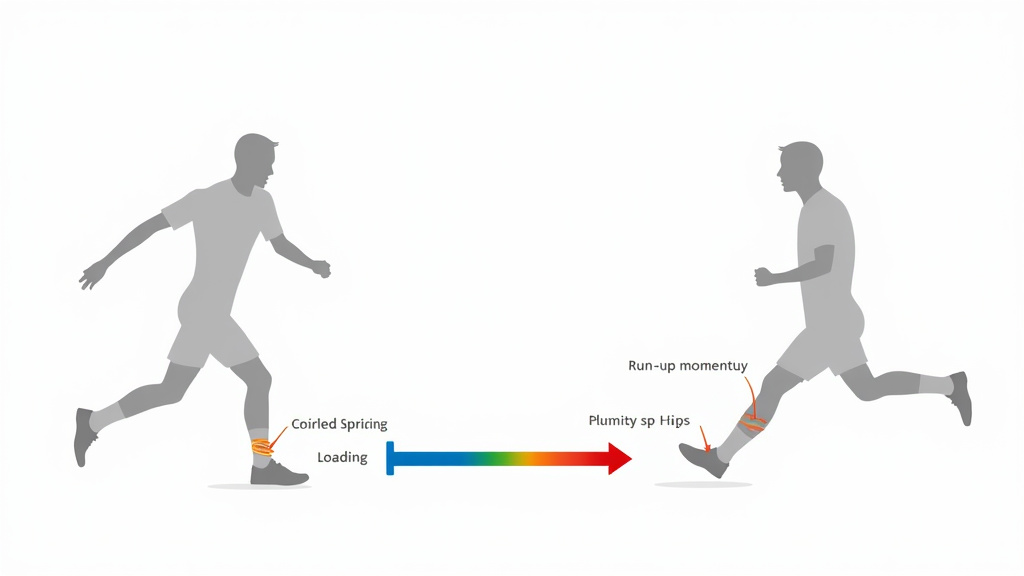
Power doesn’t come from big leg muscles alone. It comes from kinetic linking — connecting the force from your run-up, your core rotation, and your leg swing into one fluid motion. The commitment step is the key. That last long, jumping step before you plant loads your hips and core like a coiled spring.
Your hip flexors and core muscles snap forward as you swing, adding rotational force to the linear power of your leg. This is the core of generating shot power. A stiff, upright torso kills this link. You must allow your shoulders to rotate naturally with the swing.
| Power Source | How It Works | What Happens If You Skip It |
|---|---|---|
| Run-Up Momentum | Converts forward speed into kicking force. | The kick relies solely on leg strength, resulting in weak, easily saved shots. |
| Commitment Step | Loads the hips and creates a longer leg swing. | The swing becomes short and choppy, with no hip drive behind the ball. |
| Core Rotation | Transfers torque from the torso to the leg. | The kick is “all leg,” lacking penetrating power and often going off-target. |
| Follow-Through | Ensures complete energy transfer to the ball. | Up to 30% of the potential power is lost, and accuracy plummets. |
Young players often try to kick harder by swinging their leg faster with a loose ankle. That never works. Speed matters, but rigidity matters more. A fast, floppy foot is a wet noodle. A fast, locked ankle is a hammer.
Fixing the 3 Most Common Kicking Mistakes
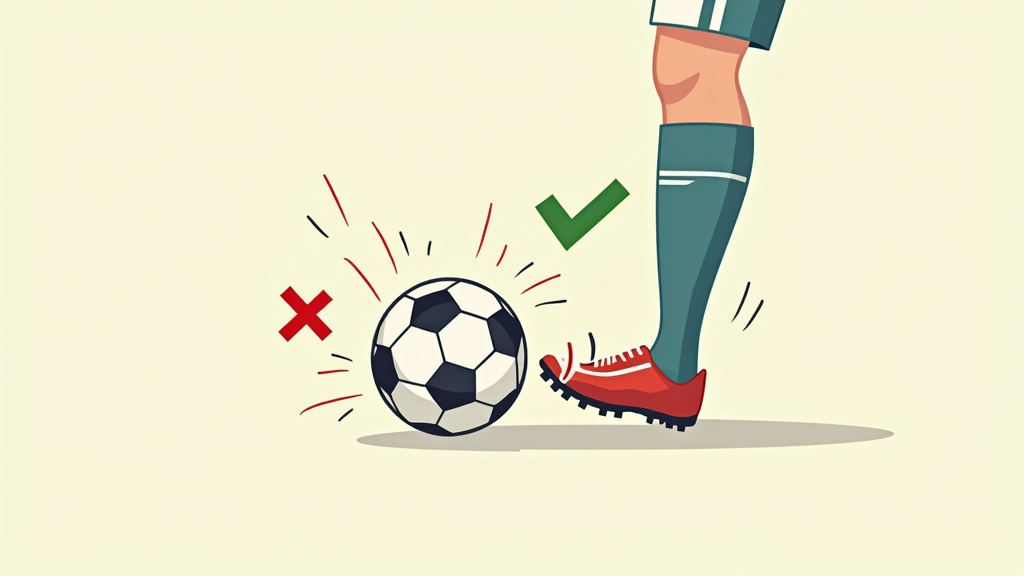
You’ll see these errors at every park and pitch. Correcting them instantly improves your game.
Mistake 1: Toeing the Ball
This is the classic beginner error. Striking with the toe (the very end of the foot) offers a tiny, rounded contact point. The ball spins wildly, flies unpredictably, and hurts your foot.
* The Fix: Focus on the “laces” cue. Practice without a ball: sit in a chair and tap the floor with the flat part of your laces, ankle locked. Feel that solid surface. That’s your sweet spot.
Mistake 2: The Floppy Ankle
A loose ankle on contact turns your foot into a sponge, absorbing the power meant for the ball. The result is a weak, misdirected pass or shot.
* The Fix: Use the “tap drill.” On your knees, hold a ball in front of you. Using only your ankle action (no leg swing), pull your toes back and tap the ball with your laces. Do 50 taps with each foot. This builds the muscle memory for a locked position.
Mistake 3: Stopping the Follow-Through
Fear of falling or losing balance makes many players brake their leg swing immediately after contact. This deceleration happens before the ball has fully left the foot.
* The Fix: Practice the “fall-over” drill. On a soft surface, kick a stationary ball with intent to follow through so completely that you must take 2-3 hopping steps forward or even land on your kicking side. It feels exaggerated, but it trains the full motion.
I coached a youth player who had a strong leg but couldn’t score. Every shot rocketed over the crossbar. His plant foot was a foot behind the ball, forcing his body to lean back. We spent one session just placing cones where his plant foot should go. The next game, he scored two from outside the box. The power was always there. The direction was just wrong.
Other Essential Kicks and When to Use Them
The instep drive is your powerhouse, but soccer requires a full toolbox. Each kick has a specific application based on the surface of the foot you use.
The Inside-of-the-Foot Pass (Push Pass)
This is your bread and butter for accurate short passes. Use the flat, broad surface between your big toe and ankle. Your plant foot points at the target, and your kicking foot turns outward to present that flat side. The ankle is locked, but with toes pointed up and out. It’s a pushing motion, not a swing. This is the most accurate pass in soccer over short distances.
The Chip or Lofted Pass
Need to lift the ball over a defender’s leg or play a long, hanging pass? Use a lofted pass technique. The foot strikes underneath the center of the ball. Use the inside-of-the-foot or the instep, but with your body leaning back slightly. The kicking motion is more of a scoop or a wedge. The follow-through is high and upward. Mis-hit this by striking too low on the ball, and you’ll just pop it straight up.
The Outside-of-the-Foot Pass
This is for deception and quick releases. Use the outer bone of your foot, near the little toe. It naturally imparts curve to the ball. It’s less accurate but much quicker, as you don’t have to adjust your body shape as much. Mastering the outside foot kick allows you to pass in one fluid motion while running.
| Kick Type | Best For | Foot Surface | Key Cue |
|---|---|---|---|
| Instep Drive | Power shots, long drives | Laces / Top of foot | “Ankle locked, knee over ball” |
| Inside-Foot Pass | Accuracy over 5-20 yards | Arch / Inside of foot | “Foot turned out, push don’t swing” |
| Chip / Loft | Lifting over obstacles | Underneath the ball | “Scoop from below, lean back slightly” |
| Outside-Foot | Quick, curved passes | Outside edge of foot | “Strike across the ball” |
Choosing the right kick is a split-second decision. A driven pass technique cuts through wind, while a lofted pass hangs for a teammate to run onto. Practice each one until it becomes automatic.
Drills to Build Accuracy and Consistency
Knowledge is useless without repetition. These drills isolate components of the proper kicking technique.
Wall Rebounds (The Fundamental)
Find a solid wall. Stand 10 feet back and practice striking the ball with your instep, aiming for the same spot on the wall each time. Control the rebound and strike again. This builds consistency, first-touch control, and power. Start with your strong foot, then force yourself to do equal reps with your weak foot.
Cone Gate Accuracy
Set up two cones 3 feet apart to form a “gate.” Start 15 yards back. Practice passing the ball through the gate using the inside-of-the-foot pass. Then move back and use the instep drive to shoot through the gate. This trains precision under the pressure of a small target.
Moving Ball Striking
Have a partner roll the ball gently across your path. Time your approach to strike it while it’s moving. This mimics game conditions. The mechanics are identical, but your timing must adapt. Start with slow rollers, then increase speed. This is the bridge between static practice and match execution.
Before you start: Always warm up your ankles, hips, and hamstrings before a kicking session. Cold muscles are more prone to strains. Wear proper soccer cleats or flats — running shoes can slip and cause ankle rolls on grass.
Integrate these into a routine. Twenty minutes of focused shooting practice routines three times a week will yield more improvement than two hours of aimless kicking once a month.
Frequently Asked Questions
What part of your foot should you kick a soccer ball with?
It depends on your intent. For power and distance, use the instep (the laces). For accuracy on short passes, use the inside of your foot. To chip or loft the ball, strike underneath it with your instep or inside foot. Never use your toe.
How do you kick a soccer ball hard and far?
Power comes from technique, not brute strength. Use the instep drive: a committed angled approach, a planted non-kicking foot level with the ball, a locked ankle, a strike through the ball’s center, and a full follow-through that carries your body forward. The kinetic chain from your run-up to your follow-through generates the force.
Why does my soccer ball always go in the air when I shoot?
This is almost always caused by your plant foot being placed behind the ball. This forces your body to lean back, and your foot strikes the lower half of the ball, lifting it. Place your plant foot level with the ball and focus on keeping your knee over it at the moment of contact.
How can I improve my weak foot kicking?
Repetition is the only answer. Use the wall rebound drill and commit to taking twice as many touches with your weak foot as you do with your strong foot. Start with simple inside-foot passes from short range, then progress to instep drives. It will feel awkward for months. That’s normal.
What size soccer ball should I use to practice?
Match the ball to your age. Size 5 (27-28 inches) is standard for players aged 12 and up. Size 4 (25-26 inches) is for ages 8-12. Size 3 (23-24 inches) is for young children under 8. Using a ball that’s too large makes proper technique impossible to learn.
How important is follow-through?
It’s critical. The follow-through ensures you transfer all the energy from your swinging leg into the ball. Stopping your leg at contact is like slamming the brakes in a car—you lose momentum. A complete follow-through also helps with accuracy and prevents injury by allowing a natural deceleration of your leg.
The Bottom Line
Kicking a soccer ball correctly isn’t a mystery. It’s a mechanical skill built on the instep drive. Forget about just kicking harder. Focus on planting your foot correctly, turning your ankle into a solid block, and following through every single time.
Power is a product of that technique, not a replacement for it. Drill the basics until they’re boring, then drill them more. Your first few hundred proper strikes will feel forced. Around rep number one thousand, it starts to feel natural. That’s when you stop thinking about foot placement for power and start deciding where the ball goes before it even leaves your foot.
Start with a wall and a single ball. The rest follows.
I come from the “soccer heart” of Germany, the Ruhrpott. I have played, trained and followed soccer all my life and am a big fan of FC Schalke 04. I also enjoy following international soccer extensively.