The 7 Best World Cup Finals Ever Ranked by Drama & Legacy
To rank the best World Cup finals ever, you weigh relentless drama against historical significance, iconic individual performances, and moments that permanently entered football folklore. The 2022 final between Argentina and France currently stands atop this list for its unprecedented narrative swings and the direct clash of two generational talents.
Most lists get this wrong by treating it as a simple nostalgia contest or by just counting goals. They separate the match from the stadium’s electricity, the tactical gambles that backfired, and the raw, unscripted human emotion that cameras captured in real time. That’s what turns a good game into a permanent piece of culture.
This guide ranks the seven greatest finals by those standards. We’ll break down why each match earned its spot, the legendary players who defined them, and the specific moments you still see replayed decades later.
Key Takeaways
- The 2022 final is the modern benchmark, featuring two comebacks, a Messi-Mbappé duel, and a penalty shootout, it redefined what a final could be.
- Brazil’s 1970 victory over Italy remains the gold standard for team performance and aesthetic beauty in football.
- England’s 1966 win and West Germany’s 1954 “Miracle of Bern” are foundational for their national football identities, despite, or because of, their controversies.
- Individual brilliance, like Maradona in 1986 or Zidane’s infamous 2006 headbutt, can elevate a final’s legacy beyond the scoreline.
- A high-scoring game like 1958 (Brazil 5-2 Sweden) is iconic, but narrative tension and stakes often matter more than just the goal tally.
What Makes a World Cup Final “Great”?
A great final is more than 11 players beating 11 others. It’s a 90-minute story that captures every emotion the sport can produce. The criteria aren’t vague.
You need high stakes with a visible prize, the trophy, a player’s legacy, a nation’s first title. The match needs a clear narrative arc: a favourite dominating, an underdog rallying, a momentum swing that changes everything. Iconic individual moments are non-negotiable. Think Geoff Hurst’s hat-trick, Zinedine Zidane’s headbutt, or Kylian Mbappé’s 80th-minute penalty to force extra time. These are the clips that never get old.
The greatest finals possess a perfect storm: technical quality, unscripted drama, legendary performances, and a consequence that resonates for generations. They are the matches that make fans of people who don’t even like football.
Tactical battles matter, but they’re the subtext. The average fan remembers the Maradona dribble or the Lionel Messi lift more than the defensive shape. The atmosphere, both in the stadium and across the globe, acts as the final layer. A silent, tense game can be great. A loud, chaotic, emotionally draining one is almost always better. This is why comparing eras is tricky but necessary. The 1970 final was a technical masterpiece for its time. The 2022 final was a cinematic epic made for the modern, highlight-saturated age.
TL;DR: Judge a final on its drama, iconic moments, legacy stakes, and the raw emotion it generates, not just the scoreboard.
The Undisputed Champion: Argentina vs France, 2022
This wasn’t just a football match. It was a three-act play with two of the best actors on the planet. Argentina, driven by Lionel Messi’s last chance at glory, faced France, led by Kylian Mbappé ready to claim his throne. The script was almost too perfect.
Act One was Argentine dominance. Messi scored a 23rd-minute penalty, then watched Angel Di Maria make it 2-0 with a sublime team move. France was invisible. They had zero shots in the first half. The narrative was set: the sentimental farewell for a legend. Then, in a dizzying two-minute spell around the 80th minute, Mbappé scored two goals. A penalty, then a stunning volley. The stadium noise shifted from Argentine celebration to pure shock.
Common mistake: Remembering this final only for the goals, the real story was the physical and emotional collapse you could see in real time. Players from both sides cramped, gasped, and stared into space during extra time, completely spent. The quality didn’t drop; it transformed into a different, desperate kind of sport.
Act Two was extra time. Messi tapped in a rebound in the 108th minute. Argentina led 3-2. Surely that was it. But Mbappé completed his hat-trick with another penalty in the 118th. 3-3. No other player had scored a hat-trick in a final since 1966. The sheer audacity of it, twice dragging his team back from the brink, re-wrote the definition of clutch performance.
Act Three was penalties. Kingsley Coman missed. Aurelien Tchouameni missed. Gonzalo Montiel scored the winner. Messi finally had his World Cup. The match contained everything: mastery, collapse, resurrection, individual genius, and ultimate catharsis. It set a new bar. For a deeper look at how this final compares to every other, our analysis of every World Cup final ranked provides the full historical context.
The Gold Standard: Brazil vs Italy, 1970
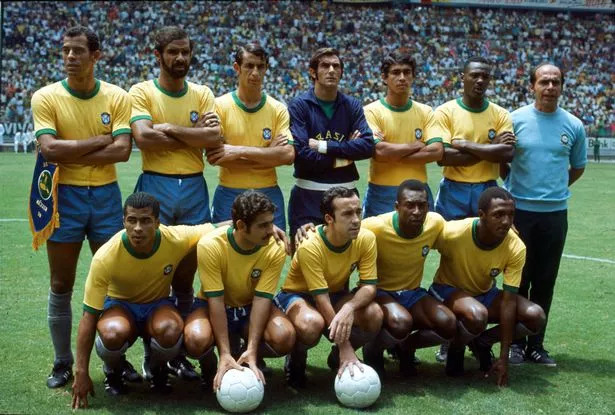
Photo: El Gráfico / Wikimedia Commons / Public domain

If the 2022 final was a blockbuster, the 1970 final was a symphony. This is the match purists point to when they talk about “the beautiful game.” Brazil’s 4-1 win wasn’t just a victory; it was a statement. They became the first nation to win three World Cups and earned the right to keep the Jules Rimet trophy permanently.
The team was a constellation of stars. Pelé, Jairzinho, Rivelino, Tostão, Carlos Alberto. But it was their collective movement that was hypnotic. Italy, a brilliant defensive side, was simply unpicked. The fourth goal, finished by captain Carlos Alberto after a sweeping team move involving almost every outfield player, is the most replayed goal in football history for a reason. It was the culmination of a philosophy.
Pelé’s performance was iconic. His early header, saved by Enrico Albertosi, set the tone. His assist for Carlos Alberto’s goal was a masterclass in vision. This final wasn’t about drama or comebacks. It was about witnessing a peak. It showed what football could be when artistry and athleticism merged perfectly. It remains the benchmark for a single team’s performance on the grandest stage. This match is a cornerstone when discussing the greatest World Cup moments in the sport’s long history.
| Aspect | Why It Was Great | Lasting Image |
|---|---|---|
| Team Play | Unmatched collective movement and one-touch football. | Carlos Alberto’s thunderbolt finish after a 7-pass move. |
| Individual Genius | Pelé’s all-round display: goals, assists, and leadership. | Pelé’s celebratory leap after his opening goal. |
| Historical Weight | Brazil’s third title, earning the permanent Jules Rimet trophy. | Pelé carried off the field on teammates’ shoulders. |
The Foundation of a Nation: England vs West Germany, 1966

Photo: Keven Law from Los Angeles, USA / Wikimedia Commons / CC BY-SA 2.0
.jpg)
This final built modern English football identity. Played at Wembley, it had everything a home nation could want, and a controversy that still fuels debates. England won 4-2 after extra time, with Geoff Hurst scoring the only hat-trick in a final until Mbappé in 2022.
The drama was relentless. West Germany equalized in the 89th minute to force extra time. Then came the iconic moment: Hurst’s shot in the 101st minute hammered the underside of the bar, bounced down near the goal line, and was cleared. The referee consulted his linesman, and the goal was given. Did the whole ball cross the line? Decades of analysis say it probably didn’t. That uncertainty is now part of the legend. Hurst completed his hat-trick in the final minute, sealing the win.
The match’s greatness lies in its lasting cultural footprint. It gave England its only World Cup. It created a national hero in Hurst and a manager in Alf Ramsey. The “Wembley Goal” debate is a rite of passage for English fans. It was a gritty, hard-fought battle, not a flowing spectacle. But for narrative stakes and permanent national significance, few finals come close. For a different kind of historic drama, the shock results that define tournaments are captured in our list of the greatest World Cup upsets.
I’ve sat in pubs in London where men who weren’t alive in 1966 can describe that Hurst goal like they saw it live. That’s the power of a truly great final, it becomes folklore passed down, not just a result in a record book.
The Original Miracle: West Germany vs Hungary, 1954

Photo: Sandstein / Wikimedia Commons / CC BY 3.0

The “Miracle of Bern” is the ultimate underdog story. Hungary’s “Magical Magyars,” led by Ferenc Puskás, were unbeaten in four years. They had thrashed West Germany 8-3 in the group stage. The final was a foregone conclusion. Hungary went up 2-0 within eight minutes.
Then it happened. West Germany clawed back to 2-2 by the 18th minute. The second half was a tense siege. In the 84th minute, Helmut Rahn scored the winner. A nation still recovering from war had its first World Cup. The impact was profound. It helped rebuild German national pride and is often cited as a foundational moment for the modern German state.
This final’s greatness is almost entirely historical. The match itself wasn’t a technical masterpiece by today’s standards. The conditions were muddy, the ball heavy. But for pure, unadulterated shock and for the scale of the upset, it has never been surpassed. It proved that in one game, anything is possible. That belief is now a core part of every underdog story that follows. This victory is a key data point when looking at the most World Cup wins by country, marking the start of Germany’s footballing dynasty.
TL;DR: The 1954 final is the prototype for the greatest sporting upset. It transcended sport to become a national healing moment, proving narrative can outweigh pure football quality.
The One-Man Show: Argentina vs West Germany, 1986

Diego Maradona won the 1986 World Cup almost by himself. The final was the exclamation point. Argentina beat West Germany 3-2 in a tense, tactical battle. But this match is great because of who defined it.
Maradona didn’t score. He was man-marked, fouled, and contained for large periods. Yet, his influence was absolute. With Argentina leading 2-0 and cruising, West Germany staged a typical comeback to level at 2-2 with 10 minutes left. The momentum had completely flipped. Panic could have set in.
Instead, in the 83rd minute, Maradona received the ball near midfield, turned, and played a perfect, defense-splitting pass to Jorge Burruchaga, who ran through to score the winner. It was a moment of cold, calculating genius under maximum pressure. The pass wasn’t flashy; it was lethal. It was the ultimate captain’s intervention.
This final cemented Maradona’s tournament. He had already delivered the “Hand of God” and the “Goal of the Century” against England. The final was his coronation. It showcased a different kind of greatness, not dribbling past five players, but providing the one moment of quality when his team needed it most. It’s the final that proves a single player’s will can be the deciding factor. For other examples of individual dominance, the tournament’s all-time World Cup top scorers list is built on such legendary performances.
The Infamous Exit: Italy vs France, 2006

Sometimes, a final is remembered for one moment that overshadows the entire 120 minutes. Italy beat France 5-3 on penalties after a 1-1 draw in Berlin. The game was tense, tactical, and high-quality. Marco Materazzi headed Italy level after Zinedine Zidane’s audacious early panenka penalty.
But the match’s place in history was sealed in the 110th minute of extra time. Zidane, playing his final professional game, turned and headbutted Materazzi in the chest. The red card was instant. As he walked past the trophy, head down, the image was heartbreaking and inexplicable. The greatest player of his generation ended his career in disgrace, minutes from a penalty shootout where he would have taken the first kick.
The 2006 final is the prime example of a match where the story around the game became bigger than the result. For weeks, the world wasn’t talking about Italy’s triumph; it was asking, “What did Materazzi say?” That intrusion of raw, flawed humanity is what makes it unforgettable.
The match itself was excellent, two brilliant, evenly matched sides. But its legendary status comes from that shocking, human rupture. It’s a tragedy in three acts: Zidane’s glorious early penalty, his dominant midfield performance, and his catastrophic, emotion-driven exit. It serves as a permanent reminder that athletes are not characters in a script. They are people, and people break under pressure. This final, which stretched to the absolute limit, joins other classic matches in our review of the best World Cup overtime matches.
The Goal-Fest That Crowned a King: Brazil vs Sweden, 1958
Before the drama, before the controversies, there was pure, joyful attacking football. The 1958 final saw a 17-year-old Pelé announce himself to the world. Brazil beat hosts Sweden 5-2 in a match that was open and thrilling from start to finish.
Sweden took a surprise lead in the fourth minute. Brazil, unfazed, equalized nine minutes later and then took control. Vavá scored twice, Pelé scored a brilliant goal, flicking the ball over a defender and volleying home, and Mario Zagalo added a fifth. It was a display of attacking flair that Europe hadn’t seen from a non-European side. This final was great because it was the birth of a global superstar and the arrival of Brazil as a football superpower. It was the first World Cup final broadcast live on television to a significant international audience, etching its images into a new medium.
While not as narratively complex as later finals, its historical importance is massive. It set the stage for Brazil’s golden era and introduced the template for the beautiful, samba-style football they would become famous for. It remains the highest-scoring final decided in regular time. For fans of offensive fireworks, this match is a direct ancestor of the modern highest scoring World Cup matches.
| Final | Score | Key Reason for Greatness | Defining Figure |
|---|---|---|---|
| 2022 | Argentina 3-3 France (4-2 pens) | Unparalleled narrative drama & generational star clash. | Lionel Messi & Kylian Mbappé |
| 1970 | Brazil 4-1 Italy | Peak team performance & aesthetic beauty. | Pelé & Carlos Alberto |
| 1966 | England 4-2 West Germany (a.e.t.) | National identity-defining win & enduring controversy. | Geoff Hurst |
| 1954 | West Germany 3-2 Hungary | The greatest underdog upset in final history. | Helmut Rahn |
| 1986 | Argentina 3-2 West Germany | One player’s will dragging a team to victory. | Diego Maradona |
| 2006 | Italy 1-1 France (5-3 pens) | A shocking moment of human drama eclipsing the sport. | Zinedine Zidane |
| 1958 | Brazil 5-2 Sweden | The joyful arrival of a footballing dynasty and its first king. | Pelé |
Frequently Asked Questions
Which World Cup final is considered the best ever?
The 2022 final between Argentina and France is now widely regarded as the greatest ever due to its non-stop drama, two dramatic comebacks, a hat-trick from Kylian Mbappé, and the legacy-defining victory for Lionel Messi, all decided by a penalty shootout.
Has any player scored a hat-trick in a World Cup final?
Yes, twice. Geoff Hurst scored a hat-trick for England in the 1966 final against West Germany. Kylian Mbappé matched this feat for France in the 2022 final against Argentina, making him the second player to do so.
What was the highest-scoring World Cup final?
The 2022 final (3-3 after extra time) is the highest-scoring when including extra time. The 1958 final, where Brazil beat Sweden 5-2, is the highest-scoring final decided within the regular 90 minutes.
Which final featured the most controversial moment?
The 1966 final is famous for the “Wembley Goal,” where Geoff Hurst’s shot may not have fully crossed the line. The 2006 final is equally famous for Zinedine Zidane’s headbutt on Marco Materazzi, a moment of personal controversy that overshadowed the match result.
How many times has the World Cup final gone to a penalty shootout?
The final has gone to a penalty shootout three times: in 1994 (Brazil vs Italy), 2006 (Italy vs France), and 2022 (Argentina vs France). Argentina’s victory in 2022 is the most recent.
The Final Whistle
Ranking these games isn’t about picking a winner in a vacuum. It’s about recognizing the different ways football can deliver a timeless experience. The 2022 final gave us the most complete, edge-of-your-seat story. The 1970 final gave us the most beautiful football. The 1966 and 1954 finals gave nations their sporting souls.
The common thread is immortality. Each match produced images, sounds, and feelings that refuse to fade. They are the matches we rewatch not to see who wins, but to feel the same tension, joy, and shock all over again. That’s the real mark of the best World Cup finals ever, they don’t end when the referee blows his whistle.
I come from the “soccer heart” of Germany, the Ruhrpott. I have played, trained and followed soccer all my life and am a big fan of FC Schalke 04. I also enjoy following international soccer extensively.