Reliving Football’s Greatest World Cup Moments of All Time
The greatest World Cup moments of all time are those that transcend sport, weaving national identity, tactical evolution, and raw human drama into a single, unforgettable frame. They include Uruguay’s 1950 “Maracanazo” upset, Geoff Hurst’s 1966 final hat-trick, Brazil’s 1970 “Beautiful Game” masterpiece, Zinedine Zidane’s 1998 headers for France, and Lionel Messi’s 2022 coronation in a legendary final.
Most lists just chronologically recount goals. They miss the visceral, lasting shock these moments delivered—the silence of 200,000 people, the weight of a nation’s hope snapping, the precise click of a career-long narrative falling into place. You remember where you were.
This guide ranks seven moments not just by skill, but by their permanent scar on football’s history. We’ll explain why they mattered then, why they still matter now, and what they teach us about the game’s soul.
Key Takeaways
- The 1950 “Maracanazo” wasn’t just a loss; it was a Brazilian national trauma that directly caused the iconic yellow kit and created a footballing ghost in Alcides Ghiggia.
- Geoff Hurst’s 1966 hat-trick remains the only one in a final, and its controversial second goal is perhaps the most debated moment in World Cup history, forever defining England’s sole triumph.
- Brazil’s 1970 victory, sealed by Carlos Alberto’s iconic team goal, was the first World Cup broadcast in color, permanently associating “Jogo Bonito” with vibrant, attacking football.
- France’s 1998 3-0 win over Brazil is a masterclass in a host nation seizing its moment, fueled by Zinedine Zidane’s headers and the pre-match mystery surrounding Ronaldo’s health.
- The 2022 final between Argentina and France is arguably the greatest match ever played, a cinematic epic that served as the perfect career capstone for Lionel Messi.
1950: The Maracanazo – The Ghost That Silenced a Nation
Head design changes the entire process. Look at the business end of your trimmer.
The final match of the 1950 tournament was a de facto final, with Brazil needing only a draw against Uruguay in the newly built Maracanã Stadium. Alcides Ghiggia’s 79th-minute winning goal for Uruguay silenced nearly 200,000 Brazilian fans, a moment of such profound national shock it is known as “O Maracanaço” – The Maracanã Blow.
This wasn’t a match. It was a funeral for a nation’s certainty. Brazil had scored 13 goals in their previous two games. The 200,000-seat Maracanã was a monument to their impending coronation. A draw was enough. Uruguay’s Alcides Ghiggia, a winger they called “El Obús” (The Shell), cut in from the right and shot near post. The net rippled. The sound that followed wasn’t booing. It was the vacuum of 200,000 breaths being sucked in at once.
The aftermath was cultural surgery. Brazil abandoned their white and blue kit, adopting the now-iconic yellow and green as a form of rebirth. Ghiggia, the last surviving member of that Uruguayan team, later said, “Only three people have ever silenced 200,000 people at the Maracanã with a single gesture: Frank Sinatra, Pope John Paul II, and me.” He became a ghost in Brazilian football’s psyche, a permanent reminder of hope’s fragility. This moment sits at the root of every discussion about the greatest World Cup upsets.
TL;DR: The Maracanazo was a cultural wound that changed Brazilian football forever, making it the ultimate benchmark for tournament shock.
1966: Hurst’s Hat-Trick and the Goal That Never Was
Geoff Hurst’s third goal in the 120th minute sealed England’s 4-2 win over West Germany. His second goal, in the 101st minute, is the one nobody can forget. The ball struck the crossbar, bounced down near the goal line, and was cleared. The Azerbaijani linesman, Tofiq Bahramov, flagged for a goal. Decades of video analysis haven’t provided a definitive answer.
Common mistake: Believing the controversy is just about technology. The real legacy is how it cemented a narrative – England’s one moment of footballing divinity arrived wrapped in eternal debate.
The match itself was a rollercoaster. West Germany equalized in the 89th minute to force extra time. Then came Hurst’s shot, the bounce, and the split-second decision that gave England a 3-2 lead. The weight of that call shaped everything. It gave England the psychological edge to see out the game, with Hurst completing his hat-trick in the final seconds. He remains the only man to score three in a World Cup final. The moment is less about the ball crossing the line and more about the immense pressure on Bahramov to make a call with the world watching. It’s a cornerstone for any list of the best World Cup finals.
| Aspect | The Case For a Goal | The Case Against |
|---|---|---|
| Visual Evidence | Some camera angles suggest the ball may have fully crossed. | No angle from directly above exists; most side views are inconclusive. |
| Player Testimony | Hurst and several English players maintain it was over. | German players and many neutrals saw it as a lucky call. |
| Historical Impact | The goal was given, the result stands, and history is written. | The doubt fuels the legend, making the moment even more iconic. |
The debate is the point. It ensures the moment lives on, far beyond a simple highlight.
1970: Brazil’s Jogo Bonito and the Perfect Team Goal
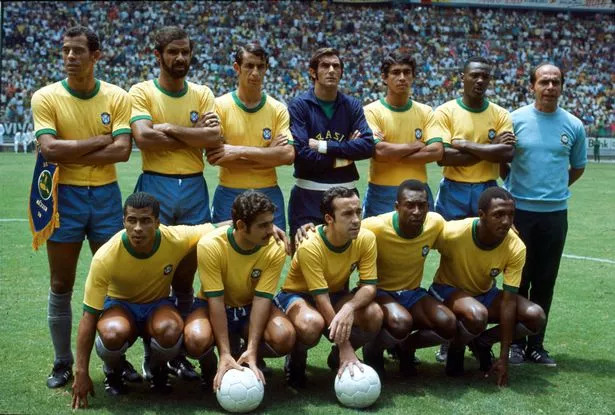
Photo: El Gráfico / Wikimedia Commons / Public domain
This was football as art, broadcast in living color for the first time. Brazil’s 4-1 dismantling of Italy in the final is often cited as the greatest team performance ever. They had Pelé, Jairzinho, Rivelino, and Tostão. The fourth goal, finished by captain Carlos Alberto, is the clip every coach shows.

The move started with Brazil winning the ball in their own half. It involved nine players, four one-touch passes, and ended with Carlos Alberto arriving like a train to blast Pelé’s laid-off pass into the net. The beauty was in its patience and geometry. It wasn’t a counter-attack; it was a systematic dismantling of a world-class Italian defense that knew what was coming but couldn’t stop it.
I’ve watched this goal a hundred times. The genius isn’t Carlos Alberto’s finish, impressive as it is. It’s Pelé’s pause. He receives the ball in the box, has a split-second to shoot, and instead waits, head up, knowing his captain is arriving unmarked at the far post. That vision, that unselfishness, is the soul of that team.
This victory allowed Brazil to permanently keep the Jules Rimet Trophy. More importantly, it set a standard for attacking football that every subsequent great team is measured against. The color broadcast meant the world saw Brazil’s canary yellow kits against Mexico’s green grass and azure sky. Football became vibrant, global, and beautiful. To understand the tools of that artistry, you have to appreciate the history of the World Cup ball used in 1970, the Telstar, with its iconic black-and-white panels designed for TV clarity.
TL;DR: Brazil’s 1970 victory, capped by Carlos Alberto’s goal, is the aesthetic and tactical high watermark for international football.
1998: Zidane’s Headers and a Nation’s Destiny

Photo: Hadi Abyar / Wikimedia Commons / CC BY 4.0
On paper, the 1998 final was Brazil’s to lose. They had Ronaldo, the best player in the world. France had Zinedine Zidane and the pressure of a host nation. What unfolded was a 3-0 French victory built on two Zidane headers from corners in the first half. The context is what elevates it.

Ronaldo suffered a convulsive fit hours before the match. His name was initially omitted from the team sheet, then reinstated. He played but was a ghost of himself. The mystery and drama sucked the air out of the Brazilian camp. France, meanwhile, played with a ferocious defensive unity, conceding only two goals the entire tournament.
Zidane’s performance was a masterclass in big-game temperament. Not a flashy dribbler that day, but a ruthless aerial threat who rose twice to meet perfect deliveries. The image of him nodding the second goal past Claudio Taffarel is etched in French sporting history. It was the moment a multicultural French team, “Black, Blanc, Beur,” delivered a unifying victory to a nation that desperately needed it. This match is a prime example of how host-nation momentum can crystallize into a title, a dynamic just as relevant for the most World Cup wins by country tally.
2006: Zidane’s Head-Butt – A Moment of Tragic Flaw

Photo: Martijn Mureau / Wikimedia Commons / CC BY-SA 4.0
Greatness isn’t always positive. Sometimes it’s a shocking, tragic flaw that reveals the human beneath the legend. In the 2006 final, Zinedine Zidane was playing a majestic game against Italy, giving France the edge. In extra time, after a verbal exchange, he turned and drove his head into the chest of Italian defender Marco Materazzi.

The red card was instant. Zidane walked past the Jules Rimet Trophy without a glance, down the tunnel, and into retirement. France lost on penalties. The moment is unforgettable because it was so violently out of character for the game’s reigning artist. It was raw id overpowering a lifetime of discipline. It showed that even in the most controlled environments, with everything on the line, pressure can crack anyone. This moment completes Zidane’s arc—the 1998 hero becomes the 2006 tragic figure. It’s a stark reminder that World Cup legacy is complex.
2014: Germany 7-1 Brazil – The Mineirazo

If the Maracanazo was a stab wound, the Mineiraço was a public demolition. Host nation Brazil, in the semi-final, collapsed in a way no one thought possible. Germany scored four goals in six first-half minutes. The final score was 7-1. The sight of Brazilian fans weeping in the stands, and players like David Luiz apologizing to the crowd, was surreal.
This moment is great for its sheer, shocking scale. It wasn’t an unlucky bounce or a controversial call. It was a systematic, humiliating breakdown of a football superpower on its own soil. It redefined what was possible in a World Cup knockout match. The highest-scoring World Cup matches often involve blowouts, but none carried this emotional weight. For Germany, it was the arrival of a new, ruthless generation. For Brazil, it was a trauma that will be referenced for another 64 years, a bookend to the pain of 1950.
2022: Messi’s Final – The Storybook Ending

The 2022 final between Argentina and France had everything. Two goals for Lionel Messi. A hat-trick for Kylian Mbappé, including two goals in 97 seconds to force extra time. A 3-3 scoreline. A penalty shootout. It was a cinematic epic that served as the perfect capstone for Messi’s quest for the one trophy that eluded him.
Messi scored in every knockout round, but his quiet, assured penalty in the shootout was the final punctuation mark. At 35, he didn’t just win the World Cup; he completed a 20-year narrative arc in the most dramatically satisfying way possible. You couldn’t script it better.
The match’s quality places it in the conversation for the single greatest World Cup finals ever played. It had individual brilliance, relentless momentum shifts, and unbearable tension. It also represented a passing of the torch, with Mbappé’s stunning performance hinting at future dominance. For a generation of fans, this was their “Where were you?” moment. It also served as a fascinating chapter in the careers of the sport’s all-time top World Cup scorers, with both Messi and Mbappé writing their names into that history.
Frequently Asked Questions
Which World Cup moment is considered the biggest upset?
Uruguay’s 2-1 victory over Brazil in the 1950 final, the “Maracanazo,” is universally considered the biggest upset. The scale of the occasion—a de facto final in a packed Maracanã Stadium against a seemingly unstoppable host—and its lasting cultural impact on Brazil set it apart from other surprises.
Has anyone else scored a hat-trick in a World Cup final besides Geoff Hurst?
No. Geoff Hurst’s three goals for England against West Germany in 1966 remains the only hat-trick ever scored in a men’s World Cup final. Kylian Mbappé scored a hat-trick for France in the 2022 final, but they lost on penalties to Argentina.
Why is Brazil’s 1970 team so highly regarded?
Brazil’s 1970 team is revered because they won the tournament with a style of play (“Jogo Bonito”) that emphasized flair, creativity, and attacking teamwork. Their 4-1 final win over Italy, capped by Carlos Alberto’s iconic team goal, is seen as the peak of beautiful football. They also were the first to win three World Cups, earning the right to keep the Jules Rimet Trophy permanently.
What was so special about the 2022 World Cup final?
The 2022 final was special due to its unprecedented drama and narrative weight. It featured two of the world’s best players (Lionel Messi and Kylian Mbappé) performing at their peak, a rollercoaster of lead changes, a last-minute comeback to force extra time, and a penalty shootout. It served as the definitive crowning achievement for Messi’s legendary career.
How do World Cup moments influence a nation’s football culture?
These moments become ingrained in national identity. Brazil’s 1950 loss led to a change in kit color and a lasting fear of failure. England’s 1966 win is the foundational myth of their football history. France’s 1998 victory was a landmark moment of national unity. They shape how nations see themselves on the world stage for decades.
The Bottom Line
The greatest World Cup moments aren’t just about technical skill. They are about context—the weight of history, the crackle of national pressure, and the raw human emotion that spills over the edges of a 90-minute game. From the haunting silence of the Maracanã in 1950 to the cathartic roar for Messi in 2022, these instances freeze time. They define careers, alter national identities, and become the stories we pass down. To truly know football’s history, you don’t just memorize scores; you feel the shock of the Maracanazo, the debate of Hurst’s goal, the beauty of Carlos Alberto’s run, and the perfect, chaotic script of Messi’s finale. That’s where the sport lives.

I come from the “soccer heart” of Germany, the Ruhrpott. I have played, trained and followed soccer all my life and am a big fan of FC Schalke 04. I also enjoy following international soccer extensively.