False Nine vs Traditional Striker: Key Differences in Soccer
The key difference between a false nine and a traditional striker is their fundamental purpose. A traditional striker is a static goal-scorer anchored in the penalty area. A false nine is a dynamic playmaker who drops into midfield to create space and chances for others, redefining the team’s attacking structure.
The difference between a false nine and a traditional striker is positional fluidity versus positional rigidity. A traditional striker is a fixed reference point whose primary job is to finish moves inside the penalty area. A false nine is a mobile creator who starts centrally but drops deep into midfield to disorganize defenders and create space for teammates, acting more as a playmaker than a pure scorer. The choice isn’t about which role is better, but which one unlocks your specific opponent.
Most explanations get this wrong by focusing only on goals. They treat the false nine as just a striker who passes a bit more. That misses the entire point. The real difference is a structural one, it changes how every other player on your team has to move and where the goals come from. Deploy a false nine without the right supporting cast and you get a crowded midfield with no threat. Use a traditional striker against a deep, organized block and he disappears.
This guide breaks down the movement, the demands, and the tactical systems that make each role work. You will learn how to spot the difference in real time and understand which players fit which mold.
Key Takeaways
- The false nine’s primary weapon is movement into midfield, creating a 5v4 overload and pulling defenders out of position. The traditional striker’s weapon is positioning, holding the line to pin defenders and finish chances.
- A false nine requires specific, intelligent teammates: fast, goal-scoring wingers and midfield runners who can exploit the space he creates. A traditional striker needs creative providers behind him.
- The system dictates the role. A false nine thrives in a 4-3-3 or 4-2-3-1 with possession dominance. A traditional striker is essential in a 4-4-2 or any two-striker system that relies on a direct reference point.
- Player profile is non-negotiable. You cannot ask a pure finisher to play as a false nine, nor can you ask a creative midfielder to act as a traditional target man. The skillsets are almost opposites.
- The defensive dilemma is the core of the false nine. If a center-back follows him, space opens behind. If the center-back stays, the false nine receives the ball unmarked between the lines. There is no good answer.
How the False Nine Actually Works on the Pitch
Forget the fancy name. The false nine position is a tactical decoy. His job is to be a problem the defense cannot solve cleanly. He starts in the central striker’s position, but his first move is almost always away from the goal, toward the midfield.
This simple movement creates a cascade of problems. The first question is who marks him. The opposition’s center-backs are trained to mark the central striker. When that striker drops 20 yards into midfield, they have a choice: follow him and leave a massive gap in the heart of their defense, or stay put and let him receive the ball unmarked in a dangerous area. Most teams hate this choice.
A false nine dropping between the lines forces a central defender to make a decision with no correct answer: follow and leave space in behind, or hold and concede midfield control. This single movement breaks zonal marking structures.
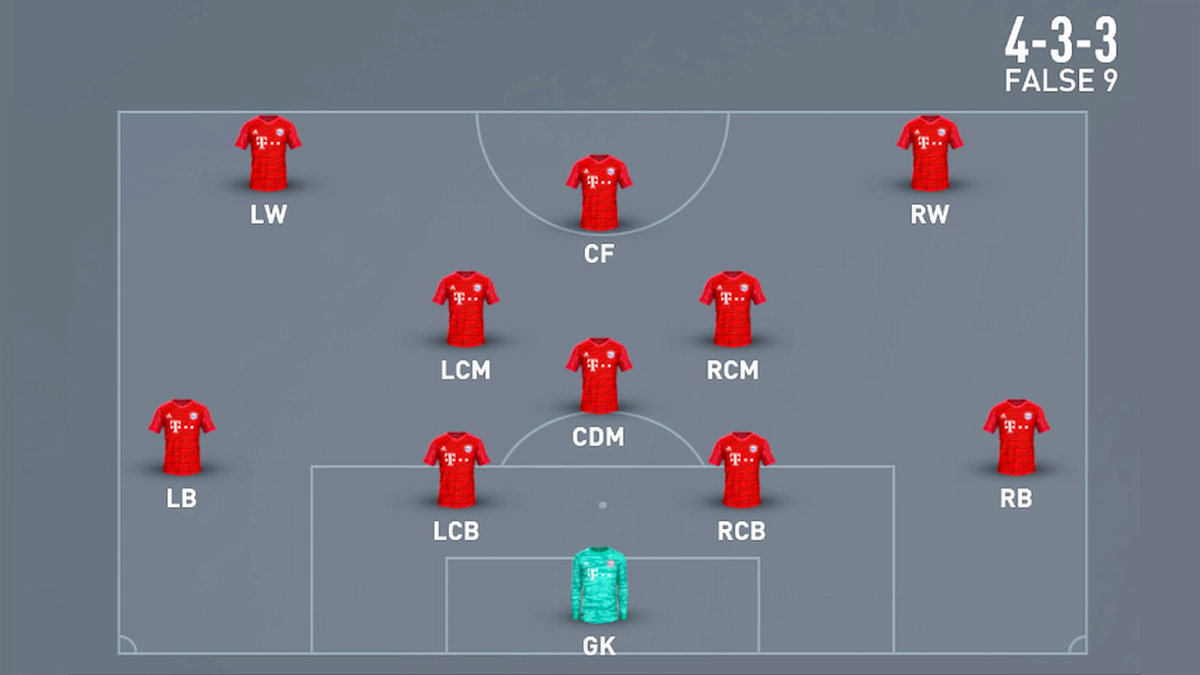
The second effect is a numerical overload. By dropping deep, the false nine adds an extra body in midfield. Your team now has five players (three midfielders plus the false nine and perhaps a dropping winger) against their four. This is how possession-based teams like Pep Guardiola’s Barcelona suffocated opponents. They won the midfield battle before the ball even reached the final third.
TL;DR: The false nine creates goals by not being where the defense expects him to be, pulling defenders out of shape so his teammates can score.
The Specific Movement Pattern and Defender’s Dilemma
Watch Lionel Messi’s heatmaps from 2009 to 2012. You will see his most intense activity zones are not in the penalty area, but in the “hole” between the midfield and defensive lines. This is Zone 14, the playmaking sweet spot.
The movement is a check toward the ball, not a run in behind. He wants the ball at his feet, back to goal, with time to turn. When he receives it, the panic starts. The defender who followed him is now horribly out of position. The space he left is now a runway for a winger like Pedro or an attacking midfielder like Andrés Iniesta.
I made this mistake coaching a youth side against a clever false nine. I told my center-back, “Stay tight, don’t let him turn.” He did. The false nine received the ball, pivoted, and played a simple pass into the space my defender had just vacated. Their winger scored. The lesson was brutal. The next time, I told my defender to hold the line. The false nine received the ball, turned, dribbled past two midfielders, and scored himself. That is the dilemma. You pick your poison.
| Defender’s Choice | Immediate Consequence | Long-Term Result |
|---|---|---|
| Center-back follows the false nine | A gap opens between the center-backs for a winger or midfielder to attack. | The defensive line is bent and disorganized, vulnerable to through balls. |
| Center-back holds the line | The false nine receives the ball unmarked between the lines, facing the goal. | He now has time to turn, dribble, or play a killer pass. The midfield is overloaded. |
| Midfielder picks him up | The false nine drags a midfielder out of position, creating space for his own midfielders. | Your team’s defensive shape in midfield is broken, opening passing lanes. |
The Non-Negotiable Player Profile
You cannot put just any attacker in this role. The false nine role demands a hybrid skillset that is exceptionally rare. The player must have the touch and vision of a world-class attacking midfielder and the finishing instinct of a striker. He needs a low center of gravity to receive under pressure, the agility to turn on a dime, and the passing range to split a defense from 30 yards out.
Roberto Firmino at Liverpool was the modern prototype. His touch in tight spaces was immaculate. His first-time flick-ons to Mohamed Salah and Sadio Mané were a trademark. He scored goals, but his real value was the chaos he created that allowed Salah and Mané to become goal machines. Cesc Fàbregas played the role for Spain not because of his pace, but because of his preternatural ability to receive a pass in traffic and release it with one touch.
The physical profile is wrong for a traditional number 9. He does not need to be tall or physically dominant. He needs to be clever, technically flawless, and two-footed. If your candidate cannot consistently receive a ball with his back to goal, spin, and play the correct pass, he is not a false nine.
The Traditional Striker’s Enduring Role
The traditional striker’s job is simple on paper: score goals. His value is measured in numbers at the end of the season. But his role within a team’s structure is profoundly different from a false nine. He is a fixed point, a reference for his teammates. He pins defenders. He occupies center-backs. He makes the penalty box his office.
Where the false nine creates by moving, the traditional striker creates by not moving. He holds his position on the shoulder of the last defender, constantly threatening the space in behind. This threat alone occupies two defenders’ minds, creating space for the creative number 10 playing behind him. In a 4-4-2 vs 4-3-3 debate, the traditional striker is the reason the 4-4-2 exists, to get two of these finishers close to goal.
Common mistake: Judging a traditional striker solely on goals. A striker who scores 15 but occupies two defenders every game creates more space for midfield runners than a striker who scores 20 but never pins a defender.
There are subtypes within this role. The target man striker uses his physicality to hold up the ball, bring others into play, and win aerial duels. The poacher striker lives on anticipation, sniffing out rebounds and loose balls in the six-yard box. Both, however, operate primarily within the width of the 18-yard box. Their world is defined by the penalty area.
The Skillset: Finishing Above All Else
A traditional striker can be a limited player elsewhere on the pitch and still be world-class. His first touch only needs to be good enough to set up a shot. His passing only needs to find a nearby teammate. His defensive work rate can be minimal. What he must have is a predator’s instinct for space in the box and ice in his veins when the chance arrives.
This is a specialist role. You do not ask a traditional striker to drop deep and link play, that wastes his one irreplaceable skill. You get the ball to him in and around the box. The system is built to serve him. Wide players cross. Midfielders play through balls. His movement is about darting across defenders, bending his run to stay onside, and finding pockets of space between center-backs. It is a game of inches, not yards.
The physical demands are different too. He needs explosive pace over 10 yards, not endurance. He needs upper-body strength to hold off a defender and shoot. He needs to be brave, willing to take a hit to get the shot off. Aerial ability is a huge bonus, especially in a two-striker system where knock-downs are crucial.
Direct Comparison: System, Teammates, and Output
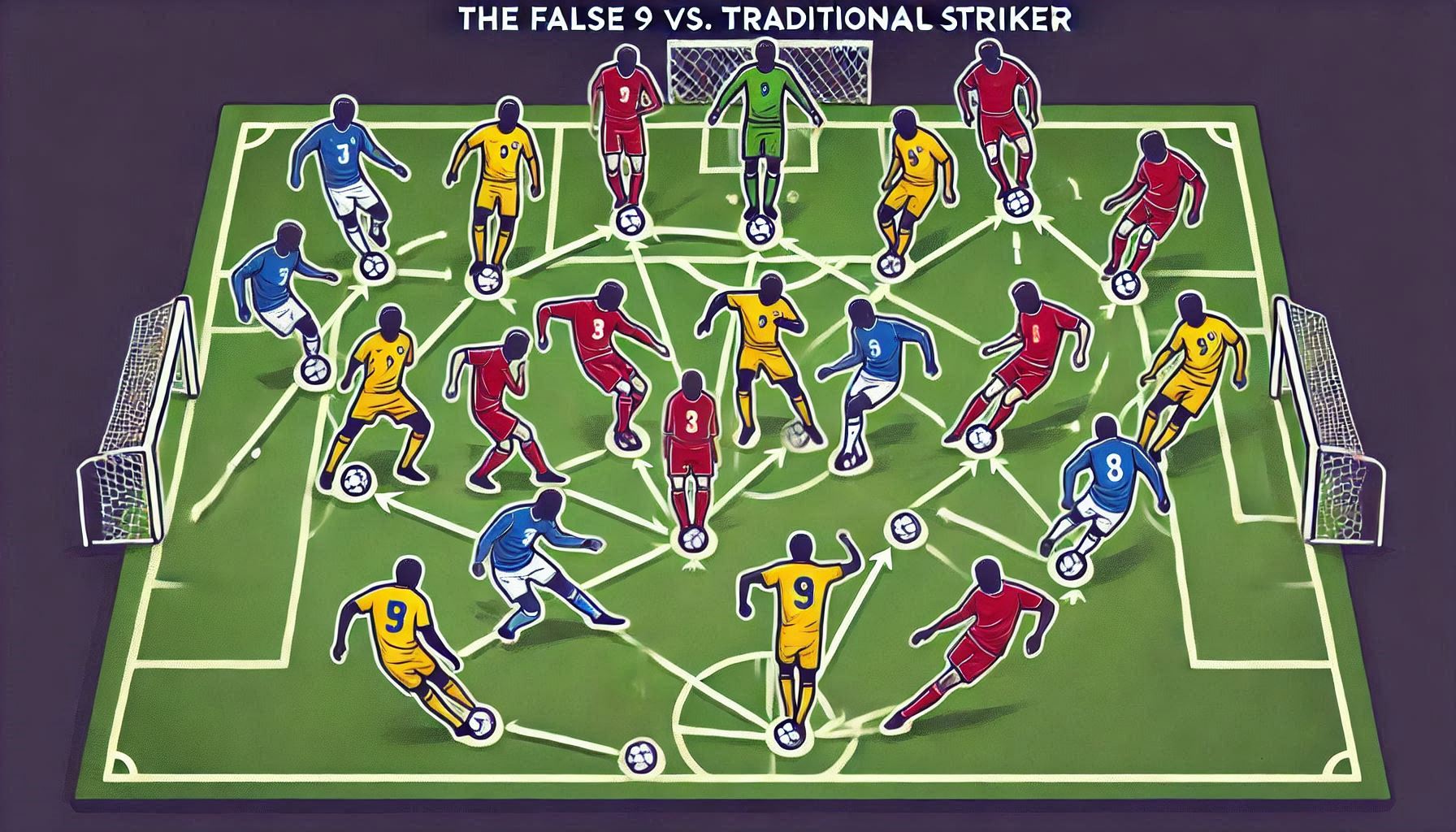
Choosing between a false nine and a traditional striker is not about picking a better player. It is about picking the right cog for your tactical machine. The wrong choice makes the entire system grind to a halt.
| Aspect | False Nine | Traditional Striker |
|---|---|---|
| Primary Role | Creator & Space Generator | Finisher & Reference Point |
| Typical Formation | 4-3-3, 4-2-3-1 | 4-4-2, 3-5-2, 4-4-1-1 |
| Ideal Teammates | Goal-scoring inverted wingers, overlapping full-backs, attacking midfielders | Creative wingers, a playmaker position number 10, crossing full-backs |
| Key Attribute | Vision, dribbling, first touch, passing | Finishing, positioning, aerial ability, composure |
| Measurable Output | Assists, key passes, defensive disruptions | Goals, shots on target, xG (expected goals) |
| When It Fails | Against a back three, or with passive wingers | Against a deep, compact defensive block |
Which Formation Demands Which Role?
The formation dictates the role more than the player does. You cannot effectively use a false nine in a classic 4-4-2. There is no space for him to drop into, that area is already occupied by two central midfielders. The 4-3-3 formation is the false nine’s natural home. The single pivot defensive midfielder holds, the two advanced midfielders push up, and the wide forwards cut inside into the central spaces the false nine vacates.
Conversely, the 4-2-3-1 formation can work with either, but it changes the entire dynamic. With a traditional striker, the number 10 plays as a pure creator behind him. With a false nine, the number 10 must become a second runner, making forward bursts into the box to become the primary goal threat. The modern 4-2-3-1 used by top teams often features this hybrid.
The 3-5-2 formation is built for two traditional strikers, often pairing a target man with a quicker partner. The false nine is redundant here, the wing-backs provide the width, and the two strikers stay high to combine and finish. Trying to force a false nine into this setup leaves you without a presence in the box.
Historical Context and Modern Evolution
The origins of the false nine are older than most think. Matthias Sindelar, playing for Austria’s “Wunderteam” in the 1930s, and Nándor Hidegkuti for Hungary’s “Golden Team” in the 1950s, both operated as deep-lying center-forwards. They confused man-marking defenders who were assigned to track them. The modern revival, however, is singularly tied to Pep Guardiola’s Barcelona and Lionel Messi.
Guardiola’s innovation wasn’t the role itself, but deploying it within a possession-dominant 4-3-3 with two of the best off-the-ball runners in the world on the wings. The system was the catalyst. Without the right players in the right structure, the false nine tactics are just a striker wandering around midfield.
Today, the role has evolved again. Few teams use a pure false nine for 90 minutes. Instead, it’s a tactical tool, a “game state” role. A team might start with a traditional striker, then switch to a false nine if they are struggling to break down a low block. Or a fluid forward line might interchange the role, with a winger sometimes drifting inside to act as the false nine while the central striker moves wide. The principle of creating space through deceptive movement remains, but the application is more flexible.
Frequently Asked Questions
Can a team play without any striker?
Yes, but it’s extremely rare and usually a temporary in-game adjustment. Some teams use a “strikerless” system where three attacking midfielders or wingers rotate as the most advanced player. However, this requires immense technical skill, coordination, and is vulnerable against teams that dominate possession. Most systems still designate a primary central reference point, even if that player isn’t a traditional number 9.
Who are the best false nines in soccer history?
Lionel Messi’s 91-goal year in 2012 is the pinnacle of the role, blending creation and scoring. Roberto Firmino at Liverpool defined the modern, hard-working version. Francesco Totti at Roma in his later years perfected the “creative false nine.” Cesc Fàbregas was used there for Spain due to his passing. Currently, players like Harry Kane and Thomas Müller exhibit false nine tendencies, though they are hybrids.
Is the false nine role killing the traditional striker?
No. It has simply created another option. Against deep-lying defenses, a false nine can be more effective. Against teams that play a high line, a pacey traditional striker is often the perfect weapon. The market still highly values pure finishers like Erling Haaland. The role has evolved, not disappeared.
Can a false nine be a team’s top scorer?
Absolutely, but it’s not the primary objective. Lionel Messi proved a false nine can lead the scoring charts because he was also the most lethal finisher on the planet. For most players in the role, topping the assist chart while scoring 15-20 goals is a more realistic and valuable output. Their success is measured by the team’s total goals, not just their own.
What’s the difference between a false nine and a number 10?
classic number 10 role starts in midfield and looks to get on the ball between the lines. A false nine starts as the most advanced forward and drops into that same space. The difference is their starting position and the defensive reaction they provoke. A number 10 is marked by a midfielder. A false nine is marked by a center-back, and when that center-back follows him, the defensive structure breaks.
Before You Go
The false nine versus traditional striker debate is really about philosophy. Do you want to break a defense with movement or with presence? Do you want your goals to come from a specialist or from chaos you create for others?
There is no universal answer. The best managers have both tools in the box and know when to use each. They understand that a traditional striker types like a target man can win you a physical battle on a wet Tuesday night, while a false nine can unlock a parked bus in a title decider. The real skill is diagnosing the opponent, knowing your own players’ limits, and having the courage to deploy the right tool.
Look at your own team. Do you have a clever, technical player who sees passes early? You might have a false nine. Do you have a ruthless finisher who wants service in the box? You have a traditional striker. Build the system around that player’s strength, not the latest tactical trend. The difference between the roles is vast, but the choice, when you understand it, is simple.

I come from the “soccer heart” of Germany, the Ruhrpott. I have played, trained and followed soccer all my life and am a big fan of FC Schalke 04. I also enjoy following international soccer extensively.