The Critical Difference: Firm vs Soft Ground Soccer Cleats
The difference between firm ground (FG) and soft ground (SG) soccer cleats comes down to their studs. FG cleats have numerous short, fixed, molded plastic studs for balanced traction on dry to damp, firm natural grass. SG cleats have 6-8 longer, removable, often metal studs designed to pierce deep into wet, muddy, or soft natural grass for maximum grip.
Most players get this wrong by choosing the boot they like, not the boot the field demands. They wear their flashy FG boots in a downpour or force SG cleats onto a hard pitch because they’re “more pro.” That’s how you lose a step, twist an ankle, or spend the match slipping.
This isn’t about fashion or brand loyalty. It’s a gear decision with real consequences for your performance and safety. Let’s break down the studs, the surfaces, and the one rule you should never bend.
Key Takeaways
- SG studs are for mud, FG studs are for grass. SG’s long, removable studs sink into soft ground; FG’s short, fixed studs grip firm ground. Using them backwards is the fastest way to get hurt.
- Test the field with your heel, not your eyes. Before you choose, press down hard on the grass. If water pools around your foot, it’s an SG day. If the ground is compact and dry, stick with FG.
- FG cleats clog, SG cleats pivot. On a muddy field, FG studs fill with mud and become useless slick plates. On a firm field, SG studs can’t penetrate, turning your foot into an unstable pivot point.
- Neither belongs on artificial grass. Modern artificial turf requires specific AG soccer cleats with dozens of short, rubber nubs. Using FG or SG on turf reduces performance and increases injury risk.
- Your position doesn’t change the rule. A striker needs SG traction in the mud as much as a defender does. The field condition dictates the cleat, not your role on the pitch.
The Core Difference: Studs That Can’t Swap Places
Head design changes the entire process. Look at the business end of your trimmer.
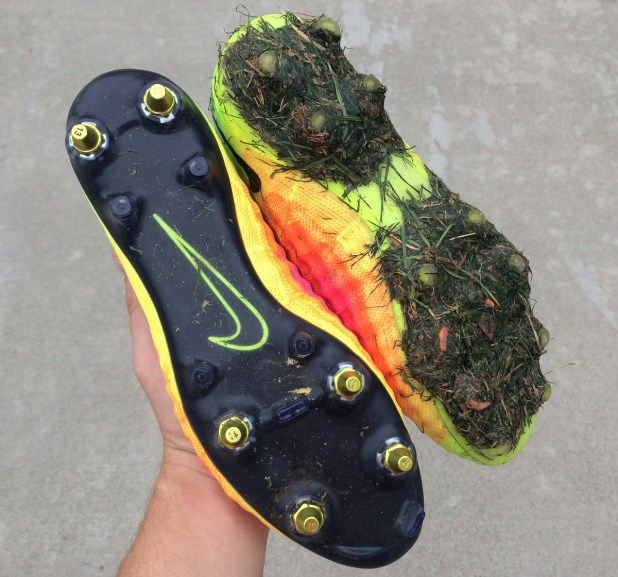
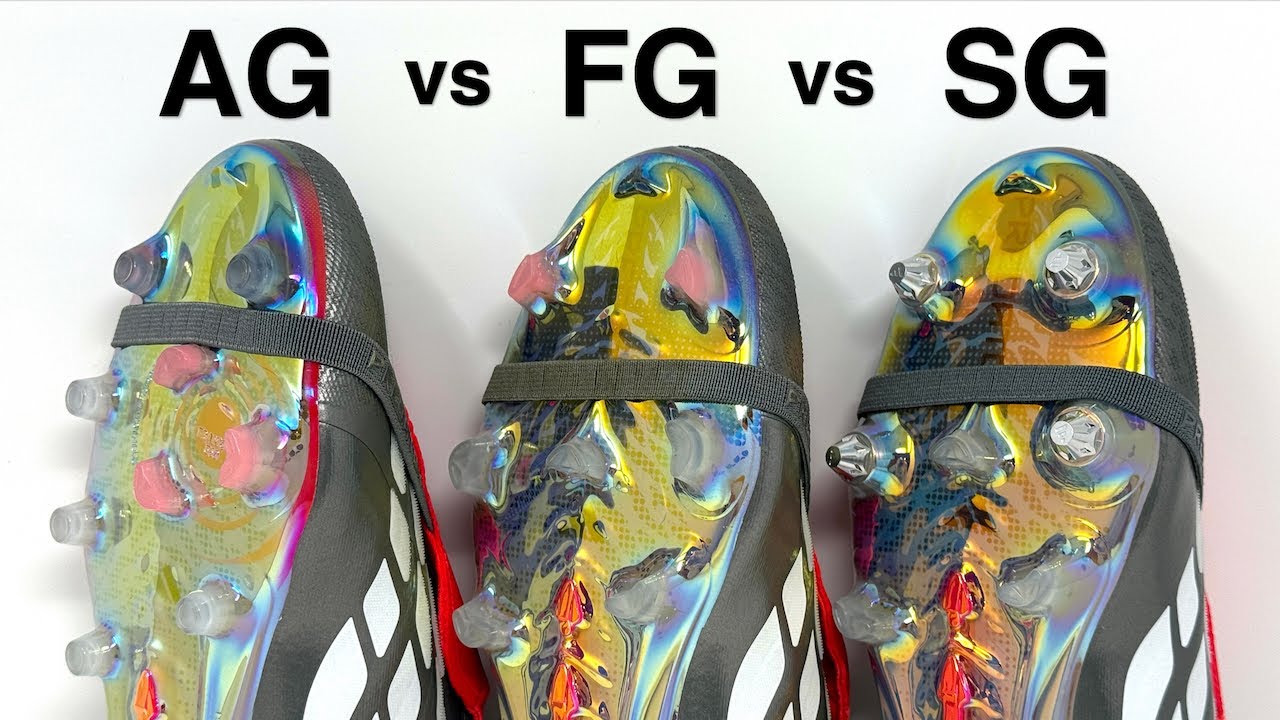
FG cleats utilize a multi-stud configuration of short, fixed, molded plastic or rubber studs. These studs are non-removable and designed for balanced weight distribution and multi-directional traction on compact natural grass surfaces. SG cleats employ a minimalist pattern of 6-8 longer, removable studs, frequently constructed from aluminum, engineered for deep penetration into saturated soil.
The soleplate tells the whole story. Pick up a firm ground boot. You’ll see a forest of studs, 12, 14, sometimes more. They’re short, maybe 10-12mm tall, and molded directly into the soleplate. They can be conical, bladed, or a mix, but they’re not coming out. This high count spreads your weight evenly. It’s like wearing cleated sneakers.
Now pick up a soft ground boot. You’ll find six, maybe eight studs total. They’re long, often 15mm or more, and they screw into threaded receptacles in the sole. You can swap them out for different lengths. This low count focuses pressure. Each stud acts like a tent peg, driving deep to find solid purchase below the mud.
The mechanics are simple. On firm ground, you need many small pressure points to prevent slippage during lateral cuts. On soft ground, you need a few deep anchors to prevent your foot from sliding on the soupy surface. Using the wrong pattern doesn’t just feel bad, it fails at a fundamental level.
TL;DR: FG = many short, fixed studs for surface grip. SG = few long, removable studs for deep anchor.
The Field Condition Decoder: It’s About Moisture, Not Season
Wind direction decides whether the head feeds or jams. Most guides tell you “FG for summer, SG for winter.” That’s lazy. I’ve played on rock-hard pitches in December and waterlogged swamps in July. The real decider is the amount of water in the top inch of soil.
Forget the calendar. Use the heel test five minutes before warm-ups. Drive your heel into the grass with your body weight. Watch what happens.
- The field is firm ground if: Your heel compresses the grass and soil slightly, leaving a clear imprint. The ground feels solid underneath. No water appears. The grass might be damp from morning dew, but the soil structure is intact.
- The field is soft ground if: Your heel sinks in noticeably. Water visibly seeps up and around the edges of your footprint. The ground feels spongy, and pulling your foot out makes a sucking sound. This is your SG signal.
This table maps the field state to the right tool. It’s your pre-match checklist.
| Field Condition | Recommended Cleat | What Happens With the Wrong Cleat |
|---|---|---|
| Dry, well-maintained grass | Firm Ground (FG) | SG studs skate on the surface, causing instability and high risk of ankle roll. |
| Slightly damp, firm grass | Firm Ground (FG) | FG performs perfectly. SG studs partially penetrate but feel “tippy” and slow. |
| Wet, muddy, waterlogged grass | Soft Ground (SG) | FG studs clog with mud instantly, becoming slick plates. You will slip on every cut. |
| Very hard, sun-baked ground | Turf or Indoor | Both FG and SG studs are painful and dangerous. Use turf shoes or molded cleats. |
| Modern artificial turf | AG Cleats | FG cleats wear quickly and offer poor grip. SG cleats are prohibited and can cause severe knee injury. |
The mistake is thinking a little rain means SG. A summer shower on a well-drained pitch might just mean slightly damp FG conditions. Conversely, a dry spell after weeks of rain can leave a field deceptively soft underneath a crusty top layer. Test it.
Common mistake: Choosing cleats based on the weather forecast instead of the actual field, you’ll show up with SG cleats to a firm pitch and have no safe alternative, forcing a dangerous game or a last-minute boot swap.
Why-Layer: The Physics of Grip and Slip
For at least 3 instructions, recommendations, or technical claims in the article, include the underlying mechanism in 1–2 sentences. Surface-level “do X because it’s better” does NOT count.
FG studs clog because mud is a non-Newtonian fluid. Under pressure, it flows into the narrow spaces between the short studs, packs solid, and effectively creates a smooth, flat sole. You lose all traction. The soccer cleat studs are still there, but they’re encased in a layer of mud that acts as a lubricant. This is why you slip.
SG studs cause injury on firm ground because they create a high-pressure pivot point. The long stud can’t penetrate the hard soil, so all the force from a sudden cut or twist is concentrated on that single point of contact. Your foot wants to rotate around the stud, but your ankle and knee ligaments aren’t designed for that torque. This mechanism is detailed in the NIH systematic review on cleat-surface interaction, which links improper cleat-surface matching to a higher incidence of non-contact ligament injuries.
The benefit of removable SG studs isn’t just customization. It’s wear management. You can replace a single worn-down metal stud for a few euros instead of binning the entire boot. With FG cleats, once the molded studs wear past a certain point, usually when the front studs are visibly flattened, the cleat wear signs say it’s time for a new pair.
The One Rule That’s Not Flexible: SG on Firm Ground is Forbidden
Before you start: Never wear SG cleats on firm ground or artificial turf. The metal studs cannot penetrate, creating a fulcrum that can lead to severe ankle sprains or ACL tears. On artificial turf, they also damage the expensive surface and are almost always prohibited by facility rules.
This is the non-negotiable. I learned it the hard way in a youth tournament. The field was dry, but I’d just gotten my first pair of SG boots with shiny metal studs. I wanted to wear them. Ten minutes into the match, I planted my foot for a sharp cut. The stud grabbed nothing. My foot stayed planted while my knee twisted inward. I heard the pop. That was a torn medial collateral ligament and six weeks on the sidelines.
The sensation is unmistakable. Instead of your foot gripping and releasing smoothly, it feels like you’re balancing on stilts. There’s a constant, unsettling wobble. Any aggressive change of direction makes your ankle roll. It’s not a question of if you’ll get hurt, but when.
This rule extends to artificial grass. The artificial grass vs turf cleats debate is for another article, but neither FG nor SG is the correct choice. The plastic blades and rubber infill of modern turf require the specific pressure distribution of AG cleats.
TL;DR: SG cleats on firm ground or turf = high risk of ligament injury. Don’t do it.
FG vs SG: The Head-to-Head for Your Game
When you cover multiple options, include at least one direct “X vs Y” paragraph or H3 that commits to a winner per use case.
This isn’t about which is better. It’s about which is right for the dirt under your feet. Here’s the breakdown.
| Aspect | Firm Ground (FG) Cleats | Soft Ground (SG) Cleats |
|---|---|---|
| Stud Type | Many short, fixed, molded plastic/rubber. | Few (6-8) long, removable, often metal. |
| Ideal Surface | Dry to slightly damp, firm natural grass. | Wet, muddy, soft, waterlogged natural grass. |
| Traction Action | Multiple surface points prevent slippage on compact soil. | Deep anchors prevent sliding on soupy surfaces. |
| Versatility | High. The default for most grass matches. | Very low. Only for specific wet conditions. |
| Key Risk | Clogging and becoming useless in mud. | Causing ankle/knee injuries on firm ground or turf. |
| Cost & Longevity | Lower upfront, but entire boot is replaced when studs wear. | Higher upfront, but individual studs can be replaced cheaply. |
FG wins for 80% of matches. It’s the workhorse. SG wins for that 20% when the pitch is a legitimate swamp. There is no “depends on your position.” A midfielder needs just as much grip in the mud as a forward. The types of soccer cleats are defined by surface, not by player role.
For the other surfaces, you need other tools. Hard, dry ground or indoor courts demand turf shoes. Modern artificial pitches demand AG soccer cleats. Trying to make FG or SG do those jobs is a compromise that hurts your play.
Making the Choice: A Practical Walkthrough
Your first step is knowing what you already own. Check the soleplate and the inside tongue of your boots. Manufacturers always label them: FG, SG, AG, TF, or IN. If it’s not labeled, the stud pattern tells you.
If you’re buying your first serious pair, start with FG. They’ll see the most use. Add SG cleats to your bag later if you regularly play in a rainy climate or on poor-quality, muddy fields. A proper cleat fit guide is more important than chasing the fanciest model.
I prefer a hybrid SG/FG boot for variable conditions, not the all-in-one kind, but the models that come with two sets of screw-in studs. You get the FG soleplate with shorter studs for firm days and longer metal ones in the box for soft days. It’s more upfront cost, but it covers you for everything nature throws at a grass pitch.
Material choice is a separate battle. The leather vs synthetic cleats debate matters for touch and waterproofing, but it doesn’t change the stud rule. A leather SG boot is still only for soft ground.
Finally, get the soccer cleat sizing right. A boot that’s even slightly too big will slide on the studs, negating all their traction. Your heel must be locked in.
TL;DR: Identify your boots, start with FG, upgrade to SG if needed, and always prioritize fit over features.
Frequently Asked Questions
Can I use firm ground cleats on artificial grass?
You can, but you shouldn’t. The performance is poor and it’s hard on the boot. FG studs are too aggressive for the turf’s plastic fibers and rubber infill. They don’t flex properly, leading to unstable footing and faster wear on both the cleat and the turf surface. Dedicated AG cleats are the correct and safer tool.
What if my firm ground cleats have both conical and bladed studs?
This is a common hybrid pattern aimed at providing multi-directional grip. The conical vs bladed studs serve different functions: conical studs offer rotational ease for turning, while bladed studs provide explosive grip for forward/backward motion. The mix is a design feature, not an indicator that the boot is suitable for soft ground.
Are soft ground cleats allowed in youth soccer?
League rules vary, but many youth leagues ban metal studs (SG cleats) for safety reasons. Always check your local association’s rules. Even if allowed, only use them if the field conditions are truly soft and muddy, never on a dry or artificial field.
How long do soft ground studs last compared to firm ground studs?
SG metal studs are more durable than FG plastic studs on abrasive surfaces like hard ground, but using them there is dangerous. When used correctly in soft ground, SG studs can last multiple seasons. FG molded studs wear down with use on all surfaces; once the leading edges are visibly rounded and flattened, traction is compromised.
Do professional players really switch cleats based on the field?
Absolutely. It’s standard procedure. Teams and equipment managers assess the pitch hours before a match. Players often have multiple pairs. FG, SG, and AG, ready to go. They choose based on the exact conditions that day, not the forecast or the season.
The Bottom Line
Stop thinking about cleats as shoes. Think of them as tires. You wouldn’t drive slick racing tires in a snowstorm, or deep-tread snow tires on a dry track. The wrong choice fails at its job and puts you in danger.
Match the stud to the soil. FG for grip, SG for anchor. Test the field with your heel, respect the injury risk of SG on firm ground, and invest in the right footwear for foot type and surface. Your performance, and your knees, will thank you.

I come from the “soccer heart” of Germany, the Ruhrpott. I have played, trained and followed soccer all my life and am a big fan of FC Schalke 04. I also enjoy following international soccer extensively.