Choosing Soccer Cleats for Your Foot Type: The Fit Guide
To choose soccer cleats for your foot type, match three non-negotiable elements: the playing surface (which dictates the stud configuration), your precise foot width and volume, and the cleat’s upper material. The right fit feels like a second skin, snug with zero lateral movement and about half a centimeter of space at the toe.
Most players get this wrong by shopping backwards. They fall for a flashy colorway or a star player’s signature model first, then try to force their foot into it. The cleat dictates your performance and safety for months. A bad choice doesn’t just feel uncomfortable, it changes how you cut, pass, and shoot.
This guide walks you through the sequence that actually works: surface, then fit, then material. We’ll cover how to measure your foot properly, decode the alphabet soup of stud types, and name the specific models that work for wide feet, narrow feet, and everything in between.
Key Takeaways
- Your playing surface is the first and most critical filter. Using Firm Ground (FG) cleats on artificial turf is a leading cause of ankle and knee stress.
- True fit means zero lateral movement. If your foot slides side-to-side inside the boot, you will blister and lose ball feel. Sizing up for width creates heel slip, which is worse.
- Leather uppers (kangaroo or calfskin) mold to wide or high-volume feet. Synthetic and knit uppers are lighter and water-resistant but offer minimal stretch.
- For kids, prioritize width and room to grow. Pain after a game usually means the cleat is too narrow, not too short. Brands like New Balance offer true 2E wide sizes in youth models.
- Break-in is mandatory for leather, minimal for synthetic. Never play a full match in brand-new leather cleats; the blisters will sideline you for a week.
The One Rule That Trumps Everything: Surface First
Choosing cleats for your foot shape is pointless if you’re wearing the wrong tool for the pitch. The stud configuration, the plastic or metal nubs on the bottom, is engineered for specific ground conditions. Get this wrong, and you risk injury before you even feel a pinch in your toes.
The surface decides everything. A Firm Ground cleat on artificial grass doesn’t just wear down fast. Its longer studs can’t penetrate the rubber infill, so your foot stays perched on top. Your ankle rolls easier on that unstable platform. I’ve seen more than one talented kid miss a season with a sprain traced back to this single mistake.
The 2023 FIFA Quality Programme for artificial turf mandates a specific stud length and configuration for player safety. Cleats marked “AG” (Artificial Ground) are tested to meet these standards, distributing pressure across more, shorter studs to reduce joint load.
You need to know the codes. Here’s the decoder.
| Stud Type Code | Full Name | For This Surface | Never Use On |
|---|---|---|---|
| FG | Firm Ground | Natural grass in good, dry condition | Artificial turf, hard ground |
| AG | Artificial Ground | Modern 3G/4G artificial turf with rubber infill | Very soft, muddy natural grass |
| TF | Turf | Old-style compacted turf, asphalt, gym floors | Grass or 3G turf |
| SG | Soft Ground | Wet, muddy natural grass | Any firm or artificial surface |
| MG | Multi-Ground | A hybrid design for both natural grass and AG turf | Deep mud or very hard court surfaces |
If you play on modern club pitches, you’re likely dealing with AG or FG. Community pitches and school fields might be TF. Check the soleplate label every time. This isn’t a suggestion.
TL;DR: Match your cleat’s stud code to your actual playing surface. It’s a safety rule, not a performance tip.
How to Actually Measure Your Foot for Cleats
You know your sneaker size. That number is almost useless for cleats. Soccer boots fit tighter, and brand sizing varies wildly, a Nike Mercurial in a US 10 fits differently than an Adidas Copa in a US 10. You need two measurements: length and width.
Do this at the end of the day. Your feet swell after hours of standing or walking. Measuring in the morning gets you a cleat that will feel like a vise by halftime.
Place your foot on a piece of paper, heel against a wall. Mark the longest toe (it’s not always the big toe). Measure that distance in centimeters. That’s your foot length. For width, wrap a measuring tape around the ball of your foot, at its widest point. This circumference matters more than you think.
Most cleats are built on a “last” shaped for a D-width foot, the standard medium. If your foot is wider than that, the sides will press against the rigid upper. That pressure point at the base of your pinky toe is the first sign you’re in the wrong boot. Sizing up one length might give you width, but it will also give you a centimeter of empty space in front of your toes. Your foot will slide forward on every sprint, jamming your toes. The blisters form on the heels and toenails within two sessions.
Common mistake: Buying a longer cleat to accommodate width, the heel cup becomes too voluminous, causing lift and slippage on cuts. The blisters that form are deep and painful, often taking a week to heal.
For a visual reference on how different components affect fit and function, see our breakdown of soccer cleat stud patterns.
The Wide Foot, Narrow Foot, and High-Instep Guide

This is where generic advice stops working. Your foot shape points you to specific families of cleats.
If You Have Wide Feet (E or EE Width)
Your hunt is for volume. The goal is a forefoot that doesn’t feel like it’s in a clamp. Stiff, synthetic speed boots are your enemy. Look for these three paths:
- True Wide Sizes: New Balance is the outlier here. Their Furon and Tekela models often come in 2E width. This is the simplest solution.
- Leather Uppers: Kangaroo leather (like the Adidas Copa Mundial) stretches and molds. It will give 3-5mm over 2-3 weeks of proper break-in. Calfskin leather, used in the Nike Tiempo Legend, is slightly less pliable but still forgiving.
- “Roomy” Lasts: Some synthetic boots are built on a wider last for control players. The current Puma Future and older Adidas Predator editions often have more forefoot volume than a Mercurial.
A wider soleplate also helps. AG and TF cleats tend to have outsoles that splay the studs wider for stability on artificial surfaces. That extra base can make the whole shoe feel more accommodating, even if the upper is snug.
The leather vs synthetic cleats debate ends here for wide-footed players. Leather is usually the answer.
If You Have Narrow Feet
You need a boot that hugs. Excess material will bunch and create friction points. Your best bets are speed-oriented models built on a tapered last:
* Nike Mercurial Vapor
* Adidas Predator (synthetic versions)
* Puma Future (fits narrow-to-medium)
* Under Armour Magnetico Select 3.0
These uppers are often a one-piece knit or synthetic sleeve that wraps tightly. Try your true size first. You should feel secure without any pinching.
If You Have a High Instep or High-Volume Foot
This isn’t about width; it’s about height. The top of your foot feels cramped. Laces are your best friend. Laceless cleats offer a seamless strike zone but often have less adjustable volume. A laced boot lets you loosen the midfoot to create a dome of space over your instep.
Models with a traditional tongue, like the Nike Tiempo or the Mizuno Morelia, are ideal. You can also use a strategic lacing technique, skip the eyelet directly over the highest point of your instep to relieve pressure.
I have a moderately high instep. I forced myself into a laceless Adidas boot for a season because I loved the clean look. By November, I had a permanent numb spot on the top of my foot that took months to go away. Now I only wear laced Tiempos.
For more on adapting your cleats, our guide on breaking in new cleats covers lacing tricks in detail.
The Step-by-Step Fitting Session
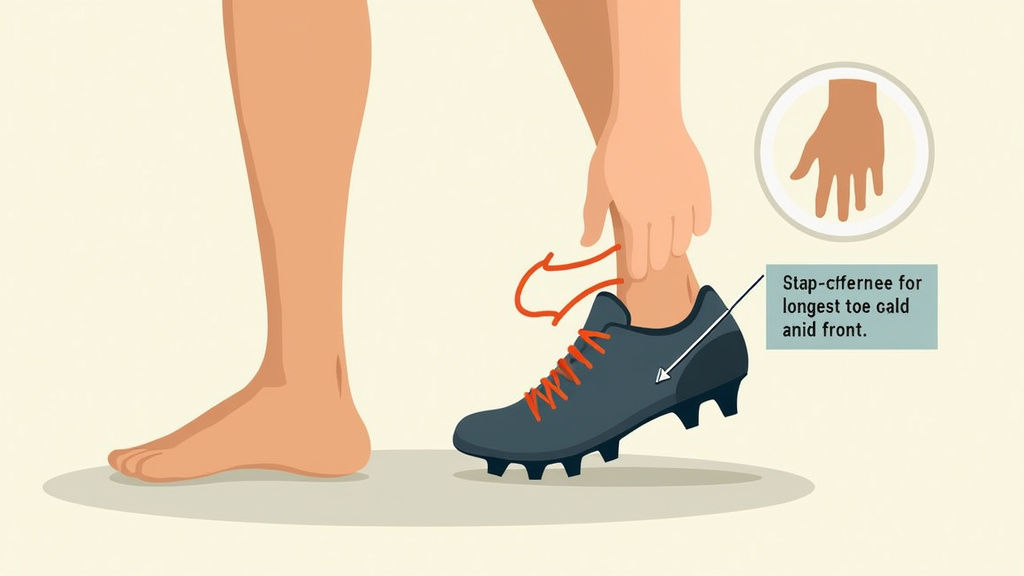
When you go to try cleats, follow this sequence. Don’t just stand up and say “feels okay.”
Before you start: Wear the exact socks you play in. Bring both shoes. Your feet are not identical.
- Slide your foot in. Don’t force it. If you struggle to get your heel past the collar, the volume is too low.
- Stand up on a hard surface. Your weight will settle your foot into the boot. Your longest toe should lightly brush the front. There should be 0-5mm of space, about the width of your thumbnail.
- Check heel lockdown. Lean forward onto the balls of your feet. Your heel should not lift at all. Any vertical movement will cause a blister.
- Test width. Can you wiggle your toes? Good. Can your foot slide side-to-side? Bad. The sides of the boot should contact your foot evenly without focused pressure.
- Walk, jog, and cut. Do a few lunges and pretend to change direction. Listen for your foot. Does it slide? Do you feel a hot spot developing on the outside edge?
This process takes five minutes. It saves you from a $150 mistake. Understanding soccer cleat sizing differences is crucial before you even begin this session.
Material Choice: Leather, Synthetic, and Knit

The upper is your interface with the ball. Your foot shape will determine which material you can tolerate.
| Material | Best For | Break-In Required? | Width Accommodation | Risk If Wrong |
|---|---|---|---|---|
| Kangaroo Leather | Wide feet, high instep, pure ball feel | Yes (1-2 weeks) | Excellent – stretches | Can over-stretch, loses structure if soaked |
| Calfskin Leather | Wide-to-medium feet, durability | Yes (1 week) | Good – molds | Heavier, absorbs water in wet conditions |
| Synthetic | Narrow feet, consistent fit, wet weather | Minimal | Poor – no stretch | Pressure points are permanent |
| Knit | Narrow-to-medium feet, sock-like fit | None | Very poor – hugs | Provides almost no protection from tackles |
Leather is a living material. It will shape itself to your foot’s bumps and contours. The first few wears might feel stiff, but it gives where you need it to. Synthetic doesn’t care. What you feel on day one is what you get on day one hundred. If it’s tight on your pinky toe, it will always be tight.
The choice between conical vs bladed studs is about traction, but the material choice is about your anatomy.
Special Considerations: Kids and Common Foot Issues
Kids’ feet are soft and growing. A tight cleat can affect bone development. The rule of thumb is a thumbnail’s space at the toe, but you must check for width constantly. Kids often complain of “foot tiredness” or pain on the sides of their feet, that’s a width problem, not a length problem.
Look for brands offering youth wide sizes. New Balance and Puma are good starts. Leather is again a smart choice for its ability to adapt. Never buy cleats for a child to “grow into” over a full season. That’s a season of discomfort and poor technique.
For common issues:
* Bunions: Avoid rigid synthetic materials that press on the bunion joint. Leather is mandatory. Look for a wide toe box.
* Plantar Fasciitis: Prioritize a supportive, stable soleplate. AG or TF cleats with their numerous, shorter studs can offer more even pressure distribution than a few long FG studs.
* Flat Feet: You don’t necessarily need arch support inside the cleat, the tight fit provides its own support. Focus on finding a comfortable width so the foot isn’t squeezed.
The differences between FG vs SG cleats or artificial grass vs turf cleats still apply to kids; the surface safety rules don’t change with age.
Frequently Asked Questions
Should soccer cleats feel tight at first?
Yes, but not painful. They should feel snug like a second skin, with no pinching or burning pressure points. Leather will loosen; synthetic will not. If a synthetic boot hurts in the store, it will hurt on the pitch.
How much room should be in the toe of a soccer cleat?
Aim for 0-5mm, or about half a centimeter. You should be able to lightly press the front of the cleat and feel your toe. More space than that, and your foot will slide forward and jam on stops.
Can you wear FG cleats on artificial turf?
You can, but you shouldn’t. It’s dangerous. FG studs are too long for the artificial surface, leading to increased stress on ankles and knees. It also ruins the studs. Use AG soccer cleats designed for that specific surface.
Do soccer cleats stretch?
Leather cleats stretch and mold, typically gaining 3-5mm in width. Synthetic and knit cleats do not stretch meaningfully. They might soften slightly, but the fit profile remains fixed.
What if one foot is bigger than the other?
Fit the cleat to your larger foot. It’s easier to add a thin insole or wear a slightly thicker sock on the smaller foot than to cram the larger foot into a boot that’s too small. Never split sizes.
Are there specific cleats for indoor soccer?
Absolutely. Indoor soccer uses flat-soled shoes, not cleats. The traction pattern is designed for court surfaces. Wearing outdoor cleats indoors is ineffective and can damage gym floors. Understand the distinction with our guide to indoor soccer shoes.
The Bottom Line
Forget the marketing. Ignore the latest colorway. The right cleat is the one that disappears on your foot, you don’t think about it, you just play. That happens only when you follow the hierarchy: surface, then fit, then material.
Start by reading the soleplate and matching it to your pitch. Then, measure your foot for width and length with the socks you’ll wear. Finally, let your foot shape guide you to leather for width and forgiveness, or synthetic for a locked-in, consistent feel. Trying on ten pairs is better than limping through ten games. Your feet are the foundation of your game. Build on them properly.
I come from the “soccer heart” of Germany, the Ruhrpott. I have played, trained and followed soccer all my life and am a big fan of FC Schalke 04. I also enjoy following international soccer extensively.