Football Field vs Soccer Field: The 5 Key Differences
Football fields and soccer fields differ in five key areas: dimensions, markings, surface, goal design, and terminology. A football field is a rigid 120-yard rectangle with dense tactical markings. A soccer pitch is a larger, variable space with minimal lines for continuous flow, governed by a flexible international rulebook.
A football field is a fixed rectangle of 120 yards by 53.3 yards, covered in dense instructional markings for stop-start play. A soccer field is a larger, variable rectangle within FIFA’s range (110-120 yards long, 70-80 yards wide) with minimal, functional lines for continuous flow. The difference isn’t just green grass. It’s a complete redesign of space for two opposing philosophies of sport.
Most comparisons get stuck on total length. They miss the real story. The critical gap is in width, marking philosophy, and the rigid versus flexible rulebook that governs every blade of grass. Getting this wrong isn’t a trivia error. It explains why converting an NFL stadium for professional soccer is a multimillion-dollar engineering problem, not a paint job.
Let’s break down the five non-negotiable differences that separate a gridiron from a pitch. We’ll look at dimensions, markings, goals, turf, and the rulebooks that lock them in place.
Key Takeaways
- The biggest physical difference is width. A football field is a narrow 53.3 yards. A soccer field must be at least 70 yards wide, creating at least a 30% larger playable area that changes tactical space completely.
- Markings are for instruction vs. flow. Football’s dense yard lines and hash marks officiate a stop-start game. Soccer’s sparse lines (penalty area, center circle) facilitate continuous play with few interruptions.
- Goals define the score zone. Soccer goals are on the line you must cross. Football goalposts are behind the end zone you must reach, splitting scoring into two distinct physical actions.
- Flexibility is written into soccer’s rules (FIFA allows a range), while American football’s dimensions are nearly identical from high school to the NFL for absolute consistency.
- Sharing fields at a professional level is functionally impossible without major compromise. The width mismatch and conflicting lines force one sport to play on a surface designed for another’s rhythm.
The 5 Core Differences at a Glance
Forget just looking at two green rectangles. The clash is in the specs. This table shows the absolute divergence in their blueprints.
| Aspect | American Football Field | Soccer Field (FIFA Regulation) |
|---|---|---|
| Total Length | 120 yards (360 ft) fixed | 110–120 yards (100–110 m) variable |
| Playing Length | 100 yards between goal lines | Same as total length – no separate end zones |
| Width | 53 1/3 yards (160 ft) fixed | 70–80 yards (64–75 m) variable |
| Total Area (approx.) | 57,600 sq ft (1.32 acres) | 69,300–86,400 sq ft (1.6–2.0 acres) – 19–50% larger |
| Primary Governing Body | NFL / NCAA | FIFA |
| Field Marking Density | Extremely High | Minimal |
| Goal Type | Y-shaped uprights behind end zone | Rectangular net on goal line |
TL;DR: Football fields are fixed, narrow, and instruction-heavy. Soccer pitches are variable, wide, and flow-oriented. The area difference is decisive.
The standard American football field spans 360 feet in length (120 yards) and 160 feet in width (53 1/3 yards), inclusive of two 10-yard end zones. In contrast, the international soccer pitch governed by FIFA regulations measures between 330 and 360 feet in length (110-120 yards) and 210 to 240 feet in width (70-80 yards), with no separate end zones.
The numbers tell a stark story. A max-size FIFA pitch is roughly 50% larger by area than an NFL field. That extra 30 feet of width on the low end isn’t optional padding. It’s the canvas for soccer’s tactical width, switching play, and stretching defenses. A professional soccer team trying to play on a 53-yard wide football field would find their wings clipped. The game collapses into a congested, central mess.
I learned this the hard way watching a pre-season friendly for Schalke years ago, played in an American football stadium. The wings, usually our outlet, were nonexistent. Our playmakers kept running into the advertising boards near the touchline, thinking they had another ten yards. The rhythm was broken. It felt like playing in a corridor.
Why the Marking Density Tells Two Different Stories
Look down. The lines under your feet are a language. Soccer’s language is minimalist. Football’s is a dense legal document.
A regulation soccer pitch needs only a handful of markings to function. You have the boundary lines, a center circle with a spot, a halfway line, the penalty area (18-yard box), the goal area (6-yard box), and the corner arcs. Each has a direct, active purpose during continuous play: where a goalkeeper can handle the ball, where a penalty is awarded, where players must stay during a kick-off. The official soccer markings are tools for the game in motion.
Now look at a gridiron. It’s a grid of instructions. Yard lines every 5 yards. Numbers every 10 yards. Hash marks for ball placement after incomplete passes. An end zone. A midfield logo. This isn’t for flow; it’s for arbitration. Every play stops, the ball is spotted on or between the hash marks, and the next play begins from that exact location. The yard lines and end zone layout exist to measure progress in discrete, officiated chunks.
Common mistake: Thinking the hash marks are just decoration. On an NFL field, they’re 18 feet 6 inches apart. Every single play starts with the ball on or between those marks. They dictate offensive formation width and defensive alignment before the snap. Miss that, and you miss how the field manages every stoppage.
This difference roots itself in the sports’ cores. Soccer is about maintaining possession and space. The free kick regulations and other set-piece rules use the lines as triggers. Football is about conquering territory in measured increments. The field itself is the scoreboard.
Goalposts vs. Goals: Scoring’s Physical Architecture
This is the most visually obvious split. One sport scores by crossing a line with the ball. The other scores by crossing a line and then kicking between uprights.
A soccer goal is a barrier on the line you must breach. It’s 8 feet high and 24 feet wide, with a net to capture the ball. The entire structure sits on the goal line, making the line itself the scoring plane. When the ball fully crosses this line between the posts and under the bar, it’s a goal. The penalty kick distance is measured 12 yards from this line. The goal kick procedure starts from its 6-yard box. Everything radiates from this net.
An American football goalpost looks nothing like it. It’s a tall, Y-shaped structure placed at the very back of the 10-yard end zone. The crossbar is 10 feet high, with uprights extending 35 feet above it. To score a field goal or extra point, the ball must be kicked from the field of play, over the crossbar, and between the uprights. The scoring act is vertical and aerial, separated from the act of crossing the goal line with the ball (a touchdown).
This architectural difference changes everything about end-game strategy. Soccer’s last-ditch defense happens on the line itself. Football’s final stand happens 10 yards deep in the end zone, with a second contest in the air above it.
Turf and Surface: Grass Isn’t Just Grass
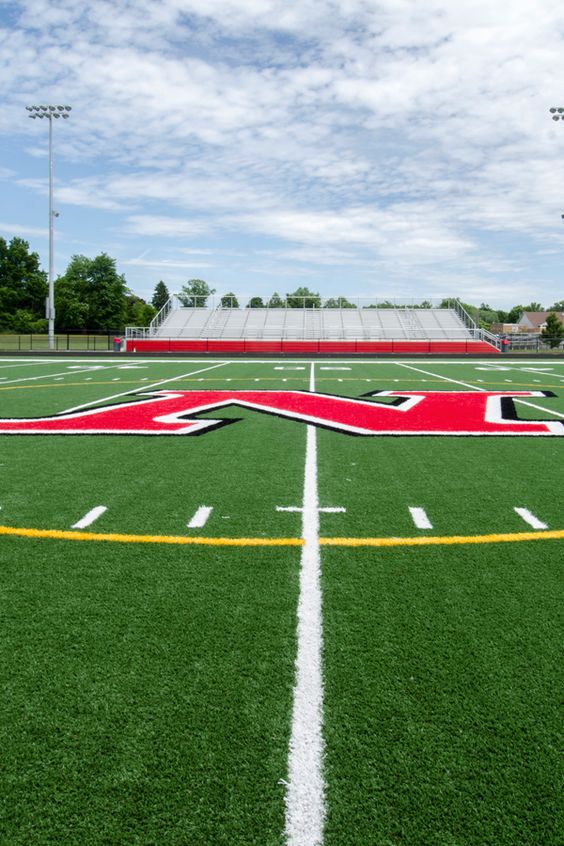
Both fields can be natural grass or artificial turf. But the word “turf” means different things to each sport’s engineers.
Natural grass is the historical surface for both. For soccer, a pristine, even grass surface is critical for true ball roll and predictable bounce. The international football pitch dimensions assume a consistent surface. In football, grass fields take a brutal, localized beating. The line of scrimmage and the hash marks get torn up by cleats, leading to mud bowls in bad weather.

Artificial turf is where the specs truly diverge. Modern soccer turf systems use longer, softer fibers infilled with sand and rubber granules. This mimics natural grass’s cushioning and ball response. The focus is on player safety for sliding and ball behavior for accurate passing.
Football turf is built for punishment. It’s often denser, with shorter fibers and more rigid infill to withstand the grinding of linemen and the impact of constant tackles. The priority is durability and traction for explosive starts and stops, not necessarily the perfect roll of a size-5 ball.
I prefer a natural grass pitch for soccer, always. Not just for tradition. On a cold, wet night in Gelsenkirchen, a good grass field holds its pace. The ball skids truly. Artificial turf, especially the older, harder varieties, changes the game. The ball runs faster but bounces higher, turning controlled possession into a pinball match. It’s a different sport.
TL;DR: “Turf” is not one product. Soccer turf is engineered for ball roll and slide. Football turf is engineered for impact and traction. Using one for the other forces adaptations that affect performance and injury risk.
The Rulebook: Flexibility vs. Absolute Standard

The final, invisible difference is on paper. The rulebooks governing these fields have opposing philosophies: flexible range versus locked standard.
FIFA’s Laws of the Game explicitly allow a range for soccer field dimensions. Length: 100-110 meters (110-120 yards). Width: 64-75 meters (70-82 yards). This flexibility acknowledges that the game must be playable worldwide, from massive professional stadiums to smaller community pitches. The regulation soccer pitch size can adapt.
The NFL and NCAA rulebooks leave almost no room for interpretation. The field must be 120 yards long (including end zones) by 53 1/3 yards wide. Period. Hash mark spacing varies slightly between levels (NFL: 18’6″ apart; College: 40′ apart), but the core rectangle is sacrosanct. This absolute standard ensures that a play drawn up in Green Bay works exactly the same in Miami. The field is a universal constant.
This is why you see shared fields in high schools but almost never in professional leagues. A school can paint different colored lines for soccer and football on the same rectangle, even if the soccer width is compromised. A professional soccer league, like MLS, cannot play its matches on a field that is 17 yards narrower than FIFA’s minimum. The soccer vs football field dimensions comparison shows the deal-breaking mismatch.
Can You Use a Football Field for Soccer (and Vice Versa)?
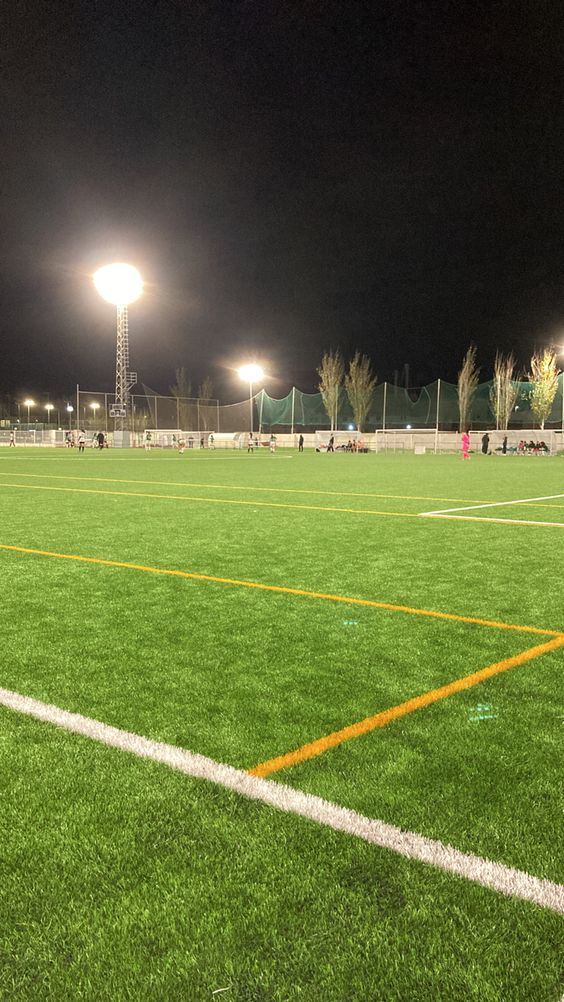
Technically, you can kick a ball on any surface. Practically, at any competitive level, the answer is no without major compromise.
Using a Football Field for Soccer:
The width is the instant failure. At 53.3 yards, it’s under FIFA’s 70-yard minimum. The game becomes overly central, long balls go out of play constantly, and tactical width vanishes. The dense football markings are also visually confusing for players and officials. The penalty area dimensions and goal area would have to be painted over a forest of other lines.
Using a Soccer Field for Football:
This is more physically possible but still problematic. The field would need permanent football markings grafted onto it, which would conflict with soccer’s lines. The goalposts would need to be installed at the back of a created end zone, requiring permanent structural foundations. The natural grass surface would be destroyed by the concentrated wear of line play.
The shared-field model only works at the youth or recreational level, where the priority is having a field, not perfect conditions. For pros, the fields are specialized tools.
Frequently Asked Questions
What is bigger, a soccer field or football field?
regulation soccer field is almost always larger in total area than an American football field. The key is width. Even a minimum-width FIFA soccer pitch (70 yards) is over 30% wider than a football field (53.3 yards), resulting in significantly more playable space.
Why does a football field have so many lines?
The lines are for officiating and strategy in a stop-start game. Yard lines measure progress. Hash marks provide the exact starting point for each play after a stoppage. The dense grid allows for precise ball placement, which is central to the sport’s down-and-distance structure.
Can a soccer goalie use the full penalty area on a shared field?
Only if the penalty area is clearly marked. On a shared field with faded or conflicting lines, this becomes a referee’s judgment call and a source of controversy. The penalty box rules depend on clear, unambiguous markings.
How far apart are the hash marks?
It depends on the level of play. In the NFL, hash marks are 18 feet 6 inches apart. In NCAA college football, they are 40 feet apart. This spacing influences where the ball is spotted and thus affects offensive play-calling and formation width.
Are all soccer fields the same size?
No. Unlike football fields, soccer pitches have a permitted range. FIFA allows lengths from 110-120 yards and widths from 70-80 yards. Professional clubs often choose dimensions within this range that suit their tactical style. The official soccer field length is a choice.
What is the purpose of the center circle?
The center circle in soccer has one main rule: opposing players must stay outside of it until the ball is kicked during a kick-off. It ensures the team taking the kick-off has space to start play. It’s a simple functional marking, not a measurement tool like football’s yard lines.
The Bottom Line
A football field and a soccer field are both green rectangles, but that’s where the similarity ends. One is a fixed, narrow grid for measured conquest. The other is a variable, wide canvas for flowing possession. The difference lives in the width, the language of the lines, the architecture of the goals, and the very rulebooks that define them.
You can’t paint one over the other and expect the sport to work. The space itself is the first player on the pitch, and it plays for only one team. Understanding these five differences does more than settle a bar bet. It shows you why the world’s two most popular sports see the same patch of grass in two completely different ways.

I come from the “soccer heart” of Germany, the Ruhrpott. I have played, trained and followed soccer all my life and am a big fan of FC Schalke 04. I also enjoy following international soccer extensively.