How to Improve Your First Touch in Soccer: 5 Proven Drills
To improve first touch in soccer, you must master three technical fundamentals: cushioning the ball with a relaxed foot, setting your body shape before it arrives, and intentionally directing the touch 0.5 to 1 meter into space. This skill is not innate, it’s built through 15 minutes of daily, focused drills like wall passes and juggling.
Most players think a good first touch means stopping the ball dead under their feet. That’s the mistake. Stopping it kills your momentum and gives the nearest defender an extra second to close you down. The real goal is to receive the ball and move it into useful space in one motion.
This guide breaks down the mechanics, the most common technical error, and five drills you can start today. You’ll learn why your touch feels “heavy,” how to use different foot surfaces, and how to train your brain to make decisions under pressure.
Key Takeaways
- Cushioning is everything. A rigid foot makes the ball bounce. Relax your ankle and pull your foot back slightly at contact to kill the ball’s momentum.
- Your first touch is a decision, not a reaction. Scan the field and decide where to move the ball before it reaches you. Your body shape, angled at 45 degrees with open hips, enables this.
- Aim for 0.5–1 meter of control. A perfect first touch places the ball one step away, not at your feet. This maintains your vision and keeps play flowing.
- The wall is your best coach. Ten minutes of daily wall passing, focusing on soft, directional returns, builds muscle memory faster than any fancy equipment.
- Train your weak foot until it’s not weak. Neglecting one side cuts your options in half. Every drill should be done with both feet from day one.
The 3 Technical Pillars of a Clean First Touch
Forget fancy tricks. A reliable first touch rests on three physical actions you can drill into habit. Get these wrong, and the ball will always feel like it’s fighting you.
Pillar one is cushioning. This isn’t about being gentle. It’s a specific mechanical withdrawal of your foot at the moment of contact. Imagine catching an egg without breaking it. Your ankle stays relaxed, and as the ball hits your foot, you pull your receiving surface back just enough to absorb the energy. A stiff ankle acts like a brick wall, the ball ricochets off unpredictably. This is the core of all ground control, whether you’re using the inside of your foot or the laces.
Pillar two is body shape. You don’t receive the ball square to the passer like a target. You receive it angled to the field. Turn your shoulders and hips at about 45 degrees before the ball arrives. This opens your vision to both the passer and the space ahead. It also prepositions your body to take that first touch forward or to the side naturally. If you’re squared up, the only comfortable direction is backwards. That’s a pass to the opponent.
Pillar three is surface selection. Each part of your body has a job.
Inside of the foot: Your bread and butter. The large, flat surface is most reliable for ground passes. Use it when you have time and want maximum control.
Outside of the foot: The escape tool. Use it to take the ball across your body, away from a defender’s tackle. It’s for creating space under pressure.
Sole: The stop sign. Perfect for killing a ball dead in a tight space or for controlling a low, skidding pass.
Laces (top of foot): For power. Cushion a hard, driven pass here to set up a long pass or shot. The ankle must be especially soft.
Thigh and Chest: Your aerial platforms. Lean back slightly and make contact with a relaxed muscle to guide the ball down to your feet. Tense up, and it pops straight up.The first touch decision is made with your eyes, not your feet. If you’re looking at the ball when it arrives, you’re already late. Your last look should be at the field, so your feet know where to send the ball.
Why Your First Touch Feels ‘Heavy’ (And How to Fix It)
That feeling of chasing the ball after every touch has a direct cause. It’s not bad luck. You’re likely committing one of two technical sins.
The first is watching the ball onto your foot. It’s a natural instinct, you want to see the contact. But your eyes need to be up, scanning for pressure and space. When you look down, you lose perception of how far your touch is going. You either stop it dead under your feet or kick it too far. The fix is deliberate. Force your eyes up after your final tracking glance. Trust your foot to find the ball. It will feel wrong for a week. Then it becomes automatic.
The second is a tense receiving surface. Anxiety or fatigue makes players lock their ankles. A locked ankle cannot cushion. The ball strikes a rigid surface and bounces, often several yards away. The physical cue is a clenched calf muscle. Before a passing drill, consciously shake out your legs and remind yourself to keep the ankle of your receiving foot “soft.” Think of it as a shock absorber, not a platform.
Common mistake: Stopping the ball dead under your feet, you now need a second touch to move it, which gives a closing defender the time to tackle you before you can look up.
Here’s a diagnostic table. Match your symptom to the likely cause and the immediate fix.
| Symptom | Likely Cause | Immediate Fix |
|---|---|---|
| Ball bounces 2–3 feet away | Rigid ankle, no cushioning | Relax calf; practice “catching” soft passes from 5 feet |
| Touch goes farther than 2 steps | Watching ball at contact | Scan field early; call out a color or object as you receive |
| Ball pops up from chest/thigh | Leaning forward, tense muscle | Lean back slightly; let the ball “sink” into you |
| First touch is always backward | Square body shape | Receive at a 45-degree angle; point lead shoulder forward |
TL;DR: Heavy touches come from locked ankles and looking down. Relax the receiving muscle and force your eyes up to fix it.
The 5 Drills That Build a Pro-Level First Touch

You don’t need a partner or a big field. You need a ball, a wall, and ten focused minutes a day. Consistency beats marathon sessions.
1. The Foundation Wall Drill. Stand 10 feet from a wall. Pass the ball firmly against it with your right foot. Control the return with the inside of your left foot, cushioning it and directing it slightly forward to a cone placed a yard ahead. Repeat 50 times. Switch: pass with left, control with right. This drill ingrains the cushion-and-direct pattern. The wall never gets tired.
2. Juggling for Aerial Sense. Start with your hands. Drop the ball onto your thigh, cushion it, and let it drop to your foot. Control it there. The goal isn’t 100 juggles. The goal is controlling each drop with a soft surface. Can’t use your hands? Let the ball bounce once between juggles. This directly translates to controlling long balls and clearances.
3. The Directional Square. Set up four cones in a 5-yard square. Start at one cone. Have a partner (or use the wall) serve you a pass. Receive it with your back to a different cone, turn, and take your first touch toward a third cone. This forces intentional direction. Mix in outside-of-the-foot touches to escape the “pressure” of the imaginary defender behind you.
4. First Touch & Finish. Pass against a wall from 15 yards. Control the bouncing return with one touch, then shoot or pass to a target with your second. This links the first touch directly to the next soccer action, the essence of game speed. It exposes a heavy touch immediately because you’ll be off-balance for the shot.
5. Pressure & Decision. This requires a partner. They serve you passes while applying light, passive pressure, standing close, shadowing. You must scan, decide to touch left or right, and execute. Start slow. The pressure isn’t to win the ball, but to force a decision before reception. This is the bridge between technique and game intelligence.
I spent a season trying to improve my first touch by just playing more. Progress was glacial. Then I committed to 15 minutes of wall drills every afternoon for a month. The first week was frustrating, the ball kept bouncing. By the third week, my touch in weekend matches was noticeably cleaner. I wasn’t faster or stronger. I was just giving myself half a second more time every time I got the ball. That’s the difference.
| Drill | Primary Focus | Reps/Session | Common Pitfall |
|---|---|---|---|
| Foundation Wall Drill | Cushioning & direction | 50 per foot | Rushing reps; sacrificing softness for speed |
| Juggling for Aerial Sense | Soft thigh/chest/foot contact | 5 controlled drops per surface | Chasing the ball instead of cushioning it |
| Directional Square | Intentional turning touch | 10 rotations | Taking touch toward “pressure” out of habit |
| First Touch & Finish | Link to next action | 20 repetitions | Poor first touch ruins shot balance |
| Pressure & Decision | Scanning under duress | 15 serves | Making the decision after receiving the ball |
How to Train Your Brain: Scanning and Decision-Making
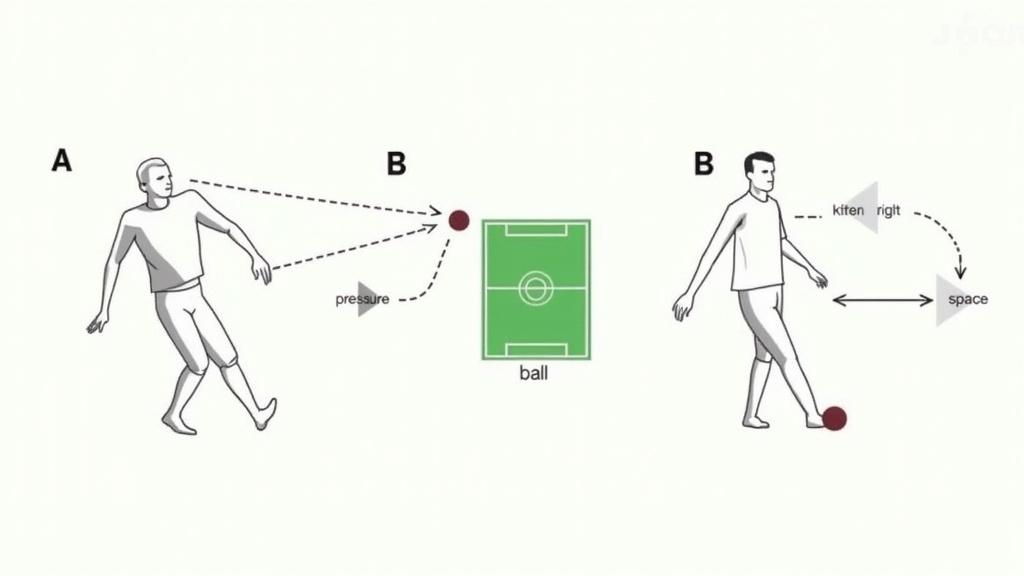
Your feet can be technically perfect, but if your brain is late, the touch is useless. The highest-level players separate themselves here.
Scanning is not glancing. It’s a systematic check of your surroundings before you receive the ball. As the pass is traveling to you, your head should be on a swivel. Look over your shoulder to see the defender’s position. Look ahead to see your passing options or space to drive into. This information tells your feet where the first touch should go. If you only scan after you control it, that space is already gone.
The decision is simple: touch away from pressure, touch into space. The scanning tells you where the pressure is and where the space is. Your body shape, already angled, allows you to execute that decision. This cognitive load is why first touch deteriorates when you’re tired, your brain stops collecting information early.
Practice this without a ball. Stand in the middle of your room. Have a friend call out “pressure left!” or “space right!” React by turning your body and miming a first touch in the correct direction. It feels silly. It wires the connection.
Common mistake: Receiving the ball before deciding what to do with it, this turns a proactive skill into a reactive panic, and you will consistently lose possession in tight areas.
First Touch Under Pressure: The Game Reality
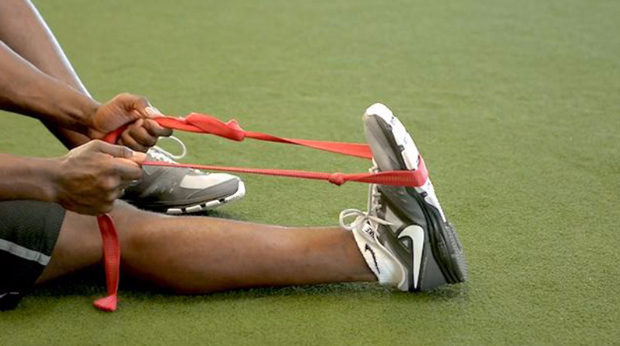
Drills in open space are the foundation. But the game is played with defenders breathing down your neck. Your training must graduate to include this variable.
Pressure changes the technical priority. Cushioning is still key, but direction becomes survival. You can’t take a touch into a defender. Your scanning must identify the “escape lane”, the direction away from the opponent’s tackle. Often, this means using the outside of your foot to whisk the ball across your body the moment it arrives.
The touch distance also changes. Under high pressure, that 1-meter touch might be too far, a defender can intercept it. You might need to take a tiny touch, just enough to move the ball from your right foot to your left, to evade a lunge. This is where sole control becomes vital.
To train this, start with passive pressure. A partner stands behind you and shadows your movement as you receive passes. Their job is to channel you, not tackle. This adds the cognitive element without the fear of a hard tackle. As you get comfortable, increase the intensity to light contact. The goal is to make the correct directional choice automatic, even when someone is physically crowding you.
TL;DR: Under pressure, cushion the ball but direct it sharply with the outside of your foot or sole. Your pre-reception scan must identify the escape route.
Equipment, Gimmicks, and What Actually Works
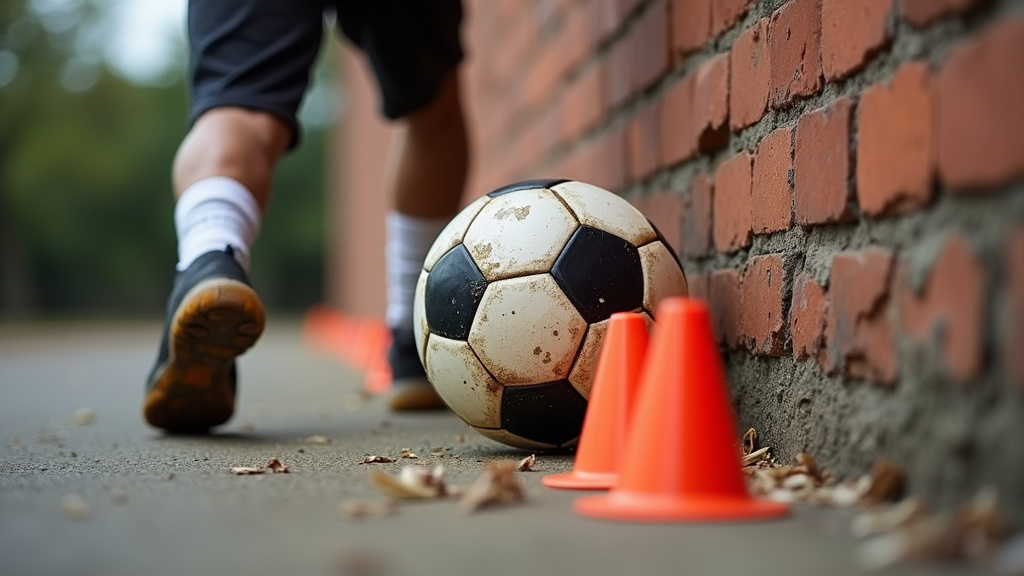
The soccer training market is full of flashing lights and promises. Ignore almost all of it.
A good ball (Size 5, properly inflated) and a solid wall are 95% of what you need. A rebound net is a worthy investment if you lack a good wall, it’s portable and consistent. Cones are helpful for creating targets. That’s the complete list for first touch development.
Gadgets like reaction-light pods? They train general reaction time and fitness, not the specific technique of cushioning a soccer ball. For a young player, that money is better spent on a second ball or a membership to a local pickup game. The best first touch drills at home require no technology at all.
The same principle applies to fancy “control mats” or patterned balls. They create a dependency on a visual cue that isn’t present in a match. Your focus should be on the feel of the ball on your foot, not a colored circle on the ground. Save your money. Invest your time.
Frequently Asked Questions
What is the most important part of a first touch?
The mental decision made before the ball arrives. Knowing where you will direct the ball allows your body to execute the technical aspects, cushioning, body shape, surface selection, smoothly. Without that decision, you’re just reacting, and your touch will often put you in trouble.
How long does it take to see improvement?
With focused, daily practice of 10-15 minutes, you can see noticeable improvement in controlled drills within 2-3 weeks. Translating that improvement to a full-speed, pressurized game typically takes 2-3 months of consistent application. The key is daily touches, not weekly marathons.
Should I always try to take a directional first touch?
Almost always. The exception is when you intentionally want to draw a defender in before spinning away, or in an extremely tight space where any movement might lose possession. For 95% of situations, a touch into space is better than stopping the ball dead. It’s the foundation of ball control mastery.
How can I practice if I don’t have a wall or a partner?
Juggling is your solo savior. Focus on controlling drops to your feet, thigh, and chest. You can also dribble in a small space, intentionally kicking the ball a few feet ahead and practicing controlling it on the move. Even tossing the ball in the air against a slight slope and controlling the return works. Creativity beats a lack of equipment.
Is first touch more important than dribbling?
They are different tools. A good first touch sets up everything else, a pass, a shot, or a dribble. Without it, your dribbling speed drills are irrelevant because you’ll never cleanly receive the ball in space to start your run. Think of first touch as the foundation, and dribbling as the house you build on it.
Why does my touch get worse when I’m tired?
Fatigue affects concentration first. You stop scanning early. Your brain doesn’t make the pre-reception decision, so your feet default to a safe, often backward, touch. Your muscles also tense up, reducing your ability to cushion. This is why fitness is a hidden component of technical skill.
The Bottom Line
Improving your first touch isn’t about magic or talent. It’s about reps. Specifically, the daily repetition of three things: cushioning with a soft foot, receiving with an angled body, and consciously directing the ball into space. Start with the wall. Graduate to juggling. Finally, add pressure.
The payoff isn’t just prettier play. It’s time. A clean first touch gifts you an extra half-second on the ball. In soccer, that’s the difference between a tackled player and a playmaker. It’s the reason the best players seem to have all day. They don’t. They just took a better first touch.
Put the ball in the trunk. Find a wall. Your next touch starts now.

I come from the “soccer heart” of Germany, the Ruhrpott. I have played, trained and followed soccer all my life and am a big fan of FC Schalke 04. I also enjoy following international soccer extensively.