Inside vs Outside Foot Kick: Which Soccer Technique Wins?
To choose between an inside foot (instep) kick and an outside foot kick in soccer, match the technique to the situation: use the inside foot for straight-line power and accuracy over distance; use the outside foot for creating bending angles, deceiving opponents, and executing quick releases in tight spaces. The inside foot kick generates higher ball velocity (around 96 km/h), while the outside foot kick averages 87 km/h but offers superior curve.
Most players learn the inside foot pass and shot first. They get comfortable with that flat, predictable surface. So when a game situation demands a bending finish from a tight angle, they default to the inside foot anyway and blast the ball into the side netting. The real mistake isn’t poor technique. It’s poor recognition.
This guide breaks down the physics, the muscle mechanics, and the split-second decision logic that separates a predictable player from an unpredictable one. You’ll learn not just how to execute each kick, but exactly when your brain should fire the command for one over the other.
Key Takeaways
- The inside foot (instep) kick is your power and accuracy tool, ideal for shots from central positions, driven passes over 15 yards, and situations where a straight trajectory is an advantage.
- The outside foot kick is your angle and deception tool, generating bend by striking the ball with the area just outside your laces, forcing the goalkeeper to recalculate the ball’s path mid-flight.
- Forwards show measurably better technical scores for outside-foot kicking, a study in the International Journal of Disabilities Sports and Health Sciences confirms this positional specialization aligns with their need for creative finishing.
- Plant foot placement is non-negotiable: an inside foot kick needs the plant foot beside the ball, pointed at the target; an outside foot kick requires the plant foot 10 inches away and angled 45 degrees off-line.
- The common failure point for the outside foot kick is an unlocked ankle at contact, which adds uncontrolled spin and turns a sharp pass into a wobbling, inaccurate mess.
The Biomechanical Blueprint: How Your Body Moves
Forget “inside foot for power, outside foot for curve.” That’s surface level. The real difference is in the joint loading and muscle firing sequences your body uses to generate force.
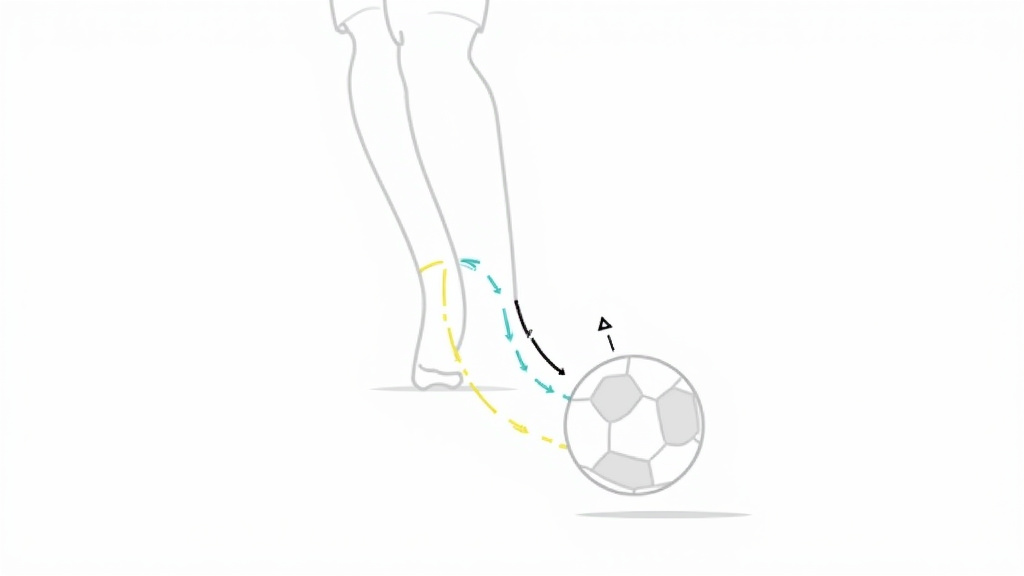
The inside foot (instep) kick relies on a straight-leg swing with locked ankle and high hip-flexor torque. The outside foot kick demands significant hip external rotation torque and inward ankle abduction (turning the foot in) to present the correct bone surface to the ball. A 2002 kinetic analysis in Medicine & Science in Sports & Exercise recorded this hip rotation as a primary differentiator.
Your quadriceps do most of the work on an instep drive. Specifically, the vastus lateralis and vastus medialis fire aggressively to extend the knee. You are a piston. On an outside foot kick, the activation pattern shifts. Research in the Montenegrin Journal of Sports Science and Medicine shows positive activation for the vastus muscles but negative or stabilizing activation for the biceps femoris (hamstring) and gastrocnemius (calf). Your body is coiling, not just thrusting.
TL;DR: The inside foot kick is a linear hammer strike; the outside foot kick is a rotational whip. Your brain must pick the right tool for the job.
Inside Foot Kick: The Power Engine
The goal is direct force transfer. You use the large, flat surface area of your instep, the area covered by your laces, to punch through the ball’s center.
- Contact Point: The central bone of your instep, directly behind the ball’s midline.
- Ankle Position: Locked rigid, toes pointed down. A floppy ankle disperses energy.
- Plant Foot: Placed 6 to 8 inches beside the ball, toes pointing directly at the target. This alignment squares your hips.
- Follow-Through: Your kicking leg drives straight toward the target, your body leaning slightly over the ball to keep it down.
Get the plant foot wrong, too close, and you’ll stub your toe into the ground. Too far away, and you overreach, strain your groin, and slice the ball with your toe. The sound of a pure instep strike is a deep, satisfying thump. A toe poke sounds like a weak tap.
Outside Foot Kick: The Deception Artist
This isn’t about hitting with the literal outside edge of your foot. That’s a shank. You’re using the part of your foot just outside the instep, closer to the little toe’s base.
- Contact Point: The bony ridge on the outside of your foot, about an inch from where your laces end.
- Ankle Position: Rotated inward (abducted). You actively pull your little toe downward.
- Plant Foot: Positioned about 10 inches from the ball, pointed roughly 45 degrees away from your intended starting direction. This open stance allows the inward swing path.
- Follow-Through: Your leg swings across your body. The follow-through points where the ball starts, not where it ends up curving to.
Common mistake: Trying to “swing sideways” for an outside foot kick, this comes from rotating the entire leg from the hip in a unnatural, sweeping motion. The swing should still originate from the hip like a regular kick; the curve comes from the angled foot surface and the inside-to-outside brush across the ball. Do it wrong and you’ll feel a sharp pull in your hip flexor within five attempts.
| Biomechanical Factor | Inside Foot (Instep) Kick | Outside Foot Kick |
|---|---|---|
| Primary Motion | Sagittal plane (forward-back) | Transverse plane (rotational) |
| Key Muscle Activation | Vastus lateralis, Rectus femoris | Hip external rotators, Vastus medialis |
| Ankle Action | Plantarflexion (toes down) & rigid lock | Abduction (inward turn) & dynamic lock |
| Typical Ball Velocity | ~96 km/h (60 mph) | ~87 km/h (54 mph) |
| Ball Spin | Minimal backspin | Strong side-spin |
When Your Brain Must Choose: The Decision Matrix
Technique is useless without timing. You have half a second from receiving the ball to committing to a kick. The geometry of the situation dictates the choice.
Use the Inside Foot (Instep) Kick When:
- You are within 18 yards of goal and centrally positioned. The shortest path is a straight line.
- You are taking a penalty. Power and placement beat deception from 12 yards.
- You are making a driven pass over 15 yards to a teammate’s feet. The low, skipping trajectory is harder to intercept.
- You are shooting through a crowded penalty area. A knuckleball or driven shot has a better chance of deflecting favorably than a curling ball.
- You need maximum power, like on a long-range strike or a clearance. The instep kick is the biomechanical engine for shooting with power.
Use the Outside Foot Kick When:
- You are at a 30 to 45-degree angle to the goal. This is the outside foot shot’s sweet spot. You can bend it around the goalkeeper’s near-post dive.
- A defender is blocking the direct line to your target. The curve can go around them.
- You are in a congested midfield and need a quick, disguised pass to release a winger. The compact wind-up is faster.
- You are executing a give-and-go (wall pass). The outside foot naturally shapes the ball into the path of your teammate’s run.
- You are taking a free kick near the edge of the box and need to bend the ball over the wall. It’s the foundational mechanic for curving free kicks.
I learned this the hard way training youth players in Gelsenkirchen. A talented striker would consistently miss one-on-ones from sharp angles, blasting the ball into the side netting with his instep. We filmed it. His brain saw “shot on goal” and defaulted to his most practiced technique. After a week of forced repetition, only allowing outside foot finishes from those angles, his conversion rate tripled. His muscle memory needed a new rule.
Positional Play: Are You a Hammer or a Sculptor?
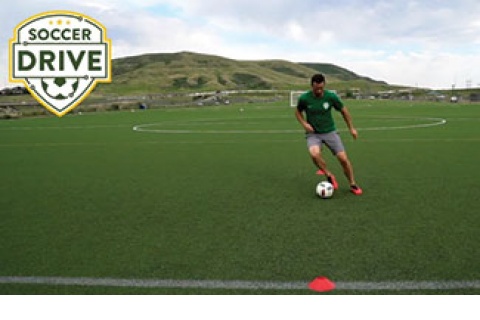
Your position on the pitch subtly biases which kick should be in your top drawer. A comparative soccer technique biomechanics PDF from Europe PMC underscores how development shapes these skills.
Forwards and Attacking Wingers: You are the sculptors. Your role demands the outside foot kick. That study in the International Journal of Disabilities Sports and Health Sciences didn’t just note a correlation; it measured it. Forwards had superior technical scores for outside-foot kicking and greater associated leg strength. Why? You face more angled shooting opportunities, more tightly marked passing lanes, and need that moment of deception. Your training should heavily feature shooting drills that force curved finishes.
Central Midfielders and Defenders: You are the hammers. Your primary passing tools are the side-foot passing for accuracy and the instep drive for switching play with long passing technique. You need power and straight-line reliability to break lines. The outside foot pass is a useful trick, a disguised driven pass to bypass a pressing forward, not your bread and butter.
This doesn’t mean a defender should never bend a shot. It means your training focus should match your game’s most frequent demands. A center-back spending 80% of training on David Beckham’s technique is misallocating time.
Training the Duality: Drills That Force the Choice
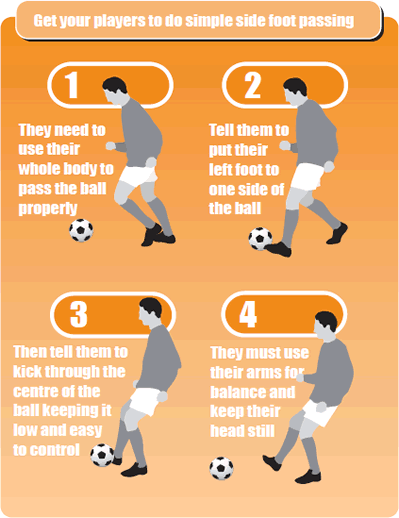
You can’t just practice each kick in isolation. The skill is in the swift, correct selection. These drills bridge the gap.
The Angle Gate Drill
Set up two small goals (or cones) at opposite corners of the 18-yard box, about 30 degrees from the main goal. Place a cone at the top of the D. Have a server pass you the ball at that central cone.
– If the server calls “Left!”, receive and finish at the left-side goal. This angle demands an outside foot curler.
– If the server calls “Center!”, turn and shoot at the main goal. This demands a powerful instep kick execution.
This drill wires the connection between visual cue and technical execution.
Pressure-Response Passing Squares
Mark a 10×10 yard square with four players, one on each side. Two defenders apply light pressure in the middle. The rule: you can only use two touches. The first touch must set up either a crisp inside-foot pass or a bent outside foot pass around a defender. The defenders are passive at first, then become active. This isn’t about knuckleball physics; it’s about game-speed decision making.
Common mistake: Practicing the outside foot kick only on stationary balls, this builds a technique that collapses under pressure. The muscle memory for the ankle lock must be built while moving, off-balance, and with a defender’s shadow in your periphery. Otherwise, in a game, the ankle will give way and the pass will drift hopelessly wide.
Three-Goal Decision Game
Set up three small goals: one central, one at a 45-degree angle to the right, one at a 45-degree angle to the left. Play 2v2 or 3v3 in a confined space. The coach or a server plays a ball into the area. The attacking team must score in any goal within 10 seconds. The geometry of the ball and your body relative to each goal forces the technical choice. You will make wrong decisions. That’s the point.
The Limits and Risks of Each Technique
Every tool has a failure mode. Knowing when not to use a kick is as important as knowing when to use it.
Inside Foot Kick Risks:
- Predictability: A goalkeeper reads your hips and plant foot. From a central position, they can set early. You need disguise or exceptional power.
- Wind-Up Time: The full backswing for maximum power takes time. In a crowded box, that time often doesn’t exist.
- Poor for Acute Angles: From a tight angle, the straight-line trajectory has a very small margin for error. It’s often the wrong percentage play.
Outside Foot Kick Risks:
- Lower Power: The ball velocity caps out lower. A keeper has more time to react if they read the spin early.
- Accuracy Volatility: The technique is less forgiving. A few degrees of error in ankle angle magnifies over distance. A pass meant for a winger’s feet can bend out for a goal kick.
- Physical Strain: The required hip external rotation and ankle abduction put unique stress on joints not heavily used in running. Overuse without proper mobility work leads to groin and ankle issues.
| Situation | Recommended Kick | Why It Wins | Risk If You Choose Wrong |
|---|---|---|---|
| Through Pass into Space | Outside Foot | Shapes the ball into the runner’s path, away from a trailing defender. | A straight instep pass goes behind the runner, forcing them to check back and lose momentum. |
| Shot from Top of the Box | Inside Foot (Instep) | Maximizes power and gives the keeper less reaction time due to speed. | An outside foot shot from here often lacks the pace to beat a keeper who isn’t cheating. |
| Cross from Deep Wide Position | Outside Foot | Imports natural bend, bringing the ball back toward attackers in the box. | A flat, inside foot cross is easier for a goalkeeper to intercept or claim. |
| Clearing a Defensive Header | Inside Foot (Instep) | Maximizes distance and gets the ball out of immediate danger. | An outside foot clearance lacks power and can spin dangerously into a central area. |
Frequently Asked Questions
Can you score from a free kick with the outside of your foot?
Absolutely. It’s a standard technique for bending a free kick over or around a wall from a central or slightly off-center position. The mechanics are identical to the outside foot shot, striking the ball with the outside bone of your foot to impart side-spin. Players like David Beckham and Ricardo Quaresma mastered variations of this.
Which kick is better for beginners to learn first?
Start with the inside foot (instep) kick. It’s more intuitive, uses a larger, flatter striking surface, and builds the fundamental coordination of plant foot placement and balanced follow-through. The outside foot kick requires finer ankle control and an understanding of spin, which is a secondary layer of skill. Get the power and accuracy foundation first.
Does the outside foot kick work with a wet ball?
It can be more effective, but also more unpredictable. The reduced friction between boot and ball can make it harder to impart clean spin, sometimes causing the ball to skid rather than curve. However, a wet, skidding ball that doesn’t bend as expected can still deceive a goalkeeper. The risk is losing all control and simply slicing it.
How do I generate more power on my outside foot shot?
Power comes from core rotation and leg swing speed, not just your foot. Focus on a strong, rapid hip rotation (pivoting on your plant foot) and a fast, snapping leg swing. Ensure your ankle is firmly locked in that abducted position at the moment of impact. A loose ankle absorbs the energy. Practice without a ball, just snapping your leg through the motion to build the muscle speed.
I keep toe-poking the ball on my instep shot. What am I doing wrong?
Your plant foot is almost certainly too far from the ball. You are overreaching. This forces you to point your toes to make contact, turning your instep into a toe. Move your plant foot closer, 6 to 8 inches is the sweet spot. This allows your knee to be over the ball at contact, letting you drive your laces through the center of it.
The Bottom Line
The inside foot and outside foot kick are not rivals. They are complementary instruments in your soccer toolkit. One is a sledgehammer, the other a scalpel. The elite player isn’t the one with the hardest shot or the prettiest curve; it’s the one whose brain instantly matches the tool to the task presented by the game’s geometry.
Spend your training time wisely. Solidify your proper kicking technique for power and repetition. Then, deliberately break your patterns. Force yourself to use the outside foot in drills until its feel becomes automatic. Finally, and most crucially, train the decision. Set up exercises where the correct answer changes with every pass. That’s where the magic happens, when technique disappears and only the right choice remains.

I come from the “soccer heart” of Germany, the Ruhrpott. I have played, trained and followed soccer all my life and am a big fan of FC Schalke 04. I also enjoy following international soccer extensively.