Soccer Originated in England in the 19th Century
This post contains affiliate links. As an Amazon Associate, we earn from qualifying purchases.
You’ve probably wondered where did soccer originate and when as you watch today’s global phenomenon captivate billions. The answer spans continents and centuries, beginning not with a single inventor but through a fascinating evolution that transformed military drills into the world’s most popular sport. While most assume soccer began in Victorian England, the truth stretches back over two millennia to ancient civilizations that kicked balls long before standardized rules existed.
Understanding where did soccer originate and when reveals soccer’s deep cultural roots across multiple societies. From Chinese military training exercises to medieval village battles, humans have been kicking balls toward goals for reasons ranging from combat preparation to community celebration. This journey from primitive ball games to the codified sport we know today explains why soccer requires minimal equipment yet delivers maximum excitement—making it accessible to anyone with a ball and open space.
Chinese Military Training That Became Soccer (206 BCE)

The earliest documented soccer ancestor emerged during China’s Han Dynasty as Tsu Chu (also called Cuju), where soldiers kicked leather balls stuffed with feathers through small bamboo goals. Historical military manuals from 206 BCE describe these matches as crucial training exercises that developed battlefield skills like agility, coordination, and strategic thinking. Unlike modern soccer, these contests served dual purposes: preparing warriors for combat while entertaining imperial courts with displays of athletic prowess.
Soldiers performed remarkable feats of ball control while wearing heavy armor, developing sophisticated kicking techniques that form the foundation of today’s footwork fundamentals. The game required players to maneuver the leather sphere through a 30-40 cm opening fixed 10 meters high on bamboo canes—demanding precision that would impress even modern professionals. This ancient Chinese practice established soccer’s core concept: using feet to control a ball toward a specific target, a principle that remains unchanged after 22 centuries.
Japan’s Cooperative Soccer Evolution (644 CE)
Japan transformed China’s competitive Cuju into Kemari, creating a more ceremonial version focused on cooperation rather than competition. Developed during the Asuka period, Kemari featured 6-8 aristocratic players standing in circles, keeping a deerskin ball airborne using feet, knees, chest, and head without letting it touch the ground. The first dedicated Kemari field appeared in 644 CE at Kyoto’s Shimogamo Shrine, establishing soccer’s first permanent playing space.
This cooperative approach emphasized grace and artistry over scoring goals. Players wore traditional robes while performing elaborate kicks, creating a ritual that combined athletic skill with cultural expression. Unlike Chinese military applications, Kemari served as a meditative practice and social activity among Japan’s elite. The circular formation and emphasis on continuous ball control directly influenced later soccer training methods, particularly in developing touch, coordination, and spatial awareness—skills still essential to modern players.
Greek and Roman Ball Games: Soccer’s European Ancestors
Ancient Greeks pioneered team-based competition through Episkyros around 800 BCE, using inflated pig bladders wrapped in leather strips. Teams of 12-14 players competed on marked fields, advancing balls over opponent goal lines while allowing limited handling. This marked soccer’s first transition from individual skill displays to organized team tactics, establishing concepts of positioning and coordinated movement that remain fundamental today.
Romans refined these concepts into Harpastum, spreading ball games throughout their empire from 100 BCE to 400 CE. The name “Harpastum” derives from the Greek word “harpazein,” meaning “to snatch away,” reflecting the game’s physical nature. Roman legions introduced these activities to Britain, where local populations adapted them into their own traditions. This Roman influence explains soccer’s tactical complexity and strategic depth—elements that distinguish it from simpler kicking games and contribute to its enduring appeal as both a physical and intellectual challenge.
Medieval British Folk Football: Chaos Before Codification
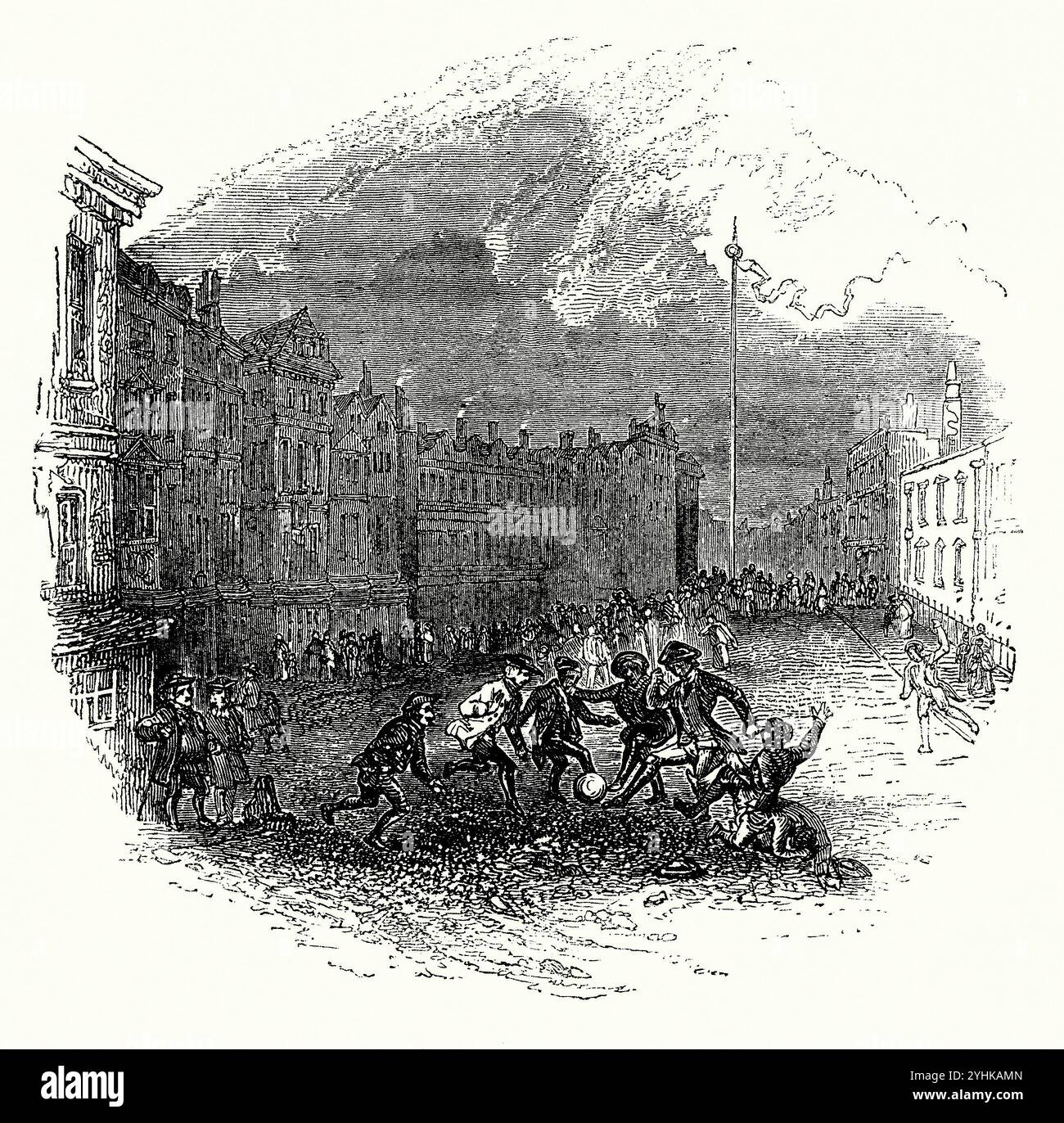
Following Rome’s withdrawal from Britain in 410 CE, localized ball games evolved into Mob Football or Shrovetide Football, featuring entire villages competing across miles of countryside. Documented matches in Derby (217 CE), Chester (973 CE), and Kingston-upon-Thames (1175 CE) involved 100-500 participants using balls made from inflated animal bladders. Games continued for hours or days with objectives ranging from moving the ball to specific landmarks to simply maintaining possession.
Why Royal Bans Failed to Stop Soccer
Medieval monarchs repeatedly banned football, viewing it as disruptive to military training and public order. King Edward II prohibited “hustling over large balls” in 1314, followed by Edward III’s 1365 decree requiring citizens to practice archery instead. King James I outlawed “fute-ball” throughout Scotland in 1424, yet these bans failed completely. Football persisted as integral parts of festival celebrations, particularly during Shrove Tuesday and Easter, demonstrating soccer’s deep cultural roots that would eventually lead to its global spread.
The Critical Moment: Soccer’s Official Birth Date (October 26, 1863)
October 26, 1863 marks soccer’s official birth when 11 London clubs met at the Freemasons’ Tavern on Great Queen Street to establish The Football Association. Ebenezer Cobb Morley from Barnes Club drafted the original 13 laws that created the first standardized rules distinguishing soccer from rugby. This single day transformed soccer from chaotic folk games into an organized sport with consistent regulations playable anywhere in the world.
The FA’s original laws established fundamental concepts still used today: 90-minute matches divided into halves, 11-player teams, defined goal dimensions, throw-ins, offside rules, and free kicks for violations. Most importantly, these rules created soccer’s defining characteristic: a kicking-only game where players primarily use their feet to control the ball. This standardization enabled fair competition between different clubs and regions, solving the problem of inconsistent local rules that had previously limited the sport’s growth.
How Soccer Split From Rugby Football (December 8, 1863)
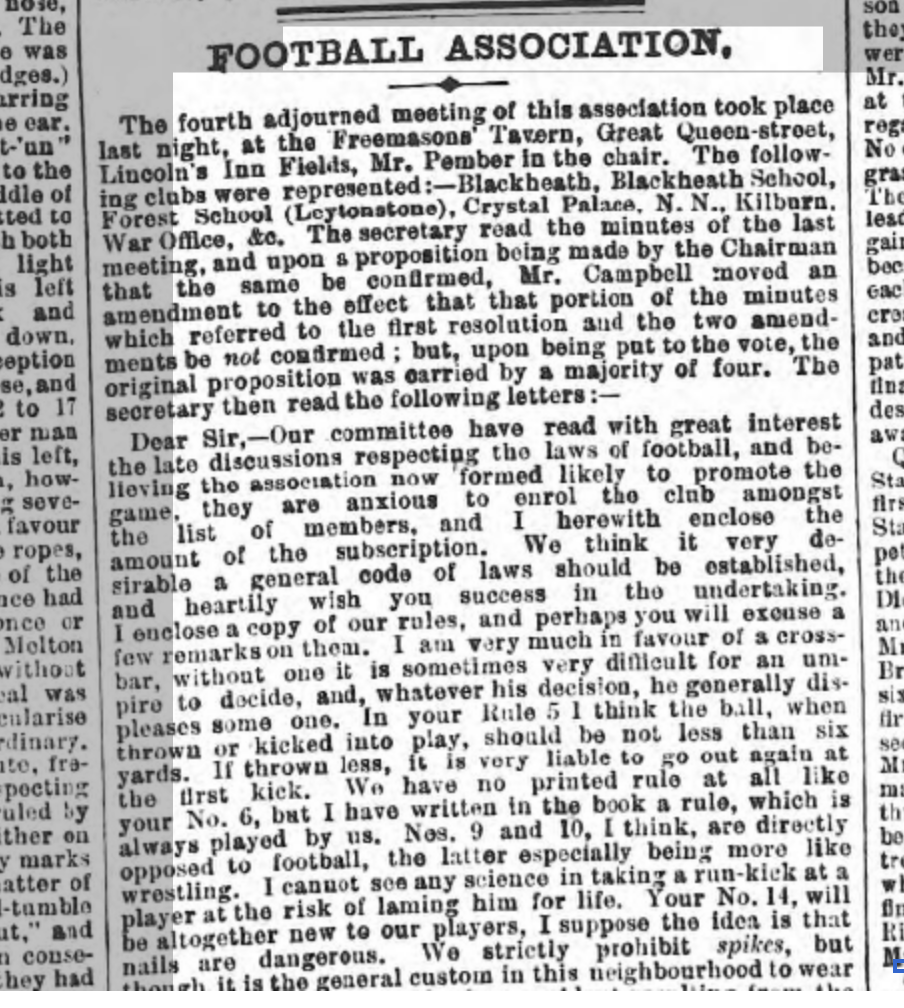
Just six weeks after The FA’s formation, Blackheath Club withdrew from the association over ball handling disputes, creating the permanent separation between Association Football (soccer) and Rugby Football. This December 8, 1863 decision established soccer’s identity as a distinct kicking-only game, resolving the fundamental question of whether players could handle the ball during play.
The split occurred because Blackheath preferred a game allowing running with the ball—a preference that would develop into rugby football. By choosing to prohibit handling (except by goalkeepers), The FA created soccer’s unique character as a continuous-flow game emphasizing foot skill over physical carrying. This critical decision explains why soccer developed different tactics, formations, and player positions compared to rugby, shaping the beautifully technical sport we watch today.
Soccer’s Global Spread: From London to World Domination
Soccer’s expansion followed British imperial and commercial networks, spreading through three key phases. First came the British Empire phase (1863-1880), when railway workers introduced the game to Argentina in 1869, and British engineers brought it to Denmark in 1878. The simplicity of requiring only a ball and open space facilitated rapid adoption across diverse cultures, with the first international match occurring between Scotland and England in 1872.
Next came the Continental Europe phase (1880-1900), when nations established their own football associations—Denmark in 1889, Netherlands in 1890, Belgium in 1895. Finally, the Global Governance phase culminated on May 21, 1904, when representatives from seven European nations founded FIFA in Paris. Today’s 211 FIFA member associations trace their origins to these early expansions, making soccer the only sport with truly global governance and participation.
Why Soccer’s True Origin Story Matters Today
Soccer’s journey from Chinese Cuju (206 BCE) through medieval folk games to 1863’s codification represents over 2,200 years of continuous evolution. The sport’s accessibility—requiring minimal equipment while offering maximum excitement—explains its transformation from ancient military training to the world’s most popular pastime with 3.5 billion fans. Understanding where did soccer originate and when reveals not just historical facts, but humanity’s universal desire for competitive play, community bonding, and athletic expression.
This historical perspective transforms how you experience modern soccer. When you watch players execute precise footwork, remember Chinese soldiers training in armor. When you see coordinated team movements, recall Greek Episkyros tactics. When you celebrate a goal, recognize the ancient human impulse to kick a ball through a target. From ancient Chinese soldiers to modern World Cup champions, soccer’s essence remains unchanged: using feet to control a ball toward a goal, creating joy that transcends culture, language, and time.
Key Takeaway: Soccer originated as Cuju in 2nd century BCE China, evolved through medieval British folk games, and became the modern sport on October 26, 1863, when The Football Association established the first standardized rules in London—marking soccer’s official birthday that every fan should know.

I come from the “soccer heart” of Germany, the Ruhrpott. I have played, trained and followed soccer all my life and am a big fan of FC Schalke 04. I also enjoy following international soccer extensively.