The History of How Soccer Was Invented & Its True Origins
Modern soccer was invented through a process of standardization, not a single moment of creation. The game’s rules were formally codified on October 26, 1863, at the Freemasons’ Tavern in London with the founding of The Football Association. This body issued the first unified “Laws of the Game,” which distinguished association football from rugby and other football variants. The sport’s deeper roots lie in ancient ball-kicking games across cultures and the chaotic folk football of medieval Britain.
Most people get this wrong because they look for a single inventor or a precise birth year. They picture a lightbulb moment. The reality is messier and more interesting—a century of arguments in English boarding schools and pub meetings that slowly carved a universal sport out of regional chaos.
This guide walks through that messy birth. We’ll start with the ancient games that show humans have always kicked balls, move through the unruly British traditions that needed taming, and land on the pivotal 1863 meeting that gave us the rulebook. We’ll also tackle the recent Scottish challenge to England’s origin story and trace how those London rules conquered the world.
Key Takeaways
- Soccer wasn’t “invented” in 1863; that was the year its modern rules were codified to unify dozens of local variants.
- Ancient games like China’s Cuju (2nd century BC) and the Mesoamerican ballgame are cultural parallels, not direct ancestors, of modern association football.
- The critical shift happened in 19th-century English public schools, where students wrote down rules to play inter-school matches.
- The Football Association’s 1863 Laws of the Game specifically banned “hacking” (kicking opponents) and handling the ball, creating a distinct, less violent sport.
- Scottish players and clubs were instrumental in refining the early English rules, emphasizing passing and teamwork over individual dribbling.
Ancient Roots, Global Games
Long before London’s pubs hosted rule-making committees, humans on different continents were already inventing games centered on propelling a ball with the feet. These are not the direct ancestors of modern soccer, but they are proof of a universal impulse. FIFA, the sport’s global governing body, calls them “parallel expressions.”
The strongest early evidence comes from a Chinese military manual from the 2nd century BC. It describes Cuju, which translates literally to “kick ball.” Soldiers played it for fitness, using a leather ball stuffed with feathers. The goal was to kick the ball through a small opening in a net strung between bamboo poles—a clear, if distant, echo of scoring today. A standardized version with rules even emerged during the Han Dynasty.
FIFA’s museum recognizes Cuju as the earliest form of football with scientific evidence, though it states there is no direct historical link to the modern game developed in Britain.
Across the sea in Japan, Kemari developed around the 7th century AD. It was less a competition and more a cooperative, ritualistic exercise in skill. Players formed a circle and tried to keep a deerskin ball aloft using only their feet, demonstrating control and grace. The focus was on keeping the play alive, not beating an opponent.
Perhaps the most spectacular ancient tradition was the Mesoamerican ballgame, played by the Olmec, Maya, and Aztecs as far back as 3,000 years ago. Using a solid rubber ball weighing up to 4 kg, players could only strike it with their hips, thighs, or elbows. Stone hoop goals were mounted high on court walls. The game held deep religious and political significance, and its outcomes could be literally life-or-death. While the body part was different, the concept of moving a ball toward a target within a defined court is a powerful shared idea. You can explore more about these diverse ancient ball games that form the deep background of sport.
TL;DR: Ancient China, Japan, and Mesoamerica all had sophisticated ball-kicking games, but modern soccer evolved separately from European traditions.
The English Crucible: Public Schools and Folk Football
While ancient games flourished elsewhere, the direct precursor to modern soccer was simmering in the towns and fields of Britain. For centuries, a chaotic tradition known as “folk football” or “mob football” was played, especially on Shrove Tuesday. These matches involved unlimited numbers of players from rival villages, a ball (often an inflated pig’s bladder), and goals that could be miles apart, like the opposing parish churches.
The rules were simple: get the ball to your goal by any means necessary. Kicking, carrying, and throwing were all common. The matches were notoriously violent, destructive to property, and frequently banned by royal decree. This was the raw, unruly material that would eventually be refined.
The transformation began in the 19th century within England’s elite public schools like Eton, Harrow, and Rugby. Each school developed its own version of football to keep boys occupied. The problem arose when students from different schools went to university and wanted to play together—their rules were incompatible. At Cambridge University in the 1840s, students made the first serious attempt to create a universal code, producing a written set known as the “Cambridge Rules.”
This push for standardization, driven by the practical need for inter-school competition, was the essential catalyst. It moved football from a localized, oral tradition to a written, debatable set of laws. The stage was set for a definitive meeting. This period of conflicting school codes is a key part of the evolution of soccer and debunks the idea of a single inventor.
| School / Influence | Key Characteristic | Lasting Impact on Modern Game |
|---|---|---|
| Folk Football | Mass participation, minimal rules, extreme violence | Established the basic concept of moving a ball between goals. |
| Cambridge Rules (1848) | First written attempt at unification; banned handling. | Provided the foundational template for the FA’s later laws. |
| Rugby School | Explicitly allowed picking up and running with the ball. | Led to the schism and creation of rugby football as a separate sport. |
| Sheffield FC (1857) | First club outside a school; used its own “Sheffield Rules.” | Proved the demand for organized club football and influenced FA rules. |
What Happened at the Freemasons’ Tavern in 1863?

The need for one national rulebook reached a tipping point. On the evening of October 26, 1863, representatives of eleven London football clubs and schools gathered at the Freemasons’ Tavern on Great Queen Street. Their goal was unambiguous: “to form a Football Association for the purpose of settling a definitive code of rules for the regulation of the game.”
The driving force was Ebenezer Cobb Morley, a solicitor and captain of the Barnes Club. He is often called the “father of association football.” Over a series of meetings, the group debated fiercely, especially over two issues: hacking (kicking an opponent’s shins to trip them) and handling the ball.
Morley and the majority wanted a less violent, more skillful game that emphasized kicking. A minority, represented by Blackheath Club’s F. W. Campbell, argued that hacking and carrying the ball were essential, manly elements. When the vote went against them, Blackheath withdrew. This split formalized the separation between association football (soccer) and rugby football.
The original 1863 Laws of the Game comprised 14 rules. They established a crossbar, banned running with the ball in hand (except for a fair catch), and outlawed tripping and hacking. The term “soccer” derives from “association,” a slang shortening common at Oxford University.
The FA’s first published laws were a compromise and still odd to modern eyes. They allowed a player to make a fair catch and claim a free kick, and there was no dedicated goalkeeper. But the core principle was set: this was a game primarily played with the feet. The creation of this governing body was the definitive moment in the codification of the rules.
TL;DR: The 1863 FA meeting created the first universal rulebook and split soccer from rugby by banning hacking and limiting handling.
From Rough Draft to Modern Game: The Rule Evolution
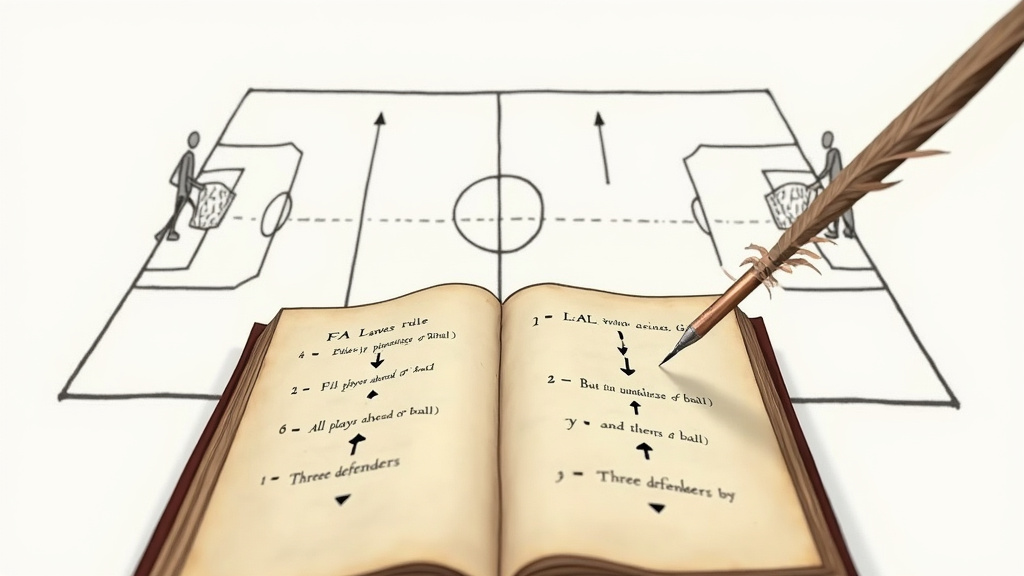
The 1863 laws were just the starting pistol. The game we recognize today was forged through critical amendments over the next two decades. The FA committee treated the laws as a living document, responding to how the game played out on the field.
The most significant changes came fast. In 1866, the offside rule was radically simplified. The original “Cambridge” offside law meant every attacking player ahead of the ball was offside, forcing a tedious, forward-shy game. The new rule required only three defenders between the attacker and the goal, opening up play for through passes. Then, in 1871, the specific position of the goalkeeper was introduced, the only player allowed to handle the ball within his own half.
The FA Cup, founded in 1871, acted as a massive laboratory. As clubs from different regions with slightly different interpretations of the rules competed, inconsistencies became glaring. This pressure forced the FA to continually clarify and standardize. The first-ever tournament trophy, the Youdan Cup, was actually played in 1867 in Sheffield under local rules, proving the hunger for competitive structure even before national unification was complete. The legacy of that competitive spirit lives on in the modern Football Association Challenge Cup.
Common mistake: Thinking the 1863 rules were perfect and final. They allowed handling and had no goalkeepers; the fluid, fast game we know emerged from 20 years of critical tweaks driven by actual competition.
Another seismic shift was the legalization of professionalism in 1885. For years, northern English clubs, made up of working-class players who lost wages to play, pushed for it. The southern, amateur-dominated FA resisted but eventually relented. This allowed the best players to dedicate themselves to the sport, improving quality and enabling the creation of formal leagues. The need to organize these professional clubs directly led to the formation of the Football League in 1888, the world’s first professional league soccer competition, which established the English league pyramid still in place today.
| Year | Rule Change | Impact on Gameplay |
|---|---|---|
| 1863 | Founding Laws published. Hacking banned. | Created a distinct, less violent sport separate from rugby. |
| 1866 | Offside rule changed to require 3 defenders (not all). | Unleashed forward passing and attacking play. |
| 1871 | Introduction of the goalkeeper (can handle in own half). | Defined a specialist position and added defensive strategy. |
| 1872 | Standard size and weight for the ball defined. | Eliminated equipment disputes and standardized play. |
| 1885 | Professionalism legalized. | Enabled skilled working-class players to compete, raising standards and leading to leagues. |
The Scottish Challenge and Global Conquest
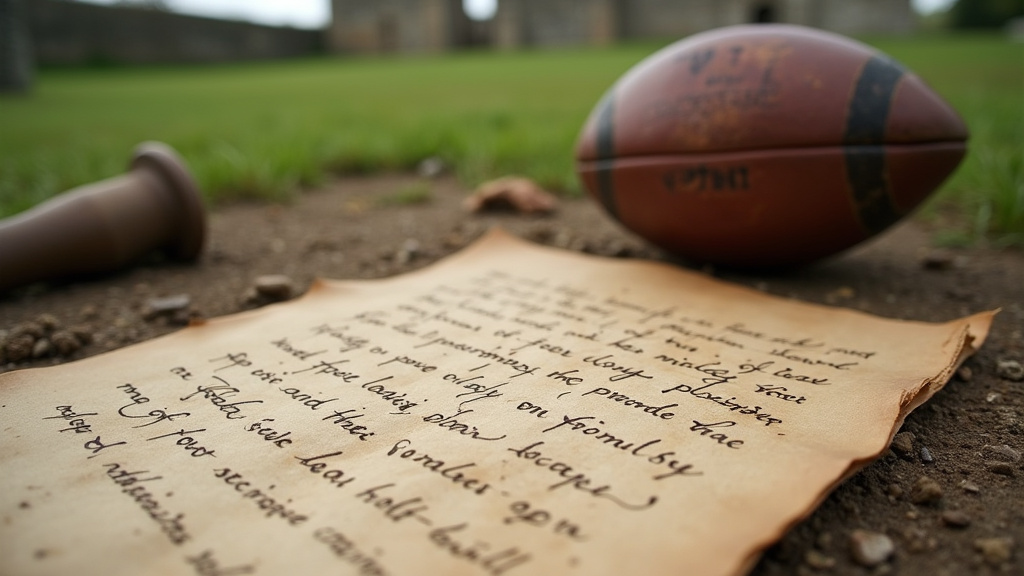
The traditional narrative places England as the sole birthplace. Recent archaeology, however, suggests a more nuanced British history. Excavations at Stirling Castle in Scotland uncovered a 17th-century “foot-ball” field, complete with official documentation from 1621 banning playing on Sundays. This implies an organized, recognized version of football in Scotland at least 240 years before the FA’s formation.
Does this make Scotland the true birthplace? Most historians say no—it doesn’t disprove England’s role in codifying the modern global sport. But it does highlight that structured football was a broader British phenomenon. Furthermore, Scottish influence on the early game was profound. When the FA’s rules reached Scotland, clubs like Queen’s Park pioneered a passing-and-moving style, a stark contrast to the individualistic dribbling favored in England. This “Scottish passing game” proved superior and was quickly adopted south of the border, fundamentally shaping soccer’s technical evolution.
The real conquest began once the rules were stable. The British Empire—through sailors, soldiers, traders, engineers, and teachers—exported the game everywhere. In South America, British railway workers introduced it; in Europe, students and businessmen formed the first clubs. The game’s simple requirements (a ball) and thrilling pace made it instantly popular.
To regulate this international growth, the Fédération Internationale de Football Association (FIFA) was founded in Paris in 1904 by seven European nations. Its mission was to oversee matches between different countries. FIFA’s crowning achievement was organizing the first FIFA World Cup in Uruguay in 1930, creating the single largest sporting event on the planet and cementing soccer’s global reign. This tournament represents the ultimate evolution of the FIFA World Cup tournament format.
The sport’s governance structure also spread, with nations adopting variations of the global league structures pioneered in England. Meanwhile, the pinnacle of club competition became the UEFA Champions League tournament, a direct descendant of the early desire for organized, high-stakes play that began in 19th-century England. The terminology also traveled, leading to the enduring divergence of soccer and football in naming conventions across different countries.
TL;DR: Scotland had early organized football, but England’s codified rules were the package exported globally by the British Empire, leading to FIFA and the World Cup.
Frequently Asked Questions
Did China invent soccer?
China invented one of the earliest recorded ball-kicking games, Cuju, over 2,000 years ago. However, there is no historical evidence that Cuju directly influenced the development of modern association football in 19th-century Britain. FIFA recognizes it as an important cultural precursor but a separate “parallel expression.”
Why is it called soccer if the rest of the world says football?
The term “soccer” originated in 19th-century England as Oxford University slang, shortening “association football” to distinguish it from “rugger” (rugby football). It was common in England alongside “football” until about the 1970s. The word was exported to countries like the US, Canada, and Australia, where other sports (American football, rugby) already held the name “football.” The split in global terminology is a historical accident, not an American invention. The full story of this linguistic divide is covered in our article on the linguistic origins of soccer.
What was the first soccer club in the world?
Sheffield Football Club, founded in England in 1857, is recognized by FIFA and the FA as the world’s oldest existing football club. It was formed before the FA and initially played under its own “Sheffield Rules,” which influenced the eventual FA laws.
How did soccer become so popular worldwide?
Its global spread is a story of British influence and inherent appeal. The British Empire carried the game to every continent. Its simple rules and low equipment cost made it accessible to anyone, anywhere. The establishment of FIFA in 1904 provided international structure, and the World Cup, first held in 1930, created a powerful global spectacle and sense of national pride. You can trace the key pathways in the global adoption of soccer.
What was the most important rule change after 1863?
The 1866 amendment to the offside rule was revolutionary. Changing it from requiring all defenders to be ahead of the attacker to just three defenders completely transformed the game. It moved soccer from a congested, backward-focused dribbling contest to a dynamic, forward-passing team sport, creating the strategic depth we see today.
Before You Go
Soccer’s invention wasn’t a eureka moment but a century-long process of distillation. Ancient cultures from China to Mesoamerica proved the universal appeal of kicking a ball. Medieval Britain provided the chaotic raw material. English public schools and universities provided the need for written rules. Finally, the pragmatists in a London pub in 1863 provided the unified code.
That code succeeded because it was adaptable. It evolved through competition, from the first FA Cup matches to the pressure of Scottish passing tactics. It was then packaged and exported by a global empire, its governance structure copied worldwide to form the leagues and tournaments we follow today. The story isn’t about who invented it, but about how a simple idea was refined, argued over, and shared until it became the world’s game.

I come from the “soccer heart” of Germany, the Ruhrpott. I have played, trained and followed soccer all my life and am a big fan of FC Schalke 04. I also enjoy following international soccer extensively.