World Cup Group L Scenarios: Qualification Paths Explained
To qualify from World Cup Group L, teams must finish top two or be among the eight best third-placed teams. England and Croatia are favorites, but Ghana and Panama can advance with third place if they earn points and a strong goal difference, as four points nearly guarantees progression.
To qualify from 2026 World Cup Group L, a team must finish in the top two, or be one of the eight best third-placed teams across all 12 groups. The group contains England, Croatia, Ghana, and Panama. The top two advance automatically with 24 total spots. The remaining eight knockout spots go to the best third-placed teams, ranked by total points, then goal difference, then goals scored. Four points for a third-placed team is a near-guarantee; three points makes goal difference critical.
Most fans still think only the top two teams go through. That was the old rule. The 2026 expansion to 48 teams rewrites the entire group stage math, and it makes every single goal in every single match matter for more than just pride. A narrow 1-0 loss isn’t a death sentence anymore. A scrappy draw against a favorite might be the point that gets you in.
This guide breaks down the exact scenarios for England, Croatia, Ghana, and Panama. We’ll cover the new format’s rules, the specific tie-breakers, the realistic point targets for third place, and what each team needs to do.
Key Takeaways
- The 2026 World Cup format grants 32 knockout spots: 24 to group winners and runners-up, plus 8 to the best third-placed teams.
- Head-to-head results are the first tie-breaker within Group L, but they are NOT used to rank third-placed teams across different groups.
- For a third-placed team, 4 points almost certainly means advancement. At 3 points, goal difference becomes the decisive factor for qualification.
- England are heavy favorites to win the group. The real battle is for second place between Croatia and Ghana, with Panama needing a historic upset to contend.
- Fair play points (yellow/red cards) are the sixth tie-breaker within the group and the fourth for ranking third-placed teams—a clean disciplinary record could be the final decider.
The New 48-Team Format Changes Everything
The 2026 World Cup is not the tournament your father watched. Forget 32 teams. The field is now 48, split into 12 groups of four. This expansion creates a new arithmetic for survival and success.
The 2026 FIFA World Cup qualification system awards 32 spots in the Round of 32: the top two finishers from each of the 12 groups (24 teams) plus the eight best third-placed teams from across all groups. This structure, confirmed by FIFA’s official competition regulations, fundamentally alters the risk calculus for every team in the group stage.
The old “Group of Death” concept weakens. In a 32-team tournament with only two advancing, a tough draw could eliminate a strong team early. Now, with 50% more teams reaching the knockouts, there is a safety net. A powerhouse that stumbles once likely still advances. For a team like Ghana, it means their path isn’t solely about beating Croatia. It’s about accumulating points and goals against everyone.
The schedule is a standard round-robin. England faces Croatia on June 17, 2026, in the group’s headline opener. The final matches kick off on June 27. Every goal in those 90 minutes counts twice: for your group standing and for your potential standing among all third-placed teams. That changes late-game tactics. A team losing 2-0 might still push for a consolation goal, knowing that -1 goal difference is far better than -2 in the cross-group ranking.
TL;DR: 48 teams, 12 groups, 32 knockout spots. Finishing third is no longer a failure—it’s a second chance that depends on points and goal difference.
Breaking Down Group L: Contenders and Underdogs

The draw placed England, Croatia, Ghana, and Panama together. Each brings a distinct profile and a different set of pressures to the qualification scramble.
England are the clear favorites. Their squad depth, experience in major tournaments, and consistent performance under Gareth Southgate make them the expected group winners. Their primary objective is securing first place to likely face a weaker third-placed qualifier in the Round of 32. A deep tournament run is the expectation; topping the group is the first non-negotiable step.
Croatia presents the most intriguing tactical puzzle. Their golden generation has aged, but the core of Modrić, Brozović, and Kovačić retains the technical quality to control matches. Their challenge is physical endurance over three group games. They are slight favorites over Ghana for second place, but a loss or draw in the opener against England immediately puts them in a precarious fight for third. Their tournament savvy is their greatest asset in a tight scenario.
Ghana is the wildcard. They possess the athleticism and individual talent to upset anyone on a given day. Their historical performance in the group stage of the 2022 tournament showed both promise and fragility. For Ghana, the target is clear: avoid defeat against Panama and compete fiercely with Croatia. Four points from those two games might be enough for second, and almost certainly guarantees advancement as a third-placed team. Their match against Panama is their absolute must-win.
Panama enters as the definitive underdog. Their 2018 World Cup debut was a learning experience. To have any realistic hope, they need to at least draw with Ghana and keep the scorelines respectable against England and Croatia. Their goal is to be competitive and use the tournament as building blocks for the future. A single point would be an achievement, but it almost certainly won’t be enough for the knockouts.
| Team | Primary Objective | Realistic Path to Knockouts | Key Match |
|---|---|---|---|
| England | Win the group | Top two finish is expected. A stumble could still see them advance easily. | vs. Croatia (Matchday 1) |
| Croatia | Secure 2nd place | Must beat Ghana. A draw with England would be a massive boost. | vs. Ghana (Matchday 2) |
| Ghana | Challenge for 2nd, secure 3rd | Must beat Panama. A result against Croatia is critical for automatic qualification. | vs. Croatia (Matchday 2) |
| Panama | Be competitive, seek an upset | A draw vs. Ghana is the baseline. Must avoid heavy defeats to aid goal difference. | vs. Ghana (Matchday 1) |
The Points System and Third-Place Thresholds
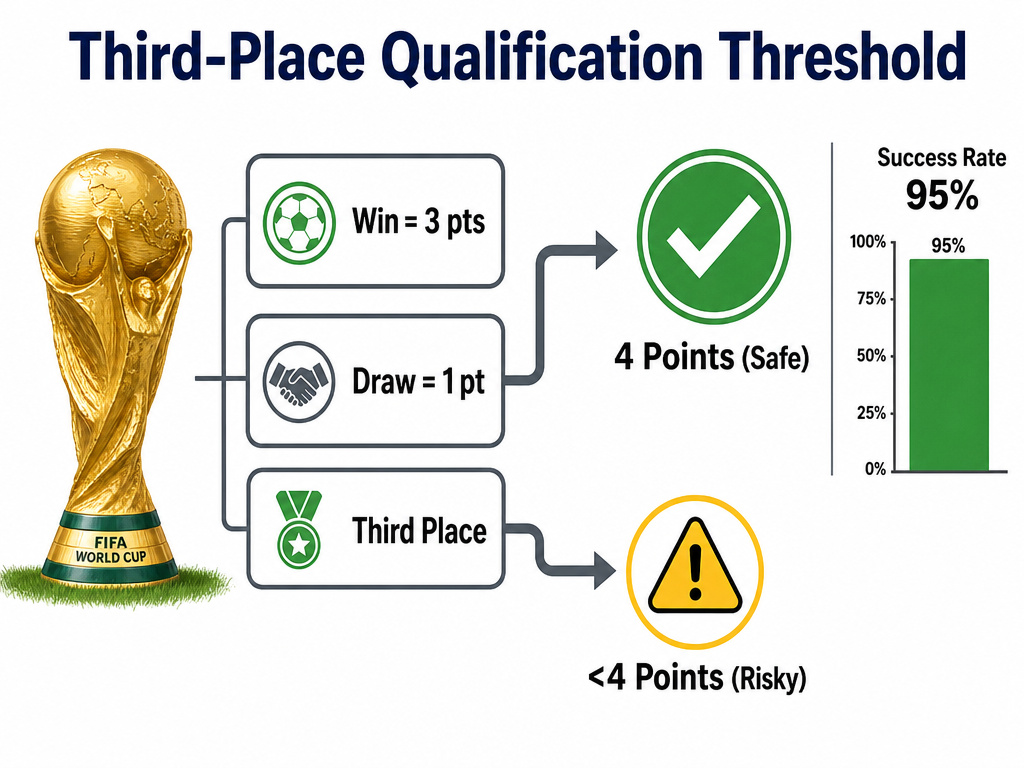
Three points for a win, one for a draw. It’s simple. How many points you need to finish third and still advance is the complex part of the new format.
Historical data from similar formats in the UEFA European Championship provides a clear blueprint. Four points for a third-placed team is a golden ticket. In the expanded 24-team Euros, a third-placed team with four points has almost always advanced. It would take a statistical anomaly across multiple other groups for a four-point team to miss out. Therefore, for Ghana or Croatia, a win and a draw from their three matches should be enough.
The three-point zone is where calculators come out. About half of all third-placed teams with three points historically advance. The difference between staying home and moving on comes down to goal difference. A 0 GD is decent. A +1 GD is strong. A -1 GD is nervous. A -2 or worse is likely fatal. This turns every match into a 90-minute goal difference battle, especially if a team knows a draw leaves them on three points.
Common mistake: Assuming a win and two losses (3 points) is enough to advance as a third-placed team — without that win being by multiple goals or the losses being narrow, your negative goal difference will likely see you eliminated.
Two points is the danger zone. It’s possible, but it requires not just a good goal difference, but also for several other groups to produce weak third-placed teams. One point is effectively a group stage exit.
For Group L, this creates clear targets:
* England: Aim for 7+ points to win the group.
* Croatia/Ghana: Target 4+ points to feel secure. If you end up on 3 points, you must mind your goal difference in every match.
* Panama: A historic achievement would be reaching 4 points. The realistic goal is to fight for 1-3 points and build for the future.
Group L Tie-Breakers: The Exact Order

If two or more teams finish level on points within Group L, FIFA has a strict sequence to separate them. Knowing this order changes how managers approach the final minutes of a tied game.
The first three criteria all focus on the matches between the tied teams. This makes every head-to-head clash a potential mini-tournament.
1. Points in head-to-head matches.
2. Goal difference in head-to-head matches.
3. Goals scored in head-to-head matches.
If teams are still tied after these, the tie-breaker looks at all group matches.
4. Goal difference in all group matches.
5. Goals scored in all group matches.
The final two criteria are external.
6. Fair play points. This is calculated as: -1 point per yellow card, -3 points for an indirect red (second yellow), -4 points for a direct red card.
7. FIFA World Ranking.
This order has massive implications. Imagine Ghana and Croatia finish tied on points. If Ghana beat Croatia 2-1, Ghana wins the tie-breaker regardless of what happens in their other matches. This incentivizes aggressive play in direct duels. A cautious 0-0 draw might secure a point, but losing the head-to-head tie-breaker later could be costlier.
How the Best Third-Placed Teams Are Ranked

This is where most people get it wrong. The rules for picking the eight best third-placed teams are different from the within-group rules.
Head-to-head results are not used. You cannot compare Ghana’s result against Croatia with, say, Serbia’s result against Switzerland. The ranking is a pure statistical comparison across 12 different groups.
The criteria, in order, are:
1. Total points.
2. Goal difference in all group matches.
3. Goals scored in all group matches.
4. Fair play points.
5. FIFA World Ranking.
This system rewards aggressive play. A third-placed team that loses 3-2 and 2-1 (0 points, -2 GD) is in a worse position than a team that draws 0-0 and 0-0 (2 points, 0 GD), even if the latter seems less impressive. It makes every goal scored precious and every goal conceded a potential liability.
For a team like Ghana, if they end up third with 4 points and a +2 goal difference, they will almost certainly be among the top eight. If they finish third with 3 points and a 0 goal difference, they’ll be nervously watching other groups, hoping for low-scoring draws elsewhere.
Potential Knockout Stage Matchups
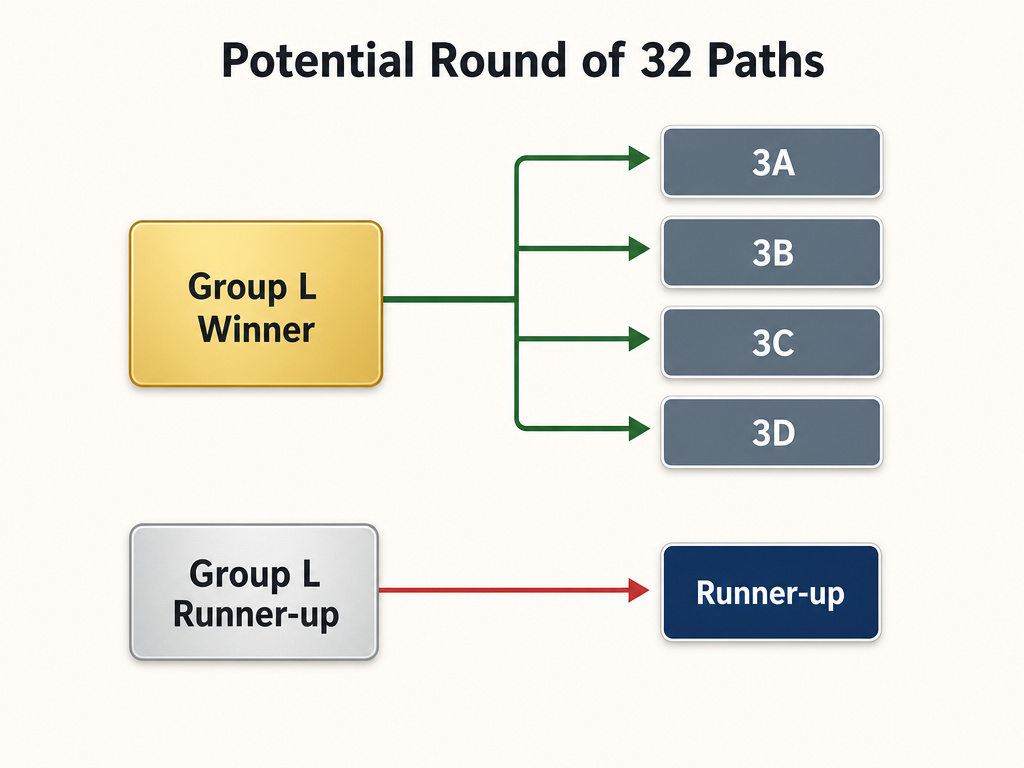
Qualifying is just step one. Where you finish determines your likely path in the Round of 32, and it gets tricky.
The basic bracket principle is that group winners will play third-placed qualifiers, while group runners-up will face each other. This is designed to reward winning the group with a theoretically easier matchup. However, with eight third-placed teams coming from different groups, the specific matchups depend on a draw or a seeding system based on their third-place ranking.
Finishing first in Group L likely means facing a third-placed team from Groups A, B, C, or D. Finishing second likely means a tough duel against another group runner-up, possibly from a group containing teams like France, Argentina, or Brazil.
There is also talk that the four highest-seeded group winners might receive byes or play the lowest-ranked third-placed teams. This detail is still being finalized by FIFA, but the core incentive remains: win your group for the best possible draw.
For Croatia or Ghana, scraping through in second place could mean an immediate showdown with another European or South American powerhouse. Advancing as a third-placed team might mean facing a group winner, but potentially one that topped a weaker group. The path is less predictable, but the first goal is simply to get there.
TL;DR: Win the group for the easiest Round of 32 match. Second place leads to a runner-up showdown. Third place leads to a match against a group winner, with seeding based on your points and goal difference.
Frequently Asked Questions
What happens if two teams in Group L finish with the same points?
If England and Croatia both finish on, say, 7 points, the first tie-breaker is their head-to-head result. If England beat Croatia, England win the group. If they drew, it goes to head-to-head goal difference, then head-to-head goals scored, then overall group goal difference.
Can Panama still qualify with just one win?
It is highly unlikely. One win gives them 3 points. For a third-placed team, 3 points is often not enough unless they have a very strong goal difference (like +2 or +3) and other groups produce several third-placed teams with only 2 or 3 points. Panama’s more realistic hope is to be competitive and aim for a draw or two.
Do yellow cards really matter for qualification?
Yes, but usually as a last resort. Fair play points are the sixth tie-breaker within the group and the fourth for ranking third-placed teams. It’s rare, but we have seen teams eliminated on fair play points in major tournaments. A needless yellow card in the 90th minute of a decided match could theoretically be the difference.
If Ghana finishes third with 4 points, are they guaranteed to advance?
While not mathematically 100% guaranteed, it is as close as you can get. Historical data from tournaments with this format shows it is extremely rare for a third-placed team with 4 points to miss out. They would need multiple other groups to produce third-placed teams with 4 points and superior goal difference.
The Bottom Line
The 2026 World Cup’s new format turns Group L into a three-stage race. England are racing for first. Croatia and Ghana are in a direct duel for second, with the loser firmly in the hunt for a third-place lifeline. Panama is playing for pride and progress.
For fans, it means more meaningful football. A team isn’t out after one loss. Every goal matters in the larger table of third-placed teams. Watch the goal difference column from Matchday 1. It’s the silent scorekeeper that will decide who stays and who goes home early.
The group stage is no longer just about winning. It’s about accumulating. Points, goals, and a clean disciplinary record are your tickets to the knockout rounds. For England, Croatia, and Ghana, the margin for error is larger than ever. For Panama, the mountain is high, but the expanded format at least gives them a clearer target for future campaigns. The drama starts June 17, 2026.
I come from the “soccer heart” of Germany, the Ruhrpott. I have played, trained and followed soccer all my life and am a big fan of FC Schalke 04. I also enjoy following international soccer extensively.