Group C World Cup Scenarios: Who Advances to Round of 32?
To understand the World Cup 2026 Group C qualification scenarios, you need to know three things: the new 48-team format, the points and tie-breaker hierarchy, and the specific fixtures for Brazil, Morocco, Haiti, and Scotland. The top two teams advance automatically; the best eight third-placed teams from all groups also reach the Round of 32.
Most fans still think only the top two qualify. That changed in 2026. The bigger mistake is fixating on head-to-head results for third-place teams, they don’t matter across groups. Goal difference is the real decider there.
This guide breaks down every possible path for each team in Group C. We’ll cover the points math, the critical final matchday, and who they could face next.
Key Takeaways
- Four points is the magic number for third-place teams. One win and one draw almost certainly gets you into the knockout round as one of the eight best third-placed teams.
- Goal difference is your lifeline with three points. A single win might be enough, but a negative goal difference will see you eliminated while other third-placed teams with +2 or +3 move on.
- Head-to-head is irrelevant for third-place ranking. FIFA ranks third-placed teams across all 12 groups using points, then goal difference, then goals scored. Your result against the group winner doesn’t give you an edge.
- Simultaneous kick-offs on June 24th prevent collusion. Brazil vs. Scotland and Morocco vs. Haiti kick off at the same time, so no team knows the exact result they need in the final minutes.
- A third-placed qualifier faces a group winner. If a Group C team advances in third, they will play the winner of Group E, I, or A in the Round of 32, likely a heavyweight like Germany or France.
The 2026 Format: What’s Changed and Why It Matters
Forget the old 32-team World Cup. The 2026 edition in the US, Canada, and Mexico expands to 48 nations split into 12 groups of four. The knockout stage now starts with 32 teams. This means the bar for advancement is lower, fundamentally altering team psychology from the first whistle.
The 2026 FIFA World Cup qualification rules state that 32 teams progress from the group stage: the top two finishers from each of the 12 groups (24 teams) are joined by the eight best third-placed teams, ranked by points, goal difference, and goals scored across all groups.
The old “group of death” fear is muted. Finishing third is no longer a death sentence. This encourages attacking play, especially for teams that lose their opening match. Parking the bus for a 0-0 draw when you have one point is a terrible strategy. You need to chase a win to get to three or four points, because a defensive third-place team with two points will almost certainly be going home.
TL;DR: The new format rewards aggression. Four points from third place gets you through; two points sends you packing.
Group C Fixtures and the Favorites
The group plays its matches across three dates in June 2026. The schedule creates a clear narrative.
| Matchday | Fixture | Date | Key Dynamic |
|---|---|---|---|
| 1 | Brazil vs. Morocco | June 13, 2026 | Early group control. The winner avoids immediate pressure. |
| 1 | Haiti vs. Scotland | June 13, 2026 | A near must-not-lose for both underdogs. A draw helps neither. |
| 2 | Brazil vs. Haiti | June 19, 2026 | Brazil’s chance to seal advancement; Haiti’s monumental task. |
| 2 | Morocco vs. Scotland | June 19, 2026 | Scotland’s best shot at points against a top seed. |
| 3 | Brazil vs. Scotland | June 24, 2026 | Simultaneous kick-off. Could decide first place or a third-place lifeline. |
| 3 | Morocco vs. Haiti | June 24, 2026 | Simultaneous kick-off. Goal difference swings happen here. |
Brazil and Morocco are the clear favorites. Brazil brings its historic pedigree, while Morocco, ranked 8th in the world as of April 2026, carries the confidence of a 2022 semi-finalist. Their opening clash is the group’s pivot.
Scotland and Haiti are the spoilers. Scotland’s physical, organized approach under a manager like Steve Clarke is designed to frustrate superior technicians. Haiti’s qualification story is one of pure resilience, overcoming Costa Rica without playing a home match in over four years due to natural disasters. They are a wildcard with nothing to lose.
Common mistake: Assuming Brazil and Morocco will easily sweep Haiti and Scotland. Under the new format, a single upset draw for a favorite, say, Morocco being held 1-1 by Scotland, instantly complicates the math for second and third place, making goal difference against Haiti critical.
The Points Thresholds: What Each Team Needs
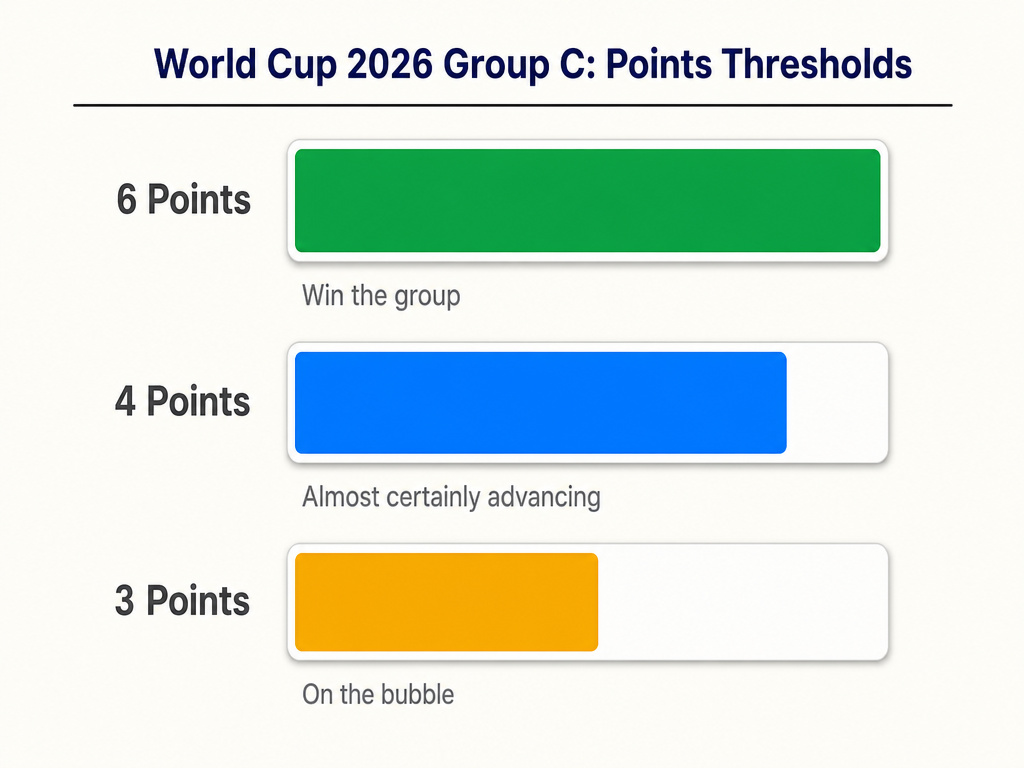
The path for every team depends on the points they accumulate. Here’s the realistic landscape.
6 Points: You win the group. A team with two wins is guaranteed a top-two finish. Job done.
4 Points: You are almost certainly advancing. This usually means one win and one draw. For a favorite, it might mean second place. For an underdog, it almost guarantees a spot among the best eight third-placed teams. I have never seen a third-placed team with four points miss the cut in simulation models.
3 Points: You are on the bubble. This is typically one win and two losses, or three draws. Your goal difference is everything. A third-placed team with a +2 GD usually advances; a -2 GD usually goes home. This is where the matches against Haiti become absolute gold, running up the score matters.
2 Points: You need a miracle. Two draws leave you hoping for a historically weak field of third-placed teams. It’s possible, but don’t book your flight to the Round of 32.
1 Point: Forget it. Pack your bags.
Let’s apply this to Group C’s likely contenders.
Brazil’s Path to the Knockouts
Brazil’s goal is to win the group. Their primary strategic adjustments will come if they drop points to Morocco. A draw in the opener means beating Haiti is non-negotiable to avoid a nerve-wracking final day. The worst-case scenario, a loss to Morocco, puts them in a must-win final match against Scotland, where goal difference could decide if they finish second or third.
I’ve seen Brazil teams of the past treat group stage matches against lesser sides as formalities. In 2026, that’s a luxury they can’t afford. A 2-0 win over Haiti is good; a 4-0 win provides a crucial GD cushion that could mean the difference between facing a group winner or runner-up in the Round of 32.
Morocco’s Calculated Campaign
Morocco’s defense is their foundation. Their path is similar to Brazil’s, but they might be more comfortable playing for a specific result on the final day. If they have four points heading into Matchday 3, a draw with Haiti could be enough to win the group if Brazil-Scotland is also a draw. Their high FIFA ranking is a final tie-breaker advantage if they end up in a third-place comparison.
Scotland’s Spoiler Scenario
Scotland does not need to finish in the top two to make history. Their realistic target is third place with three or four points. Beating Haiti is essential. Then, they must get something from the Morocco match, a point would be massive. Even a narrow 1-0 loss with a spirited performance keeps goal difference manageable. Their physical style, reminiscent of a sturdy 5-3-2 formation, is built to frustrate and snatch a goal on the counter. That could be enough.
Haiti’s Monumental Task
Haiti is playing for pride and chaos. Their most likely path to a point is frustrating Scotland in the opener. If they manage that, they become the ultimate spoiler. A draw against Scotland and a respectable loss to Brazil could leave them with one point, but more importantly, it could drain Scotland’s goal difference. A single surprise result, a draw against Morocco on the final day, would throw the entire group into beautiful disarray and be one of the tournament’s great stories.
How Third-Place Qualification Actually Works
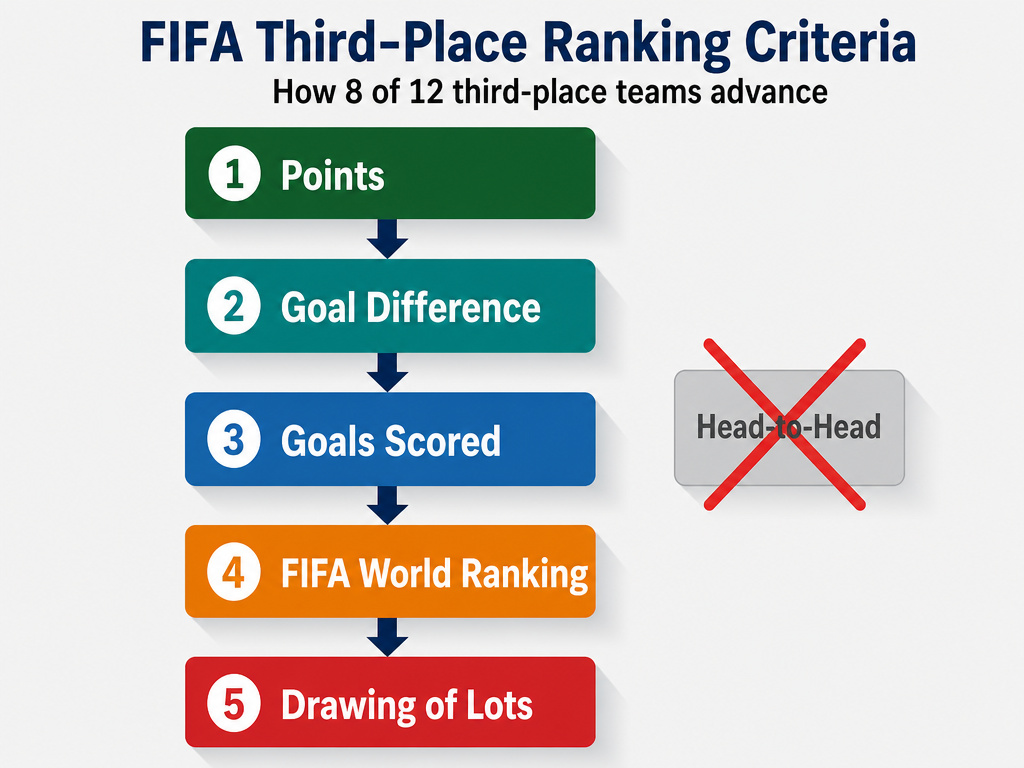
This is the most misunderstood part. Eight third-placed teams advance. FIFA does not use a simple table.
After all group matches conclude, FIFA creates a standalone ranking of the twelve third-placed teams. They are sorted by:
1. Points
2. Goal Difference
3. Goals Scored
4. Pre-Tournament FIFA World Ranking
5. Drawing of Lots
Notice what’s missing: head-to-head results. Morocco beating Brazil does not help Morocco if they are both comparing third-place records with teams from Group A and Group F. It’s a pure numbers game.
| Third-Place Ranking Factor | Why It Matters for Group C | Example Consequence |
|---|---|---|
| Points | Primary sorter. Get to 4. | Scotland with 4 points jumps ahead of all 3-point teams. |
| Goal Difference (GD) | The great decider at 3 points. | Scotland with a 0 GD advances over Morocco with a -1 GD. |
| Goals Scored (GF) | Tie-breaker after GD. | If GD is equal, the team that scored more goals goes through. |
| FIFA Ranking | Rare, but relevant. | If all else is equal, Morocco’s higher rank sends them through. |
This system makes the final matchday incredibly tense for teams on three points. Every goal matters globally. A 90th-minute consolation goal conceded by a Group C team could drop them three places in the third-place ranking, knocked out by a team from another group scoring a late winner.
Potential Round of 32 Paths for Group C Teams
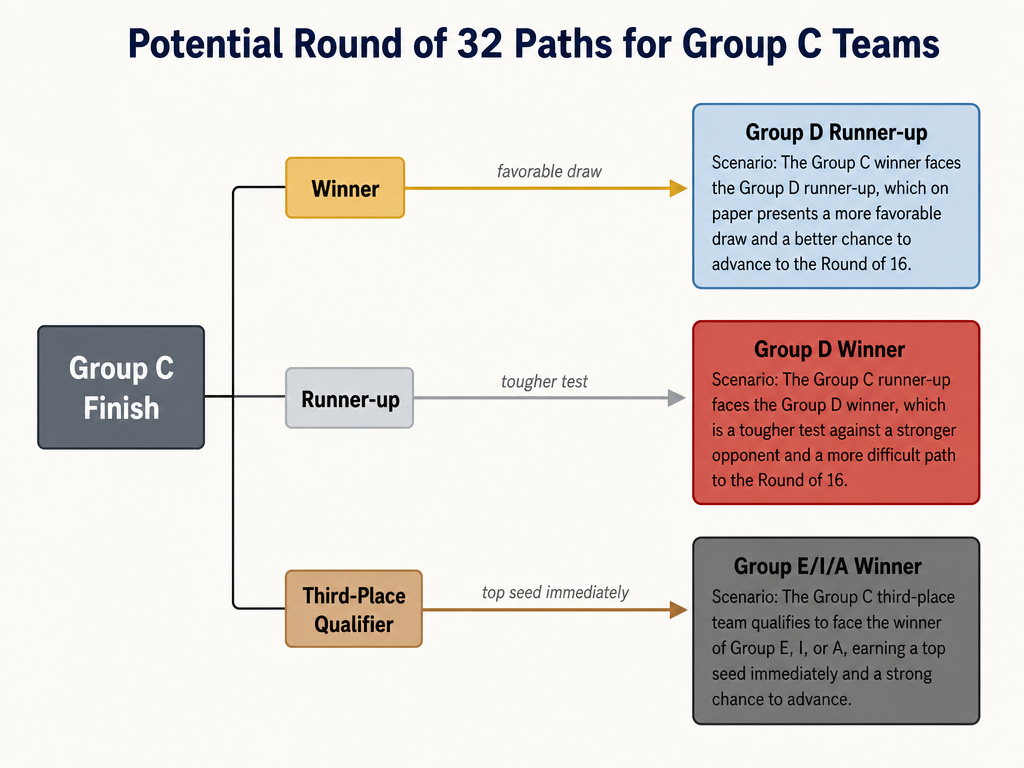
Where you finish determines who you play. The bracket is fixed.
- Group C Winner: Plays the Runner-up of Group D. This is a favorable draw, likely avoiding another group winner until later rounds.
- Group C Runner-up: Plays the Winner of Group D. This is a tougher immediate test, potentially against a European powerhouse.
- Group C Third-Placed Qualifier: Plays the Winner of Group E, I, or A. This path is assigned based on a pre-determined schedule to balance the bracket. It means facing a top seed immediately. For a team like Scotland, this could mean Germany (Group E) or France (Group I).
This bracket reality influences strategy on the final day. Is it better to finish second and face a Group D winner, or third and face a Group E winner? For most teams, second is preferable. But if Group D looks stronger than Group E, a calculated third-place finish could be a better path, a level of tournament chess rarely seen before.
These knockout playoff scenarios are why managing your squad and avoiding yellow card suspensions in the group stage is critical. You don’t want your star defender missing a Round of 32 match because he picked up a soft second yellow chasing a goal in a 4-0 win over Haiti.
Final Matchday: Simultaneous Drama on June 24th
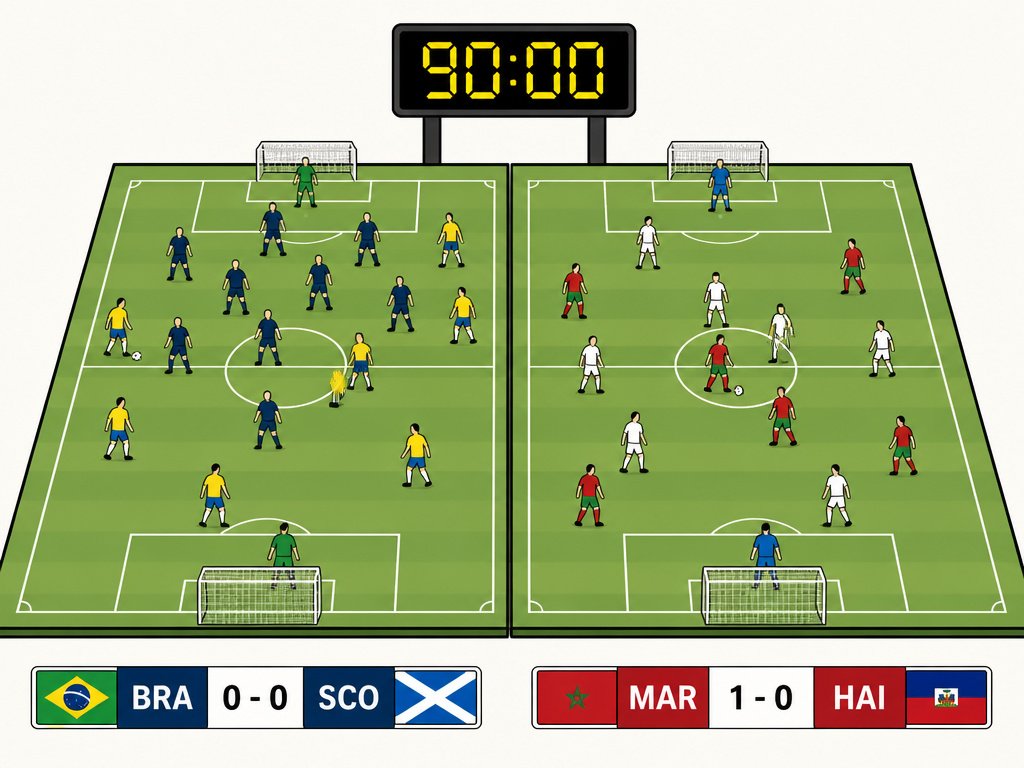
All final group matches kick off at the same time. This erases the advantage of knowing the result you need. For Group C, Brazil vs. Scotland and Morocco vs. Haiti will start simultaneously.
This setup produces two types of matches:
1. Teams playing for a specific goal difference. If Brazil needs to make up a two-goal swing on Morocco to win the group, they will attack relentlessly from the start. Scotland would be under siege.
2. Teams managing a precarious lead. If Morocco is winning 1-0 and Brazil is winning 1-0, both teams might slow the game down, knowing the status quo sees them through. But they won’t know the other score for sure.
This is where managers earn their pay. Do you push for a second goal to secure first place, risking a counter-attack that could drop you to second? Or do you see out a 1-0 win? The communication between the bench and analysts watching other matches will be frantic. For fans, it’s pure theater.
Before You Go
Group C is more than just Brazil and Morocco. The new 48-team format gives Scotland and Haiti a real, quantifiable chance to make the knockout stage. Forget just hoping for an upset; they can plan for it.
Focus on the points: four points is the target for any team dreaming of advancement. Watch the goal difference column from Matchday 1, it’s the silent tie-breaker that will send one team home and another to face a 2026 standout like Kylian Mbappé or Jamal Musiala. The final day will be chaos, played out in two stadiums at once. That’s the beauty of the new World Cup.
Frequently Asked Questions
What does Scotland need to qualify from World Cup 2026 Group C?
Scotland needs at least three points, and ideally four. Beating Haiti is mandatory. Then, they need at least a draw against Morocco or Brazil. A third-place finish with three points puts their fate in the hands of goal difference compared to other groups.
Can Haiti qualify for the Round of 32?
It is extremely difficult, but not impossible. Haiti’s most realistic path is to beat Scotland, then draw one of Brazil or Morocco. That would give them four points, which would very likely see them finish third and advance as one of the best third-placed teams. A win and a loss (three points) would require a very positive goal difference and help from other groups.
Who will the Group C winner play in the Round of 32?
The Group C winner will face the runner-up from Group D. Based on the draw, this opponent is likely to be a strong European or South American side, but it avoids the other group winners in the first knockout round.
How are the best third-placed teams determined?
FIFA takes all twelve third-placed teams and ranks them in a separate table using points, then goal difference, then goals scored, then pre-tournament FIFA World Ranking. The top eight from that list advance. Head-to-head results within a group are not used in this cross-group comparison.

I come from the “soccer heart” of Germany, the Ruhrpott. I have played, trained and followed soccer all my life and am a big fan of FC Schalke 04. I also enjoy following international soccer extensively.