World Cup Group H Qualification Scenarios & Team Analysis
To qualify from World Cup 2026 Group H, a team must finish in the top two, or be one of the eight best third-placed teams across all 12 groups. Spain and Uruguay are the clear favorites for the automatic spots. For Saudi Arabia or Cape Verde, the path is narrower: securing at least three points as the third-placed team gives a fighting chance, but four points makes qualification highly probable.
Most analysis stops at the simple “top two advance” rule. That misses the entire drama of the new 48-team format. The real battle in Group H isn’t just for first and second. It’s for the lifeline of third place, where goal difference isn’t just a tie-breaker – it’s your passport.
This guide breaks down every qualification scenario for Spain, Uruguay, Saudi Arabia, and Cape Verde. You’ll learn the exact point thresholds that matter, how the complex tie-breakers work, and what each team must do on the final matchday when all games kick off at the same time.
Key Takeaways
- Four points almost guarantees a third-placed team advances to the Round of 32. Three points is often enough but leaves you vulnerable to other group results.
- Head-to-head records only break ties within Group H. They are not used when comparing third-placed teams across different groups.
- The final matchday (June 26) features simultaneous kick-offs (Cape Verde vs. Saudi Arabia, Uruguay vs. Spain) to prevent teams playing for a specific result based on other games.
- If all else is equal, the FIFA World Ranking is the final tie-breaker. Spain’s high ranking is a significant safety net.
- Cape Verde’s debut campaign is a monumental achievement, but their realistic target is to be a competitive third-placed team and hope for a favorable goal difference.
The Simple Path: Top Two Advance
Finishing first or second in Group H is the straightforward ticket. Each team plays three matches, earning three points for a win and one for a draw. The two teams with the highest point totals after the round-robin go through.
Spain and Uruguay are projected to take these spots. Their opening match against the group’s weaker sides is critical. A slip-up there turns the pressure dial to maximum for their direct clash.
The head-to-head result between tied teams is the first tie-breaker within the group. If Spain and Uruguay finish level on points, the winner of their match on June 26 wins the group. If they draw, goal difference decides.
TL;DR: Win your first two games, and you’re practically through. For Spain and Uruguay, it’s about avoiding a surprise defeat to Saudi Arabia or Cape Verde that would turn their head-to-head clash into a sudden-death playoff.
The 4-Point Safety Net for Third Place
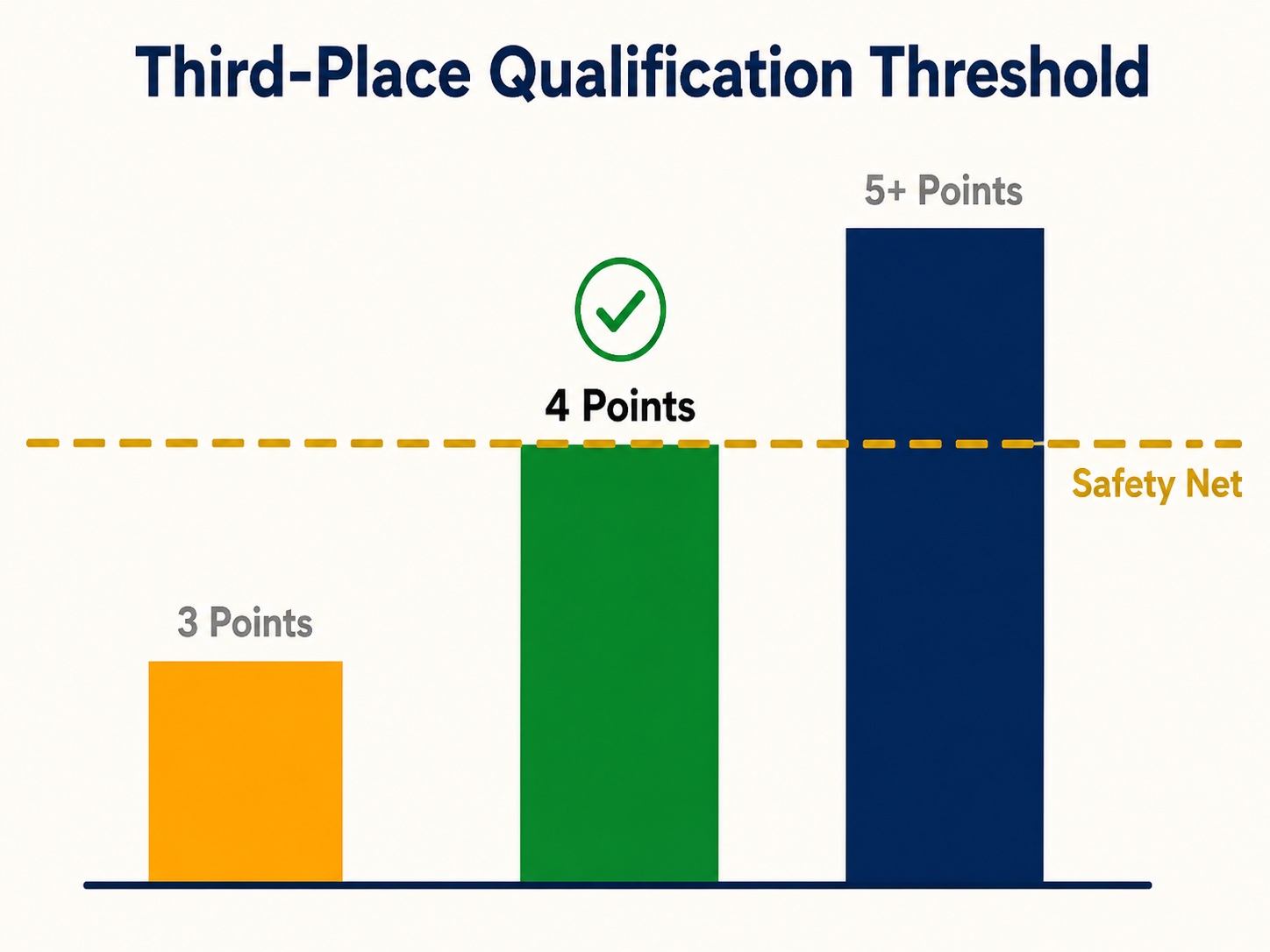
This is the new reality of the 48-team World Cup. Third place is no longer a consolation prize; it’s a viable route to the knockout stage. Eight of the twelve third-placed teams will advance. This changes everything for Saudi Arabia and Cape Verde.
Historical data from tournaments with similar formats, like the European Championship, shows a clear pattern. The safety net is made of points.
| Third-Place Points | Qualification Likelihood | Risk If Below |
|---|---|---|
| 4 Points | Very High | Almost certain to advance. A team would need exceptionally strong third-placed teams in other groups to miss out. |
| 3 Points | Probable | Goal difference becomes critical. You are at the mercy of results in other groups. |
| 2 Points | Risky | Requires a very strong goal difference and several other third-placed teams to finish with 1 or 0 points. |
| 1 Point | Very Low | Effectively eliminated. The math almost never works out. |
For Saudi Arabia, the mission is clear: target four points. That likely means beating Cape Verde and drawing one of the two giants. Their aggressive, high-pressing style can disrupt Spain or Uruguay for 90 minutes. A single famous result changes their entire calculus.
Cape Verde’s task is harder. As debutants, a single victory would be historic. To reach three or four points, they must be flawless defensively and clinical on the counter. Their compact defensive block is designed for this exact challenge – frustrating superior opponents and snatching a goal.
Common mistake: Thinking a win and two losses (3 points) is always enough for third place. In a tight tournament, several third-placed teams can finish on 4 points, pushing 3-point teams with poor goal difference out.
Tie-Breakers: When Every Goal Counts
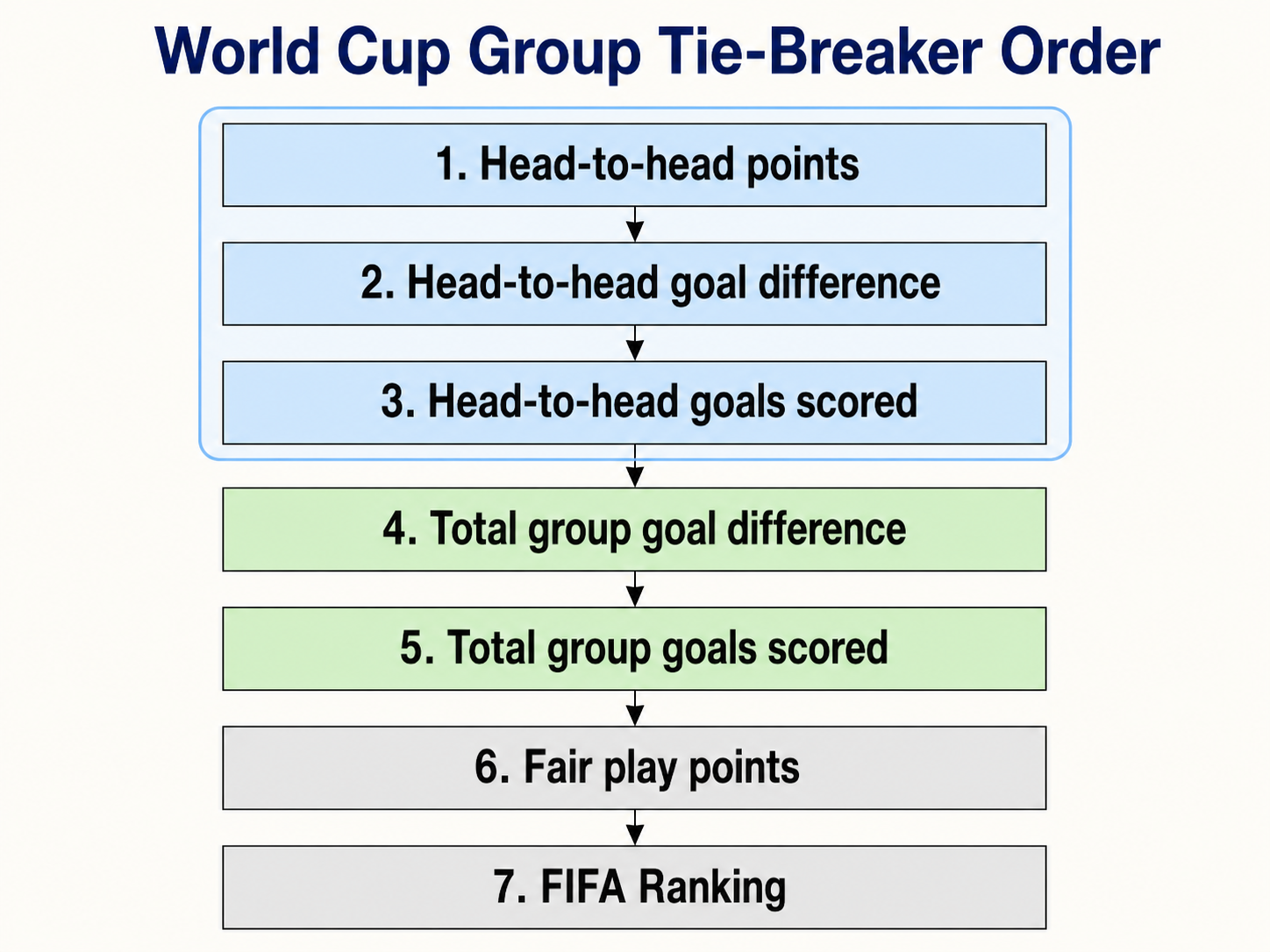
When teams are level on points, a cascade of rules determines who finishes higher. The order is strict and favors direct competition first.
Within Group H, the tie-breakers are:
- Points in head-to-head matches between the tied teams.
- Goal difference in those head-to-head matches.
- Goals scored in those head-to-head matches.
- Goal difference in all group matches.
- Goals scored in all group matches.
- Fair play points (yellow/red card deductions).
- FIFA World Ranking.
This order makes the Spain-Uruguay match monumental. If they are tied on points, that result settles it before overall goal difference even comes into play.
For ranking third-placed teams across all groups, the rules are different:
- Total points.
- Overall goal difference.
- Overall goals scored.
- Fair play points.
- FIFA World Ranking.
Notice the absence of head-to-head. This is the most common misconception. Saudi Arabia’s result against Cape Verde matters for their group standing, but when compared to a third-placed team from Group F, only total points, GD, and goals scored are compared.
A single red card can be the difference between going home and going through. Fair play points are a real factor. A team’s disciplinary record in all three group games contributes to its final “Team Conduct Score.”
Saudi Arabia’s Pragmatic Roadmap
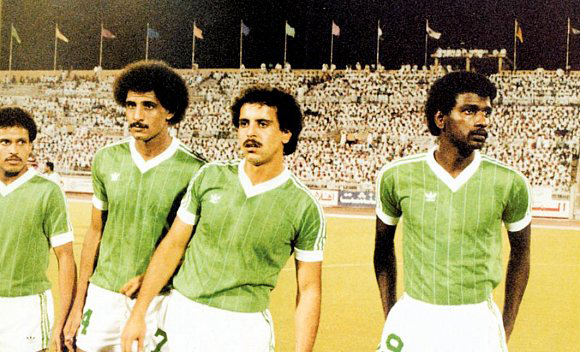
Photo: Al-Riyadh Newspaper / Wikimedia Commons / Public domain

Saudi Arabia cannot out-talent Spain or Uruguay over 90 minutes. They can out-work them. Their roadmap to third place relies on a specific sequence.
First, they must beat Cape Verde. That’s non-negotiable. Three points from that match provides the foundation. Then, they need to scramble a point from either Spain or Uruguay. A dogged defensive display and a set-piece goal could do it. Four points would make them a very strong third-placed candidate.
If they only manage three points (a win over Cape Verde and two losses), their goal difference in those losses becomes everything. Losing 1-0 to Spain and 2-0 to Uruguay is a -3 GD. Losing 4-1 in both is a -6 GD. That gap could be the margin between 8th and 9th best third-place team.
Their high-pressing system is a double-edged sword. It can force errors against Spain’s possession game, but it also leaves vast spaces for Uruguay’s explosive forwards like Darwin Nunez on the break. The manager’s game-state awareness will be critical.
Cape Verde’s Historic Mission

Photo: Xavier Rondón Medina / Wikimedia Commons / CC BY-SA 2.0

For Cape Verde, qualification is a secondary dream. The primary goal is to be respectable, competitive, and to seize any opportunity. Their entire federation is built on a solid defensive soccer tactics guide, often employing a low block that forces opponents into speculative shots.
Their best chance for points is against Saudi Arabia. That match is their World Cup final. A draw keeps them alive; a win changes their story forever. Against Spain and Uruguay, damage limitation is key. Every goal conceded hurts their third-place ranking prospects across the tournament.
Even with one point, if their goal difference is only -2 or -3, they could still finish above a third-placed team from another group that has -5. It’s a numbers game, and their strategy must be built around that cold math from the first whistle.
I’ve watched teams like this before. The danger is chasing the game too early. If Cape Verde goes a goal down to Spain in the first 20 minutes and abandons their shape to equalize, they could lose 5-0. That kills their goal difference and their tournament. Patience is their only weapon.
The Final Day Chess Match
All Group H matches on June 26 kick off simultaneously. This rule exists to preserve sporting integrity. Teams cannot tailor their strategy based on the real-time result of the other game.
This has massive implications. Imagine this scenario heading into the final day: Spain has 6 points, Uruguay has 3, Saudi Arabia has 3, and Cape Verde has 0. Spain has qualified. Uruguay and Saudi Arabia are fighting for second and third.
Uruguay plays Spain. Saudi Arabia plays Cape Verde. If Uruguay knows a draw is enough to finish second, they might play conservatively. But they won’t know the Saudi Arabia score. If Saudi Arabia is beating Cape Verde, a Uruguay draw with Spain would see Saudi Arabia jump to second on goal difference. Uruguay must play to win without knowing their rival’s fate.
This simultaneous kick-off rule creates pure, unscripted drama. It forces every team to play for a win until the final whistle, because the alternative is elimination. It’s why we see some of the most memorable overtime matches and dramatic finishes in tournament history.
How Third Place Shapes the Knockout Draw
Qualifying as a third-placed team comes with a catch: you get a harder draw. The Round of 32 is structured so group winners face third-placed qualifiers or runners-up from specific other groups.
The winner of Group H will face a third-placed team from Groups C, E, F, or I. This is a perceived advantage, avoiding another group winner early. The runner-up from Group H will face the winner of Group G – a much tougher immediate assignment.
For Saudi Arabia or Cape Verde, if they sneak through in third, they would likely face a group winner like Brazil or France. It’s a brutal reward for surviving the group, but it’s still a knockout game at the World Cup. It also means studying 11v11 formations of potential opponents becomes a frantic 72-hour exercise.
This structure makes winning the group even more valuable for Spain and Uruguay. Second place is a significantly more difficult path. It adds another layer of stakes to their direct encounter, beyond just local bragging rights and the chance to be remembered among the 2026 soccer legends.
Frequently Asked Questions
What happens if two teams in Group H finish with identical records?
If Spain and Uruguay finish with the same points, the winner of their June 26 match finishes first. If that match was a draw, then overall goal difference in the group decides. If that is also identical, it goes to goals scored, then fair play points, and finally the FIFA Ranking.
Can Cape Verde realistically qualify?
It is extremely unlikely they finish in the top two. Their realistic hope is to finish third with a competitive points tally (3 or 4 points) and a goal difference better than several other third-placed teams. This requires at least a draw with Saudi Arabia and a very narrow defeat to one of the giants.
Why is head-to-head not used for third-place ranking?
It’s logistically impractical. Comparing head-to-head results between teams that never played each other (e.g., Saudi Arabia vs. a third-placed team from South Korea’s group) is meaningless. The tournament uses universal metrics: points, overall goal difference, goals scored.
How do fair play points work?
yellow card is -1 point, a second yellow/indirect red is -3 points, a direct red card is -4 points, and a yellow card followed by a direct red is -5 points. The team with the higher score (fewer deductions) wins the tie-breaker. It has decided group standings before.
What is the most likely Group H outcome?
The consensus is Spain first, Uruguay second. The intrigue is whether Saudi Arabia can reach four points as a strong third-placed team. A popular simulation had both Saudi Arabia and Cape Verde finishing with just one point, which would eliminate them both.
The Bottom Line
Qualifying from World Cup 2026 Group H offers two doors. The front door is for Spain and Uruguay: win your games and you’re in. The back door is for Saudi Arabia and Cape Verde: fight for every point, mind your goal difference, and hope the numbers fall your way across 12 groups.
The new format makes every goal in every game matter, even for teams that lose twice. For the neutral, it’s fantastic. For the teams, it’s a brutal arithmetic test under the brightest lights. Spain’s talent should see them top the group, but Uruguay’s intensity makes them dangerous. Saudi Arabia has the tactical plan to spring a surprise, while Cape Verde will play with a nation’s pride on their shoulders.
Watch the goal difference column from matchday one. It tells the real story.

I come from the “soccer heart” of Germany, the Ruhrpott. I have played, trained and followed soccer all my life and am a big fan of FC Schalke 04. I also enjoy following international soccer extensively.