World Cup Schedule & Fixtures: Dates, Stadiums, Match List
The FIFA World Cup 2026 schedule runs from June 11 to July 19, 2026, across 16 host cities in North America. The tournament features 48 teams playing 104 matches, beginning with a group stage of 12 groups of four, followed by a new Round of 32 knockout stage, culminating in the final at MetLife Stadium.
Most guides just list the dates. They miss the logistical reality for fans and the sheer physical scale of this event. The 2026 schedule isn’t just a calendar; it’s a continental puzzle of travel, time zones, and stadium capacities.
This guide breaks down the complete fixture list, explains the new format, and gives you the on-the-ground details you need to follow the tournament from opener to final whistle.
Key Takeaways
- The 2026 World Cup introduces a Round of 32, adding an extra knockout round after the group stage for the first time.
- Kick-off times are in local stadium time, spanning three countries and four primary time zones (PT, MT, CT, ET). Converting these correctly is essential for watching.
- Estadio Azteca in Mexico City becomes the first stadium to host three World Cup opening matches, a piece of history worth noting.
- Travel between host cities is a major factor; the distance from Vancouver to Mexico City is greater than from London to Baghdad.
- The 104-match schedule is designed to maximize rest for players but creates a grueling travel itinerary for teams advancing deep into the knockout stage.
World Cup 2026 Schedule At a Glance
Forget the old 32-team, 64-match timeline. The 2026 edition is a different beast. The expanded 48-team format means 104 matches crammed into 39 days, a schedule that pushes infrastructure and endurance to the limit.
The group stage alone features 72 matches over 17 days. Then it gets interesting. Instead of a Round of 16, the knockout phase starts with a Round of 32. This new round adds an entire extra matchday for eight teams that finish second in their groups, creating more drama and more fatigue.
The 2026 FIFA World Cup will feature 104 matches played across 16 stadiums in three host nations over 39 days, according to the official FIFA match schedule released in June 2024. This represents a 62.5% increase in total matches from the 2022 tournament in Qatar.
You can find a clear breakdown of the groups and early matchups in resources like the Al Jazeera World Cup 2026 schedule guide. The official 2026 tournament format on our site details the qualification path and group structure.
TL;DR: The 2026 World Cup schedule is 104 matches over 39 days, starting with a 72-match group stage and introducing a new Round of 32 knockout round.
The Complete Match Fixture List
The fixture list is set, but the specific pairings for 27 of the 48 slots are still TBD, waiting on the final qualification playoffs in March 2026. We know the groups and the schedule framework, but not every team.
The opening match is locked in: Mexico vs. South Africa, June 11, 2026, at the iconic Estadio Azteca in Mexico City. This isn’t just an opener; it’s history. No other stadium has hosted three World Cup opening matches.
| Match Day | Date Range | Stage | Key Fixtures (Confirmed) | Total Matches |
|---|---|---|---|---|
| 1-17 | June 11 – June 27 | Group Stage | Mexico vs South Africa, USA vs Paraguay, Brazil vs Morocco, England vs Croatia | 72 |
| 18-23 | June 28 – July 3 | Round of 32 | TBD (Winners & Runners-up from Groups A-F) | 16 |
| 24-27 | July 4 – July 7 | Round of 16 | TBD (Winners from Round of 32) | 8 |
| 28-30 | July 9 – July 11 | Quarterfinals | TBD (Winners from Round of 16) | 4 |
| 31-32 | July 14 – July 15 | Semifinals | TBD (Winners from Quarterfinals) | 2 |
| 33 | July 18 | Third Place Playoff | TBD (Losers of Semifinals) | 1 |
| 34 | July 19 | Final | TBD (Winners of Semifinals) | 1 |
The group stage rules](https://allaboutfootball.net/soccer-world-cup-group-stage-format/) are straightforward: win or draw, with the top two from each of the 12 groups of four progressing. The eight best third-place teams also advance, filling out the new 32-team knockout bracket. This is a fundamental shift from the past.
Common mistake: Assuming all group stage matches are in the evening for prime-time TV, the schedule is packed with midday kick-offs (13:00 local) to fit 3-4 games per day across time zones, especially on weekends.
A historic moment lands on June 20 in Monterrey: Tunisia vs. Japan is slated to be the 1,000th match in FIFA World Cup history. It’s a quiet bit of scheduling magic they don’t advertise.
TL;DR: The fixture list is a mix of known marquee matches and TBD slots. The group stage has 72 matches, followed by a new Round of 32, all leading to the final on July 19.
The 2026 Host Cities and Stadiums
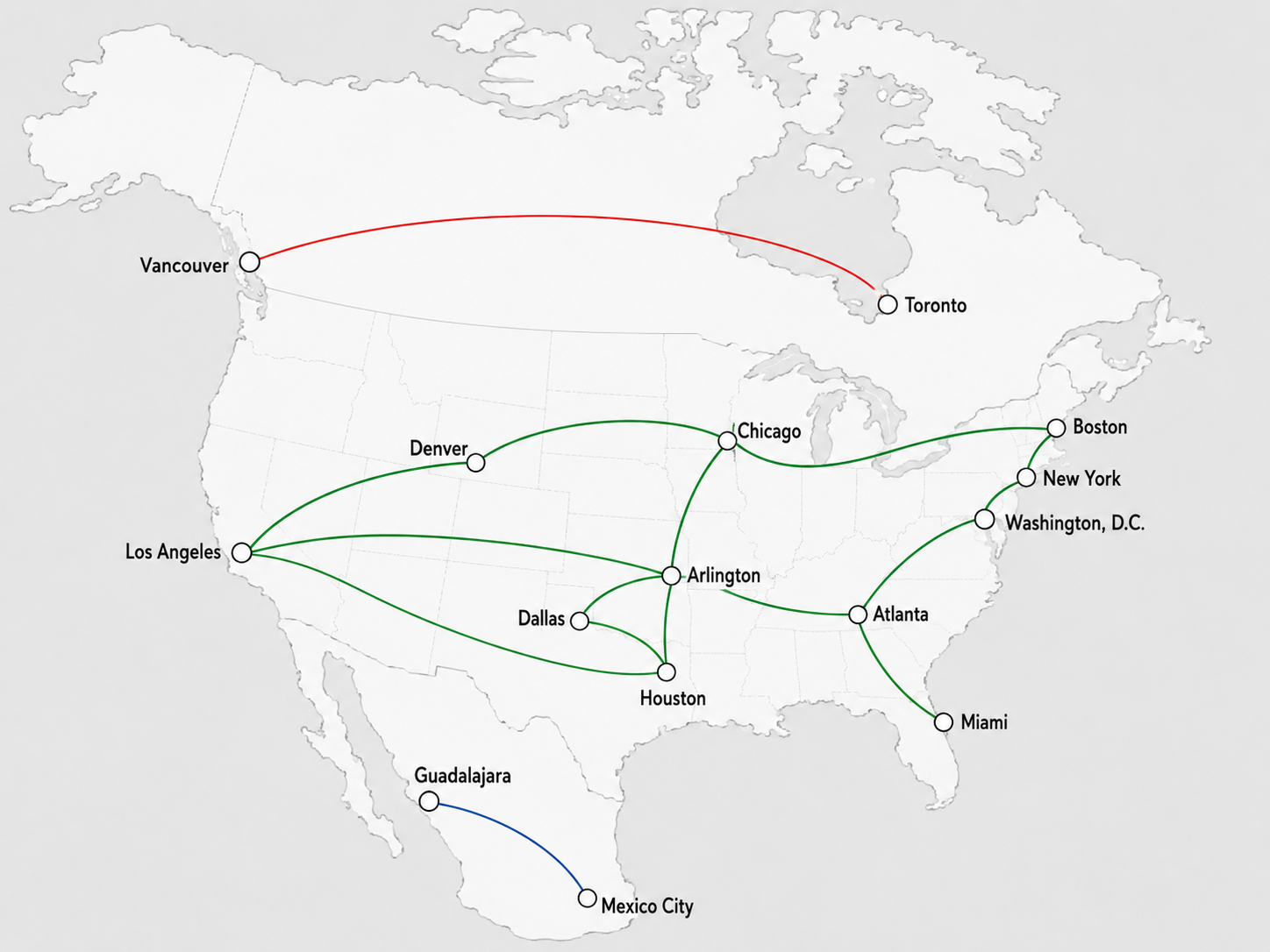
Sixteen cities. Three countries. The geography alone makes this World Cup unique. A fan following a team from Vancouver to Guadalajara to Boston would rack up more air miles than a pilot.
The USA carries the bulk with 11 venues, including modern giants like SoFi Stadium in Los Angeles and AT&T Stadium in Arlington. These are showpieces, but they come with a catch. The vast distances between 2026 host cities](https://allaboutfootball.net/world-cup-2026-host-cities-and-stadiums/) mean teams and supporters face significant travel. FIFA’s scheduling tries to cluster group stage games regionally, but once the knockout stage hits, cross-continent flights become inevitable.
Canada’s two venues, BMO Field in Toronto and BC Place in Vancouver, offer a different vibe. These are proper soccer-specific stadiums with roofs, a contrast to the massive American football arenas. Mexico’s trio, the Azteca in Mexico City, Estadio Akron in Guadalajara, and Estadio BBVA in Monterrey, brings the tournament’s deepest football culture and the highest altitude (Azteca sits at 7,200 feet).
Here’s a snapshot of the key venues and what they mean for the tournament venues](https://allaboutfootball.net/world-cup-2026-host-cities-and-stadiums/):
| City | Stadium | Capacity | Notable Feature |
|---|---|---|---|
| New York/New Jersey | MetLife Stadium | ~82,500 | Hosts the final; artificial turf surface (will be overlaid with grass). |
| Los Angeles | SoFi Stadium | ~70,240 | Most expensive stadium ever built; will host a semifinal. |
| Mexico City | Estadio Azteca | ~87,523 | First stadium to host three World Cup openers; high-altitude location. |
| Dallas | AT&T Stadium | ~80,000 | Retractable roof; massive video board. |
| Vancouver | BC Place | ~54,000 | Retractable roof; soccer-specific atmosphere. |
I made the mistake once of underestimating travel time between North American stadiums](https://allaboutfootball.net/world-cup-2026-host-cities-and-stadiums/). For the 2014 World Cup in Brazil, I assumed cities were closer than they were. I missed the first half of a quarterfinal because a domestic flight was delayed. In 2026, the distances are even greater. If your team plays in Vancouver on a Friday and Miami the following Tuesday, that’s not a quick hop.
TL;DR: The 16 host venues range from historic, high-altitude cathedrals like Estadio Azteca to modern NFL arenas. Travel logistics between them are the hidden challenge of the 2026 schedule.
Kick-Off Times and Time Zone Guide
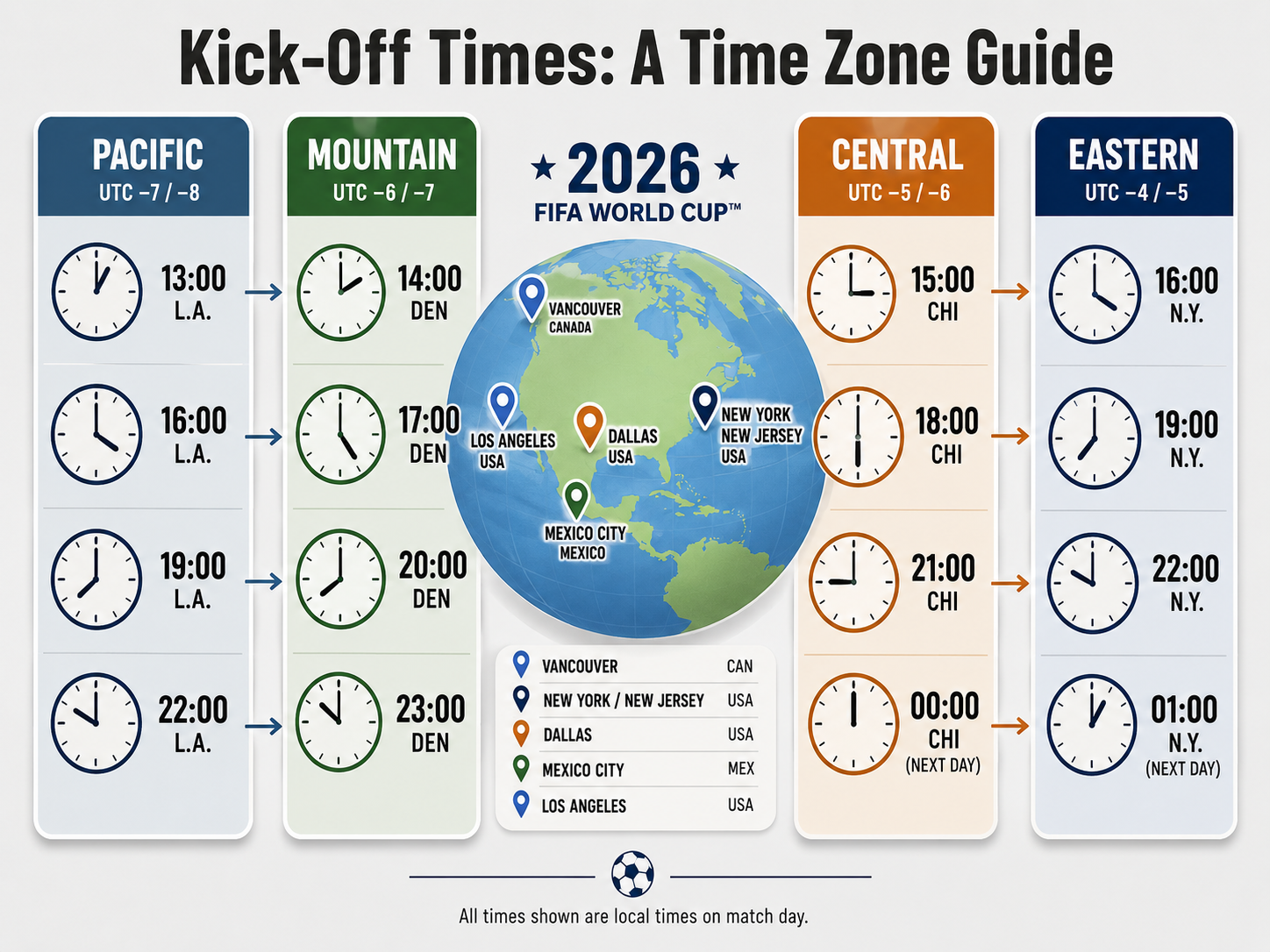
This might be the most practical piece of advice in the entire guide: always check the local time zone. The official FIFA schedule lists all kick-off times](https://allaboutfootball.net/world-cup-2026-time-zone-guide/) in the local time of the stadium.
That means you’re dealing with Pacific Time (Los Angeles, Vancouver), Mountain Time (Guadalajara), Central Time (Dallas, Kansas City, Monterrey), and Eastern Time (everywhere else in the US and Canada, including Toronto and Mexico City). A 13:00 kick-off in L.A. is 16:00 in New York and 22:00 in Central Europe. A 19:00 kick-off in Mexico City is midnight in London.
I learned this the hard way during the 1994 World Cup in the USA. I set my VCR (yes, that long ago) for a “9 PM” match listed in the newspaper, not realizing the listing was Eastern Time. I recorded three hours of late-night news. The match, in Chicago, had started at 8 PM my time. Always convert.
The schedule is packed, often with three or four matches per day during the group stage. They’re staggered across the continent to maximize TV coverage. You’ll have a lunchtime match on the West Coast, an afternoon match in the Central zone, and an evening match back on the East Coast. Planning your viewing day requires a map and a good schedule time guide](https://allaboutfootball.net/world-cup-2026-time-zone-guide/).
TL;DR: Match times are in local stadium time, spanning four time zones. Always convert to your local time to avoid missing kick-off.
Navigating the New Tournament Format
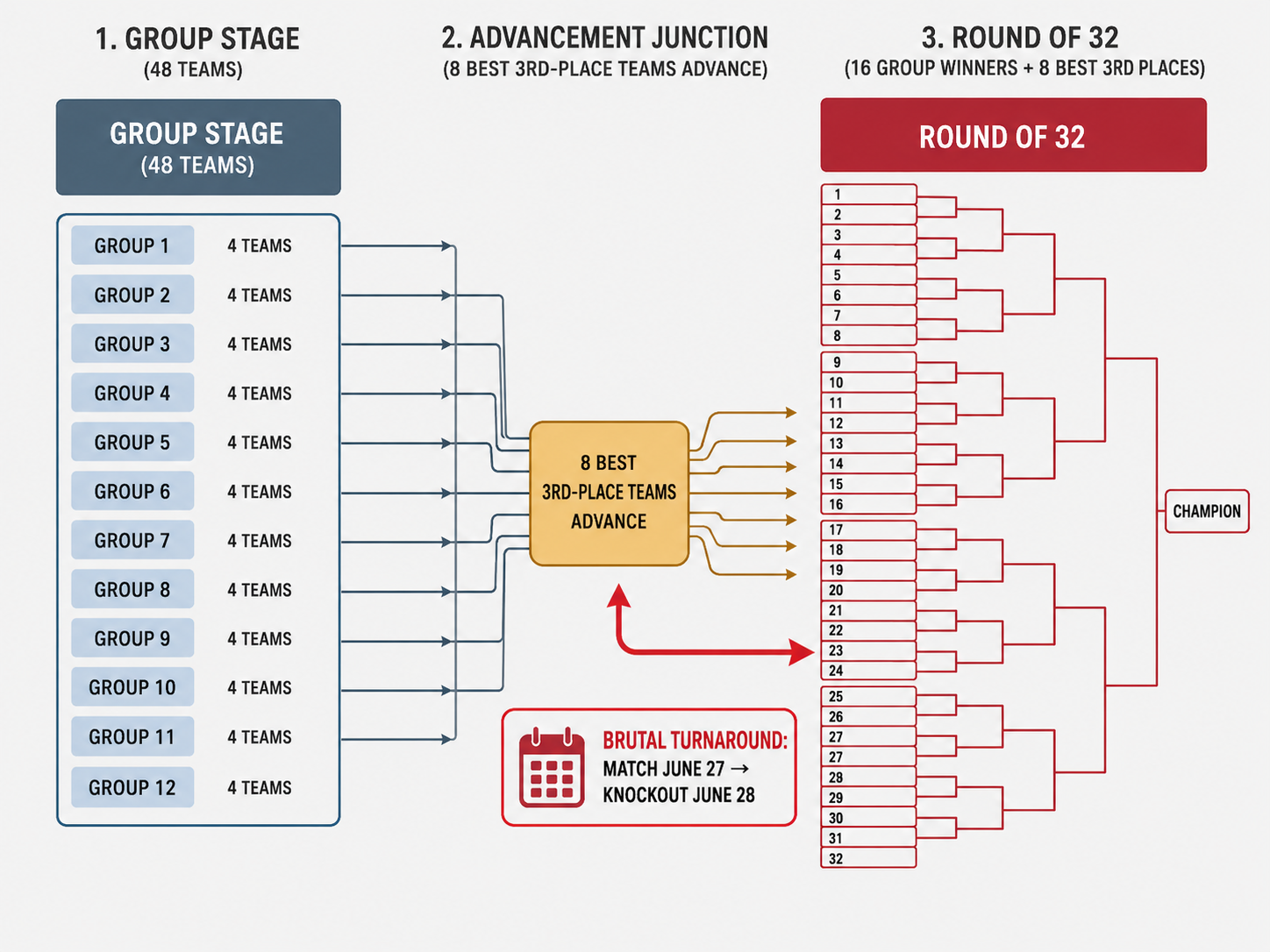
The jump from 32 to 48 teams isn’t just more games; it changes the tournament’s rhythm and risk. The old format had a clear break after the group stage. Now, with eight third-place teams advancing, the line between group and knockout stages blurs.
The new Round of 32 is the biggest change. It means 16 extra matches and, crucially, less recovery time for teams that finish second or third in their groups. A team that plays its final group match on June 27 could be back in action for the Round of 32 on June 28 or 29. That’s a brutal turnaround.
The structural differences](https://allaboutfootball.net/how-is-world-cup-2026-different-from-2022/) from 2022 are significant. More teams mean more matches, but also a greater chance for “group of death” scenarios and more potential for surprise packages to reach the knockout rounds. It dilutes the exclusivity but amplifies the drama.
FIFA has also confirmed several new tournament regulations](https://allaboutfootball.net/world-cup-2026-rule-changes/) for 2026, including an increase in the permitted squad size from 23 to 26 players. This is a direct response to the expanded schedule and increased risk of player fatigue and injury. Managers will need deeper squads.
Common mistake: Thinking the “best third-place teams” advance randomly, they’re ranked by points, then goal difference, then goals scored, then fair play points, exactly like group winners and runners-up. It’s a precise calculation, not a lottery.
The 2026 rule adjustments](https://allaboutfootball.net/world-cup-2026-rule-changes/) also likely include the permanent adoption of five substitutions per match and the continued use of semi-automated officiating](https://allaboutfootball.net/semi-automated-offside-at-world-cup-2026/). This technology, which uses limb-tracking cameras, should reduce VAR delays for offside calls, keeping the schedule tighter.
TL;DR: The 48-team format adds a Round of 32, shortens rest periods, and increases squad sizes to 26 players. Rule changes like five subs and semi-automated offside are designed for the marathon schedule.
The Opening Match and Final Venue
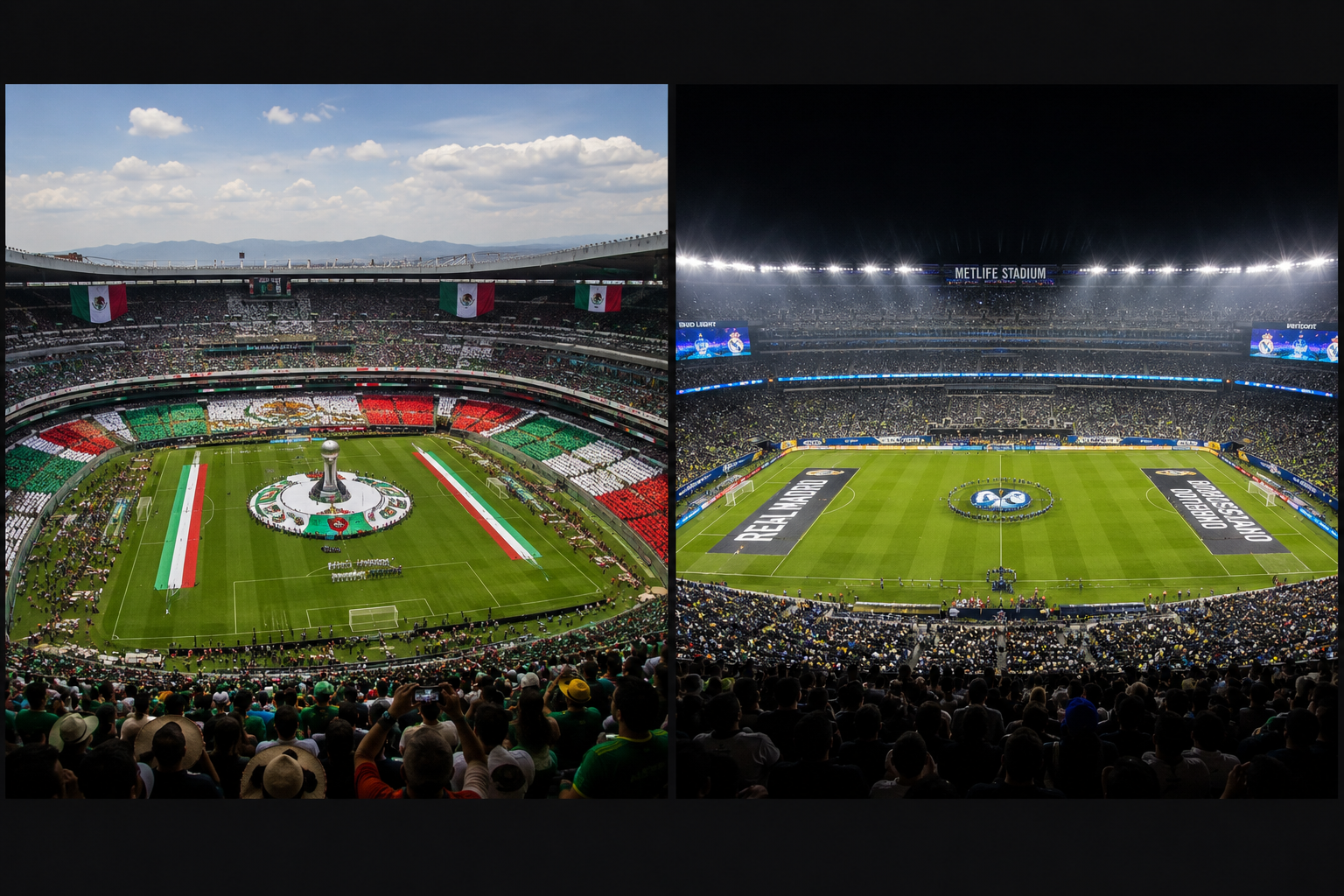
The bookends of the tournament are set in stone, and they tell a story of tradition versus spectacle.
The opening ceremony details](https://allaboutfootball.net/world-cup-2026-opening-ceremony/) for June 11 at Estadio Azteca will be a fusion of North American cultures, but the focus will quickly shift to the pitch. Mexico vs. South Africa is a fascinating tactical opener. Mexico, playing at home in the thin air, will press high. South Africa will try to absorb and counter. The altitude affects everything after the 60-minute mark.
The final match venue](https://allaboutfootball.net/where-will-the-world-cup-2026-final-be-held/) is MetLife Stadium in East Rutherford, New Jersey, on July 19. It’s a pragmatic choice. It’s the largest stadium in the largest media market, with extensive transport links. The playing surface is artificial turf, which will be overlaid with a natural grass system for the tournament, a process that has had mixed results in the past.
The 2026 World Cup final stadium](https://allaboutfootball.net/where-will-the-world-cup-2026-final-be-held/) choice signals a shift from the romantic (Maracanã, Lusail) to the logistical. It’s about capacity, security, and global broadcast readiness. The tournament final location](https://allaboutfootball.net/where-will-the-world-cup-2026-final-be-held/) is less about football history and more about modern event management.
TL;DR: The tournament opens at the historic Estadio Azteca and concludes at the massive, commercially focused MetLife Stadium, highlighting a clash of football cultures.
Planning Your Viewing and Travel
If you’re thinking of attending, start planning now. Tickets for the group stage and early knockout rounds will be sold in blind draws, you won’t know the teams. This is a gamble. You might get tickets to a dream match, or you might get Canada vs. Bosnia and Herzegovina in Toronto.
Accommodation in host cities will be scarce and exorbitantly priced. Cities like Kansas City and Philadelphia, which aren’t used to global tourism on this scale, will be stretched thin. The smart move is to pick a base city for the group stage and follow a specific team or cluster of matches in one region.
For viewers at home, your plan is different. Subscribe to 2026 World Cup news](https://allaboutfootball.net/category-world-cup-2026/) feeds early. Broadcast rights will be split among networks, and you don’t want to discover on match day that the game you want is on a streaming service you don’t have.
The environmental impact of a 104-match tournament across a continent is colossal. FIFA promises a “carbon neutral” event, but the math is daunting. Millions of air miles for teams, officials, and fans. It’s the elephant in the room nobody in the glossy brochures wants to talk about.
TL;DR: Attending requires early, flexible planning and accepting blind-draw tickets. Watching from home requires researching broadcast rights well in advance.
Frequently Asked Questions
When do World Cup 2026 tickets go on sale?
The first ticket sales phase, typically a random-selection draw, will likely open in late 2025. FIFA will announce specific dates on its official website. Be prepared for a complicated process with different sales categories.
How many matches will each team play if they win the World Cup?
The champion will play a maximum of eight matches: three in the group stage, and five in the knockout rounds (Round of 32, Round of 16, quarterfinal, semifinal, final). This is one more match than the seven required in the previous 32-team format.
What are the time zones for the 2026 World Cup?
Matches will be played across four primary time zones: Pacific Time (PT), Mountain Time (MT), Central Time (CT), and Eastern Time (ET). Kick-off times are always listed in the local time of the stadium where the match is being played.
Which stadium is hosting the most matches?
According to the initial schedule, MetLife Stadium (New York/New Jersey) and AT&T Stadium (Dallas) are slated to host the most matches (9 each), including a semifinal at MetLife and the final. SoFi Stadium (Los Angeles) also hosts 9 matches, including the other semifinal.
Will VAR and goal-line technology be used?
Yes. FIFA has confirmed that Video Assistant Referee (VAR) and goal-line technology will be used at all 104 matches. Furthermore, the semi-automated offside technology](https://allaboutfootball.net/semi-automated-offside-at-world-cup-2026/) first used in Qatar 2022 will also be deployed.
The Bottom Line
The 2026 World Cup schedule is a monster of logistics and spectacle. It’s more than a list of dates; it’s a continental test of travel, timing, and endurance. The new format rewards deep squads and punishes slow starters. For fans, success means mastering the time zones and accepting the gamble of blind-draw tickets.
Keep an eye on the final qualification playoffs in March 2026, they’ll fill in the last blanks on the fixture list. Until then, mark June 11 on your calendar. The beautiful game is coming to North America, and it’s bringing 104 matches with it. Plan accordingly.

I come from the “soccer heart” of Germany, the Ruhrpott. I have played, trained and followed soccer all my life and am a big fan of FC Schalke 04. I also enjoy following international soccer extensively.