The Complete List of All-Time Top Scorers at the World Cup
The all-time top scorer at the FIFA World Cup is Miroslav Klose of Germany, with 16 goals scored across 24 matches in four tournaments (2002, 2006, 2010, 2014). The list behind him is a mix of legendary finishers, one-tournament wonders, and active superstars still writing their stories.
Most fans know the name at the top. They miss the real drama happening three or four places down the list. They glance at the total and move on, ignoring the efficiency rates that would shatter modern analytics models and the young players currently on a trajectory to rewrite history.
This guide breaks down the official rankings, the styles that built them, and the active players with a legitimate shot at the summit. We will look beyond the raw numbers to the tournaments won, the goals that mattered, and the physical reality of scoring on football’s biggest stage.
Key Takeaways
- Miroslav Klose’s record of 16 goals is built on remarkable longevity and consistency across four World Cups, not a single explosive tournament.
- Efficiency matters: Gerd Müller scored 14 goals in just 13 matches, and Just Fontaine netted 13 in only 6 games—rates no modern player approaches.
- Kylian Mbappé is the clear active threat, with 12 goals in his first 14 World Cup matches. At his current pace, he could challenge Klose by the 2030 tournament.
- Lionel Messi’s 13 goals were crucial to Argentina’s 2022 triumph, cementing his legacy but likely marking his final tally.
- Cristiano Ronaldo’s unique record of scoring in five different World Cups highlights a different kind of longevity, despite a lower total of 8 goals.
The All-Time Top 10: A Definitive Ranking
Forget debates about the “greatest.” The historical World Cup scoring leaders list is a matter of official record. The numbers are cold, hard, and definitive. They tell a story of relentless accumulators, explosive bursts, and enduring class.
The table below is the canon. It is the starting point for every argument about World Cup greatness.
| Rank | Player | Nation | Goals | Matches | World Cups |
|---|---|---|---|---|---|
| 1 | Miroslav Klose | Germany | 16 | 24 | 4 (2002–2014) |
| 2 | Ronaldo | Brazil | 15 | 19 | 3 (1998–2006) |
| 3 | Gerd Müller | West Germany | 14 | 13 | 2 (1970–1974) |
| T-4 | Just Fontaine | France | 13 | 6 | 1 (1958) |
| T-4 | Lionel Messi | Argentina | 13 | 26 | 5 (2006–2022) |
| T-6 | Pelé | Brazil | 12 | 14 | 4 (1958–1970) |
| T-6 | Kylian Mbappé | France | 12 | 14 | 2 (2018–2022) |
| 8 | Sándor Kocsis | Hungary | 11 | 5 | 1 (1954) |
| T-9 | Jürgen Klinsmann | Germany | 11 | 17 | 3 (1990–1998) |
| T-10 | Helmut Rahn | West Germany | 10 | 10 | 2 (1954–1958) |
Klose’s record seems secure. Look closer. The threat comes from the bottom of this table, not the top. Mbappé’s name sticks out. Everyone else is a retired legend. He is 25 years old. His goals-per-game rate (0.86) is higher than Klose’s (0.67). He needs four more goals to tie Müller, five to tie Ronaldo. The 2026 tournament is next.
Miroslav Klose scored his 16 World Cup goals across 24 matches in four consecutive tournaments (2002, 2006, 2010, 2014). The German striker’s record combines aerial prowess, tactical timing, and unparalleled tournament longevity, surpassing Ronaldo’s 15-goal mark during the 2014 semi-final.
TL;DR: Miroslav Klose leads with 16 goals, but Kylian Mbappé’s 12 goals in just 14 games puts him on a record-breaking trajectory.
How They Scored: The Styles That Defined Eras
The method matters as much as the total. A tap-in in a group stage rout and a winning header in a semi-final both count as one. The great scorers are defined by how they scored when it mattered.
Klose was the archetypal German raumdeuter — a space interpreter. Seven of his 16 goals were headers. He had a knack for arriving in the six-yard box a half-step before defenders realized the cross was coming. His game wasn’t about dribbling or long-range shots. It was about timing and efficiency. He scored in four different World Cup semi-finals. That is not an accident.
Common mistake: Comparing Klose’s 16 goals directly to Gerd Müller’s 14 — Müller’s strike rate of 1.08 goals per game is almost double Klose’s, achieved in a more chaotic, defensively open era of the sport.
Contrast that with Ronaldo, the Brazilian phenomenon. His 15 goals were acts of individual destruction. The dribble against Turkey in 2002. The brace in the 2002 final. He combined raw power with balletic footwork, a predator who could create his own shot from nothing. Gerd Müller, “Der Bomber,” was pure penalty-box instinct. Every touch was a shot. His 14 goals in 13 games is arguably the most impressive stat on the entire list.
Just Fontaine’s 13 goals in 1958 is the ultimate outlier. He was not even France’s first-choice striker at the start of the tournament. An injury thrust him in, and he responded with four goals against West Germany, a hat-trick against Paraguay, and braces against Yugoslavia and Scotland. The pitches were heavier, the balls were leather, and the medical care was primitive. His record for a single tournament still stands.
TL;DR: Klose was a tactical finisher, Ronaldo a creative force, Müller an instinctive poacher, and Fontaine a perfect historical storm. The “how” explains the “how many.”
The Active Chase: Who Can Catch Klose?
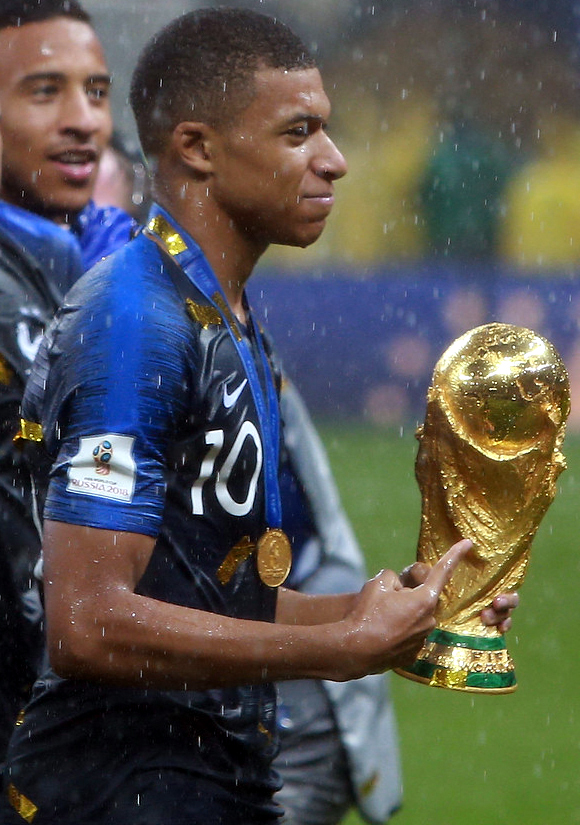
Photo: Антон Зайцев / Wikimedia Commons / CC BY-SA 3.0

The record is static. The chase is alive. Only two players in the current global game have a realistic mathematical and chronological chance to reach Klose’s 16.
Kylian Mbappé is the obvious candidate. He has 12 goals. He will be 27 at the 2026 World Cup, 31 in 2030, and 35 in 2034. If France remains a contender, he could feasibly play three more tournaments. At his current rate, he would need about 5 more games to score 4 goals and tie Ronaldo. The record is within sight.
I thought Messi or Ronaldo would make a run at it after the 2014 tournament. Messi’s game evolved deeper, and Ronaldo’s Portugal sides never had the deep runs. Mbappé is different. France are built for long tournaments, and he is their absolute focal point. He scored a hat-trick in a final and looked angry he didn’t get a fourth. That’s the mentality you need.
Lionel Messi’s chase is almost certainly over. His 13 goals, capped by his iconic performance in the 2022 final, feel complete. He is unlikely to play in 2026 at age 39. His legacy is sealed, but the all-time goals record will belong to someone else.
Cristiano Ronaldo presents a fascinating case. With 8 goals, he will not catch Klose. His legacy is a different record: the only player to score in five different World Cups (2006, 2010, 2014, 2018, 2022). It is a testament to insane physical maintenance and enduring quality, even if the peak scoring output belonged to others. This kind of longevity is a hallmark of the modern game, much like the players who chase the record for most World Cup appearances.
The table below weighs the contenders.
| Player | Current Goals | Age in 2026 | Realistic Target | Primary Obstacle |
|---|---|---|---|---|
| Kylian Mbappé | 12 | 27 | 16+ (Record) | Injury, team form |
| Lionel Messi | 13 | 39 | 13 (Retired) | Age, retirement |
| Cristiano Ronaldo | 8 | 41 | 8 (Retired) | Age, retirement |
| Next Best Active | 5 or fewer | Varies | Top 10 | Talent gap |
The math is simple. The pressure is immense. Scoring in a World Cup is the hardest thing in football. The defense is organized, the stakes paralyzing. Mbappé has already shown he thrives on that stage. The next three tournaments will define his place in this specific pantheon.
TL;DR: Kylian Mbappé is the only active player with the time, talent, and team support to realistically challenge Klose’s record of 16 World Cup goals.
Beyond the Totals: Records Within the Record
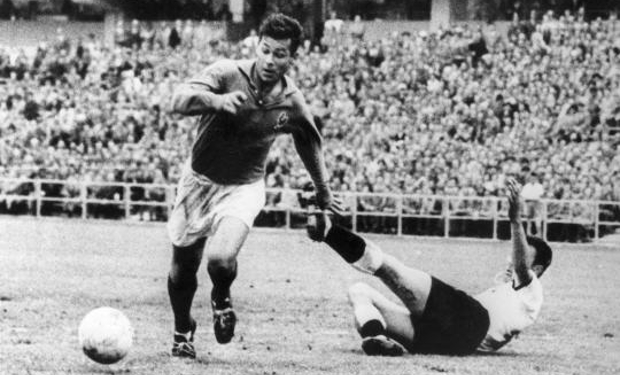
Photo: Unknown authorUnknown author / Wikimedia Commons / Public domain

The top of the scoring list generates the headlines. The footnotes contain some of football’s most remarkable trivia. These are the records that illuminate the edges of the achievement.
Just Fontaine’s 13 goals in a single tournament (1958) is the untouchable record. The modern game is too balanced, too athletic. No one has come closer than Gerd Müller’s 10 in 1970. Fontaine did it in six games. For context, the Golden Boot winner in 2022 (Messi) had 7 goals in 7 games. Fontaine’s average was over two goals per match.
Gerd Müller’s career goals-per-game average of 1.08 is another statistical marvel. He was a machine. Sándor Kocsis of Hungary scored 11 goals in just 5 matches in 1954. That is a 2.2 average, a number that belongs to a video game.
Common mistake: Forgetting that Pelé, often celebrated for his all-around genius, is also tied for sixth on the all-time list with 12 goals. He scored them as a teenager in 1958 and as the veteran leader in 1970, bridging two distinct football eras.
Then there are the team achievements. Many of these scorers propelled their nations to the ultimate prize. Pelé’s Brazil won three of the four tournaments he played in, cementing their status as one of the most successful World Cup nations. Gerd Müller’s goals won the 1974 final. Mbappé’s hat-trick nearly stole the 2022 final. These goals are weighted with history.
Other marks are more subtle. No player from outside Europe or South America has scored more than six goals (Asamoah Gyan, Ghana). It is a stark reminder of the tournament’s historical geographical dominance. Thomas Müller’s 10 goals for Germany across three tournaments is a model of modern, high-pressing, team-oriented scoring—a different path to the same prestigious list.
TL;DR: Fontaine’s single-tournament haul and Gerd Müller’s goals-per-game rate are statistical records that may never be broken, adding context to the raw career totals.
Historical Context: Comparing Football’s Evolving Eras
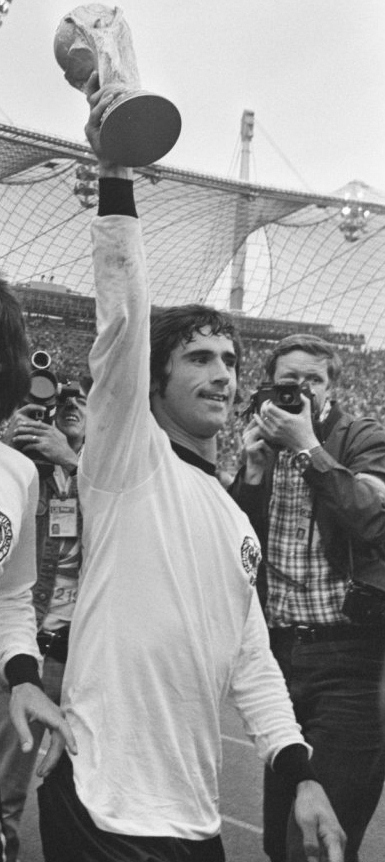
Photo: Nationaal Archief Fotocollectie Anefo NL-HaNA, ANEFO / neg. stroken, 1945-1989, 2.24.01.05, item number 927-3080 / Wikimedia Commons / CC BY-SA 3.0

You cannot view Gerd Müller’s 1974 through the lens of Mbappé’s 2022. The sport was a different organism. The ball was heavier, the pitches muddy, the tackles brutal, and the tactical analysis was done with a notepad. Defenders were man-markers, not zonal cover specialists in a high press.
Müller scored his goals in a 16-team tournament with fewer total matches. The margin for error was zero. Fontaine’s 1958 tournament had no group stage red cards, no VAR, and goalkeepers who played in woolen jerseys. The physical demand was different, but so was the opportunity. A hot striker could face a disorganized defense in a knockout game and score four. That rarely happens now.
The modern era (post-1998, with 32 teams) favors the accumulator like Klose. More group games, more matches for top teams that reach the final four. The game is faster, athletes are better, and sports science prolongs careers. This is why Klose’s record of four consecutive tournaments with goals is a modern feat. It is also why Mbappé’s potential run to 2034 is plausible.
This evolution is part of the tournament’s fabric, as visible as the change in official World Cup balls from heavy leather to the aerodynamic Adidas Al Rihla. The equipment changed the game. The tactics changed the scorers.
The 1970 ball was a 32-panel Telstar. It was revolutionary for being visible on black-and-white TV. It was also a nightmare to strike cleanly in the thin air of Mexico City. Müller still scored 10 goals with it. That tells you everything about the man’s technique.
The debate about “the greatest” is pointless. The conditions are incomparable. The proper respect is to recognize each record within its own time. Fontaine’s 13 is a meteor. Klose’s 16 is a mountain. Both are permanent.
TL;DR: Early-era records reflect tournament structure and style of play, while modern records reward longevity and consistency in a more physically demanding, structured game.
Frequently Asked Questions
Who is number 1 on the all-time World Cup scorers list?
Miroslav Klose of Germany is the all-time top scorer with 16 goals. He scored across four consecutive World Cups (2002, 2006, 2010, 2014), breaking Ronaldo’s record during the 2014 tournament in Brazil.
Can Kylian Mbappé break the record?
Yes, Kylian Mbappé has a strong chance. With 12 goals already at age 25, he needs 5 more to surpass Ronaldo and 5 more to tie Klose. If he maintains his health and France’s competitive level, he could challenge the record in the 2026 or 2030 World Cups.
How many World Cup goals does Lionel Messi have?
Lionel Messi scored 13 World Cup goals in 26 matches across five tournaments (2006-2022). He is tied with Just Fontaine for fourth on the all-time list. His seven goals in 2022 were instrumental in Argentina’s victory, creating some of the greatest moments in World Cup history.
What is the record for most goals in a single World Cup?
Just Fontaine of France holds the record for most goals in a single tournament, scoring 13 times in just 6 matches during the 1958 World Cup in Sweden. No player has scored more than 10 in a tournament since.
Is Cristiano Ronaldo in the top 10 all-time scorers?
No, Cristiano Ronaldo is not in the top 10. He has scored 8 goals across five World Cups (2006-2022). While he holds the record for scoring in the most different tournaments, his overall total places him outside the top 15 all-time scorers.
Who has the best goals-per-game ratio among top scorers?
Among players with 10+ goals, Gerd Müller of West Germany has the best ratio, scoring 14 goals in 13 matches (1.08 per game). Sándor Kocsis (11 in 5 games) and Just Fontaine (13 in 6) have higher ratios but with fewer total goals.
The Bottom Line
Miroslav Klose’s 16 goals stand as the benchmark, a monument to sustained excellence on football’s hardest stage. The names below him—Ronaldo, Müller, Fontaine, Messi—are not just chasing a number. They represent different philosophies of scoring, from explosive genius to ruthless efficiency.
The story is not finished. Kylian Mbappé’s presence on the list changes everything. He is not a historical figure yet. He is a current event, a force of nature with the calendar on his side. The next three World Cups will be a live audition for the top spot.
Look past the leader. The real intrigue is in the race for second, the battle of eras, and the young star aiming for the summit. That is where the history of the World Cup’s greatest scorers is still being written, match by match, goal by goal. For a deeper look at the stages where these legends made their mark, explore the history of every World Cup final.
I come from the “soccer heart” of Germany, the Ruhrpott. I have played, trained and followed soccer all my life and am a big fan of FC Schalke 04. I also enjoy following international soccer extensively.