World Cup Ball History: From 1930 Chaos to Tech
The complete World Cup ball history is a 94-year journey from inconsistent, hand-stitched leather spheres to aerodynamically engineered, sensor-laden polymer objects. It spans the chaotic pre-Adidas era (1930-1966), the standardized innovation period under Adidas (1970-present), and a current revolution defined by data integration and sustainability, culminating in the upcoming 2026 Trionda.
Most people think the ball has always been a high-tech icon. They miss the early decades of pure chaos, where the ball could change at halftime. They also underestimate how a single design misstep, like the 2010 Jabulani, can alter an entire tournament’s narrative.
This guide walks through every major shift. We will cover the leather-and-lace beginnings, the iconic black-and-white breakthrough, the synthetic revolution, and the arrival of the chip inside the ball. You will understand not just what changed, but why it mattered on the pitch.
Key Takeaways
- Before 1970, there was no official ball; host nations supplied their own, leading to infamous moments like the 1930 final using two different balls.
- The 1970 Adidas Telstar established the 32-panel black-and-white design for TV visibility, beginning the era of consistent, branded tournament balls.
- Reducing panel counts, as seen in the 2010 Jabulani (8 panels) and 2026 Trionda (4 panels), drastically alters aerodynamics and requires extensive player adaptation.
- Modern balls like the 2022 Al Rihla and 2026 Trionda contain embedded sensors that provide real-time data for VAR and semi-automated offside technology.
- The evolution from waterlogged leather to thermally bonded synthetics reflects a parallel shift in gameplay toward speed, consistency, and data-driven officiating.
The Chaotic Prelude: Leather, Laces, and Local Varieties (1930–1966)
For the first nine tournaments, the concept of an “official World Cup ball” did not exist. FIFA delegated ball supply to the host nation, which typically meant local manufacturers providing whatever they had. The result was a wild inconsistency that directly influenced matches. The balls were heavy leather, hand-stitched, and featured a laced-up opening for the inflatable bladder. They absorbed water like a sponge, becoming unpredictably heavier and more dangerous as a match progressed.
The 1930 final in Montevideo is the perfect example of this chaos. Argentina and Uruguay could not agree on a ball. The compromise was to use Argentina’s Tiento ball for the first half and Uruguay’s T-Model for the second. Argentina led 2-1 at halftime with their ball; Uruguay won 4-2 after switching to theirs. The story is often told as a quirky anecdote, but it underscores a fundamental unfairness. The ball was a variable, not a constant.
This variability persisted for decades. In 1962, referees in Chile were so dissatisfied with the local ball’s quality and consistency that they allowed the use of different balls for various matches. You can imagine the frustration for players. Developing muscle memory for swerve, weight, and touch was impossible when the next match might feature a completely different sphere.
The pre-1970 era was defined by regional inconsistency. A ball’s performance depended on the host country’s manufacturer, the weather, and even diplomatic negotiations between teams, making cross-tournament comparison of skill nearly impossible.
TL;DR: For 36 years, the World Cup ball was whatever the host country provided, leading to infamous inconsistencies like the two-ball 1930 final and making the game less about universal skill and more about adapting to local quirks.
The Adidas Era: Standardization and Innovation (1970–Present)
Adidas’s appointment as official match ball supplier for the 1970 World Cup in Mexico was the single most important event in this history. It brought global consistency, branded identity, and a pipeline for deliberate technological innovation. The company’s first offering, the Telstar, set the template. Its name combined “Television” and “Star,” and its 32-panel black-and-white design was purely for visibility on the new phenomenon of black-and-white TV broadcasts. The iconic pattern became synonymous with soccer itself.
The next two decades saw incremental but crucial improvements within a familiar design language. The 1974 Telstar Durlast added a waterproof polyurethane coating. The 1978 Tango introduced the 20-panel design with its distinctive curved triads, a look that would define the next five tournaments. The 1982 Tango España was the last leather World Cup ball, but it featured rubberized seams for better water resistance.
The real material revolution came in 1986 with the Azteca. It was the first fully synthetic match ball. The polyurethane outer shell did not absorb water, maintaining a consistent weight and feel regardless of rain. This was a game-changer for players, especially in the humid Mexican climate. The move to synthetics was as significant as the shift to standardized designs. You can trace a direct line from the Azteca to every modern ball’s core material science.
| Ball (Year) | Key Innovation | Why It Mattered |
|---|---|---|
| Telstar (1970) | 32-panel black/white design | Made the ball highly visible on black-and-white television, creating an iconic global image. |
| Azteca (1986) | First fully synthetic construction | Eliminated water absorption, ensuring consistent weight and performance in all weather. |
| Tricolore (1998) | First multi-colored ball | Broke the black/white monopoly, allowing for national-color designs and improved player tracking. |
| Teamgeist (2006) | 14-panel thermally bonded design | Created a smoother, rounder surface for more predictable flight; each match ball was uniquely printed. |
I have a soft spot for the 2002 Fevernova ball everyone else seems to hate. Yes, its synthetic foam layer made it notoriously light and floaty for goalkeepers. But for an outfield player taking a direct free-kick, that lightness allowed for outrageous dip and swerve. It rewarded technique with spectacle in a way a heavier ball never could.
The post-2000 era shifted focus from materials to geometry. The 2006 Teamgeist (“Team Spirit”) reduced the panel count to 14, using thermal bonding instead of stitching to create a perfectly rounder surface. Then came the 2010 Jabulani (“to Celebrate”), which cut the count to just 8 panels. Its design was aerodynamically flawed. With fewer seams, the surface was too smooth, causing an unpredictable “knuckling” effect in flight once the ball slowed below a certain speed. Goalkeepers hated it. Outfield players complained it felt like a “supermarket ball.” It was a rare case where innovation backfired, proving that player feedback is as crucial as wind-tunnel data.
TL;DR: Adidas’s tenure brought standardization and sequenced innovations: TV-friendly design (1970), waterproofing (1974), synthetic materials (1986), color (1998), and geometric simplification (2006), with the 2010 Jabulani serving as a stark lesson in over-engineering.
The Modern Tech Revolution: Data, Sustainability, and Aerodynamics
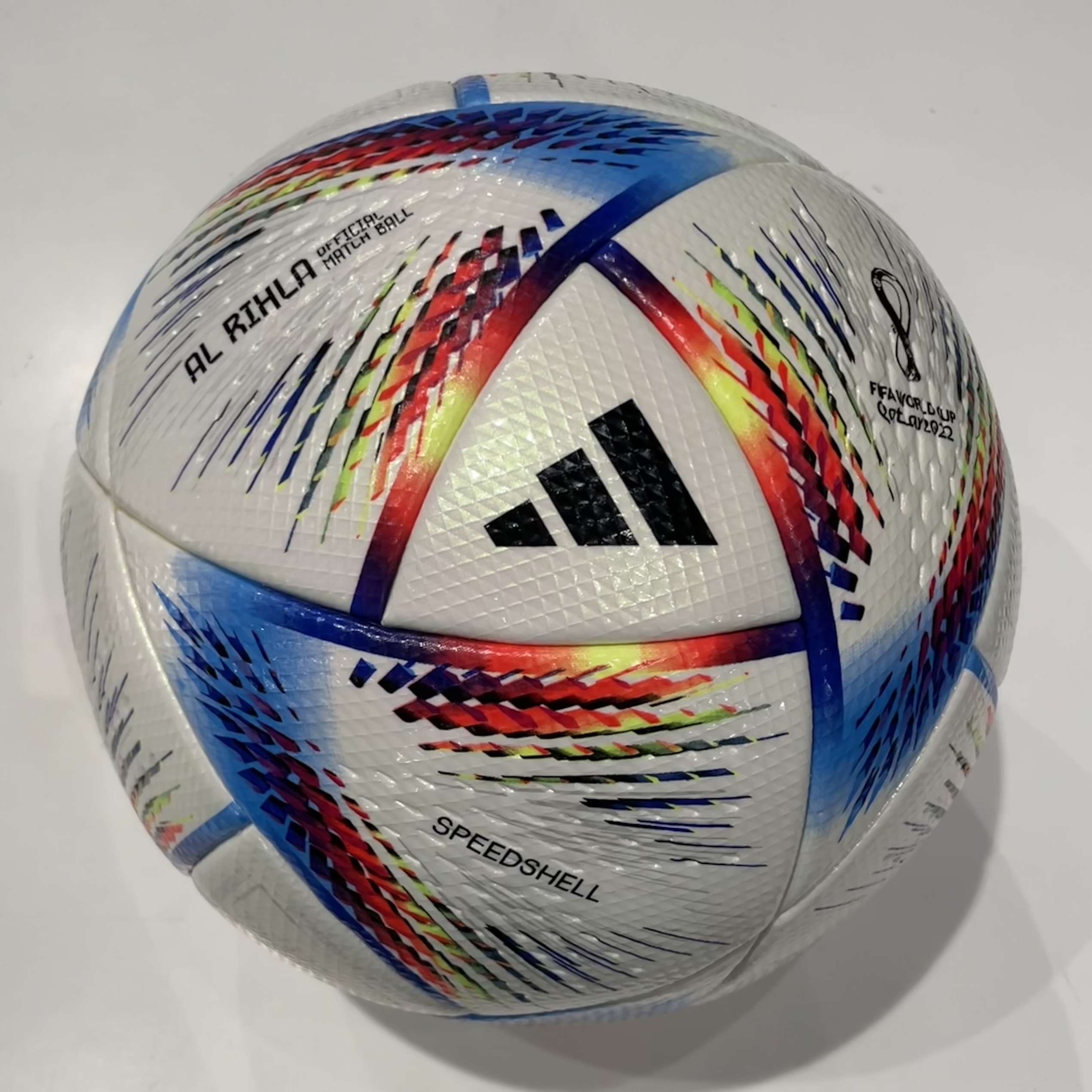
Photo: HyperionLEO / Wikimedia Commons / CC BY-SA 4.0
.jpg)
The current phase of World Cup ball history is defined by three converging trends: data integration, environmental responsibility, and advanced aerodynamics. The ball is no longer just a playing tool; it’s a data hub and a statement. The 2018 Telstar 18 was a nostalgic tribute but included an embedded NFC chip. Fans could tap their phones to the ball to access exclusive content, a gimmick that pointed toward a more connected future.
The 2022 Al Rihla (“The Journey”) made the data core functional. Its Connected Ball Technology housed a 500Hz sensor in the center. This sensor transmitted precise ball movement data to video match officials in real time, aiding the semi-automated offside technology. The ball also used water-based glues and inks, a first for a tournament ball. Sustainability entered the spec sheet.
Now, the 2026 Trionda is set to push further. Its name blends “tri” (three, for the host nations) and “onda” (wave). The four-panel design is the fewest in men’s World Cup history. According to aerodynamic tests cited in The Conversation’s expert analysis, this makes the ball “effectively rougher.” It will reach its “drag crisis”—the speed at which airflow transitions from smooth to turbulent—at a lower speed (around 27 mph) than its predecessors.
Common mistake: Comparing balls only by panel count — a lower count doesn’t automatically mean better. The Jabulani’s 8 panels created a knuckling nightmare because the surface was too smooth. The Trionda’s 4 panels are designed with specific surface texture and seam geometry to control the turbulence, not cause chaos.
What does “effectively rougher” mean for a player? It suggests the Trionda will maintain a more stable flight path through the air, with less sudden, unpredictable deviation. For a striker, that could mean more consistent dip on long-range shots. For a goalkeeper, it promises a more readable trajectory. The internal sensor unit is also housed in a specially created layer within one panel, with counterbalancing weights in others to maintain perfect equilibrium. This attention to balanced mass distribution is a silent but critical upgrade from earlier sensor prototypes.
The progression of modern soccer ball construction is a story of layers. We have moved from a simple leather casing and latex bladder to a complex system: a textured polyurethane outer cover for grip and durability, a reinforced backing layer for shape retention, a woven polyester or cotton lining for structure, and finally, a latex or butyl rubber bladder for air retention. This layered approach is what allows for the integration of technology without sacrificing the essential feel of a match-grade football.
TL;DR: Today’s balls are data collection platforms (Al Rihla) built with sustainable practices and engineered for specific aerodynamic behaviors (Trionda), moving far beyond their basic sporting function.
Iconic Balls and Infamous Flops: A Player’s Perspective
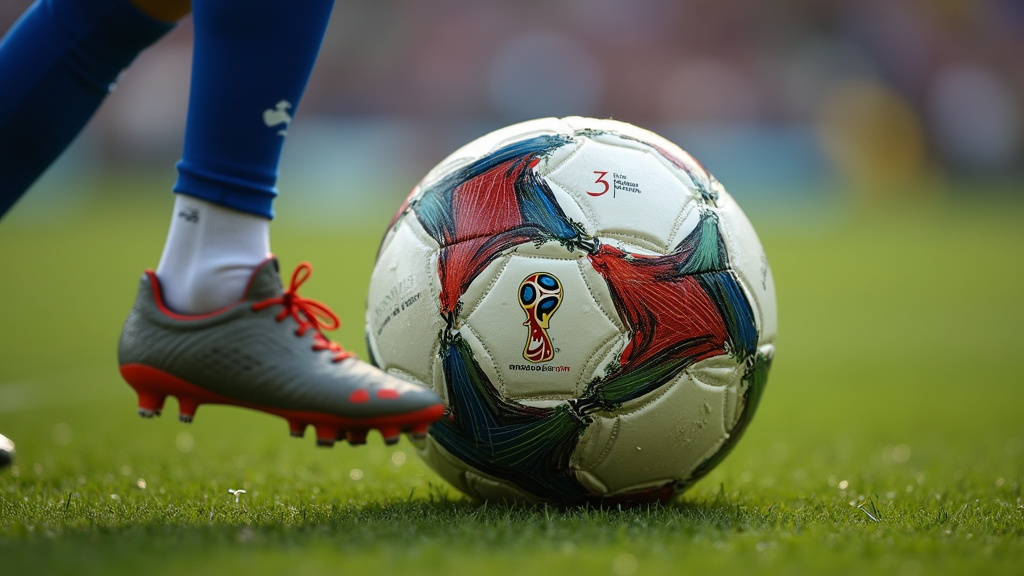
Every fan has a favorite. The nostalgia for the 1970 Telstar or the 1990 Etrusco is powerful. But which balls actually worked? Player feedback over the decades paints a clearer picture of success and failure. The 1986 Azteca and the 2014 Brazuca are consistently praised for their predictability and true flight. The Brazuca, with its six thermally bonded panels and deep seams, was a direct response to the Jabulani debacle. Players called it “perfect” and “predictable.” It behaved as expected, which is the highest compliment a ball can receive.
The Jabulani, of course, sits alone in the hall of infamy. The player revolt was universal. Brazil’s Julio Cesar compared it to a supermarket ball. Spain’s Iker Casillas and Italy’s Gianluigi Buffon were openly critical. The problem was physics. Its smooth surface lacked the necessary seams to trip airflow and stabilize flight at medium speeds. The result was a ball that would suddenly and violently swerve, making long passes and shots a lottery.
Between these extremes are the interesting cases. The 2006 Teamgeist was revolutionary but took adjustment. Its seamless, round surface offered less grip for bending shots initially. The 2002 Fevernova was considered too light and floaty, especially for goalkeepers. This variance highlights a key tension: the quest for a perfectly round, consistent ball can sometimes strip away the tactile and aerodynamic characteristics that skilled players exploit.
The discussion around official ball pressure and proper ball inflation is part of this performance equation. While FIFA mandates a pressure between 8.5 and 15.6 PSI (0.6 to 1.1 bar), teams often have preferences within that range. A harder ball travels faster and bounces more, while a slightly softer ball can be easier to control and strike. Modern ball PSI guidelines are strict, but within them, small adjustments can suit a team’s style.
| Ball Model | Player Verdict | Primary Reason |
|---|---|---|
| Brazuca (2014) | Universally Praised | Stable, predictable flight; deep seams provided consistent aerodynamics. |
| Jabulani (2010) | Universally Panned | Unpredictable knuckling; smooth surface caused violent, late swerves. |
| Teamgeist (2006) | Respectful Acceptance | Very round and consistent, but required adjustment for bending techniques. |
| Fevernova (2002) | Mixed (GK negative) | Lightweight; great for outfield swerve but difficult for goalkeepers to judge. |
Understanding this history of historical ball designs is why resources that attempt to rank them, like our guide on every World Cup ball ranked, must weigh both technological achievement and on-pitch reception. The best ball is the one that disappears, becoming a perfect extension of player intention.
The 2026 Trionda: What the Future Holds
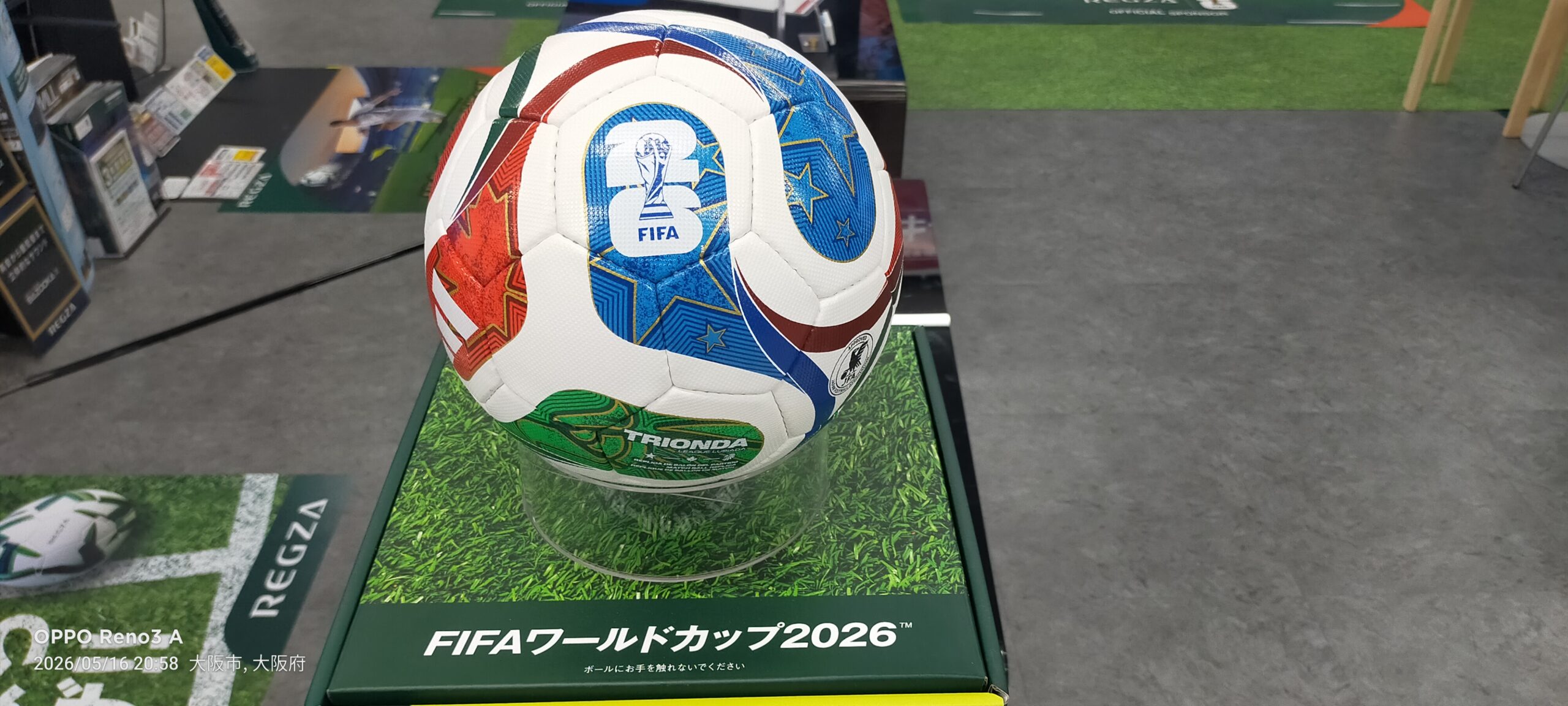
Photo: Mr.ちゅらさん / Wikimedia Commons / CC BY-SA 3.0

The 2026 World Cup ball has been unveiled, and the Trionda official ball represents the next logical step. Its four-panel design is not just an aesthetic choice; it’s the culmination of lessons learned from the Jabulani. The panels are larger, but the seam geometry and surface texture are engineered to trip airflow at the right moment, creating that “effectively rougher” profile that promises stability. The graphics incorporate maple leaves, an eagle, and stars for the host nations.
The integrated technology is more sophisticated. The sensor package is no longer an add-on but is built into a dedicated layer. The counterbalancing weights in opposite panels are a detail that shows how seriously Adidas takes the ball’s equilibrium. A off-center sensor mass would affect roll and spin. They have solved for that.
From a fan’s perspective, the latest World Cup ball technology means more accurate officiating and, potentially, new forms of engagement. From a player’s perspective, it means another period of adaptation. Early reports and tests suggest the Trionda will be fast, stable, and responsive—a return to the Brazuca’s philosophy but with even greater geometric purity. Its performance will be a major storyline in North America.
For those interested in the specifics of how such a ball is built, the evolution of ball material layers is key. The shift from stitched leather to thermally bonded polyurethane is what enables these bold, few-panel designs. Without that strong, flexible, waterproof synthetic layer, a four-panel ball would be impossible. This is also why proper ball storage and maintaining ball shape are more critical than ever; these high-tech laminates can be permanently deformed by heat or improper pressure.
Frequently Asked Questions
What was the first official World Cup ball?
The first ball supplied under a single, official supplier agreement was the Adidas Telstar in 1970. Before that, from 1930 to 1966, host nations provided their own balls, leading to no consistent “official” model.
Why was the 2010 Jabulani ball so hated?
The Jabulani had only 8 panels, creating an overly smooth surface. Aerodynamically, this caused an unpredictable “knuckling” effect, where the ball would move violently in the air without spin, making it extremely difficult for players, especially goalkeepers, to judge its flight path.
What is the chip inside the modern World Cup ball?
Since the 2018 Telstar 18 (NFC chip for fans) and more robustly in the 2022 Al Rihla, World Cup balls have contained an internal sensor. The Al Rihla’s “Connected Ball Technology” sensor transmits precise ball movement data 500 times per second to aid the semi-automated offside system used by VAR.
How has the World Cup ball changed over time?
It has evolved from heavy, water-absorbing leather balls (1930-1982) to lightweight, consistent synthetic balls (1986-present). The design shifted from many panels (32) to fewer (14, 8, 6, now 4) for a rounder shape, and the role has expanded from a simple tool to a data-collecting device integrated with officiating technology.
What is special about the 2026 Trionda ball?
The Trionda will have the fewest panels (4) in men’s World Cup history. Its design is aerodynamically “rougher” for stable flight, and it features a fully integrated sensor unit balanced with counterweights. Its graphics and name (“tri” + “onda”) honor the three host nations: Canada, Mexico, and the USA.
The Bottom Line
The World Cup ball’s history is a mirror of the game itself. It reflects the move from amateurish inconsistency to hyper-professional standardization, from natural materials to space-age synthetics, and from a simple sphere to a smart object. The early chaos of the 1930 final feels alien today because Adidas’s era imposed order. The Jabulani’s failure taught everyone that player feel matters as much as wind-tunnel data.
Now, we are in an age where the ball talks to the officials. The 2026 Trionda, with its four-panel audacity, is the next chapter. It promises aerodynamic stability and technological integration. Its success will be judged not by lab tests, but by whether it disappears during the tournament, allowing the world’s best players to perform without a second thought. That has always been the ultimate goal: to create the perfect, invisible stage for their skill. For a definitive comprehensive World Cup ball catalog, the Wikipedia list of World Cup balls remains the most detailed chronological resource, while outlets like ESPN provide ongoing analysis, such as their recent ESPN story on ball evolution for the Trionda unveiling.

I come from the “soccer heart” of Germany, the Ruhrpott. I have played, trained and followed soccer all my life and am a big fan of FC Schalke 04. I also enjoy following international soccer extensively.