What is Pressing in Soccer Tactics? The Complete Guide
This post contains affiliate links. As an Amazon Associate, we earn from qualifying purchases.
Pressing in soccer is a coordinated team tactic to win the ball back by applying collective pressure on an opponent in possession. It’s triggered by specific events, like a poor touch or a backward pass, and executed as a unit to force turnovers, often in dangerous areas of the pitch. This is distinct from one player simply “closing down.”
Most people think pressing is about fitness and hustle. They see a forward sprinting at a defender and call it a press. That’s the mistake. Real pressing is a choreographed system of triggers, traps, and collective movement. It’s a mental game disguised as a physical one. A team pressing without a plan is just a team running out of position.
This guide breaks down the systems, the history, and the coaching reality. You’ll learn the difference between a high press and a low block, why gegenpressing changed the game, and how to spot a pressing trap before it springs.
Key Takeaways
- Pressing is a collective, triggered system, not random chasing. The whole team moves on cues like a backward pass or a heavy touch.
- Gegenpressing (counter-pressing) is the immediate attempt to win the ball back within 3–8 seconds of losing it. It exploits the opponent’s momentary disorganization.
- No team can press high for 90 minutes. The physical demand is immense. Even Jürgen Klopp’s Liverpool uses a mid-block for sustained periods to manage energy.
- Effective pressing requires “rest defence”, players positioned to cover long balls if the press is broken. Without it, a failed press leads to a guaranteed counter-attack.
- Youth coaching often prioritizes athleticism over tactical intelligence for pressing. This creates players who run hard but press at the wrong time, breaking the team’s shape.
What Pressing Is (And What It Definitely Isn’t)
Forget the image of a lone striker sprinting aimlessly. That’s closing down, and it’s mostly useless. Pressing is the opposite of individual effort. It’s the entire team shifting, cutting angles, and squeezing space based on a pre-agreed signal. The moment that signal, a trigger, happens, ten players react as one.
The aim isn’t just to tackle. It’s to force a mistake in a valuable area. Winning the ball near the opponent’s goal creates a high-quality chance. According to analytics, a possession regained in the final third has a significantly higher expected goals (xG) value than one won in your own half. The secondary aim is psychological: to deny the opponent their preferred rhythm, making them rush and panic.
A coordinated press involves the nearest player engaging the ball-carrier, adjacent players marking immediate passing options, and the rest of the team shifting to block longer passes. This creates a local overload, forcing a turnover or a long, hopeful ball.
Common mistake: Telling your team to “press more” without defining triggers. The result is exhausted players chasing shadows, huge gaps opening between lines, and easy through-balls for the opponent. You’ll be 2-0 down by halftime.
I learned this coaching a youth team. We had the fittest kids in the league. I’d shout “press!” and they’d all charge. For ten minutes, we were unstoppable. Then the other coach told his keeper to roll it to a calm center-back. Our entire team surged forward, the defender lofted one ball over the top, and their quick striker scored three times in twenty minutes. We were fit, but we were dumb. Pressing without a trigger is just organized suicide.
TL;DR: Pressing is a triggered, collective system to win the ball in dangerous areas. Indiscriminate chasing is not pressing, it’s a fast way to lose.
The 4 Core Pressing Systems: From High Press to Low Block
Where your team chooses to engage the opponent defines the system. Each has a different risk profile, physical cost, and strategic goal. The choice between them often decides a match.
High Press: The Anfield Blueprint
The defensive line pushes up, sometimes into the opponent’s half. Forwards press the goalkeeper and center-backs, aiming to win the ball within three passes of the goal. It’s aggressive, intimidating, and energy-intensive.
Teams like Liverpool under Klopp and Bayern Munich use this to suffocate build-up play. The risk is the space in behind your high line. If the press is broken with one pass, your goalkeeper is in a one-on-one duel. This system demands extremely fast defenders and a sweeper-keeper.
Common mistake: Implementing a high press with slow center-backs. The first time a ball goes over the top, you’re beaten for pace and conceding. Your press is only as good as your recovery speed.
Gegenpressing: The 5-Second Rule
This isn’t a location, it’s a reaction. The moment your team loses possession, the nearest 2–3 players immediately swarm the ball-winner. The goal is to recover the ball within 3–8 seconds, before the opponent can lift their head and pick a pass.
Jürgen Klopp’s “heavy metal football” at Borussia Dortmund popularized it, but the principle is older. It works because players are most vulnerable immediately after gaining possession, their body shape is often turned, and their passing options aren’t yet sorted. A successful gegenpress leads to a transition chance against an unset defense. The non-negotiable requirement is rest defence. If those first players don’t win it, others must be positioned to snuff out the counter.
Mid-Block: The Patient Controller
The team defends in a compact shape between the halfway line and their own penalty area. They allow the opponent to have the ball in their own half, but the moment it crosses into the midfield zone, the press engages. It’s less physically draining than a high press and less risky than a low block.
Chelsea under Thomas Tuchel often used a disciplined mid-block. It forces the opponent to play through crowded central areas, leading to sideways passes and low-probability crosses. It’s a system for teams that are comfortable without the ball and confident in their defensive organization.
Low Block: The Deep Fortress
The team retreats into their own final third, forming two deep, narrow banks of four. Pressing is minimal, only if an opponent dwells on the ball in a very dangerous area. The priority is to block shots and crosses, defend the penalty box, and strike on the counter.
Atletico Madrid under Diego Simeone are the modern masters. It requires immense concentration, discipline, and resilience. The trade-off is you concede possession and territory, inviting pressure. It’s a mentally taxing system that punishes any lapse.
| System | Engagement Zone | Primary Goal | Key Risk | Physical Demand |
|---|---|---|---|---|
| High Press | Opponent’s defensive third | Win ball near goal for immediate chance | Exposed space behind high line | Extremely High |
| Gegenpress | Immediately after losing possession | Win ball back before opponent organizes | Requires perfect “rest defence” | Very High (bursts) |
| Mid-Block | Middle third of the pitch | Force mistakes in crowded areas | Can be bypassed by quick switches of play | Moderate |
| Low Block | Own defensive third | Defend penalty box, counter-attack | Sustained pressure leads to fatigue errors | Low (but high mental strain) |
TL;DR: Choose your press based on your players’ fitness and your opponent’s weakness. High press for intensity, gegenpress for transitions, mid-block for control, low block for resilience.
The Mechanics: Triggers, Traps, and the Science of PPDA

Pressing looks chaotic from the stands. From the tactical camera, it’s a sequence of if-then statements.
Triggers are the “if.” They are the specific cues that tell the team to launch the coordinated press. Common triggers include:
* A backward pass, especially to the goalkeeper or a center-back under pressure.
* A heavy or loose touch by an opponent.
* A player receiving the ball with their back to goal.
* The ball entering a pre-designated zone (e.g., the touchline, or a “triggering” midfield area).
* A specific opponent receiving possession (targeting a weak passer).
When you see Liverpool’s forward line suddenly jump into action, they’ve seen a trigger, usually a slow, square pass between defenders.
Pressing Traps are deliberate setups. A team might appear to leave a passing lane open, inviting the opponent to play into a specific area where they are outnumbered. For example, a team might channel play toward the touchline, where the sideline acts as an extra defender, making it easier to trap the ball-carrier. Marcelo Bielsa’s teams are famous for these orchestrated traps.
I won’t run a pressing trap with young players until they master basic compactness. The trap requires the discipline to hold a shape that looks vulnerable. A kid who dives in early ruins the whole setup and gifts a goal. Found that out the hard way in an under-15 tournament.
The intensity of a team’s press is now measured objectively. The most common metric is PPDA (Passes Per Defensive Action). It counts how many passes an opponent completes in your defensive half before you make a defensive action (tackle, interception, foul). A lower PPDA means a more aggressive press. A team like FC Barcelona under Pep Guardiola might allow a PPDA of 6 or 7, while a deep-lying team might have a PPDA over 15. This number tells you the story before a shot is even taken.
TL;DR: Pressing is triggered by specific cues and can involve deliberate traps. The PPDA metric quantifies its intensity.
How to Coach Pressing (And the One Drill You Should Start With)
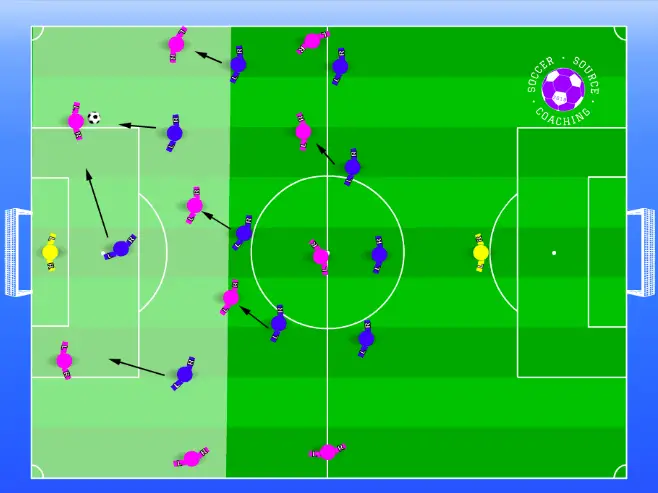
You can’t coach pressing by yelling “work harder.” You build it layer by layer, starting with the simplest concept.
Start with the 5-Second Rule. In a small-sided game (4v4 or 5v5), the rule is simple: if you lose the ball, you must try to win it back within five seconds. Don’t talk about shape or lanes yet. Just create the habit of immediate reaction. This builds the foundation for gegenpressing.
Next, introduce trigger recognition. Use a conditioned game. Tell your players the only trigger is a backward pass. Whenever an opponent passes backwards, the whole team must shout “PRESS!” and apply coordinated pressure for three seconds. Freeze play frequently. Point out who moved well and who broke the shape.
The first full-team drill should focus on compactness. Set up your 11v11 shape and have the opponent’s keeper start with the ball. Your team’s job isn’t to win it, but to move as a connected block up, down, and across the pitch, keeping the distance between defense, midfield, and attack at no more than 30–35 meters. If a gap opens, blow the whistle and reset. This is boring, grueling work. It’s also non-negotiable. A press in a disconnected shape is worthless.
Before you start: Pressing drills are high-intensity. Ensure players are properly warmed up to prevent hamstring strains. Always have a clear “reset” whistle to prevent collisions when players are fatigued and tackling late. Hydration is critical, dehydration leads to late decisions and injuries.
Here are the non-negotiable coaching points for any pressing session:
1. Communication is mandatory. The player who sees the trigger must yell.
2. The first defender’s job is to delay, not win the ball. Force the attacker in the direction you want.
3. Covering shadows. Players must position themselves to block the most dangerous forward pass, even if no opponent is there yet.
4. The chain reaction. If one player presses, the next must cover, and the next must balance. Drill this movement until it’s automatic.
TL;DR: Start with the 5-second reaction habit, then add trigger recognition, then drill compactness. Communication and connected movement are more important than aggressive tackling.
The Physical and Mental Trade-Offs
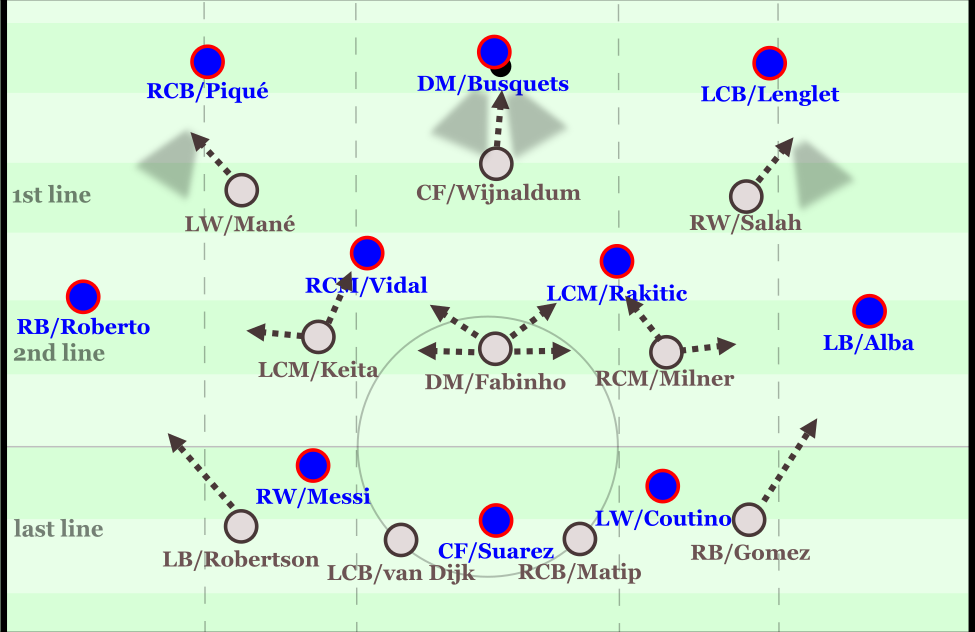
Pressing has a cost. The sport science data is clear: the metabolic load of a high-pressing game is 20–30% higher than a mid-block system. Players cover more distance at high speed. This is why even the fittest teams can’t sustain it for 90 minutes. They pick their moments, often after regaining possession, when the opponent is unbalanced, or in the first 20 minutes of each half.
Fixture congestion kills pressing intensity. A team playing every three days will almost always have a higher PPDA (meaning a weaker press) in their third game of the week. The legs are gone. The decision-making slows. This is a tangible, physical constraint on the tactic.
Mentally, pressing is exhausting. It requires constant concentration to watch for triggers and maintain shape. A single player switching off, a midfielder ball-watching for two seconds, creates a passing lane that breaks the entire system. The psychological demand is why the best pressing teams have strong leadership and communication on the pitch.
The evolution of player profiles is direct. The era of pressing has devalued the purely technical, static playmaker. It has increased the value of the “two-way midfielder” who can win the ball and pass it, and the “inverted full-back” who tucks into midfield to add numbers in the press. Scouts now look for a player’s “pressing resistance”, their ability to receive the ball under pressure and retain it, as a top-tier attribute.
TL;DR: Pressing is physically unsustainable for a full match and mentally draining. It has directly changed the type of players managers buy and develop.
Frequently Asked Questions
What’s the difference between pressing and gegenpressing?
Pressing is the broader category of coordinated defensive pressure. Gegenpressing is a specific, hyper-aggressive subset: the immediate press applied in the 3–8 seconds after your team has just lost possession. All gegenpressing is pressing, but not all pressing is gegenpressing.
Can a team press for 90 minutes?
No. The physical output required is impossible to maintain. Top teams use a high press in bursts, often for 20-30 minute periods, before settling into a more sustainable mid-block to recover and control space. The data shows pressing intensity drops significantly in the final 15 minutes of matches.
What is a “pressing trigger” in simple terms?
It’s a specific event that tells the whole team to start pressing at the same time. The most common ones are a bad touch by an opponent, a pass backwards towards their own goal, or the ball going to a player who is known to be a weak passer. It’s the cue for synchronized action.
Why is pressing so popular now?
The rules, the balls, and the pitches favor it. The modern ball is lighter and moves faster, making long passes harder to control. Pitches are immaculate, allowing for precise passing. The offside rule encourages higher defensive lines. Together, this makes winning the ball high up the pitch more effective and less risky than it was 30 years ago. Tactical evolution, led by coaches like Klopp and Guardiola, has proven its success.
How do you beat a high-pressing team?
You need players with composure and technical security under pressure (“pressing resistance”). The key is to use the goalkeeper as an extra passer to create numerical superiority, make quick one-touch passes to move the ball before the press arrives, and occasionally play direct, over-the-top passes into the space behind the high defensive line. Bravery in possession is non-negotiable.
Is pressing more important than possession?
They are two sides of the same strategic coin. The ultimate goal is to control the game. High possession does this by keeping the ball. Effective pressing does this by winning it back quickly and in good areas. The best modern teams, like Manchester City, excel at both: they press aggressively to win possession, then keep it to exhaust and control their opponent.
Before You Go
Pressing transformed from a hard-working ethic into the dominant tactical framework of modern soccer. It’s a system of collective intelligence, not just collective fitness. Understanding it means watching for the triggers, not just the tackles.
Remember the trade-offs. The high press creates chances but leaves you exposed. The gegenpress requires perfect synchronization. The low block demands unbreakable concentration. There is no perfect system, only the right one for your players and this specific opponent.
The next time you watch a match, don’t just watch the player with the ball. Watch the other ten. Their movement tells you the real story. Are they waiting for a trigger? Are they setting a trap? That’s where the game is won, long before the shot is taken.
I come from the “soccer heart” of Germany, the Ruhrpott. I have played, trained and followed soccer all my life and am a big fan of FC Schalke 04. I also enjoy following international soccer extensively.