High Press vs Low Block: Soccer’s Tactical Chess Match
To choose between a high press and a low block in soccer, assess your team’s fitness and your opponent’s weakest link. Use a high press to force errors near the opponent’s goal if you have the stamina. Use a low block to deny space and counter-attack if you have disciplined defenders. The choice isn’t about which is better, but which tool fits the specific job.
Most coaches get this wrong because they pick a philosophy and stick to it regardless of the opponent. They try to press a team that loves the long ball over the top, or they sit deep against a side that can’t defend set-pieces. It’s like bringing a hammer to a job that needs a screwdriver.
This guide breaks down the mechanics, the mentalities, and the matchups. You’ll learn why Liverpool under Klopp can’t play like Atletico under Simeone, and how to read the game to know when to switch gears.
Key Takeaways
- High press is a proactive gamble that trades defensive security for attacking chaos, creating chances with an average xG of 0.171 from final-third turnovers (per FIFA data).
- Low block is a reactive fortress that trades possession and attacking initiative for defensive solidity, forcing opponents into low-percentage crosses and long shots.
- The core physical difference is energy expenditure. A high press requires a squad capable of sustained, intense running; a low block demands less overall distance but perfect positional discipline.
- Player profile is destiny. You cannot implement a high press without forwards who relish defensive work, or a low block without center-backs who thrive in aerial duels.
- Modern elite teams rarely use one system exclusively. They blend phases, often starting with a high press to seek an early goal before dropping into a mid or low block to protect a lead.
The Core Difference: Disruption vs Denial
The high press and the low block are opposing answers to the same question: where do we want to defend? Your answer defines everything.
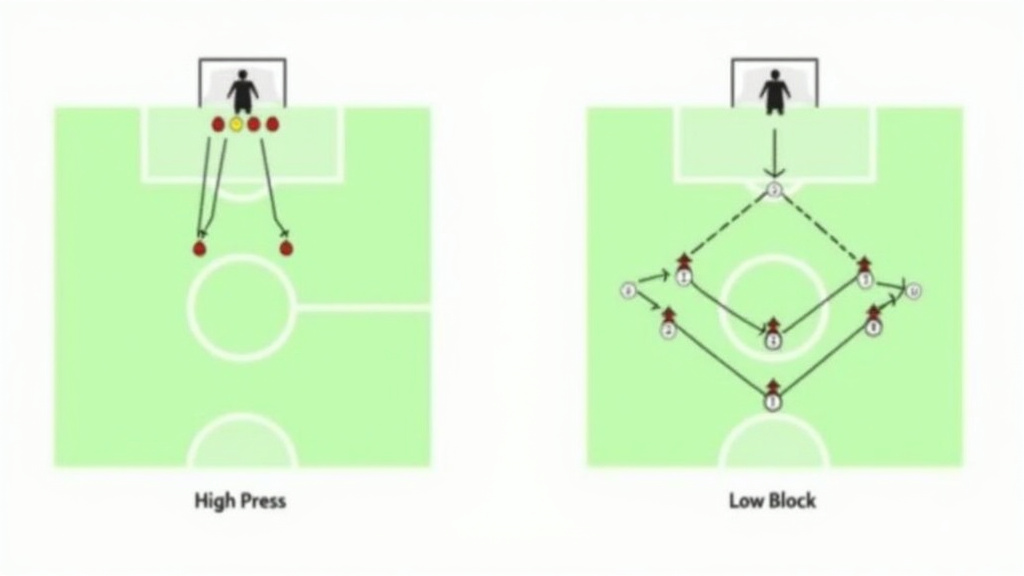
A high press aims to disrupt the opponent’s build-up play as high up the pitch as possible. The defensive line pushes to the halfway line. Forwards become the first line of defense, hunting in packs. The objective is to force a mistake, a bad touch, a panicked pass, within 40 yards of the opponent’s goal. Win it there, and you’re in.
The high press is a coordinated defensive action initiated in the opponent’s half, triggered by specific cues like a backward pass or a reception under pressure. Its success hinges on compactness between lines and synchronized player movement to block central passing lanes, trapping the ball in wide areas.
A low block aims to deny the opponent any dangerous space, full stop. The defensive line retreats to within 25–30 yards of its own goal. The entire team condenses into a narrow, deep unit, surrendering territory willingly. The objective is to funnel the attack into crowded areas, where the only options are a hopeful cross or a low-percentage shot from distance.
TL;DR: High press defends near the opponent’s goal to create chances. Low block defends near your own goal to prevent them.
How the High Press Actually Works (It’s Not Just Running)
The high press looks like frantic energy. It feels like organized chaos. But it operates on strict, intelligent rules. It’s a trap, not a chase.
The system starts with a high defensive line. This shortens the distance your midfield and attack need to cover to apply pressure. Everyone moves up as one unit. The moment the trigger appears, the opponent’s center-back receives a pass with his back to play, or the goalkeeper rolls it to a full-back, the nearest forward pounces.
That forward’s run is the signal. His job isn’t to win the ball alone. It’s to angle his press to cut off the most obvious passing lane, usually back inside. This “herds” the ball carrier towards the touchline or into a teammate who is already stepping up to intercept. You’re not pressing the man. You’re pressing the passing option he wants.
The most punishing form of this is gegenpressing, or counter-pressing. This is the immediate, ferocious reaction the moment your team loses possession. The idea is to win the ball back within five seconds, before the opponent can organize their own attack. It turns a defensive transition into an attacking opportunity instantly. It’s the hallmark of Jürgen Klopp’s Liverpool and a key component of many modern pressing systems.
Common mistake: Telling every player to press all the time, this stretches your shape into useless individual efforts. The press must be a synchronized unit response to a predefined trigger, or you’ll get played through.
The energy cost is brutal. FIFA’s analysis of the 2025 Club World Cup showed a 5% increase in high-press time compared to the 2022 World Cup. Teams are committing to it. But by the 70th minute, if the press hasn’t yielded a goal, you’ll see gaps. Players are half a yard slower to the trigger. That’s when you get killed on the counter.
The Low Block: Organized Suffering
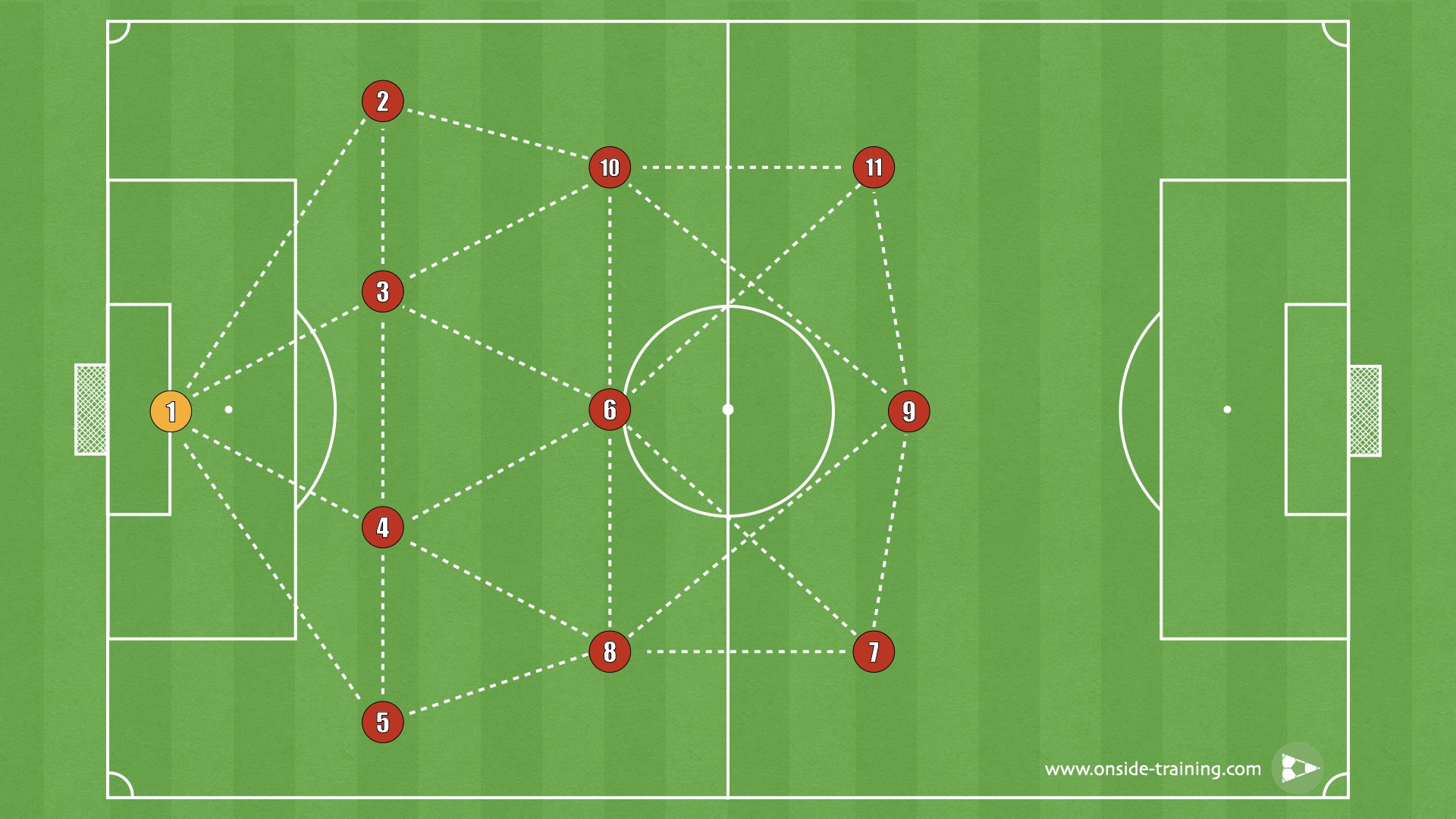
A low block is often called “parking the bus.” That’s lazy. It’s not passive. It’s a highly active, mentally exhausting form of collective problem-solving. Every player is a moving piece in a defensive puzzle that must not break for 90 minutes.
The first principle is ultra-compactness. The distance between your forward line and your defensive line might be only 30 yards. This eliminates the vertical space for through balls. The second principle is horizontal narrowness. You force the play out wide, into the corridors. You’re saying, “Go on, try to cross it into a box where we have eight defenders against your three attackers.”
| Aspect | High Press | Low Block |
|---|---|---|
| Defensive Line Height | Near the halfway line | Inside own penalty area (25-30 yards from goal) |
| Primary Objective | Win ball high to create immediate chances | Deny space, force low-percentage attacks |
| Energy Demand | Extremely high (sustained sprinting) | Moderate (focused on positioning/shifting) |
| Key Player Profile | High-stamina forward, aggressive midfielder | Aerially dominant CB, disciplined shield (DM) |
| Best Against | Teams weak in build-up from the back | Teams reliant on intricate passing in final third |
| Biggest Risk | Beaten by one long ball over the top | Conceding from set-pieces or sustained pressure |
Your defensive midfielder becomes the most important player on the pitch. He’s the shield, constantly adjusting his position to plug any gap that appears between the lines. This defensive midfield role is less about tackling and more about intelligent positioning. The system is a direct descendant of the old catenaccio style, which used a sweeper position as the ultimate safety net. Today’s low block uses zonal marking, but the sweeper’s spirit, a dedicated defender covering behind the line, lives on.
The psychological strain is different from the high press. It’s a test of concentration, not cardio. One player dozing off for a second, one failed communication on who picks up a runner, and the entire structure collapses. You spend the whole game absorbing punches. The crowd groans with every back-pass. It feels like you’re losing, even when you’re not.
Who Uses What (And Why)

Managers don’t choose these tactics at random. They build their entire squad to execute one as a primary identity, then adapt within games.
The high press is the weapon of the aggressor. Pep Guardiola’s Manchester City and Jürgen Klopp’s Liverpool are the modern blueprints. Guardiola’s press is about control, winning the ball back to restart his possession machine. Klopp’s is about chaos, winning the ball back to launch a hurricane counter-attack. Both require unbelievable squad fitness and players bought specifically for their engine and intelligence. You can’t teach an old-school target man to press.
The low block is the tool of the pragmatist. Diego Simeone’s Atletico Madrid is the masterclass. Simeone turns defending into an art form and a point of pride. Jose Mourinho’s greatest teams, like his Inter Milan side that won the treble, were built on a rock-solid low block that could flip into a devastating counter-attack in three passes. These managers prioritize warriors, players who embrace the grind and find victory in a 1-0 win.
Most teams, however, live in the middle. They use a high press for the first 20 minutes to try and grab an early goal. If they get it, they often drop into a mid or low block to protect the lead. This hybrid approach is the reality of modern football. According to Sky Sports data, Liverpool faced a low block in 26% of their build-up phases last season, the most in the Premier League. Even the best pressing teams must regularly solve the deep-lying puzzle.
The Player Profile Divide
You cannot force a square peg into a round hole. The wrong personnel will doom either system.
To run a high press, you need:
- A goalkeeper who plays as a sweeper. He must be comfortable 30 yards off his line to deal with the long balls over the top.
- Center-backs with recovery speed. They play a high line, so when the press is bypassed, they need pace to chase.
- Midfielders with endless engines and anticipation. They cover immense ground and must read the game to intercept.
- Forwards who defend. Their work rate is non-negotiable. If your striker doesn’t press, the entire system fails.
To run a low block, you need:
- A goalkeeper strong on crosses. He’ll face a barrage of aerial balls into the box.
- Center-backs who are aerial dominators. Winning every header is critical.
- A disciplined defensive midfield shield. This player’s positioning is more valuable than his tackling stats.
- Wingers who track back. They become auxiliary full-backs for most of the game.
- A lone forward who can hold the ball. He is the lone outlet to relieve pressure and start counters.
Trying to implement a high press with slow defenders and a stationary striker is suicide. Deploying a low block with small, technical center-backs who hate heading is just as bad. Your soccer tactics guide must start with an honest assessment of the players you have, not the ones you wish you had.
Making the Choice: A Tactical Decision Tree
So, do you press high or sit deep? Don’t guess. Follow a process.
- Look at the fixture list and table. Are you the favorite or the underdog? Away at the league leaders with a depleted squad? That’s a low-block game. At home against a relegation-threatened side you need to beat? That’s a high-press game.
- Analyze the opponent’s goalkeeper and center-backs. Are they shaky with the ball at their feet? Do they panic under pressure? If yes, pressing high is your shortest path to a turnover. If they are comfortable or excel at long diagonals, pressing is a high-risk strategy.
- Check your own squad’s fatigue levels. A high press is the most physically demanding team’s style of play. If you’re playing your third game in seven days, do you have the legs for it? If not, a more conservative, energy-efficient low block might be the pragmatic choice.
- What is the game state? This is the most dynamic factor. You might start with a high press. If you score early, transitioning to a more compact mid-block makes sense to control the game. If you concede early, you may have to abandon a low block and commit more men forward, changing your entire formation organization.
I tried to impose a high press with a semi-professional team in the German lower leagues. We trained it for a month. In our first match, we were brilliant for 25 minutes, creating three chances. Then we ran out of gas. By halftime, we were 2-0 down from two simple balls over the top. We didn’t have the elite fitness the tactic demands. We learned the hard way that the tactic must fit the athletes.
Frequently Asked Questions
Which formation is best for a high press?
The 4-3-3 is the gold standard. It provides natural width from the wingers to press the opponent’s full-backs, a compact three-man midfield to control the center, and a central striker to lead the press. The 3-4-3 is also highly effective, as it adds an extra center-back to cover the space behind the high defensive line.
Can a low-block team actually win a league?
Absolutely. Diego Simeone’s Atletico Madrid has won La Liga twice against Barcelona and Real Madrid, and Jose Mourinho’s Chelsea and Inter Milan won titles with a low-block foundation. It wins by being relentlessly efficient, not always dominant. It requires extreme mental fortitude from every player.
What is PPDA?
PPDA stands for Passes Per Defensive Action. It’s a key metric for measuring pressing intensity. It counts how many passes the opponent makes in their own half before your team makes a defensive action (tackle, interception, foul). A lower PPDA (e.g., 8) indicates a more aggressive, high-pressing team. A higher PPDA (e.g., 15) suggests a more passive, deeper defensive block.
Is a mid-block just a compromise?
Not at all. A mid-block is a distinct, intelligent tactic. You defend in the middle third of the pitch, allowing the opponent to have the ball in their own half but springing a press when they cross the halfway line. It’s less physically taxing than a high press and more proactive than a low block. It’s a great option for balanced teams.
Why do teams struggle to break down a low block?
Because it removes the space they need to play their game. Creative players like midfield playmakers have no room to turn. Fast wingers have no space to run into. The attacking team is forced into sideways passes, eventually hitting hopeful crosses into a crowded box, exactly what the defending team wants. It requires patience, width, and often a moment of individual brilliance.
How do you beat a high press?
You bypass it. The most direct method is the accurate long ball from the goalkeeper or center-back over the pressing forwards and midfield, targeting a physical striker or a fast winger. You can also use quick, one-touch combinations (give-and-gos) in tight spaces to play through the press, but this requires exceptional technical skill and composure under pressure.
The Bottom Line
The debate between high press and low block isn’t about which is superior. It’s about context. The high press is a glittering sword, aggressive, dazzling, and lethal when it strikes, but it leaves you exposed. The low block is a weathered shield, unyielding, resilient, and often unappreciated until it saves the day.
The best coaches in the world, from Guardiola to Simeone, understand this. They build a primary identity but are not slaves to it. They read the game, the opponent, and the condition of their own players. They know that the most sophisticated soccer tactics are the ones you can adapt. Your philosophy might be to press, but your survival on a cold night in a tough stadium might depend on your ability to dig in, drop deep, and secure a point. That’s not abandoning your principles. That’s understanding the game.
I come from the “soccer heart” of Germany, the Ruhrpott. I have played, trained and followed soccer all my life and am a big fan of FC Schalke 04. I also enjoy following international soccer extensively.