Erling Haaland’s World Cup Story: How He Led Norway to
Erling Haaland’s career and World Cup story is defined by a single, relentless mission: ending Norway’s 28-year major tournament drought. He achieved it by scoring 16 goals in 8 qualifiers, becoming the top scorer in 2026 World Cup qualifying, and leading Norway to their first World Cup since 1998 with a decisive win over Italy.
Most articles frame this as a simple fairytale. They miss the weight Haaland carried for half a decade before the breakthrough. The pressure wasn’t just to score; it was to single-handedly rewrite a nation’s sporting narrative against a history of near-misses.
This guide walks through the numbers, the pivotal moments, and the quiet leadership that turned Norway from Europe’s also-ran into a World Cup qualifier. We’ll look at his club-record trajectory, the family legacy he’s chasing, and what his presence means for Norway’s chances in a tough 2026 group.
Key Takeaways
- Haaland scored in all 8 of Norway’s 2026 World Cup qualifiers, netting 16 goals total to become the top scorer across all continental qualifying campaigns.
- His 55 goals in 48 caps make him Norway’s all-time top scorer and the fastest player ever to reach 50 international goals (46 games).
- Norway’s 4-1 win over Italy, where Haaland scored twice, secured their first World Cup berth since 1998 and first major tournament since Euro 2000.
- At club level, his 36-goal Premier League record season in 2022-23 and continental treble with Manchester City created a unique pressure to deliver for his country.
- Despite his individual brilliance, Norway faces a monumental task in 2026 World Cup Group I against top-ranked France, Senegal, and Iraq.
The Anatomy of a World Cup Qualification
Norway’s path to the 2026 World Cup wasn’t a gentle stroll. It was an eight-game demolition job led by one man. The qualifying campaign statistics, detailed in a BBC Sport report on Haaland’s World Cup qualifying, tell a story of relentless efficiency.
Haaland’s 16 goals in 8 matches for Norway in 2026 World Cup qualifying made him the top scorer across all continents. He scored at least once in every single qualifier, a consistency that broke the will of opponents like Italy, Israel, and Estonia.
The campaign had a clear turning point. The final matchday against Italy was a straight shootout for the automatic qualification spot. Norway needed to win. The atmosphere in Oslo was tense, a mix of hope and the dread of another near-miss.
Haaland opened the scoring in the 22nd minute, a powerful near-post finish that settled the entire stadium. He added a second just after halftime, a classic run behind the defense followed by a cold, low finish. The 4-1 victory wasn’t just a win; it was a catharsis. For the first time in a generation, Norway was going to a World Cup.
TL;DR: Haaland scored in every qualifier (16 total goals), and his brace against Italy sealed Norway’s first World Cup spot in 28 years.
Why This Qualification Was Different
Previous Norwegian teams had talented individuals. This team had a gravitational force. Haaland’s mere presence on the team sheet changed how opponents set up, often dedicating two defenders to track him. This created space for midfielders like Martin Ødegaard to operate.
The tactical shift was noticeable. Norway played more direct, yes, but with purpose. They leveraged his two greatest weapons: his explosive pace to run in behind and his physical strength to hold up play. It was a simple plan executed with world-class precision.
Common mistake: Comparing Haaland’s qualifying stats to a normal striker’s season — his 16 goals came against international defenses set up specifically to stop him, not mid-table club sides. The degree of difficulty was higher.
| Qualifying Opponent | Haaland’s Contribution | Match Result |
|---|---|---|
| Italy (Home) | 2 goals | 4-1 Win (Qualification Secured) |
| Israel (Away) | 3 goals | 4-2 Win |
| Estonia (Home) | 2 goals | 5-0 Win |
| Moldova (Away) | 1 goal | 2-1 Win |
The numbers are absurd. But they only show the output, not the input. The training ground work, the analysis of defender tendencies, the repeated finishing drills—this is where matches are won before kickoff. His soccer workouts are legendary for their intensity, building the player physique that can withstand 90 minutes of constant grappling.
A Career Built on Goals, From Molde to Manchester
Haaland’s club career is a vertical line on a graph. His trajectory from Molde in Norway to Manchester City via Salzburg and Dortmund is a masterclass in strategic, relentless progression. Each step was a bigger stage, and each time he immediately became the main attraction.
At Red Bull Salzburg, he announced himself to Europe with a hat-trick on his Champions League debut. At Borussia Dortmund, he maintained a goal-per-game ratio in the Bundesliga and became the youngest player to reach 20 Champions League goals. But the move to Manchester City in 2022 for €60 million was the ultimate test.
His first season in England rewrote the record books. He scored 36 goals in the Premier League, a new record for a 38-game season. He hit 52 goals in all competitions, powering City to the Premier League, FA Cup, and their first-ever Champions League title. He won the Golden Boot. The treble was complete.
I remember watching his debut against West Ham. He missed a sitter in the first half. The old narrative about physical Premier League defenders handling him started up. Then he scored two, including a ruthless penalty. The narrative died before halftime. He wasn’t just adapting; he was setting the new standard.
The Physical Prototype
What makes him so effective? Start with the specs. At 6’5″ and 95kg, he possesses a rare combination of size and speed that places him among the tallest players and the fastest footballers in world football. This isn’t just about being big or fast. It’s about how he uses it.
His first touch is often directed into space, using his strength to shield the ball from a defender while his acceleration takes him away. His movement in the box is clinical, not frantic. He finds pockets of space and attacks crosses with a timing that belies his age. This aerial dominance is a primary weapon.
I used to think a pure number nine was outdated. Then Haaland arrived. He doesn’t just occupy defenders; he terrorizes them. You can see the hesitation in a center-back’s eyes when he starts his run. That half-second of doubt is all he needs.
His game is a fascinating study in efficiency. He averages fewer touches per game than most midfielders, but his touches have a devastatingly high conversion rate. He is the ultimate finisher in an era of possession-based football, proving that directness, when executed at this level, is unplayable.
The International Record: Chasing a Father’s Shadow
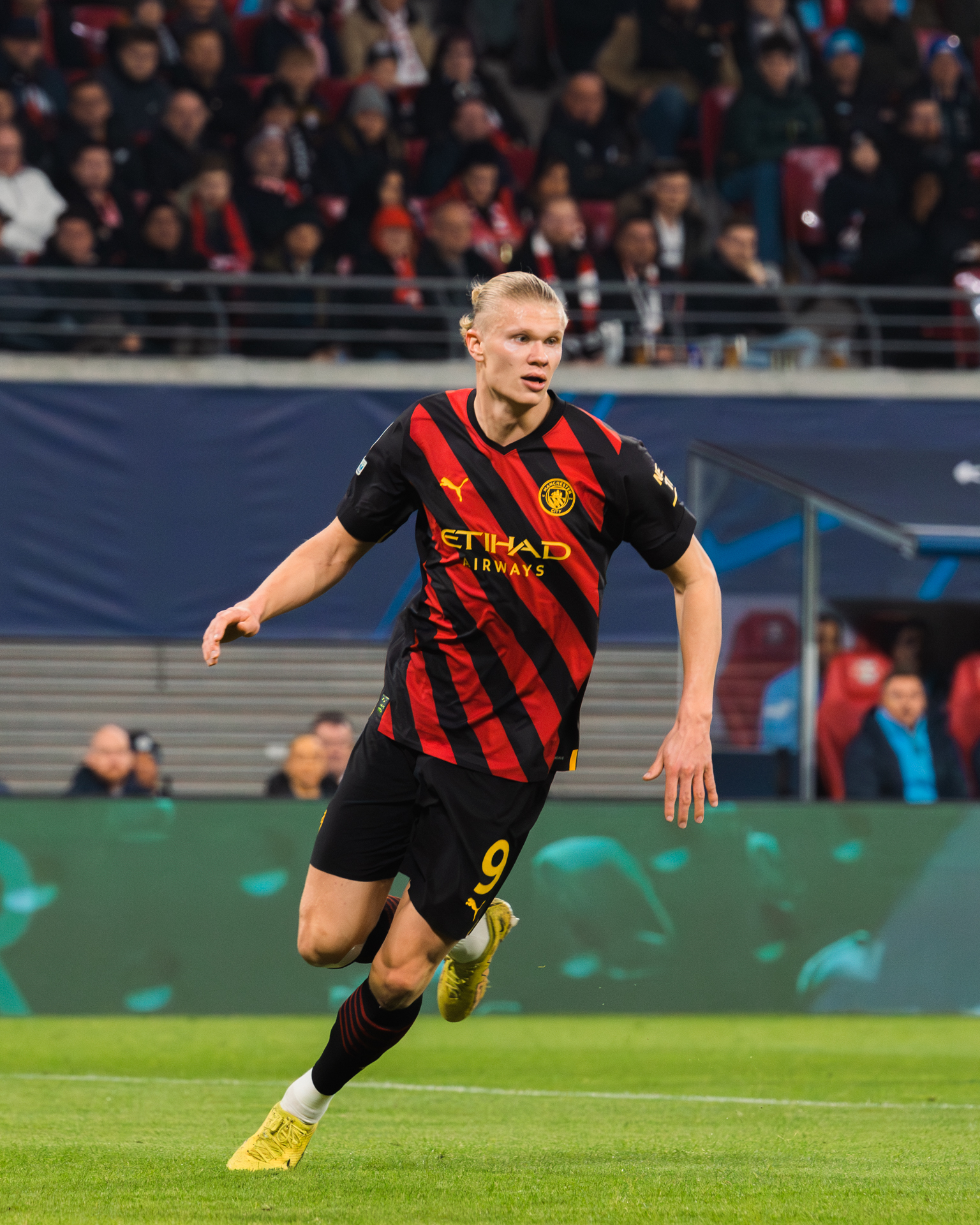
Photo: Jacek Stanislawek / Wikimedia Commons / CC BY-SA 4.0
The international chapter of Haaland’s story is deeply personal. His father, Alfie Haaland, played for Norway in the 1994 World Cup. Erling’s entire international career has been framed by this legacy—the desire to not just match his father’s achievement, but to surpass it.

For years, that seemed a distant dream. Norway failed to qualify for Euro 2020 and the 2022 World Cup. Despite Haaland’s goals, the team fell short. The pressure mounted. The narrative of “the best striker never to play at a major tournament” began to stick.
Then came the 2026 qualifying campaign. Haaland didn’t just score; he carried the team. He became Norway’s all-time top scorer, surpassing legends like Jørgen Juve. He reached 50 international goals in just 46 games, a pace that eclipses modern greats. For context, players like Harry Kane and Robert Lewandowski took over 70 caps to hit that mark.
The full scope of his international achievements is best seen in his Wikipedia entry for Erling Haaland, which meticulously tracks every cap and goal.
TL;DR: Haaland broke Norway’s scoring record and reached 50 international goals faster than any player in history, finally fulfilling his personal mission to reach a World Cup.
Leadership Beyond the Goals
His impact isn’t quantified just by goals. His work ethic in training sets the tone. His willingness to press from the front, something he honed at Manchester City under Pep Guardiola, forces the entire Norwegian team to adopt a higher defensive line. He leads by relentless example.
Young Norwegian players now have a tangible, global superstar to emulate. His success makes the dream of playing at the highest level feel attainable. This psychological shift, this belief, might be his most lasting legacy. He has changed Norwegian football’s self-perception from a developmental league to a producer of world-class talent.
Norway’s 2026 World Cup Reality and the Ballon d’Or Question
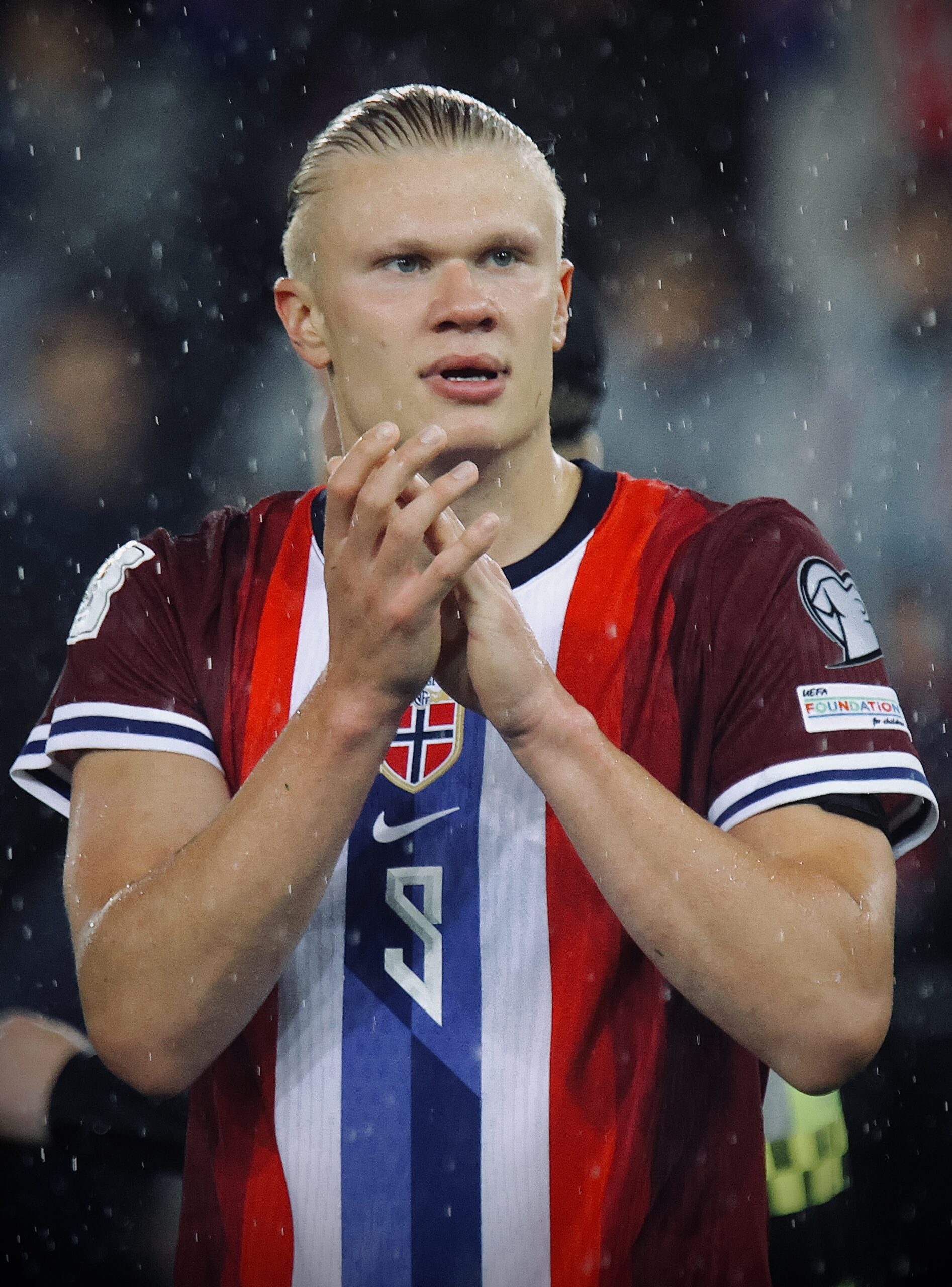
Photo: MichaelEmilio / Wikimedia Commons / CC BY 4.0
Qualification was the hard part. Now comes the harder part: competing. Norway has been drawn into 2026 World Cup Group I alongside France (FIFA ranking #1), Senegal (#14), and Iraq (#57). It is, without question, the “Group of Death.”

The opening match against France is the headline. It pits Haaland directly against Kylian Mbappé, a player with a World Cup winner’s medal already in his cabinet. It’s more than a striker duel; it’s a clash of philosophies. Norway will sit deep, absorb pressure, and look to release Haaland on the counter. His elite speedsters will be tested against France’s high line.
This tournament also brings the Ballon d’Or conversation into sharp focus. As Harry Kane noted, individual awards in modern football are tied to team trophies. You can score 100 goals, but without a Champions League or World Cup, the prize remains elusive.
Common mistake: Assuming Haaland’s Premier League records guarantee him a Ballon d’Or. Since 2008, every winner except Luka Modrić in 2018 has won the Champions League in their award year. The World Cup amplifies that requirement tenfold.
Haaland’s 2023 season—a treble and a record goal haul—was arguably the greatest individual season in English football history. Yet he finished second in the Ballon d’Or voting to Lionel Messi, whose crowning achievement was winning the 2022 World Cup. The precedent is clear.
A deep run with Norway in 2026, or even winning the tournament, would fundamentally alter his legacy and his claim to football’s highest individual honor. It would move him from a phenomenal club striker to an all-time international legend.
| Tournament Scenario for Haaland | Likely Ballon d’Or Impact |
|---|---|
| Wins 2026 World Cup with Norway | Becomes the overwhelming favorite, potentially a multi-year winner. |
| Leads Norway to Semi-Finals | Enters the top 3 conversation, dependent on club performance. |
| Norway exits at Group Stage | Remains reliant on Champions League success with Manchester City. |
Frequently Asked Questions
Is this Erling Haaland’s first World Cup?
Yes. The 2026 FIFA World Cup will be Erling Haaland’s first major international tournament. He led Norway to qualification, ending a 28-year drought since their last appearance in 1998.
How many goals did Haaland score in World Cup qualifying?
Haaland scored 16 goals in 8 matches during the 2026 World Cup qualification cycle. This made him the top scorer across all continental qualifying campaigns, and he scored in every single one of Norway’s qualifiers.
Could Erling Haaland have played for England?
Yes. Haaland was born in Leeds, England, while his father, Alfie, was playing for Leeds United. He was eligible to represent England but chose to play for Norway, the nation of his parents, from youth level onwards.
What is Erling Haaland’s goal record for Norway?
As of the 2026 World Cup qualification, Erling Haaland has scored 55 goals in 48 appearances for Norway. He is the nation’s all-time top scorer and reached 50 international goals faster than any player in history (46 games).
Who is in Norway’s group for the 2026 World Cup?
Norway is in Group I for the 2026 World Cup. Their opponents are France (FIFA ranking #1), Senegal (#14), and Iraq (#57). It is considered one of the most difficult groups in the tournament.
The Bottom Line
Erling Haaland’s story is no longer about potential. It’s about legacy in real time. He has already cemented his place as one of the most prolific club strikers of his generation with Manchester City. Now, by dragging Norway back to the World Cup, he has begun writing his international legend.
The 2026 tournament is his canvas. Success there would silence any remaining doubters and propel him into the stratosphere of all-time greats, alongside the Argentine legends and other icons who defined eras. More than any individual award, his mission is to prove that a single player, with enough force of will and quality, can change a nation’s footballing destiny. For Norway, that change has already arrived.
I come from the “soccer heart” of Germany, the Ruhrpott. I have played, trained and followed soccer all my life and am a big fan of FC Schalke 04. I also enjoy following international soccer extensively.