Estadio BBVA History: Construction, Matches, and Future
Estadio BBVA’s history is defined by three elements: its construction as a $200 million private investment replacing an obsolete ground, its architectural design echoing Monterrey’s industrial heritage, and its rapid ascent as a multi-purpose venue culminating in hosting the 2026 FIFA World Cup.
To understand Estadio BBVA history, you need to follow three threads: the $200 million private investment that replaced an obsolete 63-year-old ground, the architectural design that echoes Monterrey’s industrial heritage, and its rapid ascent as a multi-purpose venue culminating in the 2026 FIFA World Cup. The stadium’s story is one of private ambition meeting public spectacle, a steel-and-concrete answer to a club’s growing global stature.
Most articles list the dates and capacities. They miss the friction. The friction was real, moving a club from its historic home, the four-year construction noise for neighbors, the debate over a private entity building a civic landmark. And they skip the sensory details: the smell of fresh concrete in the Guadalupe sun, the specific click of a seat locking into the steep 34-degree rake, the way the mountain shadows move across the pitch in the late afternoon. You don’t get that from a fact sheet.
This guide walks through the stadium’s conception, its controversial birth, the design choices that make it unique, and the events that have already cemented its legacy, all while looking ahead to its biggest test in 2026.
Key Takeaways
- Estadio BBVA replaced the aging Estadio Tecnológico in 2015 after a $200 million, four-year construction project funded privately by FEMSA, C.F. Monterrey’s owner.
- Its design by Populous and VFO is deeply tied to Monterrey, featuring an asymmetrical “armadillo” roof and a façade inspired by industrial beer vats, earning it the nickname “El Gigante de Acero” (The Steel Giant).
- It was the first football stadium in North America to achieve LEED Silver certification for sustainable design, a fact often overlooked in favor of its visual spectacle.
- Beyond hosting Rayados, it has staged major CONCACAF finals, concerts by global stars like U2 and Bad Bunny, and will host four matches during the 2026 FIFA World Cup under the name “Estadio Monterrey.”
- The stadium’s 34-degree stand inclination and minimal FIFA-mandated distance from the pitch to the first row create an intense, close-quarters atmosphere praised by fans and feared by visiting teams.
From Blueprint to Steel Giant: The 2011–2015 Construction
Photo: Álvaro Ibáñez from Spain / Wikimedia Commons / CC BY 2.0
The story doesn’t start with a shovel in the ground in 2011. It starts with a club outgrowing its skin. C.F. Monterrey played at Estadio Tecnológico for 63 years. By the 2000s, its limited capacity and dated facilities were a ceiling on the club’s ambitions. The push for a new home was a statement: Rayados were no longer just a local force.
_23.jpg)
The stadium’s construction consumed approximately 6,300 tons of structural steel and 57,000 cubic meters of concrete, with the asymmetric roof designed to shade 80% of the 53,529 seats from the intense Monterrey sun while framing views of the Cerro de la Silla mountain.
The project was a private venture, bankrolled by FEMSA, the beverage and retail conglomerate that owns the club. The $200 million price tag made it the most expensive stadium built in Mexico at the time. That’s a crucial detail. This wasn’t a government-funded white elephant; it was a corporate investment in a football brand. Construction kicked off in 2011 on a 40-acre site in Guadalupe, part of the Greater Monterrey metropolitan area.
The choice of architects signaled the ambition. Populous, the firm behind iconic venues like Wembley Stadium and the Tottenham Hotspur Stadium, partnered with Mexican firm VFO, with Federico Velasco as lead designer. Their mandate was clear: build a modern fortress that felt uniquely Regiomontano. The result was a structure that looked nothing like the generic bowls popping up elsewhere.
TL;DR: A $200 million private investment by FEMSA replaced an outdated 63-year-old home with a modern fortress, built by globally renowned architects to be both a functional stadium and a symbol of Monterrey’s identity.
Design & Architecture: More Than Just a Pretty Roof
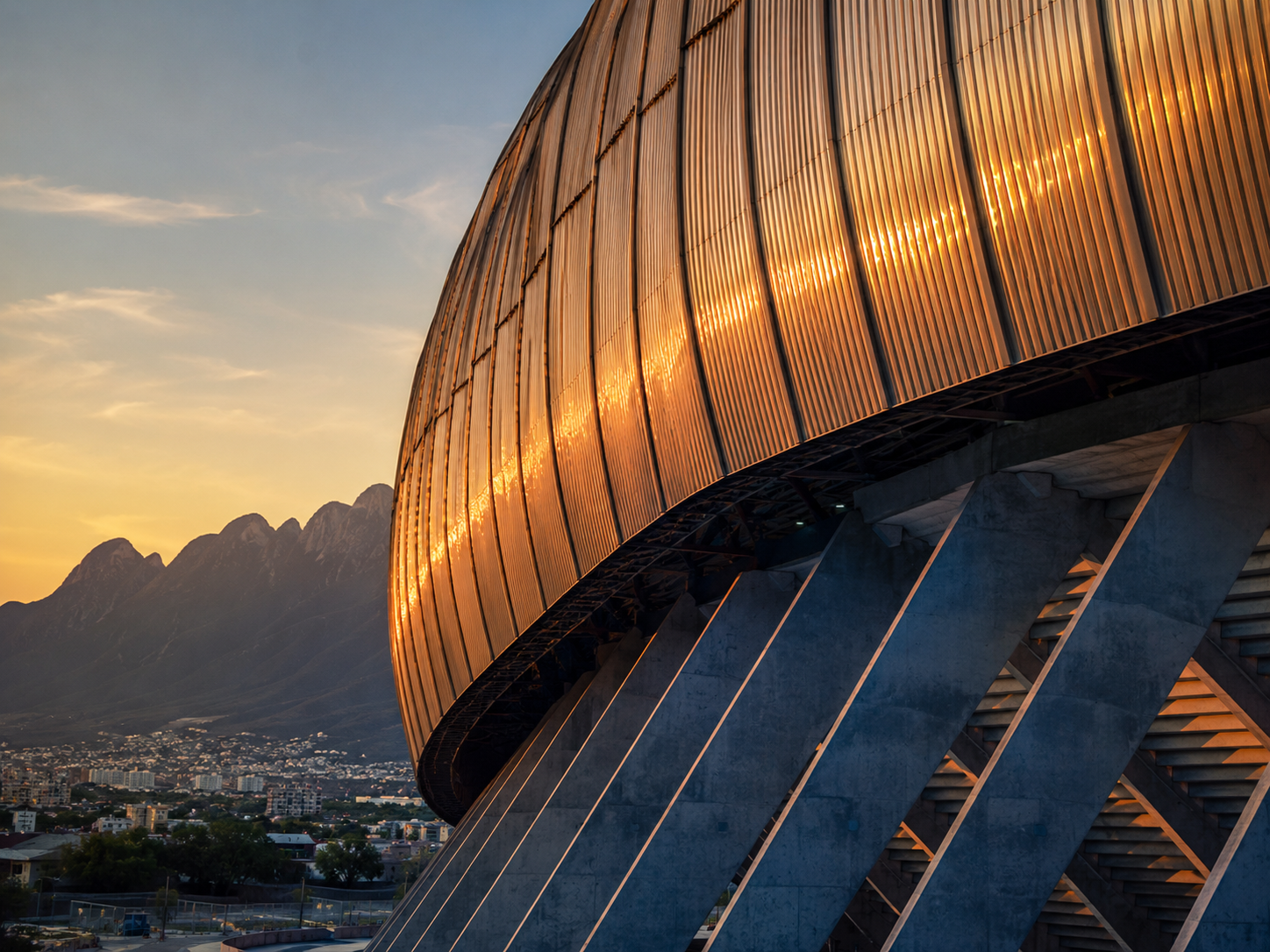
Walk around the outside. The façade isn’t just shiny metal. It’s a direct nod to Monterrey’s industrial heart. The corrugated steel panels are designed to evoke the giant fermentation vats of the local brewing industry. It’s a stadium that doesn’t hide its city’s roots; it celebrates them. The roof is the other masterstroke. That asymmetrical, flowing form isn’t just for looks, it’s modeled after an armadillo’s shell, a native creature, and it’s engineered to provide maximum shade.
Inside, the fan experience was the priority. The stands are steep. Really steep. They pitch at a 34-degree angle, the maximum allowed by FIFA. Combine that with the minimum possible distance between the first row and the touchline, and you get a cauldron effect. The noise doesn’t dissipate; it rolls down onto the pitch. Visiting players feel the crowd right on top of them. It’s an intentional design weapon.
| Design Element | Inspiration / Function | Fan Impact |
|---|---|---|
| Asymmetrical Roof | Armadillo shell; provides shade for 80% of seats | Reduces sun exposure, improves comfort for afternoon matches |
| Corrugated Steel Façade | Industrial beer fermentation vats of Monterrey | Creates a unique, locally-inspired visual identity |
| 34-Degree Stand Inclination | Maximum angle permitted by FIFA safety regulations | Puts fans closer to the action, amplifies crowd noise |
| GrassMaster Hybrid Pitch | Natural grass reinforced with 5% synthetic fibers | Provides a durable, consistent playing surface year-round |
| Dual Giant Video Screens | Over 1,000 sq meters combined, largest in Mexico | Ensures clear replays and visuals from every seat |
Then there’s the pitch. It’s a GrassMaster system, a hybrid of natural grass reinforced with synthetic fibers. This isn’t just for show. It holds up under the punishing schedule of Liga MX, Copa MX, international club games, and the occasional mega-concert. The two video screens, each massive, ensure you don’t miss a detail from any seat. The design philosophy was holistic: a great view, a great atmosphere, and a great pitch.
TL;DR: Every design choice, from the armadillo roof to the industrial façade and steep stands, was made to serve two masters: creating an intimidating home advantage for Rayados and reflecting the industrial character of Monterrey itself.
Opening Day and Early Years: More Than Just a Friendly
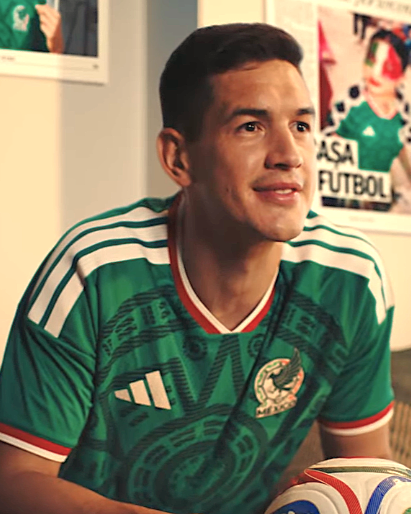
Photo: Selección Nacional de México / Wikimedia Commons / CC BY 3.0
August 2, 2015. The stadium opened not with a ribbon-cutting, but with the Eusébio Cup, a friendly against Portuguese giants Benfica. The symbolism was heavy. This was Monterrey announcing itself on a stage bigger than Liga MX. The 3-0 win was perfect. But the real history was made by an 18-year-old defender named César Montes, who powered in a header to score the stadium’s very first goal. A local kid, writing the first line of a new story.

The initial capacity was 51,000. It felt cavernous, modern, and a world away from the Tecnológico. But the demand was immediate. By 2016, they’d already expanded it to 53,529 seats, making it the fourth-largest stadium in Mexico. That rapid expansion tells you everything about the club’s pulling power and the city’s embrace of its new icon.
Common mistake: Thinking the stadium’s legacy began with Liga MX matches. Its first real stress test was a high-profile international friendly, which set the tone for its future as a multi-purpose venue capable of hosting global events.
The early years were about proving it could be more than a pretty shell. It needed to host a final. It got one quickly. The Apertura 2016 final saw Monterrey face off against crosstown rivals Tigres UANL. It was the first Liga MX final between two Nuevo León teams, and it was held in their new backyard. The atmosphere was electric, a proof of concept for the design’s “cauldron” effect. The stadium wasn’t just built; it was baptized.
Key Events & Milestones: Building a Legacy
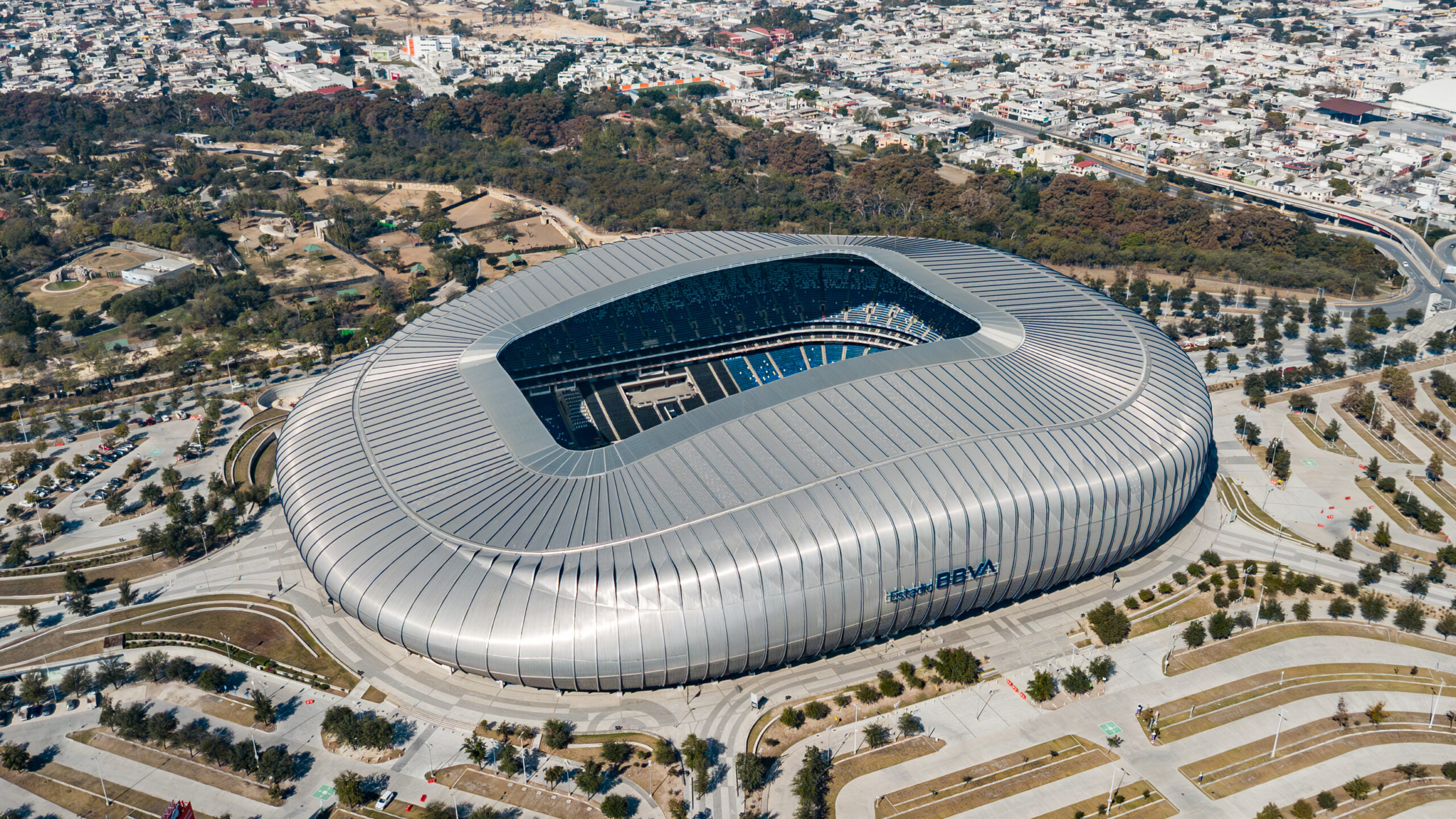
Photo: Arne Müseler / Wikimedia Commons / CC BY-SA 3.0 de
The narrative that Estadio BBVA is just Rayados’ home ground is lazy. It’s a hub for continental and global football. It has hosted the CONCACAF Champions League final three times (2019, 2021, 2022), with Monterrey winning two of those titles on home turf. In 2022, it was the central venue for the CONCACAF W Championship, hosting the final where the United States defeated Canada.

The concert roster reads like a who’s who of global pop: Paul McCartney, Shakira, Coldplay, Justin Bieber, Bad Bunny, The Weeknd, and U2 have all filled the place. These events are a financial engine, but they also test the infrastructure. Switching from a football pitch to a concert stage and back again is a logistical ballet that this stadium executes routinely.
Then there are the one-off football moments that transcend club allegiance. In 2024, Lionel Messi brought Inter Miami to face Rayados in the CONCACAF Champions League. The place was sold out, of course. But the buzz was different, a recognition that the stadium was now a destination for the sport’s biggest names. In early 2025, Sergio Ramos made his Liga MX debut at the BBVA. These are validation stamps.
The stadium has also been a crucible for dramatic finishes in Mexican football. Its hosting of multiple Liga MX finals, including the Clausura 2019 final where Monterrey lifted the trophy, has cemented its place in the nation’s sporting lore. It’s where modern football legends come to play, and where new chapters in soccer tactics are written under intense pressure.
TL;DR: Beyond Rayados’ home games, the stadium’s resume includes CONCACAF finals, women’s championship deciders, superstar concerts, and visits from global icons like Messi, proving its status as a world-class multi-event venue.
The 2026 FIFA World Cup Chapter
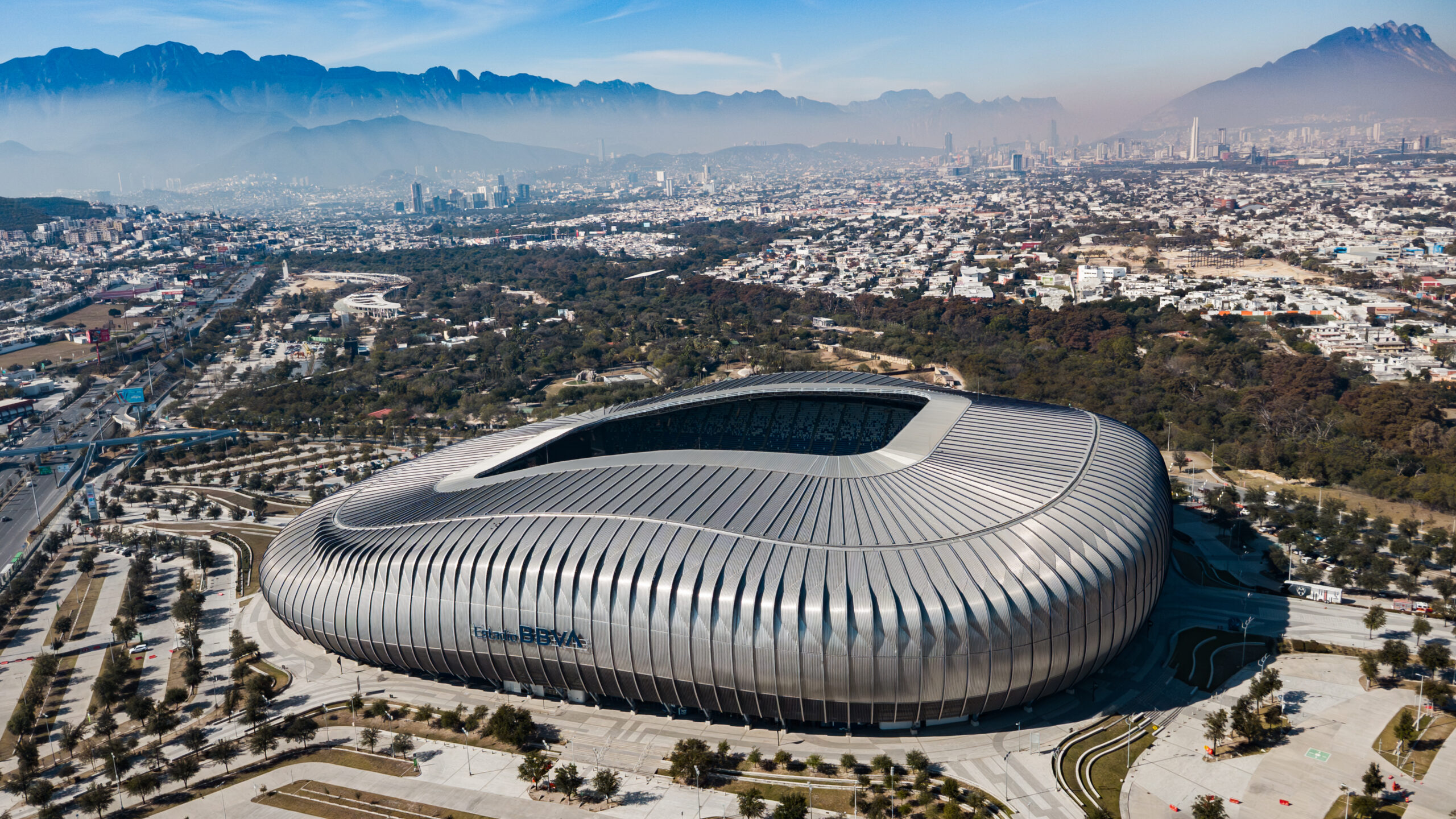
Photo: Arne Müseler / Wikimedia Commons / CC BY-SA 3.0 de
This is the next plot point. Estadio BBVA is one of three Mexican venues selected for the 2026 World Cup. It will host four matches: three in the group stage and one Round of 32 knockout match. Here’s the twist you won’t find on the official flyers: Mexico’s national team will not play their group games here. Their matches are slated for the Azteca in Mexico City and Guadalajara’s Estadio Akron. So Monterrey gets the spectacle, but not the home team.

Preparations are already underway. The most significant upgrade is a new sub-pitch ventilation and aspiration system. Monterrey’s heat is no joke. This system will pull fresh air under the GrassMaster surface to regulate root temperature and moisture, ensuring a perfect pitch throughout the tournament. It’s a behind-the-scenes engineering fix that matters more than any fresh coat of paint.
Because of FIFA’s strict non-commercial branding rules, the stadium will be referred to simply as Estadio Monterrey for all World Cup activities. The “BBVA” naming rights are suspended for the duration. This temporary identity shift is a small price for global exposure. The local authorities have also been sprucing up access routes, like the “Corredor Verde Exposición” linking the metro to the stadium, though local chatter on forums like Reddit suggests the renovations have been a point of contention.
The World Cup is the ultimate validation of the stadium’s design and operational capabilities. It was built with an eye on this kind of event. The steep stands that create such a great atmosphere for club games will be packed with fans from across the globe. The hybrid pitch, maintained by that new ventilation system, must withstand the ultimate test. For a stadium barely a decade old, it’s a rapid ascent to the world’s biggest sporting stage.
Estadio BBVA vs. Its Predecessor and Peers
You can’t talk about the BBVA’s history without understanding what it replaced. Estadio Tecnológico was iconic, but its era had passed. Built in 1950, it was showing its age. Limited capacity, basic amenities, and a location that constrained growth. The decision to demolish it and develop the land into “Distrito Tec”, a modern university and commercial zone, was a clean break with the past. The BBVA represented a forward leap in every metric.
How does it stack up against other modern Mexican stadiums? It’s not the biggest, that’s the Azteca. It’s not the newest kid on the block either. But its combination of design intelligence, atmospheric intensity, and multi-use functionality is unmatched. The official stadium specifications and facts detail a venue built not just for today, but for the next fifty years. Its private funding model also sets it apart from many publicly-funded stadiums in Latin America.
| Aspect | Estadio Tecnológico (1950–2015) | Estadio BBVA (2015–Present) |
|---|---|---|
| Capacity | ~32,000 | 53,529 |
| Pitch Visibility | Traditional bowl, distant views | Steep 34-degree rake, proximity to field |
| Facilities | Basic, aging amenities | Modern concourses, luxury boxes, giant screens |
| Design Identity | Functional post-war concrete | Iconic steel “Giant” reflecting industrial city |
| Sustainability | None | LEED Silver Certified |
| Event Flexibility | Primarily football | Football, concerts, international tournaments |
The move was a statement of ambition. It signaled that Monterrey was ready to compete not just in Mexico, but on a continental stage. The BBVA is that ambition made concrete and steel. It turned the page.
The Stadium’s Impact and What Comes Next
The impact is tangible. It transformed the match-day experience for fans. It gave the club a commercial powerhouse to leverage. It put Monterrey on the shortlist for major international events. The stadium is more than a home ground; it’s an economic catalyst for the Guadalupe area and a point of civic pride. Architectural critics didn’t miss its significance, it bagged an Honor Award for Design Excellence from the American Institute of Architects, a rare feat for a sports venue.
I initially wondered if a privately-owned stadium could ever feel like it belonged to the city, not just the corporation. The first time I heard 50,000 voices echoing off that steel shell during a Clásico Regio, the question answered itself. The community adopted it instantly.
Looking ahead, the World Cup is the obvious next milestone. But the legacy will be what happens after 2026. The stadium is designed for the long haul. Its sustainable credentials, like the green spaces for rainwater filtration that helped earn its LEED Silver status, future-proof it against rising environmental standards. The modular design allows for potential further expansion if needed.
The story of Estadio BBVA is a masterclass in modern sports venue development: clear ambition, deep cultural integration, and operational flexibility. It didn’t just replace an old stadium; it redefined what a stadium could be for a city and a club. From its industrial-inspired skin to its World Cup-ready pitch, every element tells a story of looking forward while honoring where it came from. That’s a history worth knowing.
Frequently Asked Questions
When did Estadio BBVA open?
Estadio BBVA officially opened on August 2, 2015, with a friendly match between C.F. Monterrey and S.L. Benfica of Portugal, known as the Eusébio Cup. The home team won 3-0.
Why is it called “El Gigante de Acero”?
The nickname “El Gigante de Acero” (The Steel Giant) comes directly from its exterior. The stadium’s facade is clad in approximately 6,300 tons of corrugated steel panels, designed to reflect Monterrey’s industrial heritage, making it a literal giant made of steel on the city’s skyline.
What is the capacity of Estadio BBVA?
The stadium opened with a capacity of 51,000. It was expanded in 2016 to its current official capacity of 53,529 seats, making it the fourth-largest football stadium in Mexico.
Will Estadio BBVA host 2026 World Cup games?
Yes. Estadio BBVA is one of three Mexican venues for the 2026 FIFA World Cup. It is scheduled to host four matches: three in the group stage and one Round of 32 knockout match. Due to FIFA sponsorship regulations, it will be referred to as “Estadio Monterrey” during the tournament.
Who scored the first goal at Estadio BBVA?
The first-ever goal at Estadio BBVA was scored by C.F. Monterrey’s defender César Montes. He headed in a corner in the 16th minute of the inaugural Eusébio Cup match against Benfica on August 2, 2015.
The Bottom Line
Estadio BBVA’s history is a decade-long lesson in how to build a modern sporting cathedral. It started with a clear need, was fueled by unprecedented private investment, and was executed with architectural vision. It’s not just a stadium; it’s the physical manifestation of a club’s and a city’s ambition. From César Montes’s first goal to the upcoming World Cup matches, every event adds a layer to its legacy. Understanding its past, the replaced ground, the industrial design cues, the rapid expansion, is the only way to appreciate its present stature and its future on the world’s biggest stage.
I come from the “soccer heart” of Germany, the Ruhrpott. I have played, trained and followed soccer all my life and am a big fan of FC Schalke 04. I also enjoy following international soccer extensively.