Every World Cup Host Country Ranked By Frequency & Legacy
To rank every World Cup host country, you must weigh three factors: how many times they’ve hosted, how they performed as hosts, and their historical significance in the tournament’s evolution. Mexico leads with three hosting stints, while nations like South Africa and Qatar are singular, landmark hosts for their continents.
Most rankings just list countries by year. They miss the real story—the shifting politics, the ballooning costs, and the fact that hosting the tournament is no longer a guaranteed path to glory on the pitch. The home-field roar matters less when your opponent’s stars play in your league every weekend.
This guide ranks all 18 host nations by a combined metric of frequency and legacy. We’ll break down their tournament results, unpack the trend toward multi-nation hosting, and look at what the future holds for 2026, 2030, and beyond.
Key Takeaways
- Mexico stands alone as the only nation selected to host three World Cups (1970, 1986, 2026).
- Only six hosts have ever won the tournament on home soil, and none have done so since France in 1998.
- The “home advantage” is statistically real but has diminished significantly in the modern era of globalized football.
- Future hosting is defined by multi-nation bids and the expanded 48-team format, starting with North America in 2026.
- A host’s success is now measured more by stadium legacy and economic impact than by lifting the trophy.
The Definitive Ranking: Who Has Hosted the Most?
Forget alphabetical order. The true ranking of World Cup hosts is a tiered system based on frequency. At the top sits a unique club, then a group of repeat hosts, followed by the singular, landmark hosts.
Since the first tournament in 1930, 18 sovereign nations have hosted the FIFA World Cup. The selection reflects football’s historical power centers, with Europe hosting 11 times and South America 5 times, while Africa and Asia have had one host each so far.
The first tier contains just one country: Mexico. It was the first to host twice (1970 and 1986) and will make history in 2026 as part of the unprecedented three-nation hosting model with Canada and the United States. No other nation comes close to this level of FIFA trust and operational experience.
The second tier is the multiple-host club. Five nations have hosted twice:
* Brazil (1950, 2014)
* Italy (1934, 1990)
* France (1938, 1998)
* Germany (1974 as West Germany, 2006)
* United States (1994, and again in 2026 as co-host)
The third tier is the largest: the one-time hosts. This includes football founding nations like Uruguay and England, as well as landmark hosts that broke continental barriers, like South Africa (2010, first African host) and Qatar (2022, first Middle Eastern host).
TL;DR: Mexico is the undisputed hosting king with three tournaments, followed by a club of five two-time hosts. Everyone else has hosted once.
What Makes a Great Host? Performance vs. Legacy
Hosting comes with immense pressure and an automatic qualification spot. But does it translate to success? The data reveals a complex picture where legacy often outweighs podium finishes.
Let’s cut through the myth. Hosting does not guarantee a deep run, let alone a win. Since the tournament’s inception, only six hosts have won on home soil: Uruguay (1930), Italy (1934), England (1966), West Germany (1974), Argentina (1978), and France (1998). That’s six out of twenty-two tournaments. More tellingly, it hasn’t happened in over 25 years.
The modern trend is clear. The last host to even reach the final was Germany in 2006. Recent hosts like South Africa (2010) and Qatar (2022) hold the dubious distinction of being the only hosts eliminated in the group stage. Russia (2018) made a respectable quarter-final run, but that’s now the ceiling.
So what defines a “great” host? It’s the infrastructure left behind and the cultural moment created. The 1994 World Cup in the United States is a masterclass. The host team was mediocre, but the tournament ignited soccer in a major market, setting attendance records that still stand. The 2002 co-hosting by Japan and South Korea was a logistical triumph that brought the tournament to Asia and saw both host nations exceed expectations on the field. Their success is a key part of any analysis of the greatest World Cup finals, proving a host’s story isn’t always written by the winner.
Common mistake: Equating host performance with hosting success — South Africa’s group-stage exit in 2010 overshadowed its historic achievement as the first African host, but its stadiums and tourism legacy endured long after.
| Host Nation | Year(s) | Best Result as Host | Defining Legacy |
|---|---|---|---|
| United States | 1994 | Round of 16 | Commercialization and record attendance that changed FIFA’s business model. |
| Japan/South Korea | 2002 | Semi-finals (SK) / Round of 16 (JPN) | Successful first co-host, proved large-scale multi-nation events were feasible. |
| Germany | 2006 | Third Place | “A Time to Make Friends” campaign rebranded the nation’s image globally. |
| South Africa | 2010 | Group Stage | First African host, delivered iconic venues like Soccer City. |
TL;DR: A great host builds lasting stadiums and grows the game. Winning is a bonus that hasn’t happened for any host this century.
The Evolution of Hosting: From Solo Acts to Continental Projects
The World Cup has outgrown single hosts. The tournament’s expansion to 32 teams in 1998 stretched national infrastructures. The coming shift to 48 teams in 2026 makes solo hosting nearly impossible for all but the largest economies.
The first crack in the solo-host model appeared in 2002 with Japan and South Korea. It was a political and logistical gamble that ultimately worked, paving the way for the future. The 2026 tournament, awarded to Canada, Mexico, and the United States, is the logical endpoint of this trend. This three-host-nation model is a direct response to the scale and cost of the modern World Cup.
This shift fundamentally dilutes the “home advantage.” A team playing across three time zones and multiple countries doesn’t get the same consistent crowd lift. It turns the tournament into a more neutral contest. The focus for bidding nations now is on sharing financial risk and maximizing regional investment. The projected economic impact of hosting for North America is a primary motivator, not just stadium glory.
Looking ahead, the 2030 tournament will celebrate the World Cup’s centennial. In a politically savvy move, FIFA awarded it to a transcontinental trio: Morocco, Portugal, and Spain. This again spreads the burden and the benefit. 2034 is slated for Saudi Arabia, likely a solo host but one with virtually unlimited resources to build from scratch.
TL;DR: The future is multi-nation hosting. The 48-team format and massive costs have made sharing the burden—and the home-field advantage—the new normal.
The Complete Host List: Year-by-Year and Continent-by-Continent

Here is every host, in order. The list shows football’s geographical spread and the increasing pace of new hosts entering the fold.
| Year | Host Nation(s) | Continent | Notable First |
|---|---|---|---|
| 1930 | Uruguay | South America | First ever World Cup. |
| 1934 | Italy | Europe | |
| 1938 | France | Europe | |
| 1950 | Brazil | South America | |
| 1954 | Switzerland | Europe | |
| 1958 | Sweden | Europe | |
| 1962 | Chile | South America | |
| 1966 | England | Europe | |
| 1970 | Mexico | North America | First nation to host twice. |
| 1974 | West Germany | Europe | |
| 1978 | Argentina | South America | |
| 1982 | Spain | Europe | |
| 1986 | Mexico | North America | |
| 1990 | Italy | Europe | |
| 1994 | United States | North America | |
| 1998 | France | Europe | |
| 2002 | Japan / South Korea | Asia | First co-hosts. |
| 2006 | Germany | Europe | |
| 2010 | South Africa | Africa | First African host. |
| 2014 | Brazil | South America | |
| 2018 | Russia | Europe | |
| 2022 | Qatar | Asia | First Middle Eastern host. |
| 2026 | Canada, Mexico, USA | North America | First three-nation host; first 48-team tournament. |
This table is more than a list. It’s a map of FIFA’s political and commercial ambitions. The long European dominance, the strategic entries into new markets like the US and Asia, and the recent landmark hosts in Africa and the Middle East tell a story. To understand how each tournament culminated, you can explore the drama of every World Cup final that these hosts staged.
TL;DR: Europe has hosted over half of all World Cups, but the 21st century has seen a deliberate push into new continents and new hosting models.
How Does Hosting Impact the Tournament Winner?
This is the multi-billion dollar question. Does playing at home propel a good team to greatness? The historical record says yes, but the modern record is far more skeptical.
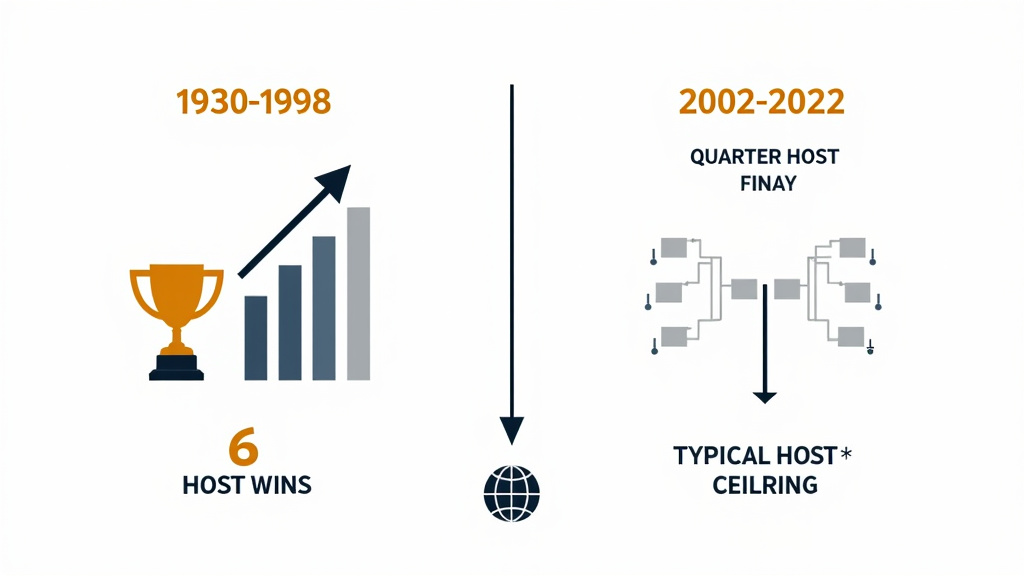
From 1930 to 1998, six hosts won. That’s a 27% win rate for hosts, which is statistically massive when you consider there were anywhere from 13 to 32 teams in those tournaments. The advantage was real: familiar climate, partisan crowds, and no grueling qualification travel.
Something changed after 1998. The game globalized. Top players from competing nations now play weekly in the host country’s leagues. Crowds are more mixed. The pressure of expectation has become a crushing weight. Consider Brazil in 2014. The 7-1 semi-final loss to Germany wasn’t just a defeat; it was a national trauma exacerbated by the hosting spotlight.
The data from the last six tournaments (2002–2022) shows a host’s typical ceiling is the quarter-finals. The magic is gone. The expansion to 48 teams in 2026 will further dilute any remaining advantage, as the expanded 48-team format creates a longer, more grueling competition where squad depth matters more than a home crowd in one city.
I remember the palpable tension in Germany in 2006. The entire country was draped in flags. Every match felt like a national event. They had a strong team and finished third, which was deemed a success. Compare that to Qatar in 2022. The team was out in the group stage, and the conversation instantly shifted to the legacy of the stadiums and the off-pitch controversies. The trophy is no longer the primary measure of hosting success.
TL;DR: The host team winning is a relic of the 20th century. In the modern global game, the advantages of hosting are logistical and commercial, not necessarily sporting.
Frequently Asked Questions
Which country has hosted the most World Cups?
Mexico holds the record. It hosted solo tournaments in 1970 and 1986, and will co-host the 2026 edition with Canada and the United States, bringing its total to three.
Has a host country ever won the World Cup?
Yes, but it’s become rare. Six hosts have won: Uruguay (1930), Italy (1934), England (1966), West Germany (1974), Argentina (1978), and France (1998). No host has won the tournament in the 21st century.
How is the World Cup host country chosen?
FIFA’s Congress votes on the host. Nations submit detailed bids covering stadiums, infrastructure, security, and finances. The process is highly political and increasingly favors joint bids, especially for the expanded 48-team tournament starting in 2026, which demands unprecedented resources.
What are the future World Cup host countries?
The next hosts are confirmed as: 2026 in Canada, Mexico, and the United States; 2030 in Morocco, Portugal, and Spain (with three matches in South America); and 2034 in Saudi Arabia. The 2026 host cities are already preparing for the unprecedented scale.
Before You Go
Ranking World Cup hosts isn’t just about counting tournaments. It’s a lesson in football’s geopolitical and economic evolution. Mexico’s triple hosting is a testament to reliability. The rise of co-hosting marks the end of solo national projects. And the fading dream of a host winning the trophy underscores how club football’s globalization has neutralized home-field advantage.
The legacy of a host is now cemented in concrete and commerce, not just in gold. As we look to the differences from the 2022 tournament, the 2026 World Cup will be the ultimate test of this new model—a sprawling, three-country spectacle where the beautiful game’s future will be shaped far from the penalty spot.

I come from the “soccer heart” of Germany, the Ruhrpott. I have played, trained and followed soccer all my life and am a big fan of FC Schalke 04. I also enjoy following international soccer extensively.