Exploring Japan’s World Cup History and Their Top Results
Japan’s FIFA World Cup history is defined by seven tournament appearances since their 1998 debut, with a best result of the Round of 16 achieved four times. Their record is marked by consistent knockout-stage qualification, landmark wins over elite nations, and a squad now entirely based in Europe aiming for a quarterfinal breakthrough.
Most fans still think of Japan as the plucky underdog. That’s a decade out of date. The real story is a methodical, two-decade climb from amateur obscurity to a team that now beats Germany and Spain in the same tournament week. The ceiling they’re trying to crack isn’t the group stage, it’s the one after the Round of 16.
This guide walks through every World Cup chapter, the players who built the legacy, and why the current Samurai Blue squad might be their strongest ever.
Key Takeaways
- Japan’s best World Cup finish is the Round of 16, reached in 2002 (as co-host), 2010, 2018, and 2022. They have never won a knockout match.
- Keisuke Honda is their all-time top World Cup scorer with 4 goals. Yuto Nagatomo holds the appearance record with 15 matches across four tournaments.
- Their 2022 campaign was a historic peak: they topped a ‘Group of Death’ by beating both Germany and Spain 2-1, a first for an Asian nation.
- The team has already qualified for the 2026 World Cup, marking their eighth straight appearance. The Japan Football Association’s public target is the quarterfinals.
- The professional J.League, founded in 1992, is the foundational engine for Japan’s rise, creating the player pipeline that now supplies Europe’s top leagues.
Japan’s World Cup Debut and Early Years (1998–2006)
Japan didn’t just arrive at the World Cup in 1998. They crashed through the door after decades as an amateur afterthought in a baseball and sumo-dominated country. Full credit goes to the J.League, which launched in 1992 and professionalized the sport practically overnight. Within six years, that new system produced a squad good enough to qualify.
Their first match was a 1-0 loss to Argentina. The first goal came in their third match, a 2-1 defeat to Jamaica. Masashi Nakayama pounced on a loose ball in the 74th minute. The celebration across Japan was for the milestone, not the result.
The 1998 squad, managed by Takeshi Okada, lost all three group matches. The tangible result was zero points. The intangible gain was a blueprint. Every player on that roster was a domestic J.League professional, a fact that would define the next twenty years of development.
Four years later, Japan co-hosted the 2002 tournament with South Korea. The pressure was immense, but so was the home support. They drew with Belgium, then beat Russia 1-0, their first-ever World Cup win, and tied Tunisia to finish top of Group H. The Round of 16 match against Turkey was a tight, tense affair. A single early goal from Umit Davala ended the dream. The 1-0 loss stung, but the achievement reset expectations permanently. Japan was now a knockout-stage team.
The 2006 cycle was a regression. Managed by Brazilian legend Zico, a talented squad featuring Hidetoshi Nakata and Shunsuke Nakamura stumbled. They lost to Australia, drew with Croatia, and fell to Brazil. One point. One goal. The lesson was harsh: technical flair without defensive structure wasn’t enough at this level. It’s a lesson that directly informs the pragmatic, disciplined style coach Hajime Moriyasu employs today.
TL;DR: Japan’s early World Cup journey was a story of firsts, first appearance, first goal, first win, culminating in a landmark Round of 16 run as co-hosts in 2002, before a reality check in 2006.
What Is Japan’s Best World Cup Result?
Japan’s best result is the Round of 16. They have reached this stage four times: 2002, 2010, 2018, and 2022. They have never advanced to the quarterfinals. Each exit has its own signature heartbreak.
The 2010 loss to Paraguay was a tactical stalemate decided by penalties. The 2018 defeat to Belgium was a brutal, last-minute counterattack after Japan had led 2-0. The 2022 exit against Croatia was another penalty shootout loss after a 1-1 draw. The pattern is clear, they can compete, but converting a knockout match into a win remains the final frontier.
| Tournament | Round Reached | How It Ended | Key Takeaway |
|---|---|---|---|
| 2002 | Round of 16 | 1-0 loss to Turkey | Proved they could advance on home soil. |
| 2010 | Round of 16 | 0-0 (3-5 pens) loss to Paraguay | Showed defensive solidity but lacked a knockout punch. |
| 2018 | Round of 16 | 3-2 loss to Belgium | Demonounced they could lead a world contender, then learned a cruel lesson in game management. |
| 2022 | Round of 16 | 1-1 (1-3 pens) loss to Croatia | Confirmed their elite status but highlighted a persistent finishing problem in decisive moments. |
This consistent ceiling is why the current federation target isn’t vague “improvement.” It’s explicit: the quarterfinals in 2026. Breaking this barrier would be the single greatest achievement in Japanese football history. The evolution from hopeful participant to consistent last-16 team is complete. The next evolution is about winning one of those games.
Record Holders: Top Scorers and Most Caps
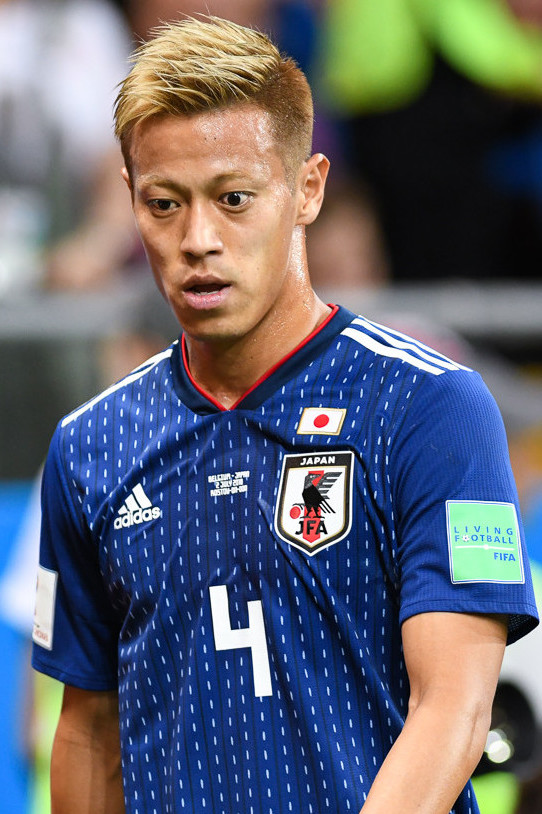
Photo: Светлана Бекетова / Wikimedia Commons / CC BY-SA 3.0
_(cropped).jpg)
The numbers tell a story of longevity and clutch moments. Keisuke Honda isn’t just the top scorer; he’s the prototype for the modern Japanese attacking midfielder who thrives in Europe. His four World Cup goals came across three tournaments (2010, 2014, 2018), a testament to his sustained quality at the highest level. The first, a blistering free-kick against Denmark in 2010, announced Japan’s arrival as a team with technical audacity.
Common mistake: Forgetting Shinji Okazaki’s work rate because he only scored once. His relentless pressing and movement in the 2010 and 2018 tournaments created the space for Honda and others to operate. He was the engine, not the finisher.
Yuto Nagatomo’s record of 15 World Cup appearances is a monument to durability and tactical flexibility. He played left-back, wing-back, and even tucked into a back three across four consecutive tournaments from 2010 to 2022. His career path, from FC Tokyo to Inter Milan to a veteran leader, mirrors the national team’s journey from domestic focus to European integration.
Other key figures include:
1. Hidetoshi Nakata (1998, 2002, 2006): The first true Japanese global superstar. His creativity was the offensive spark in the early years, though team success was limited.
2. Shinji Kagawa (2010, 2014, 2018): The silky playmaker whose vision defined Japan’s attacking play for nearly a decade. His peak coincided with their most consistent period.
3. Maya Yoshida (2014, 2018, 2022): The defensive anchor and captain during the Moriyasu era. His leadership was crucial in organizing the resilient backlines of 2018 and 2022.
These players represent different eras. Nakata was the pioneer. Honda was the game-changer. Nagatomo is the ironman. Understanding their contributions is essential to understanding the team’s layered history, much like appreciating the different styles of Argentinian football legends reveals the evolution of that nation’s football identity.
Japan’s 2022 World Cup: The Pinnacle So Far
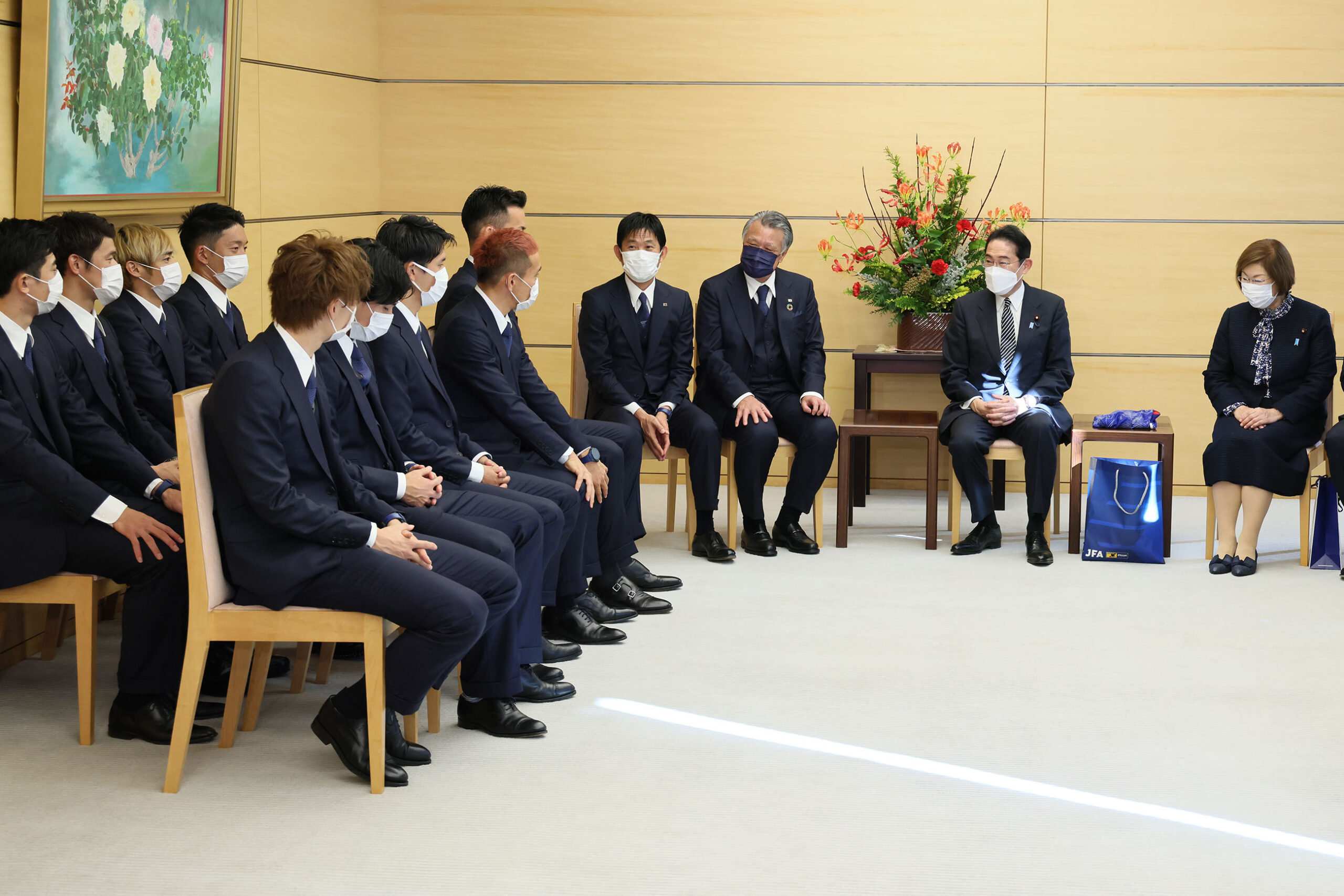
Photo: 内閣官房内閣広報室 / Wikimedia Commons / CC BY 4.0
.jpg)
Forget the Round of 16 exit for a moment. Japan’s 2022 group stage was a masterclass in tactical intelligence and mental fortitude. Drawn with Germany, Spain, and Costa Rica, they were given no chance. They won the group.
The 2-1 comeback win over Germany wasn’t a fluke. Coach Hajime Moriyasu’s game plan was executed perfectly: absorb pressure with a compact mid-block, then explode on the counter with substitutes like Ritsu Doan and Takuma Asano. The same script, with even more possession dominance from Spain, worked again days later. Two historic wins, one week.
I watched the Germany game in a bar in Gelsenkirchen. The silence after Japan’s second goal was absolute, broken only by a few disbelieving laughs. My German friends kept saying the same thing: “They were just smarter. They knew exactly what they were doing.” That was Moriyasu’s fingerprint.
This success wasn’t just about heart. It was about a specific soccer tactics overview built for tournament football. Moriyasu often used a 5-4-1 defensive shape that morphed into a 3-4-3 in attack, a system demanding incredible discipline from wing-backs like Junya Ito. This flexible approach out-thought two of the world’s best possession-based teams. It’s the kind of detailed strategic shift you’d see in a tactical breakdown of 5-3-2 or other defensive setups designed to frustrate superior opponents.
The subsequent penalty shootout loss to Croatia felt almost secondary. The statement had been made. Japan was no longer just a team that could sometimes reach the knockouts. They were a team that could outplay and beat the favorites. This performance is the benchmark for 2026.
The Road to 2026: Qualification and Ambitions
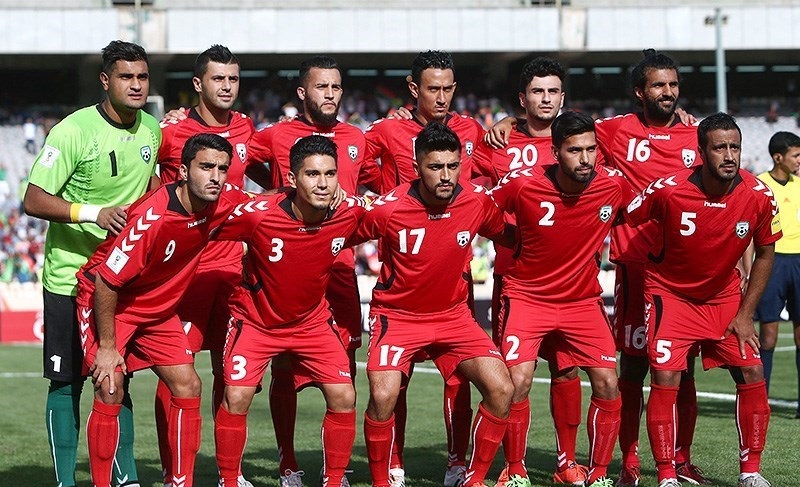
Photo: Javid Nikpour / Wikimedia Commons / CC BY 4.0

Japan didn’t just qualify for the 2026 World Cup. They were the first team in the world to secure their spot, topping their AFC qualifying group with a ruthless 7-2-1 record. This automatic, dominant qualification is a new normal. The days of nervy playoff matches seem over.
The squad announced for the final qualifying phase tells you everything about their current strength. Of the 26 players, 25 were based at European clubs. The core is in its prime: captain Wataru Endo (Liverpool), creative force Takefusa Kubo (Real Sociedad), and defensive stalwart Ko Itakura (Borussia Mönchengladbach). This is the most talented and experienced pool Japan has ever had.
The official target from the Japan Football Association is the quarterfinals. It’s not a quiet hope; it’s a public mandate for coach Hajime Moriyasu. The challenge is converting their proven group-stage prowess into a knockout victory. The pain of those near-misses in 2010, 2018, and 2022 is the fuel.
Their potential path in the expanded 48-team 2026 tournament is fascinating. With more teams, the group stage may be less daunting, but the knockout rounds will start earlier and could be more volatile. Japan’s discipline and tactical cohesion could be a huge advantage in a tournament with shorter preparation times between games, much like how a well-drilled team excels with a solid defensive setup. How they navigate this new format will be a key chapter in their World Cup results for Japan.
The J.League’s Role & The Samurai Blue Identity
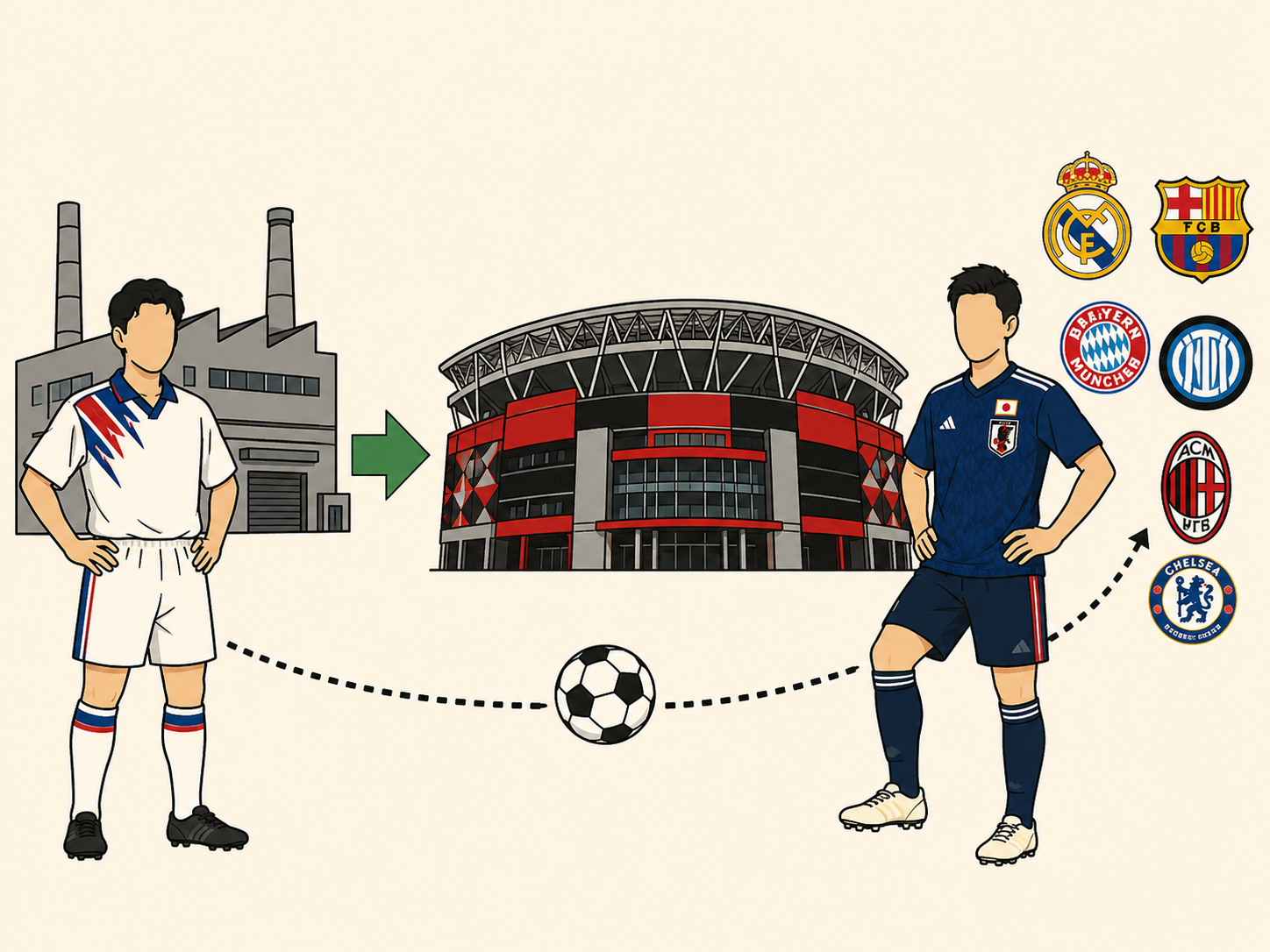
You cannot separate Japan’s World Cup story from the J.League. Before its launch in 1992, the national team was staffed by company-league amateurs. The J.League created professional clubs, imported stars like Zico and Gary Lineker as marquee players, and built a legitimate youth development pathway. The 1998 World Cup squad were children of this new league.
Today, the J.League’s role has evolved. It is no longer the final destination for top talent but the essential incubator. Players like Kubo and Kaoru Mitoma are polished in Japan before moving to Europe. The league’s technical standard and emphasis on possession football prepare them perfectly for the international stage.
The “Samurai Blue” identity is the other half of the equation. It’s more than a nickname. It’s a brand of football built on respect, collective spirit, and relentless work ethic. The fans embody this too. Visiting teams always note the immaculate condition in which Japanese fans leave stadiums after matches. This culture of discipline and respect off the pitch mirrors the team’s organization on it.
This fusion, a professional league creating technically gifted players for a team with a distinct cultural identity, is Japan’s unique formula. It explains why they have surpassed other nations with deeper footballing traditions. They built a modern system from scratch and adhered to its principles for 30 years. The results, as detailed in the comprehensive Wikipedia entry for Japan’s national team, are a testament to that long-term vision.
Frequently Asked Questions
Who is Japan’s all-time top scorer in the World Cup?
Keisuke Honda scored 4 goals across the 2010, 2014, and 2018 World Cups, making him Japan’s top scorer in the tournament. He was also the first Japanese player to score in three different World Cups.
How many times has Japan reached the Round of 16?
Japan has reached the FIFA World Cup Round of 16 on four occasions: in 2002 (as co-hosts), 2010, 2018, and 2022. They have lost each time, failing to advance to the quarterfinals.
What was Japan’s best World Cup performance?
Their best performance is the 2022 World Cup in Qatar. They topped a group containing Germany and Spain with two historic 2-1 victories, demonstrating a tactical maturity that marked their arrival as a consistent threat to elite nations.
Has Japan ever won a World Cup knockout game?
No, Japan has never won a match in the knockout stages of the World Cup. Their four Round of 16 appearances have ended in two narrow losses (2002, 2018) and two penalty shootout defeats (2010, 2022).
Who has made the most World Cup appearances for Japan?
Defender Yuto Nagatomo holds the record with 15 World Cup matches played. He appeared in four consecutive tournaments from 2010 to 2022, featuring at left-back and wing-back.
Before You Go
Japan’s World Cup history is a case study in sustained, systematic growth. From a single goal in 1998 to beating European giants in 2022, their trajectory only points upward. The records belong to Honda and Nagatomo, but the current identity is pure Moriyasu: pragmatic, fearless, and meticulously prepared.
The 2026 mission is no longer about participation or even just reaching the knockouts. It’s about winning there. With a squad fully matured in Europe’s toughest leagues, the quarterfinal barrier has never looked more breakable. The next chapter of their history of the Samurai Blue is about turning consistent excellence into a historic breakthrough.
I come from the “soccer heart” of Germany, the Ruhrpott. I have played, trained and followed soccer all my life and am a big fan of FC Schalke 04. I also enjoy following international soccer extensively.