Proper Kicking Technique Soccer Explained (The 3-Step Guide)
Proper kicking technique in soccer requires matching three mechanical pillars: plant foot placement, a locked striking surface, and a committed follow-through. The non-kicking foot dictates direction and ball flight. The instep (laces) delivers power, and the inside of the foot provides accuracy. A full-body kinetic chain from approach to finish transfers force into the ball.
Most players focus on their swinging leg. They run up, swing hard, and wonder why the ball slices or floats. The real work happens before the foot ever touches the ball. It happens in the setup.
This guide breaks down the proper kicking technique from the ground up. We’ll cover the biomechanics of power and accuracy, the step-by-step execution for different kicks, and the drills that build muscle memory. Forget toe-poking. Let’s build a repeatable strike.
Key Takeaways
- Power comes from the kinetic chain—hip rotation, knee extension, and ankle lock—not from a long run-up. A 45-degree approach angle generates more force than a straight-on sprint.
- Your plant foot placement is the steering wheel. Place it level with the ball, 6-8 inches to the side, pointing at your target. Where you plant decides if the ball stays low or rises.
- Accuracy and power use different neuromuscular pathways. Power relies on proximal (hip/knee) coordination; accuracy needs refined distal (ankle) control. You must train them separately.
- The follow-through is non-negotiable. Stopping your leg at contact wastes up to 30% of your potential force. Your kicking foot should finish high, with your body leaning over the ball for a driven shot.
- Visual focus stays on the ball until contact. Looking up to pick a spot is the most common cause of shanked shots. See the ball, hit the ball, then find it in the net.
The 3 Mechanical Pillars of a Proper Kick
A proper kick is a full-body movement, not just a leg swing. Isolate these three components in practice before chaining them together at speed.
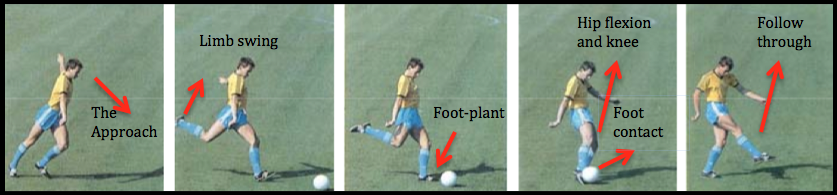
The instep drive, or laces kick, is the fundamental power strike in soccer. The player approaches the ball at a 45-degree angle, plants the non-kicking foot beside the ball with toes pointed toward the target, locks the ankle of the kicking foot with toes pointed downward, and strikes the center of the ball with the top of the foot. A full, forceful follow-through in the direction of the target completes the kinetic transfer.
1. The Plant Foot: Your Steering and Stability
Your non-kicking foot does more than hold you up. It anchors your entire body and dictates the ball’s trajectory. Get this wrong, and everything that follows is compensation.
Place your plant foot level with the ball. Not behind it, not in front of it. Imagine a line running through the middle of the ball. Your plant foot should be on that line. Position it 6 to 8 inches to the side of the ball. This distance gives your swinging leg a clear path and maintains balance.
Point your plant foot’s toes directly at your target. Your hips and shoulders will naturally align with where your foot is pointing. This simple act is the single biggest factor in aiming a shot or pass. For a low, driven ball, your plant foot should be slightly ahead of the ball’s centerline. For a chip or lofted pass, plant it slightly behind.
TL;DR: Plant your foot level with the ball, a hand’s width to the side, with toes aimed at your target. Your body follows your foot.
2. The Striking Surface: Instep vs. Inside of the Foot
You have two primary surfaces for controlled kicking. Choosing the right one is the difference between a 30-yard rocket and a 10-yard pass into a teammate’s path.
The instep drive uses the hard, bony top of your foot, just below the laces. This is for power and distance: shots, goal kicks, long switches of play. The ankle must be locked, with toes curled downward. This turns your foot into a firm extension of your leg. A floppy ankle absorbs energy and sends the ball anywhere.
The inside-of-the-foot pass uses the flat, broad surface between your big toe knob and your ankle. This is for accuracy and touch: short passes, crosses, penalties. The ankle is locked here too, but with toes pointed upward and outward, opening the foot like a paddle.
| Striking Surface | Best For | Ankle Position | Common Mistake |
|---|---|---|---|
| Instep (Laces) | Power shooting, long passes | Locked, toes down | “Toe-poking” with a loose ankle |
| Inside of Foot | Accurate short passing, finishing | Locked, toes up & out | Slapping at the ball with a bent leg |
| Outside of Foot | Bending passes, quick releases | Locked, toes inward | Hooking across the body uncontrollably |
Your choice of surface dictates your entire fundamental kicking technique. Trying to pass accurately with the instep is like hammering a nail with a wrench.
3. The Follow-Through: Committing the Energy
The follow-through is where power is realized or wasted. It’s the commitment to the kick.
Your leg should not stop at the point of contact. Drive it forward and upward, continuing its path toward the target. For a low shot, your follow-through will be long and straight, with your body leaning over the ball. For a lofted ball, your leg will lift higher, and your torso may lean back slightly. Your plant foot will often leave the ground, hopping forward. This is good. It means you’ve fully committed your body weight to the kick.
Common mistake: Stopping your leg swing at the moment of contact — the ball leaves with only a fraction of the force your muscles generated, and accuracy plummets because the strike isn’t guided.
From Plant Foot to Follow-Through: Executing the Instep Drive
Let’s chain the pillars together into the most important kick in the game. This is your shooting and long-passing stroke.
The 45-Degree Approach (Not a Straight Sprint)
Forget the long, straight run-up you see in movies. Take three to five purposeful steps. Your final approach should be at roughly a 45-degree angle to the ball’s line of flight. This angle lets you rotate your hips fully, engaging your core and glutes. More hip rotation means more potential power.
The last step before planting is the “commitment step.” It’s longer and more explosive. You’re not walking into the kick; you’re launching your body into it. This step loads your kicking leg for the backswing.
The Swing and Strike
As you plant your non-kicking foot, your kicking leg coils back. Your knee bends, and your heel should come close to your backside. This is the backswing. Don’t overdo it. A huge backswing often leads to loss of balance and slow leg speed.
From there, fire forward. Your thigh drives first, then your knee extends, and finally your ankle snaps through. Strike the center of the ball with your locked instep. You should feel a solid, clean connection—a thud, not a slap. If you hear a loud smack, you’ve likely caught it too high on the foot or with a loose ankle.
The Full Finish
Follow through completely. Your kicking leg should be high, your chest should be over the ball (for a low shot), and your momentum should carry you forward several steps. This isn’t for show. This ensures all the energy from your hips, core, and leg transfers into the ball’s momentum.
How Do You Generate Power Without Sacrificing Accuracy?

This is the eternal puzzle. Biomechanics research shows they are governed by different systems. You need targeted training for each.
Power is a proximal-to-distal movement. It starts at your core and hips, transfers to your thigh, then to your knee extension, and finally to your ankle lock. Studies comparing novices to experienced players show experts have far greater coordination between the knee and ankle segments during the kick. Their shank (lower leg) moves as a rigid, fast extension of the thigh.
I spent years trying to hammer the ball harder by just swinging faster. My shots were erratic. Then a coach had me practice kicking with my hip locked in place, just using my knee and ankle. The ball went slower, but straight every time. I learned power comes from the big muscles, but they must fire in sequence. Accuracy lives in the final, stable connection.
Accuracy is about neuromuscular control at the ankle and foot. It’s the ability to consistently present the same part of your foot to the same part of the ball, regardless of how hard you swing. This requires repetition and fine-motor skill development.
TL;DR: Train power with full-body strikes on goal from distance. Train accuracy by hitting small, stationary targets from 10 yards with inside-of-the-foot passes. They are separate skills.
Building the Technique: Drills for Muscle Memory
Theory is useless without repetition. These drills progress from isolation to game speed.
1. Wall Passing (The Foundation)
Find a flat wall. Stand 5 yards back.
– Phase 1 (Accuracy): Use only your inside foot. Pass against the wall, controlling the rebound with one touch, then passing back. Aim for the same spot on the wall every time. 100 repetitions.
– Phase 2 (Power): Move back to 15 yards. Use your instep to drive the ball against the wall. Focus on clean contact and follow-through. Don’t worry about the uncontrolled rebound. 50 repetitions.
2. The Cone Gate Challenge
Set up two cones 3 feet apart to form a “gate.” Place another cone 10 yards away as your starting point.
– Dribble to the gate and shoot a driven instep shot through the gate without touching the cones. This forces you to keep the ball low and straight. After 10 successful shots, move the gate to 15 yards and repeat. This drill directly improves your shooting with power under a precision constraint.
3. Crossbar and Down (Advanced Control)
From the edge of the penalty area, try to strike the crossbar with a driven shot. The goal isn’t to score; it’s to control trajectory and distance. If you hit the bar and the ball comes back down into the penalty area, that’s perfect. This teaches touch on a power shot. It’s a brutal but effective teacher of curving the ball and dip, as you learn to adjust your plant foot to create different spins.
Frequently Asked Questions
What is the most common mistake in kicking a soccer ball?
The “toe poke.” Using the very end of your foot sacrifices all control and power. The ball becomes unpredictable. Always use a defined surface: the instep for power, the inside for accuracy, or the outside for bend.
How can I keep my shot low and hard?
Lean your torso over the ball during your follow-through. Your plant foot should be slightly ahead of the ball’s center, and you must strike the middle of the ball. If your plant foot is behind the ball or you lean back, you’ll scoop it skyward.
Why does my ankle hurt after I kick the ball?
You are likely striking the ball with a loose, unlocked ankle. The impact forces are absorbed by the joint instead of being transferred into the ball. Consciously practice the “locked ankle” feeling by kicking stationary balls softly, focusing on a rigid foot.
How important is the run-up for a penalty kick?
It’s more about rhythm and mental routine than generating power. Three to five steady steps are plenty. The key is deciding where you’re shooting before you start your run and committing fully to your penalty kick technique. Hesitation or a stutter step gives the goalkeeper time to react.
What’s the difference between a driven pass and a lofted pass?
driven pass uses the instep, a firm ankle, and a follow-through that stays low to keep the ball on the ground or on a low line. A lofted pass uses the instep or inside foot to strike underneath the ball’s center, with your plant foot placed behind the ball and a high follow-through to generate backspin and lift. Choosing between a driven pass technique and a lofted one depends on the distance and pressure you’re under.
The Bottom Line
Proper kicking isn’t a secret. It’s mechanics, repeated until they’re automatic. Start with your plant foot. It points the way. Lock your ankle to turn your foot into a tool. Follow through to complete the job. Power comes from your hips, not your run-up. Accuracy comes from a thousand quiet repetitions against a wall.
Train power and accuracy separately. Drill the instep kick technique for shots and the inside foot technique for passes. Your game needs both. Remember, even the pros whiff sometimes. The difference is they know exactly which pillar broke down. Now you do too.
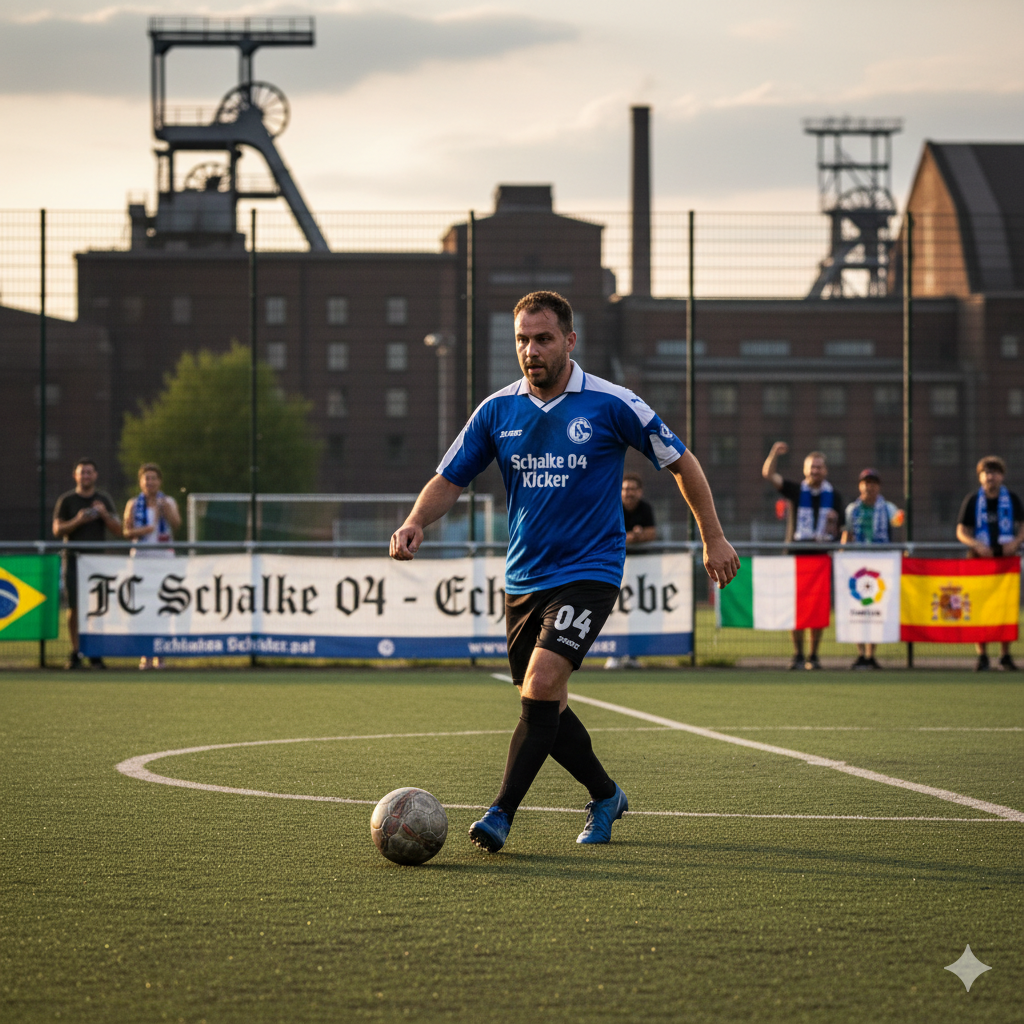
I come from the “soccer heart” of Germany, the Ruhrpott. I have played, trained and followed soccer all my life and am a big fan of FC Schalke 04. I also enjoy following international soccer extensively.