Free Kick Over Wall: The 3-Step Technique Pros Actually Use
To execute a free kick technique over a wall in soccer, match three things: a 45-90 degree run-up angle, a plant foot pointing away from the target, and a strike on the ball’s lower half with a locked, dorsiflexed ankle. This generates the friction needed for spin, not raw power, lifting the ball over the wall on a 15-22 degree trajectory before it dips or curves into the goal.
Most players get this wrong because they focus on power. They run straight at the ball and try to blast it. The result is a low, hard shot that smashes into the shins of the wall or sails hopelessly over the crossbar. Power without the correct technique is useless from 20 yards.
This guide breaks down the biomechanics the pros use. You will learn the exact body positioning for spin, the physics of the Magnus effect, a structured training plan that builds repeatability, and how to read the goalkeeper and wall to pick your spot.
Key Takeaways
- Spin comes from friction, not force. Lock your ankle and strike the lower half of the ball with your instep.
- Your plant foot dictates everything. Point it 45-90 degrees away from your target to create the lean and body angle for a proper strike.
- Aim to clear the wall by 30-50 cm (12-20 inches). This is a 15-22 degree launch angle, the sweet spot for getting over and still dipping down.
- Train one variable at a time. Master the strike without a wall before adding defenders, then a goalkeeper.
- The follow-through is non-negotiable. A full swing across your body completes the energy transfer and dictates the ball’s final curve.
The Physics of Beating the Wall: Spin vs. Power
A free kick over a wall is a physics problem. You need enough lift to clear a 1.8-meter (6-foot) obstacle, but you also need the ball to descend rapidly into the 2.44-meter (8-foot) high goal. Brute force cannot solve this. The solution is spin.
Striking the ball with a locked, dorsiflexed ankle creates friction between the foot and the ball’s surface. This friction imparts rapid rotation. For a dipping shot, this is topspin; for a curving shot, it’s sidespin. The Magnus effect, where air moves faster on one side of the spinning ball, then creates a pressure differential that bends the ball’s flight path.
This is why technicians like Juninho Pernambucano could score from 35 meters. They prioritized clean contact and spin generation over sheer power. Your first training goal is to hear the brush of your foot against the ball, not the thump.
TL;DR: Forget kicking through the ball. Focus on brushing across and under it with a stiff ankle to generate the spin that makes it dip or curve.
The 3 Non-Negotiable Body Mechanics
You can know all the theory, but if your body isn’t in the right positions, the ball goes nowhere. These three mechanical checkpoints are what coaches film in slow motion.
1. The Angled Run-Up and Plant Foot
Your approach starts the chain reaction. A straight run-up limits your hip rotation and forces a toe-poke. Instead, approach from a 45 to 90-degree angle to the ball’s path to the goal.
For a right-footed player aiming for the left corner of the goal, your left plant foot should land beside the ball pointing at the right post. This seems counterintuitive, pointing away from your target, but it opens your hips and forces the necessary upper-body lean. The distance is critical: place it 6-8 inches (15-20 cm) from the ball. Any closer jams your swing; any wider reduces control.
2. The Strike: Ankle Lock and Contact Point
This is the moment. Your ankle must be locked in dorsiflexion, toes pulled up toward your shin. A wobbly ankle dissipates energy and kills spin.
Drive the hard bone of your big toe knuckle (the first metatarsal head) through the lower quadrant of the ball. Aim to make contact just below the horizontal midline. Use your instep, not your laces, for a larger, flatter striking surface that maximizes friction.
Common mistake: “Flicking” the ball with the toes to generate spin. This adds no power and inconsistent rotation. The spin comes from the friction of the instep dragging across the ball’s surface, which requires a firm ankle and committed follow-through.
3. The Follow-Through and Lean
Your kick doesn’t end at contact. Your body must continue moving in the direction you want the ball to go. For a right-footed player putting topspin/dip on the ball, your follow-through swings across your body to the left, with your kicking foot finishing high and your toes pointing toward the target.
Your upper body should lean away from the ball at contact. This lean helps get your foot under the ball for lift and maintains balance. If you stay upright, you’ll likely lean back too late and sky the shot.
| Mechanical Checkpoint | Right-Footed Player (Aiming Left Corner) | What Happens If You Skip It |
|---|---|---|
| Plant Foot Direction | Points at right goal post | Hips stay closed; shot travels straight into the wall. |
| Ankle Position | Dorsiflexed (toes up), locked | Power and spin leak; ball floats with no dip. |
| Upper Body Lean | Leans left at moment of strike | Fails to get under the ball; produces a low drive. |
| Follow-Through | Swings left across body, foot finishes high | Incomplete energy transfer; ball lacks pace and curve. |
Spin Selection: How to Make the Ball Dip or Curve
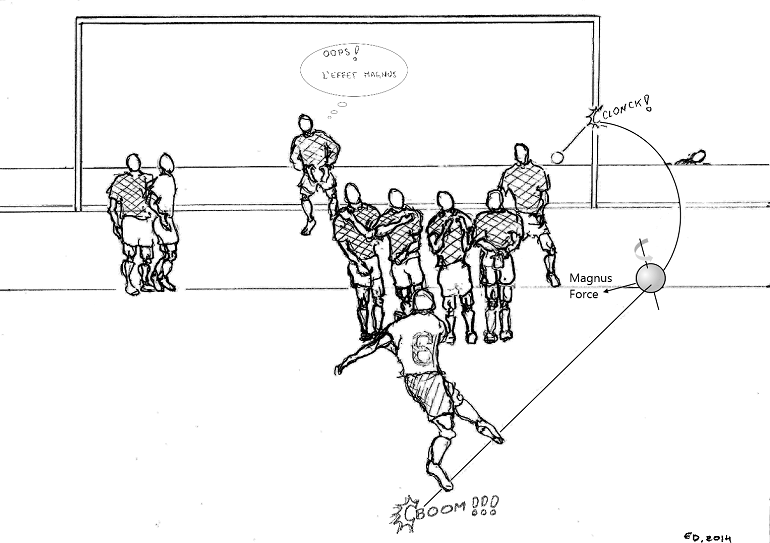
Now you understand the mechanics. The next choice is what kind of spin to apply. This is dictated by your foot’s orientation at the point of contact.
For a Dipping Shot (Topspin):
- Objective: The ball rises quickly over the wall, then drops sharply downward.
- Technique: Strike through the back of the ball, with your foot coming straight on. Your follow-through is more upward, with your toes pointing down into the ground after contact. This forward rotation makes the ball nose-dive.
- Best for: Central free kicks, 18-25 meters out, where you need to get the ball up and down quickly.
For a Curving Shot (Sidespin):
- Objective: The ball bends around the wall, away from the goalkeeper.
- Technique: Strike the inside or outside of the ball. To bend it right-to-left (for a right-footer), hit the right side of the ball with the inside of your foot. Lean your shoulders slightly right and follow through hard across your body to the left.
- Best for: Free kicks from the sides of the penalty area, or when the goalkeeper commits to one post.
The curving the ball technique mastered by players like David Beckham relies on extreme sidespin and a consistent, practiced run-up. It’s a more advanced skill that requires thousands of repetitions.
The Structured 4-Phase Training Plan

Knowledge is useless without repeatable skill. This progression builds your free kick technique over the wall from the ground up, ensuring each component is stable before adding pressure.
Phase 1: Wall-Free Striking (1-2 weeks)
Forget the goal. Place a ball 20 yards from a blank wall or fence. Your only focus is replicating the three body mechanics, angled run-up, plant foot, locked-ankle strike, full follow-through. Hit 50 balls a session. Listen for the clean brush of contact. The ball should come back to you with clear backspin or sidespin. This phase builds the neural pathway for the strike itself.
Phase 2: Introduce a Static Wall (2-3 weeks)
Set up a single mannequin or a tall cone about 9 meters (10 yards) from the ball, simulating the distance a real wall would stand. Your target is now the space 30-50 cm above the obstacle. Don’t aim for a corner yet; just practice clearing the barrier with consistent trajectory. This links your technique to a visual clearance target.
I spent two weeks in Phase 1 hitting a brick wall at my local pitch. The ball kept coming back flat. I filmed myself and saw my ankle collapsing on every strike. Fixing that one flaw, consciously pulling my toes up until it hurt, changed the sound from a slap to a zip. The ball started humming.
Phase 3: Add Accuracy to a Live Goal (Ongoing)
Now bring in a full-sized goal. Place a 3- or 4-man wall of mannequins or teammates. Start by aiming for the entire goal. Once you can clear the wall and hit the net 7 out of 10 times, narrow your target. Use cones to mark the top corners. This is where you integrate the final piece: precision under a simulated game setup.
Phase 4: Pressure Training (Pre-Season / Advanced)
Add a passive, then active, goalkeeper. Introduce fatigue, take kicks at the end of a conditioning drill. This phase is about transferring your grooved technique from the training ground to the match, where your heart rate is elevated and the crowd is watching.
| Training Phase | Primary Focus | Success Metric | Tools Needed |
|---|---|---|---|
| 1: Wall-Free | Pure striking technique | Consistent, audible spin on the ball | Ball, flat wall |
| 2: Static Wall | Trajectory and clearance | 8/10 shots clear the obstacle by 30-50 cm | Ball, mannequin/cone |
| 3: Live Goal | Accuracy after clearance | 7/10 shots hit the target zone inside the goal | Ball, goal, mannequin wall, cones |
| 4: Pressure | Technique under fatigue | Maintaining form and decision-making with a GK | Ball, goal, live wall, goalkeeper |
Reading the Game: Picking Your Spot
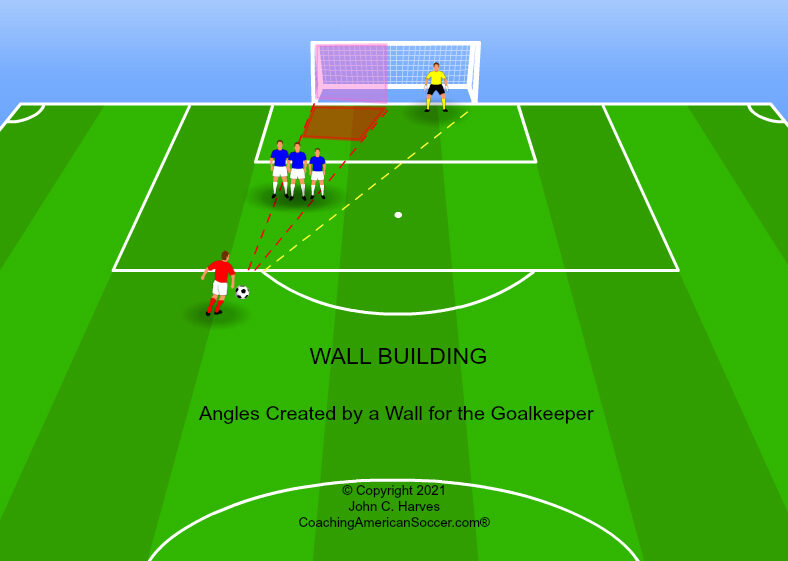
Technique is your weapon, but strategy is your trigger. Before you even place the ball, you need a plan. This involves a quick, three-part assessment.
- Analyze the Wall: Look for gaps. Is a shorter player tucked between two taller ones? Is there a player turning their head or jumping early? The defensive wall is not a monolithic barrier; it’s made of individuals who make mistakes. Your target is a specific point, like “six inches above the head of the second defender from the left.”
- Check the Goalkeeper: Where is he setting up? Is he cheating to one side, leaving more of the goal open on the other? Most keepers will align themselves with one post, expecting you to aim for the far corner. The best free-kick takers exploit this by sometimes whipping the ball inside the near post.
- Choose Your Attack Vector: Based on the wall and keeper, decide: dip over the middle, curl around the end, or drive under a jumping wall? Your free kick execution in practice should include rehearsing all these options so the decision is instinctive.
This tactical layer is what separates a good striker from a dead-ball specialist. It’s the application of set-piece tactics at the individual level.
Common Mistakes That Kill Your Kick
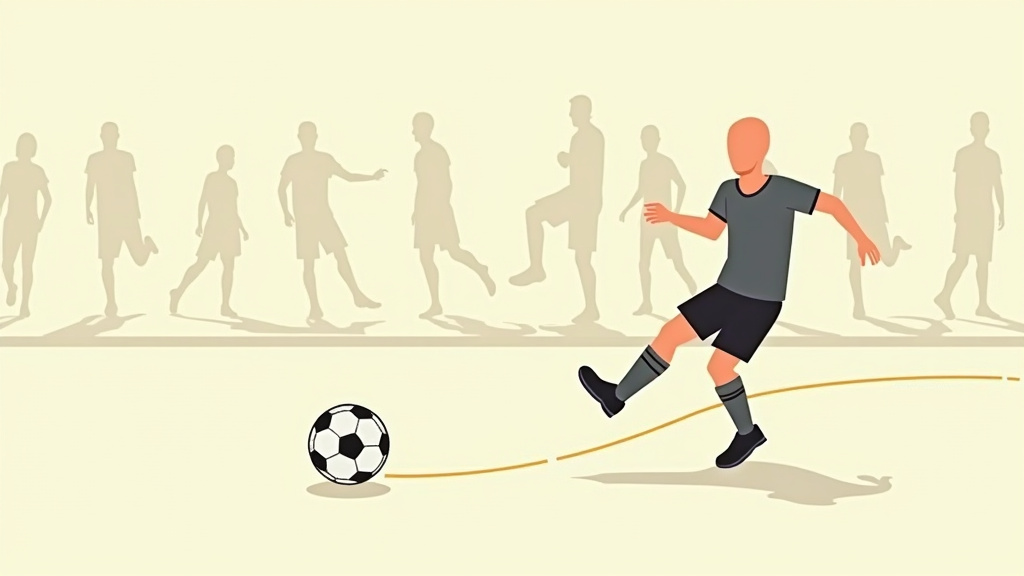
Even with good technique, small errors ruin the shot. Here are the frequent culprits.
- Rushing the Final Stride: In your eagerness, you shorten or lengthen your last step into the plant foot. This throws off your balance and contact point. Keep your stride pattern consistent, even under pressure.
- Changing Too Many Variables: You had a bad session, so you change your run-up angle, your starting position, and your strike technique all at once. You’ll never learn what’s working. Adjust one thing at a time.
- Introducing the Wall Too Early: Trying to practice clearing a wall before you can consistently generate spin is a waste of time. You’ll develop compensations that mask your core technical flaw. Master Phase 1 first.
- Neglecting the Follow-Through: Pulling your foot back immediately after contact is like shutting off a engine mid-acceleration. The follow-through guarantees full energy transfer and spin completion.
Common mistake: Judging success solely by goals in training. If you score but the ball skims the wall or wobbles unpredictably, that’s luck, not skill. Judge success by the ball’s clean flight path and your adherence to your mechanical checkpoints.
TL;DR: Practice with process-based goals (clean strike, correct trajectory) not just outcome-based goals (scoring). The goals will come when the process is automatic.
Equipment and Preparation Notes
Your tools matter. A waterlogged, low-quality training ball won’t hold spin. Use a proper match ball construction ball for practice when possible, the consistent surface and pressure are key for learning true feel.
Wear the right FG cleats for your surface. Firm ground cleats on turf can cause you to slip on plant-foot contact, disrupting your entire kinetic chain. Also, general player strength training for core stability and leg power supports the technique, but it’s secondary to the skill work.
Finally, incorporate agility ladder drills for footwork coordination. A precise, controlled run-up is born from general body control and coordination.
Frequently Asked Questions
What’s the ideal distance for a free kick over the wall?
The prime distance is 18-25 meters (20-27 yards). This is far enough to allow the ball the necessary airtime to rise over the wall and then dip down, but close enough that the goalkeeper has limited reaction time. From closer ranges, you have less space for lift; from farther, maintaining accuracy and power becomes much harder.
How do I practice if I don’t have a wall or mannequins?
Use a tall object. A bench, a row of backpacks, or even a line drawn on a fence at roughly 1.8 meters high can work. The objective is to have a visual barrier to clear. The key is practicing the trajectory, not the exact opponent.
Should I always try to go over the wall?
No. It depends on the types of free kicks and the situation. If the wall jumps, a driven shot underneath can be effective. If the wall is poorly aligned, going around the end is better. The over-the-wall technique is your primary weapon, but you must read the game.
How long does it take to get good at this?
To develop a reliable, repeatable technique, expect 6-8 weeks of consistent practice (3-4 sessions per week) following the phased plan. To master it and apply it confidently in games, think in terms of 6 months to a year. It’s a skill built by thousands of repetitions.
What’s more important, power or placement?
Placement, unequivocally. A well-placed shot with pace is unstoppable. A powerfully struck shot that’s straight at the goalkeeper or wide is worthless. Focus on clean technique for consistency first; power develops naturally as your mechanics become more efficient. Dedicated shooting power exercises can then be layered on top.
Before You Go
Beating the wall is a solvable puzzle. It requires ditching the power myth and embracing the physics of spin. Commit to the three mechanics: the angled approach, the locked-ankle instep strike, and the full follow-through. Build your skill through the structured phases, starting without any wall at all. Finally, learn to read the game, the wall’s gaps and the goalkeeper’s stance, to choose your moment.
The best free-kick takers aren’t the strongest players; they are the most meticulous practitioners. They own a repeatable action they can trust when the pressure is on. Now you know how to build yours.
I come from the “soccer heart” of Germany, the Ruhrpott. I have played, trained and followed soccer all my life and am a big fan of FC Schalke 04. I also enjoy following international soccer extensively.