Who Advances from World Cup Group A? All Scenarios Covered
World Cup 2026 Group A qualification scenarios hinge on the new 48-team format where the top two teams advance and the best eight third-placed teams from all twelve groups also reach the Round of 32. Mexico and South Korea are favorites for the top spots, but Czechia and South Africa have a real shot at third-place qualification, where four points is the safe target and three points creates a nervous wait on goal difference.
Most fans still think a third-place finish means elimination. That math changed in 2026. Finishing third is now a viable, even probable, path to the knockout stage. You just need to know the new thresholds.
This guide breaks down every scenario for Mexico, South Korea, Czechia, and South Africa. We will cover the key matches, the exact tie-breaking rules, the point totals that matter for third place, and what happens next in the knockout bracket.
Key Takeaways
- Four points (one win, one draw, one loss) virtually guarantees a third-placed team advances to the Round of 32.
- The Mexico vs. South Korea match on June 15 is the group decider; the Czechia vs. South Africa match on June 20 is the battle for third.
- Tie-breakers start with head-to-head record, not overall goal difference. Goal difference only matters if the head-to-head is perfectly level.
- Mexico’s path is softened by hosting, but playing at altitude in Mexico City is a double-edged sword that affects opponent fitness.
- A qualifying third-placed team from Group A faces a tougher knockout path, drawing the winner of Group E or Group G.
Group A Teams and Schedule
The group is a fascinating mix of styles and pressures. Mexico, as a host, carries the weight of a nation and the advantage of home support, especially at the intimidating Estadio Azteca. South Korea brings relentless energy and a cohesive tactical system under a long-term manager. Czechia offers European physicality and tournament discipline. South Africa is the classic defensive underdog, built to frustrate and grind out results.
The schedule creates a clear narrative. The opener at the Azteca sets the tone. The group likely hinges on the second matchday clash between the two strongest sides. The final day features simultaneous kickoffs, a FIFA rule designed to prevent collusion.
| Match | Date | Venue | Significance |
|---|---|---|---|
| Mexico vs. South Africa | June 11, 2026 | Estadio Azteca, Mexico City | Host nation opener. Pressure is entirely on Mexico. |
| South Korea vs. Czechia | June 12, 2026 | BMO Field, Toronto | Crucial for both to avoid a loss. Shapes the third-place race. |
| Mexico vs. South Korea | June 15, 2026 | SoFi Stadium, Los Angeles | Likely group decider for first place. |
| South Africa vs. Czechia | June 20, 2026 | MetLife Stadium, New Jersey | The direct battle for third place. A draw helps neither. |
| Czechia vs. Mexico | June 24, 2026 | Lumen Field, Seattle | Could decide automatic qualification if results are tight. |
| South Africa vs. South Korea | June 24, 2026 | Mercedes-Benz Stadium, Atlanta | Simultaneous with above. Goal difference could be decisive. |
The 2026 group stage features 12 groups of four teams. The top two finishers in each group automatically qualify for the Round of 32. The eight best third-placed teams across all groups, determined by points, goal difference, goals scored, fair play points, and finally FIFA Ranking, also advance.
Travel matters here. South Africa faces the longest trips between venues. Czechia and South Korea have more manageable geography. Mexico plays its toughest match, against South Korea, in Los Angeles, a venue that will feel like a home game.
TL;DR: Mexico vs. South Korea decides first place; South Africa vs. Czechia is a knockout game for third. Watch the travel distances.
How Many Points Do You Need to Qualify from Third Place?
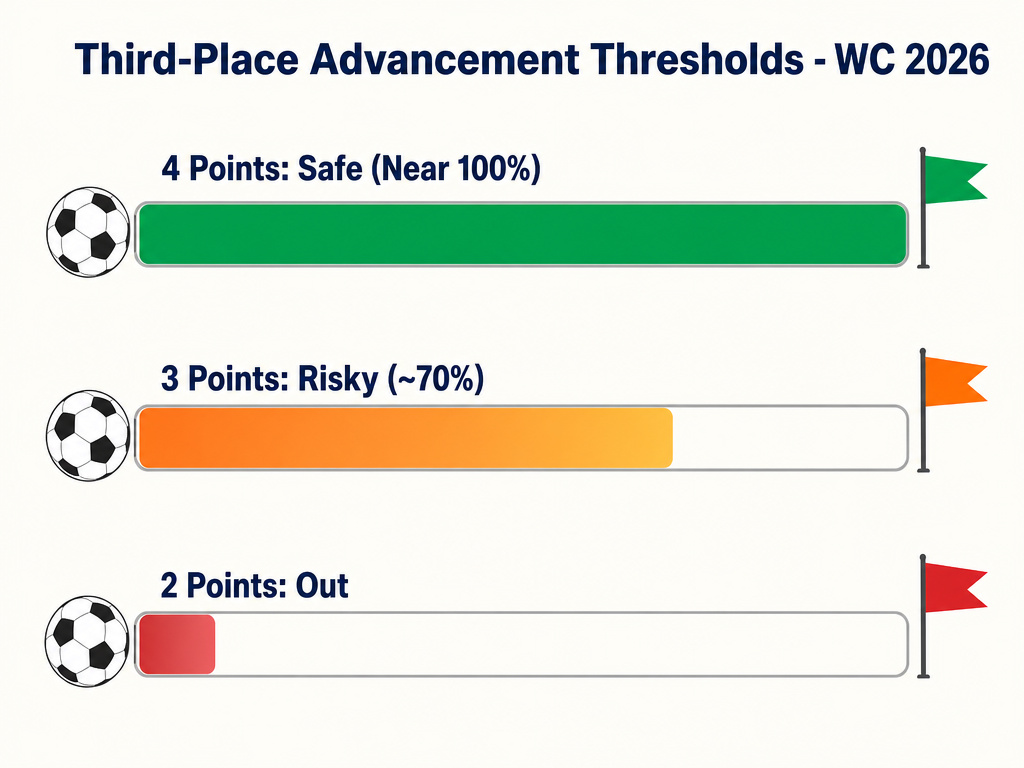
This is the single biggest change for 2026. In a 32-team World Cup, third place meant going home. Now, eight of the twelve third-placed teams move on. It completely changes the math for a team sitting on one draw after two games.
Historical data from past tournaments suggests a clear safety line. Four points, achieved through a win and a draw, has a near-100% advancement rate for a third-placed team. That is your primary target. Three points, usually a win and two losses, gives you about a 70% chance, but your goal difference becomes your lifeline. Two points almost certainly sends you home.
Common mistake: Assuming head-to-head is the first tie-breaker for third-place ranking across groups, it is not. FIFA ranks all third-placed teams by total points, then overall goal difference, then goals scored. Head-to-head only applies when comparing teams within the same group.
Here is the breakdown a coach in this group is looking at:
| Third-Place Points | Chance of Advancing | What You Need |
|---|---|---|
| 4 Points (W-D-L) | >95% | A positive goal difference of +1 or better is almost a lock. |
| 3 Points (W-L-L) | ~70% | A goal difference of 0 or better is usually enough. Negative GD is risky. |
| 2 Points (D-D-L) | <10% | Requires multiple groups to have catastrophically bad third-placed teams. |
| 1 Point (D-L-L) | 0% | Start booking flights home. |
The implication for Group A is stark. Beating South Africa is non-negotiable for Czechia. For South Africa, a draw against Czechia is a disaster. It leaves them on one point, needing a shock win against South Korea just to have a prayer. This pressure makes for an explosive final matchday, where conservative tactical strategies go out the window.
TL;DR: Target four points to sleep easy. Three points means sweating on goal difference. Two points is a hope, not a plan.
Mexico and South Korea: The Battle for First

Photo: ChrissGerard1998 / Wikimedia Commons / CC BY-SA 4.0

On paper, these are the two strongest sides. Mexico’s hosting advantage is quantifiable. A study of past World Cups shows host nations outperform their FIFA ranking by an average of 15 places. The Azteca, at 7,200 feet, is a fortress where visiting teams historically struggle after the 60-minute mark.
But that advantage has a limit. Mexico’s opening match is at altitude. Their second match, against South Korea, is at sea level in Los Angeles. The physiological switch is harder than people think. Players used to thin air can feel heavy-legged at sea level. South Korea, meanwhile, will have acclimatized in Toronto. Their high-pressing, coordinated system under a manager who has been in place for years could exploit any Mexican fatigue.
South Korea’s weakness is a lack of a true defensive anchor. They can be opened up by direct, physical play, exactly what Czechia will offer. This is where group dynamics get interesting. A South Korea loss to Czechia in their opener would throw the entire group into chaos and make the Mexico match a must-win.
I thought Mexico’s group was a gift when the draw came out. Then I looked at the travel. From Mexico City’s altitude to L.A.’s humidity, then up to Seattle? That is three distinct climates in 14 days. South Korea goes Toronto, L.A., Atlanta, a far more stable eastern route. The travel schedule is a silent opponent.
The team that wins this head-to-head likely wins the group. The reward is significant: facing a third-placed team in the Round of 32. The runner-up gets the Group B runner-up, which could be a team like Italy or the Netherlands. Finishing first is a genuine advantage.
TL;DR: The Mexico-South Korea winner tops the group and gets an easier knockout draw. Mexico’s host boost is real, but the travel between venues is a hidden challenge.
Czechia and South Africa: The Fight for Survival
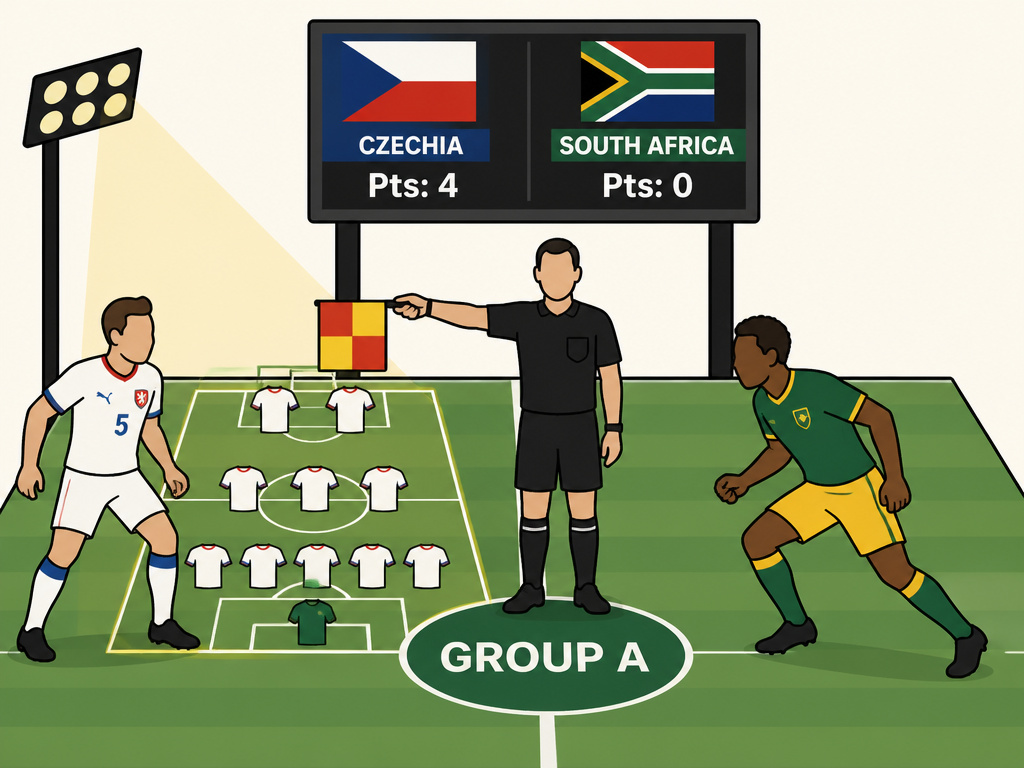
This is the undercard with higher stakes than it appears. Czechia is not a pushover. They are a classic tournament team: organized, physically strong, and difficult to break down. Their defensive formations are drilled to perfection. For them, the target is clear: beat South Africa, then scrape a point from either Mexico or South Korea. Four points puts them in a fantastic position for third.
South Africa’s entire tournament hinges on their first match against Mexico. If they can keep it respectable, a 1-0 or 2-0 loss, morale stays intact. If they get blown out at the Azteca, the campaign could be over before it starts. Their best hope is to replicate the 2010 World Cup opener, where they drew with Mexico. A point there changes everything.
Their match against Czechia is a pure cup final. A draw is a terrible result for both, likely leaving each on one or two points and needing miracles. Someone has to win.
- Czechia’s Path: Beat South Africa. This is non-negotiable. Then, aim for a draw against Mexico or South Korea. A win against South Africa and a draw gets them to four points, which should be enough.
- South Africa’s Path: Get something from Mexico. A point is a massive result. Then, beat Czechia. That puts them on four points and in the driver’s seat for third.
- The Draw Scenario: If Czechia vs. South Africa ends level, both teams are likely doomed unless they can pull off a major upset in their final game. Two points is the group stage graveyard.
Common mistake: Underestimating South Africa because of their FIFA ranking. In a short group stage, a disciplined defensive block can steal points. They have nothing to lose, and that makes them dangerous for 90 minutes.
The team that emerges from this battle with three points is alive. The team with one or zero is planning its vacation.
The Knockout Stage Paths
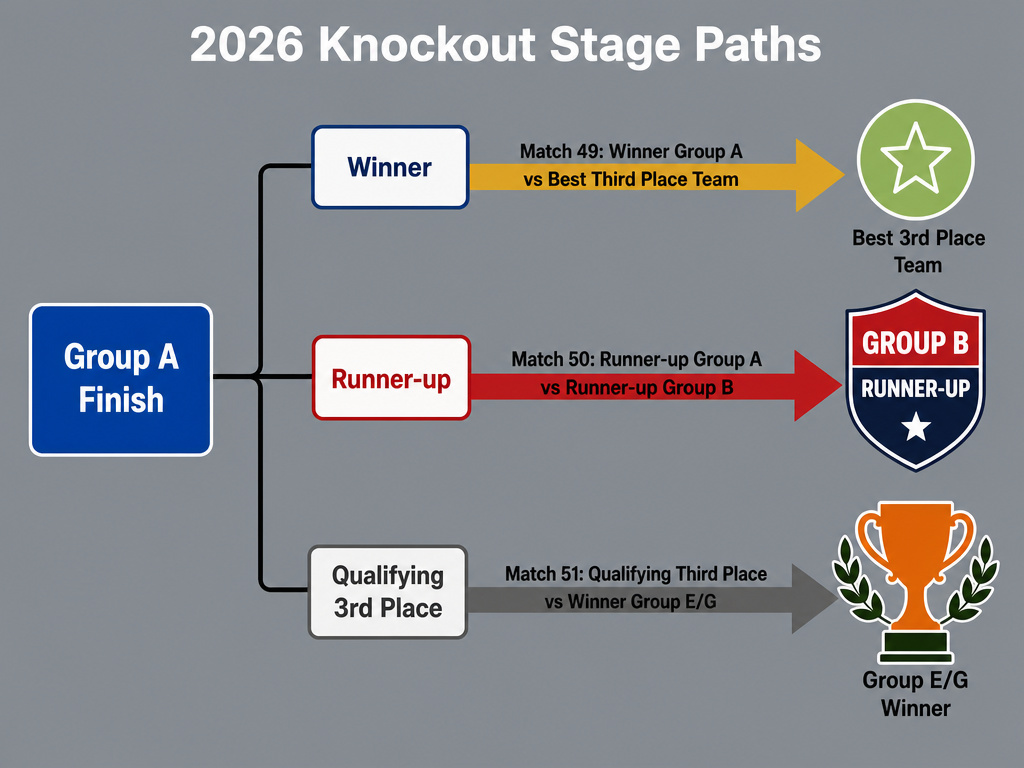
Where you finish in Group A determines who you play next. This is not just about advancing; it is about positioning for a deep run.
The Group A winner plays one of the best third-placed teams from Groups C, E, F, H, or I. This is the golden ticket. On paper, it is the easiest possible Round of 32 match. The runner-up plays the runner-up from Group B. Group B contains Spain, the USA, Japan, and a playoff winner. Finishing second likely means a brutal early knockout match against a top-tier nation.
A third-placed team that qualifies faces the winner of either Group E or Group G. These are likely to be group winners like Brazil or France. It is the hardest possible path. The message is clear: avoid third place if you can, but if third place is your only route, take it and prepare for a giant.
This bracket logic influences late-game decisions. If Mexico and South Korea are both through after two matches, their head-to-head result still matters immensely for their knockout fate. You might see more aggressive coaching strategies in a match that seems “dead” because the difference between first and second is a potential quarter-final berth or an early exit.
TL;DR: Win the group, play a third-place team. Finish second, likely play Spain or the USA. Finish third, play Brazil or France.
Tie-Breakers: It’s Not Just Goal Difference
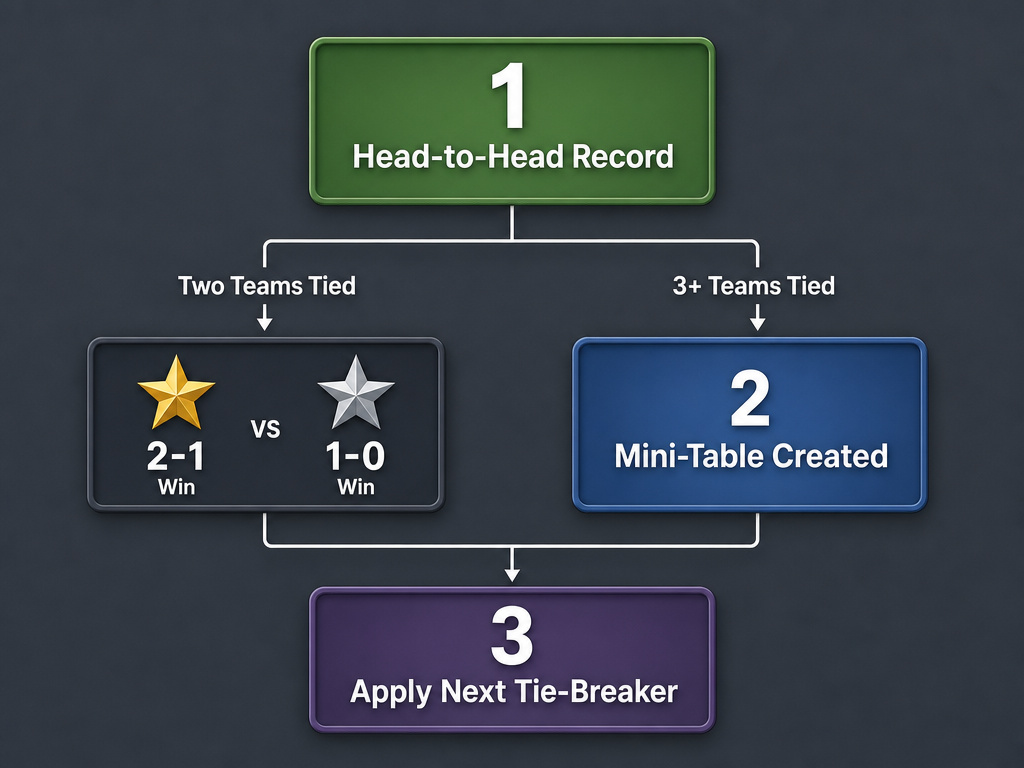
When teams are level on points, the tie-breaking order is specific and often misunderstood. It is the difference between celebration and despair.
The first tie-breaker is head-to-head record. If two teams are tied, you look only at the match between them. Who won? If it was a draw, you go to goal difference in that single game, then goals scored in that game. This is why a 2-1 win is better than a 1-0 win if you end up tied, you own the head-to-head goal difference.
If three or more teams are tied, it gets complex. FIFA creates a mini-table from the matches between the tied teams. Points, then goal difference, then goals scored in those games are compared. Only if that mini-table is perfectly level does the tie-breaker move to overall group goal difference.
The 2022 World Cup group stage saw this in action. It is not a theoretical exercise. Teams have gone out because they scored one fewer goal in a specific head-to-head match, despite having a better overall goal difference than a team that advanced.
The final tie-breakers are fair play points (yellow/red cards) and then FIFA Ranking. Fair play points have decided group standings before. A reckless yellow card in the 89th minute of a match you are winning 3-0 could cost your team a place in the knockout stage. Discipline matters.
TL;DR: Head-to-head comes first. Goal difference only matters if the head-to-head is perfectly even. A single card can be the difference.
Frequently Asked Questions
Who are the favorites to qualify from World Cup 2026 Group A?
Mexico and South Korea are the clear favorites to take the top two automatic qualification spots. Mexico has the host nation advantage, while South Korea possesses a well-drilled, energetic squad. Czechia is the strongest contender for a third-place qualification spot.
Can third place qualify in the 2026 World Cup?
Yes. This is the major change for the 48-team format. The top two teams from each of the 12 groups qualify, and then the eight best third-placed teams from across all groups also advance to the Round of 32. Finishing third is a legitimate path to the knockout stage.
What is the World Cup 2026 Group A schedule?
The group stage matches are: Mexico vs. South Africa (June 11), South Korea vs. Czechia (June 12), Mexico vs. South Korea (June 15), South Africa vs. Czechia (June 20), and the final simultaneous matches Czechia vs. Mexico and South Africa vs. South Korea (both June 24).
How do tie-breakers work if teams are level on points?
The tie-breaking order is: 1) Points in head-to-head matches, 2) Goal difference in head-to-head matches, 3) Goals scored in head-to-head matches, 4) Overall goal difference in all group matches, 5) Overall goals scored in all group matches, 6) Fair play points (fewer cards are better), 7) FIFA World Ranking.
Who will the Group A winner play in the Round of 32?
The Group A winner will play one of the best third-placed teams from Groups C, E, F, H, or I. This is considered the most favorable draw. The Group A runner-up will play the runner-up from Group B, which will likely be a much tougher opponent like Spain or the USA.
Before You Go
Group A is a tale of two battles. The first is for supremacy between Mexico and South Korea, with a massive reward for the winner. The second is a brutal scrap for survival between Czechia and South Africa, where a single win might be enough to continue the journey. Forget the old rules. Four points is the new magic number for third place. Watch the head-to-head results, not just the goal difference. And remember, in a group this tight, the final whistle on June 24 might not be the end of the story, it might just be the start of the calculator.

I come from the “soccer heart” of Germany, the Ruhrpott. I have played, trained and followed soccer all my life and am a big fan of FC Schalke 04. I also enjoy following international soccer extensively.